

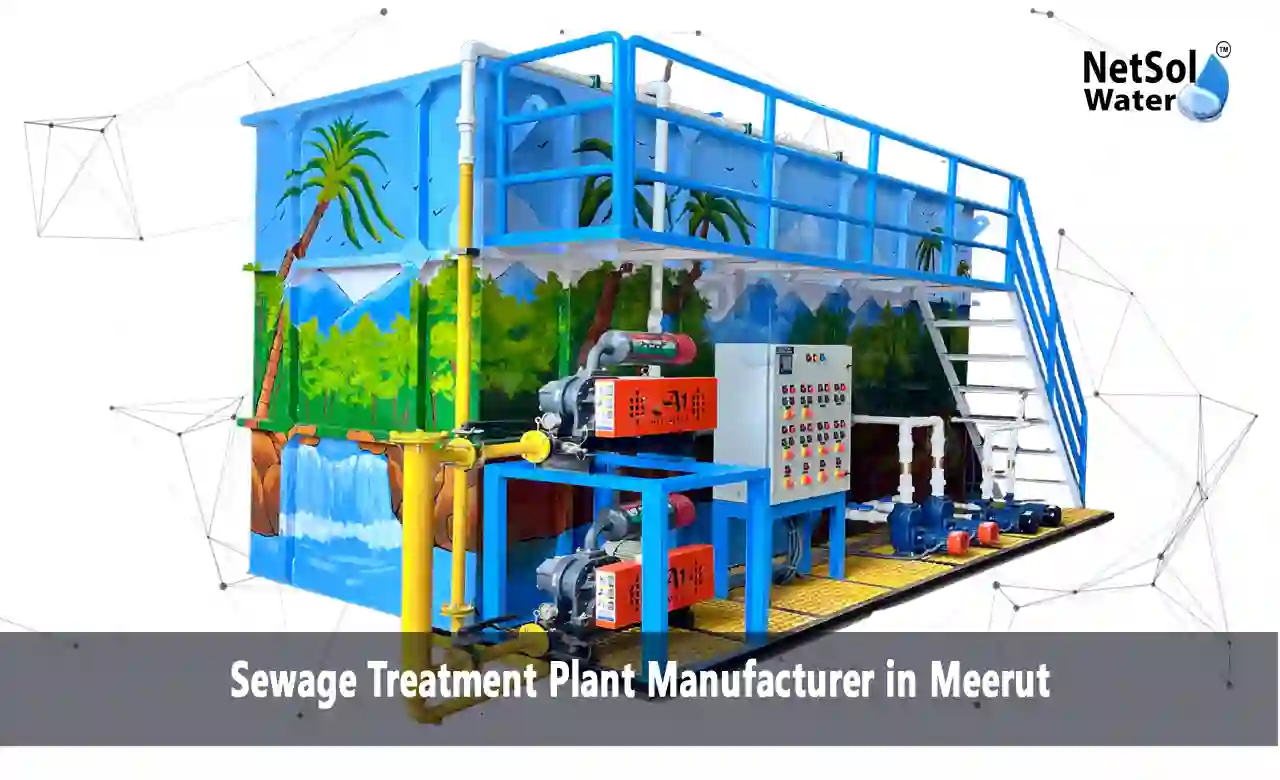
Sewage Treatment Plant Manufacturer in Meerut
Meerut is one of western Uttar Pradesh's most significant urban centers - a city that has been growing at a pace that its existing infrastructure simply can't keep up with. New residential townships, commercial complexes, hospitals, hotels, schools, and mixed-use developments are sprouting across the city's expanding boundaries every year.
This growth comes with an unavoidable byproduct: sewage. Massive volumes of it, generated daily by hundreds of thousands of households, institutions, and commercial establishments.
Meerut's existing municipal sewage network - designed decades ago for a much smaller population - is chronically overloaded. Overflow, leakage, and bypassed discharge into local drains and rivers are well-documented problems. The gap between sewage generated and sewage properly treated is widening every year.
The solution for new developments and large establishments is clear: on-site Sewage Treatment Plants (STPs) that treat wastewater at source, before it ever reaches an already-stressed municipal system. And when these STPs are well-designed, they don't just solve a disposal problem - they create a resource. Treated water can be reused for landscaping, flushing, cooling, and even groundwater recharge.
Netsol Water has been designing and commissioning STPs across Meerut for residential societies, hospitals, commercial complexes, and educational institutions. Our plants are built for Meerut's conditions - its sewage volumes, its regulatory requirements, and its operational realities.
The Scale of Meerut's Sewage Challenge
To appreciate why on-site STPs matter so much in Meerut, consider these realities:
• Population pressure: Meerut's population exceeds 3.4 million (urban agglomeration). At 135 liters per capita per day, the city generates over 460 million liters of sewage daily.
• Infrastructure gap: Meerut's existing STPs treat only a fraction of generated sewage. The remainder enters drains, rivers like the Kali Nadi and Hindon, or infiltrates groundwater.
• NGT pressure: The National Green Tribunal (NGT) has repeatedly directed UP cities including Meerut to improve sewage treatment compliance. New developments face increasing regulatory scrutiny.
• New development requirements: Under RERA and local building regulations, large residential and commercial projects must demonstrate sewage management as part of their environmental compliance.
• Water reuse opportunity: Given Meerut's groundwater stress, treated sewage represents a valuable resource. Well-designed STPs enable 70–85% of sewage volume to be safely reused on-site.
STP Technologies We Provide in Meerut
1. MBBR Technology -
Moving Bed Biofilm Reactor technology has become the most widely specified STP solution for Meerut's residential and institutional projects, and with good reason. MBBR systems are compact - critical in Meerut's space-constrained developments - highly efficient, and able to handle the kind of load variations common in residential use patterns. The biofilm carriers provide a large active surface area for microbial activity, ensuring consistent treatment quality regardless of whether sewage flow is at peak or minimum levels.
2. SBR Technology -
SBR's single-tank design eliminates the need for separate clarifiers, saving significant floor area. Automated cycle control means the system manages its own treatment process, reducing manual intervention. For hospitals and institutional campuses in Meerut where operational staff have many other responsibilities, SBR's self-managing nature is a significant advantage.
3. MBR Technology -
Meerut's premium residential projects, hospitals, and corporate campuses increasingly specify MBR-based STPs when they want to maximize treated water reuse. MBR's ultrafiltration membranes produce effluent quality consistently meeting or exceeding UPPCB reuse standards. The higher initial investment is justified by the value of treated water that can replace freshwater consumption.
4. Decentralized STP Systems
For Meerut's dispersed development pattern - where individual large buildings need on-site solutions rather than centralized systems - decentralized skid-mounted STPs offer fast installation, minimal civil work, and easy relocation if needed.
Where STPs Are Being Installed in Meerut?
1. Residential Societies and Townships
New housing developments in areas like Mawana Road, Delhi Road, and Hapur Road are increasingly incorporating STPs as a baseline requirement. Treated water is reused for landscaping the society's green areas and toilet flushing, significantly reducing freshwater consumption and water bills.
2. Hospitals and Healthcare Facilities
Hospital sewage contains pharmaceutical compounds, pathogens, and biological materials that require specialized treatment. Meerut's growing hospital sector - including new super-specialty hospitals on the city's periphery - needs STPs that meet both standard sewage treatment norms and biomedical waste management guidelines.
3. Hotels and Commercial Complexes
Hotels in central Meerut and along NH-58 generate significant volumes of sewage. On-site STPs enable water recycling for HVAC cooling, landscaping, and laundry pre-rinse, reducing municipal water demand and associated costs substantially.
4. Educational Institutions
Meerut's large university and college campuses generate predictable daily sewage volumes. Campus STPs treat this sewage and supply treated water for campus gardens, sports grounds, and sanitation facilities, achieving measurable water savings.
STP Capacity Planning for Meerut Projects
• Up to 30 KLD: Small apartment buildings (up to 200 residents), guest houses, small offices. Compact, skid-mounted MBBR or SBR units.
• 30–200 KLD: Medium housing societies, schools, clinics, smaller hotels. Multi-stage MBBR/SBR with automated controls.
• 200–500 KLD: Large residential townships, hospitals, large hotels. MBR or advanced SBR systems with full automation and water reuse infrastructure.
• 500 KLD+: Large townships, commercial mega-complexes, campuses. Continuous operation systems with advanced sludge management and biogas options.
STP Cost Guide for Meerut Projects
• Small STP (1–30 KLD): Rs5 lakh – Rs25 lakh. Basic MBBR/SBR system with primary and secondary treatment.
• Medium STP (50–200 KLD): Rs35 lakh – Rs90 lakh. Multi-stage treatment, automation, online monitoring, and treated water storage.
• Large STP (200–500 KLD): Rs90 lakh – Rs4 crore. Advanced treatment with water reuse systems and sludge dewatering.
• Very Large STP (500 KLD+): Rs5 crore+. Custom township-grade systems with full automation and SCADA monitoring.
Why Builders and Developers in Meerut Choose Netsol Water?
• RERA and NOC-compliant designs accepted by Meerut Development Authority and UPPCB
• Multiple STP technology options - MBBR, SBR, MBR, ASP - selected based on project needs
• Underground and semi-underground designs available for space-constrained sites
• Turnkey service - civil, mechanical, electrical, and commissioning under single contract
• Post-commissioning support - dedicated field engineers for Meerut region
• Transparent BOQ - no surprise costs during or after installation
Also Read: STP Plant Manufacturer and Supplier in U.P.
FAQ: Sewage Treatment Plant Manufacturer in Meerut
Q1. Is an STP mandatory for new residential projects in Meerut?
Yes. Meerut Development Authority (MDA) and UPPCB require STPs for residential projects exceeding specified sewage generation thresholds. RERA compliance also increasingly requires demonstrating sewage management plans. Projects without functional STPs risk occupancy certificate delays and regulatory penalties.
Q2. What is the cost of an STP for a 100-flat housing society in Meerut?
A 100-flat society with average 4 occupants generates approximately 54,000 liters of sewage daily, requiring a 55–60 KLD STP. Typical cost for an MBBR-based system of this capacity in Meerut ranges from ?15 lakh to ?25 lakh including civil work, depending on available space and automation requirements.
Q3. Which STP technology is best for Meerut's hospitals?
Hospitals in Meerut are best served by MBR-based STPs that combine biological treatment with membrane filtration. MBR achieves very low pathogen counts in treated water and handles the pharmaceutical and biological compounds in hospital sewage more effectively than conventional MBBR or SBR systems.
Q4. How does a Meerut STP handle peak loads during morning and evening hours?
Equalization tanks are a critical component of Meerut STP designs. They buffer peak sewage flows - morning and evening surges - storing excess flow and releasing it gradually to the treatment system. This prevents hydraulic overloading and maintains consistent treatment quality despite the wide flow variations typical in residential settings.
Q5. What are the UPPCB discharge standards an STP must meet in Meerut?
For discharge into municipal drains: BOD below 30 mg/L, COD below 250 mg/L, TSS below 100 mg/L, pH 6.5–8.5. For discharge into river bodies: stricter norms with BOD below 10 mg/L apply. Netsol Water designs all Meerut STPs to meet and exceed applicable UPPCB standards with monitoring compliance built in.
Q6. Can a Meerut STP be operated remotely?
Yes. Netsol Water offers IoT-enabled STP systems for Meerut projects with remote monitoring capability. Online sensors for flow, BOD, TSS, and pH transmit real-time data to cloud dashboards accessible on mobile phones and computers. This enables proactive maintenance alerts and remote troubleshooting without requiring on-site experts for every issue.
Get Your Meerut STP Designed by Experts - Call Netsol Water: +91-9650608473 | www.netsolwater.com