

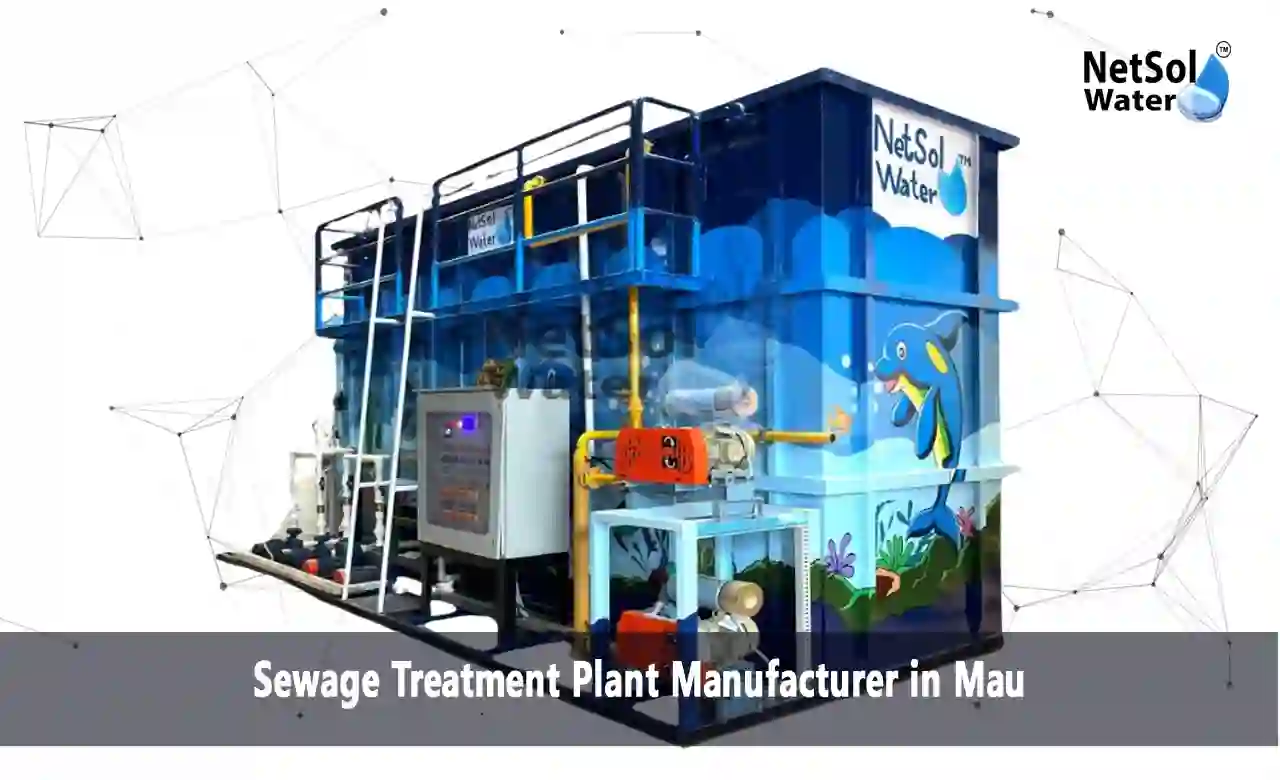
Sewage Treatment Plant Manufacturer in Mau
Mau is evolving rapidly. Known primarily for its textile industry, the city is experiencing strong residential and commercial growth, with new housing colonies, schools, hospitals, hotels, and commercial complexes expanding across the urban and peri-urban areas.
This growth translates directly into a rising volume of domestic sewage - and with it, an urgent need for proper sewage management infrastructure. Every household, hospital, school, and marketplace generates wastewater daily. Left untreated, this sewage contaminates groundwater, pollutes surface water bodies, spreads waterborne diseases, and creates the kind of environmental degradation that reverses years of urban development progress.
A Sewage Treatment Plant (STP) is the answer. It intercepts raw sewage, treats it through biological and physical processes, and produces treated water that is safe to discharge or, better yet, reuse for non-potable applications. As Mau grows, the role of efficient, reliable STPs becomes central to sustaining that growth responsibly.
Netsol Water brings proven STP design and manufacturing expertise to Mau, building plants that match local requirements - whether for a 25-unit apartment building or a 500-bed hospital campus.
The Sewage Problem in Mau: More Than Just an Environmental Issue
Unmanaged sewage in Mau creates problems across multiple dimensions:
• Health Impact: Waterborne diseases - cholera, typhoid, hepatitis A, dysentery - thrive when sewage contaminates drinking water sources. In a growing city like Mau, inadequate sewage treatment is adirect public health risk.
• Groundwater Contamination: Mau's residents and industries rely heavily on groundwater. Untreated sewage seeping into the soil creates a contamination plume that spreads through aquifers, potentially affecting drinking water for thousands of families.
• River and Water Body Pollution: Sewage discharge into local drains, ponds, and rivers degrades water quality, harms aquatic ecosystems, and makes these water bodies unusable for any beneficial purpose.
• UPPCB Compliance Risk: Under the Environment Protection Act and Water Pollution Control Act, developments generating sewage must have functional treatment systems. Non-compliance means penalties, legal notices, and risk of project shutdown.
• Water Scarcity Aggravation: Without STPs, treated water cannot be recycled. This increases dependence on freshwater sources, accelerating depletion of groundwater reserves in water-stressed regions.
STP Technologies Netsol Water Deploys in Mau
1. MBBR (Moving Bed Biofilm Reactor)
MBBR is the go-to technology for most of Mau's residential and institutional STP projects. The system uses specially designed polyethylene media carriers that float in aerated tanks. A robust biofilm of microorganisms grows on these carriers and breaks down organic pollutants in sewage. The continuously moving media ensures excellent oxygen transfer and consistent treatment performance even when sewage load varies. MBBR plants are compact, energy-efficient, and ideal for housing societies and schools where space and operational simplicity matter.
2. SBR (Sequential Batch Reactor)
SBR handles sewage treatment in sequential timed cycles within a single tank. This eliminates the need for separate clarifiers and reduces the plant footprint significantly. SBR is highly effective, producing consistently high-quality treated water. Automated cycle control reduces manual labor requirements, making it an excellent choice for facilities without dedicated wastewater operators.
3. MBR (Membrane Bioreactor)
For projects in Mau where treated water quality must be highest - particularly where reuse for gardening, flushing, or cooling is planned - MBR technology delivers superior results. By combining biological treatment with ultrafiltration membranes, MBR produces nearly pathogen-free treated water that meets stringent reuse standards. While the initial cost is higher than MBBR or SBR, MBR's water quality output and space efficiency often justify the investment for premium residential developments and hospitals.
4. ASP (Activated Sludge Process)
For large institutional campuses and township-scale projects with consistent, high-volume sewage flows, ASP remains a proven, cost-effective solution. Continuous aeration of sewage supports microbial populations that effectively break down organic matter. ASP is particularly well-suited when land availability is less constrained and operational teams are available.
STP Capacity Guide for Mau Projects
• 1–30 KLD: Individual houses, small apartments, small offices. Compact, skid-mounted systems with simple operation.
• 30–100 KLD: Housing societies (up to ~500 residents), schools, clinics. Multi-stage treatment with automated monitoring.
• 100–500 KLD: Large housing complexes, hospitals, hotels, small commercial townships. Robust systems with online effluent quality monitoring and treated water recycling.
• 500 KLD+: Large townships, university campuses, large commercial complexes. Continuous automated operation with advanced sludge management.
STP Investment Cost in Mau - What to Expect
• Small STPs (1–30 KLD): Rs5 lakh – Rs25lakh. Basic MBBR or SBR systems.
• Medium STPs (30–200 KLD): Rs25 lakh – Rs90 lakh. Multi-stage treatment with automation and treated water reuse systems.
• Large STPs (200 KLD+): Rs90 lakh – Rs3 crore+. Township-grade systems with advanced sludge handling.
Technology selection, automation level, treated water reuse requirements, and site-specific civil work are the primary cost variables.
Why Netsol Water is Mau's Preferred STP Partner
• Site-specific design - not standard templates applied regardless of local conditions
• Technology versatility - MBBR, SBR, MBR, ASP, and hybrid systems all available
• Operator-friendly systems - designed for Mau's reality where dedicated wastewater operators may not always be available
• Regulatory expertise - designs meet UPPCB and NGT discharge norms
• End-to-end service - from site survey and design through installation, commissioning, and AMC
• Transparent pricing - detailed BOQ with no hidden charges
Also Read: Sewage Treatment Plant Manufacturer and Supplier in Uttar Pradesh
FAQ: Sewage Treatment Plant Manufacturer in Mau
Q1. What is the minimum capacity STP required for a housing society in Mau?
Capacity depends on the number of residents. A general rule is 135–150 liters per person per day for sewage generation. A 50-unit society with average 4 occupants per flat generates approximately 27,000–30,000 liters daily, requiring a 30 KLD STP minimum. Netsol Water conducts detailed calculations before specifying capacity.
Q2. How long does it take to install an STP in Mau?
Small systems up to 50 KLD can be installed and commissioned in 2 to 4 weeks. Medium systems take 4 to 8 weeks. Large-scale township systems may require 3 to 6 months including civil work. Timeline depends on system complexity, site readiness, and custom fabrication requirements.
Q3. Does an STP require a dedicated operator in Mau?
Modern MBBR and SBR-based systems from Netsol Water are designed for minimal operator intervention. Automated controls handle most operational decisions. However, a trained person should perform daily checks, maintain chemical dosing systems, and coordinate quarterly servicing - which typically requires 1–2 hours of daily attention.
Q4. Can an STP be installed underground in Mau to save space?
Yes. Netsol Water designs underground and semi-underground STP systems for housing projects in Mau where surface space is at a premium. The above-ground area can be used for landscaping or parking. These systems require appropriate civil waterproofing and ventilation design but are completely feasible.
Q5. What treated water quality does an STP produce in Mau?
MBBR/SBR-based STPs produce treated water meeting BOD below 10 mg/L, TSS below 10 mg/L, and COD below 50 mg/L - suitable for irrigation and flushing. MBR systems achieve near-potable quality with coliform counts below 10 CFU/100 mL, suitable for most non-potable reuse applications.
Design Your Mau STP with Experts - Call Netsol Water: +91-9650608473