

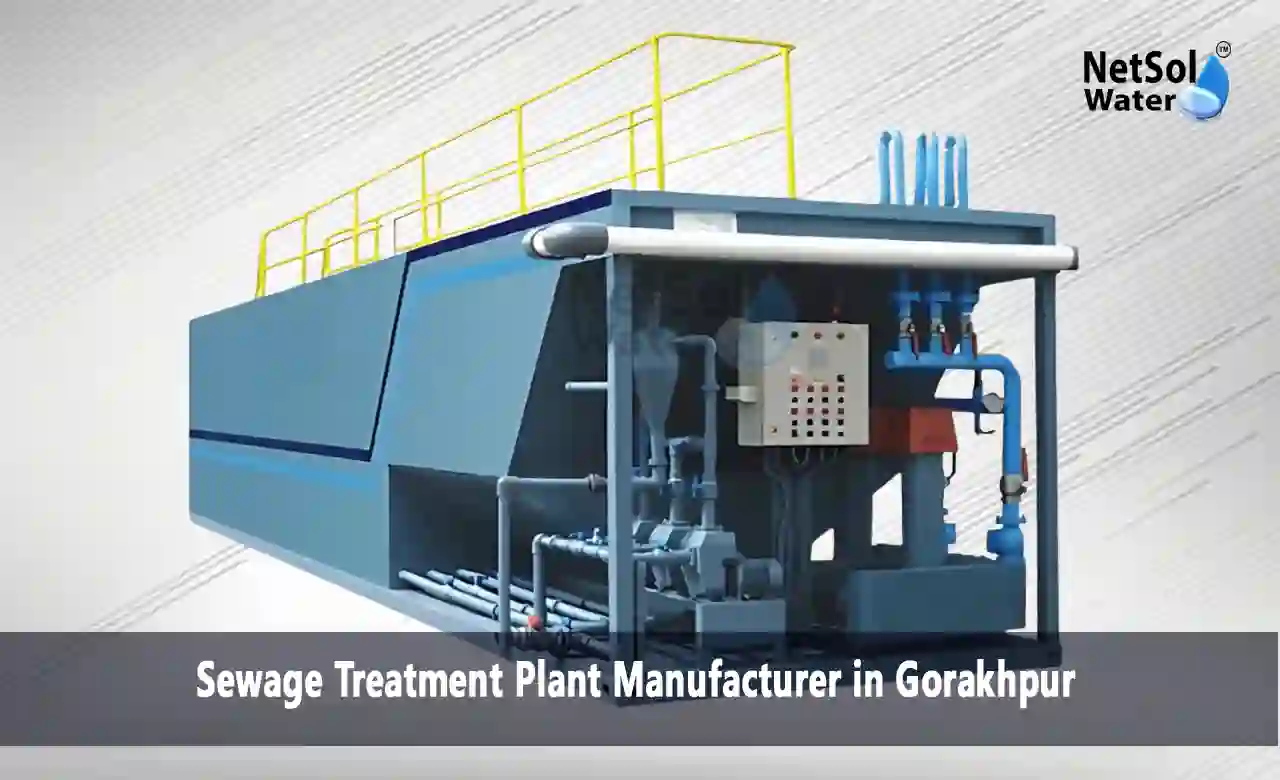
Sewage Treatment Plant Manufacturer in Gorakhpur
Gorakhpur is growing fast. New housing colonies, hospitals, food-processing units and hotels are coming up across the city and its surrounding areas. But growth brings a real challenge - managing sewage and wastewater responsibly before it reaches the Rapti River or the local groundwater.
That's where choosing the right sewage treatment plant manufacturer in Gorakhpur makes all the difference. Not just for legal compliance with UPPCB norms, but for the long-term cost of running the plant and the quality of treated water you get out of it.
Netsol Water has been solving this problem for clients across eastern Uttar Pradesh for years. With over 200 completed installations - from domestic apartments to large industrial estates - the company brings genuine field experience to every project.
Why Sewage Treatment Has Become Essential in Gorakhpur?
Gorakhpur sits in a rapidly urbanizing belt. The Gorakhpur Smart City initiative, expanding AIIMS operations, growing sugar and food industries, and rising residential density have all pushed wastewater volumes well beyond what older drainage systems can handle.
The Uttar Pradesh Pollution Control Board (UPPCB) now mandates STP installation for most residential, commercial, and industrial projects above a certain capacity. Non-compliance risks heavy fines and project shutdowns.
Beyond compliance, treated wastewater can be reused for irrigation, cooling towers, toilet flushing, and landscaping - cutting fresh water costs significantly for large campuses and industries.
About Netsol Water as STP Manufacturer in Gorakhpur
Netsol Water is a specialist wastewater treatment company and a leading Sewage Treatment Plant Manufacturer and Supplier in Uttar Pradesh, headquartered in the NCR region, with active project delivery across cities like Gorakhpur, Lucknow, Varanasi, and Kanpur.
| At a Glance | Details |
|---|---|
| Installations Completed | 200+ across UP and India |
| Technologies Offered | MBR, SBR, MBBR, ASP, FAB |
| Compliance | UPPCB, CPCB, NGT-compliant designs |
| Certifications | ISO 9001:2015, BIS-aligned standards |
| Support | 24/7 remote monitoring, annual AMC plans |
| Industries Served | Residential, Hotels, Hospitals, Food, Municipal |
The team includes licensed environmental engineers, civil engineers, and field installation specialists who understand Gorakhpur's soil conditions, water table depth, and local regulatory requirements.
STP Technologies We Use
There is no single 'right' STP technology. The correct choice depends on your site size, incoming sewage characteristics, available land, energy budget, and the quality of treated water you need.
1. Moving Bed Biofilm Reactor (MBBR)
Best for: Medium-sized hotels, hospitals, housing societies (50 KLD to 500 KLD)
• Compact footprint - ideal when space is limited
• Low sludge generation compared to conventional activated sludge
• Easy to scale up as flow increases
• Lower energy use than MBR at similar scales
2. Membrane Bioreactor (MBR)
Best for: Premium projects requiring very high-quality effluent for reuse (hospitals, pharmaceutical, food-grade)
• Produces near-drinking-quality treated water
• Smallest physical footprint of any biological system
• Higher capital cost but lowest treated water TSS/BOD
• Ideal for zero-liquid-discharge (ZLD) goals
3. Sequential Batch Reactor (SBR)
Best for: Municipal projects, large residential townships (500 KLD+)
• Single tank handles equalization, aeration, and clarification
• Handles variable flow and load well
• Proven technology in Indian municipal applications
4. Fixed Activated Biofilm (FAB) / Hybrid Systems
Best for: Retrofitting existing plants or upgrading older ASP systems
• Works well when civil infrastructure already exists
• Cost-effective upgrade path for older installations
Industries & Sectors We Serve in Gorakhpur
| Sector | Typical Capacity Range | Key Requirements |
|---|---|---|
| Housing Societies / Apartments | 50–300 KLD | Low maintenance, odour-free, compact |
| Hotels & Hospitality | 25–200 KLD | Consistent performance, aesthetic installation |
| Hospitals & Healthcare | 30–500 KLD | Pathogen removal, infection control compliance |
| Food & Sugar Industries | 100–2000 KLD | High BOD/COD load, ZLD options |
| Municipal Bodies (ULBs) | 500 KLD–10 MLD | Scalable, low OPEX, operator-friendly |
| Educational Campuses | 20–100 KLD | Water reuse for landscaping, low power |
How the STP Installation Process Works - Step by Step
1. Free Site Survey & Feasibility: Our engineer visits your site, measures available space, assesses soil type, and reviews your sewage generation volumes.
2. Custom Design & Engineering: A plant layout is designed specific to your site - no copy-paste templates. Hydraulic calculations and process sizing are done for your exact flow rates.
3. UPPCB Approvals & Documentation: We help prepare the consent-to-establish (CTE) application and related documents for UPPCB clearance.
4. Civil & Mechanical Construction: Our crews handle all civil work (tank construction, piping) and mechanical installation (blowers, pumps, membranes, panels) on site.
5. Commissioning & Trial Run: We run the plant through its startup cycle, fine-tune parameters, and verify treated water quality against UPPCB discharge norms.
6. Operator Training: Local staff are trained on daily operations, routine maintenance, and minor troubleshooting so the plant runs efficiently without full-time specialist support.
7. Handover & After-Sales Support: Complete documentation, manuals, and emergency contact support are provided. Annual maintenance contracts (AMC) available.
STP Cost in Gorakhpur - What Affects the Price?
A common question is: 'How much does a sewage treatment plant cost in Gorakhpur?' There is no single number - but here's a realistic range to help you plan:
| Plant Capacity | Indicative Cost Range (INR) | Technology |
|---|---|---|
| 1–25 KLD (Small Domestic) | Rs. 6 Lakh – Rs. 18 Lakh | FAB / Compact MBBR |
| 50–100 KLD (Housing Society / Hotel) | Rs. 35 Lakh – Rs. 65 Lakh | MBBR / SBR |
| 100–300 KLD (Hospital / Mid Industry) | Rs. 65 Lakh – Rs. 200 Lakh | MBBR / MBR |
| 500 KLD+ (Large Industry / Municipal) | Rs. 3 Cr+ (custom quotation) | SBR / MBR / ZLD |
Factors that influence the final cost include: plant capacity (KLD), inlet sewage characteristics (BOD/COD/TSS levels), treated water quality target, site conditions (soil, depth, slope), level of automation, and whether a water reuse system is included.
Netsol Water provides itemized, transparent quotations - no hidden charges. We also guide clients on optimizing capital cost vs. operating cost so the total cost of ownership stays low over a 15–20 year plant life.
Why Clients in Gorakhpur Choose Netsol Water
• Local project experience: We've worked in Gorakhpur's clay-heavy soil and high water table zones
• UPPCB compliance guaranteed: Every design meets current discharge norms
• Transparent pricing: Detailed BOQ with no surprise additions
• Fast delivery: Standard plants delivered and commissioned within 8–14 weeks
• Remote monitoring: IoT-enabled panels allow real-time plant performance tracking
• Proven track record: 200+ plants across UP with verifiable client references
• Post-installation support: Spare parts, AMC, and emergency response available
FAQ
Q1. What is the cost of a sewage treatment plant in Gorakhpur?
The cost of an STP in Gorakhpur ranges from Rs. 6 lakh for a small 1 KLD domestic unit to Rs. 3 crore or more for large industrial or municipal plants above 500 KLD. The final price depends on the plant's capacity (in KLD), the technology used (MBBR, MBR, SBR), site conditions, and the level of automation required. Netsol Water provides free, itemized quotations with no hidden charges.
Q2. Which STP technology is best for a housing society in Gorakhpur?
For most housing societies in Gorakhpur with a daily flow of 50–200 KLD, MBBR (Moving Bed Biofilm Reactor) technology is the most practical choice. It offers a compact footprint, low energy consumption, and low maintenance requirements - important factors when the plant is operated by non-specialist facility staff. MBR is recommended where treated water is intended for reuse inside the building, such as for toilet flushing or irrigation.
Q3. Is it mandatory to install an STP in Gorakhpur?
Yes. The Uttar Pradesh Pollution Control Board (UPPCB), under NGT and CPCB guidelines, mandates the installation of STPs for residential projects above a specified scale, hotels, hospitals, and all industries generating sewage or process wastewater. Non-compliance can result in show-cause notices, fines, and shutdown orders. Projects applying for environmental clearance or Occupancy Certificates (OC) must demonstrate STP installation.
Q4. How long does it take to install an STP in Gorakhpur?
A standard sewage treatment plant in Gorakhpur typically takes 8 to 14 weeks from order confirmation to commissioning. This includes manufacturing, civil work, mechanical installation, and trial run. Timeline may vary based on plant capacity, site access, and whether UPPCB approvals are needed before construction begins. Netsol Water coordinates all stages to minimize delays.
Q5. Can treated sewage water be reused? If yes, for what purposes?
Yes. Treated sewage water (also called Treated Effluent or Recycled Water) can legally and safely be reused for purposes like garden and landscape irrigation, toilet flushing, cooling towers, industrial process water, and road washing. Plants equipped with tertiary treatment and UV/chlorination disinfection produce water that meets CPCB reuse standards. This can reduce fresh water demand by 30–60% in large facilities.
Q6. What is UPPCB consent and does Netsol Water help with it?
UPPCB Consent to Establish (CTE) and Consent to Operate (CTO) are mandatory approvals from the Uttar Pradesh Pollution Control Board for any project that installs a wastewater treatment system. Netsol Water assists clients in Gorakhpur with preparing STP design drawings, technical documents, and application support for UPPCB submissions - simplifying a process that first-time applicants often find complicated.
Q7. What is the difference between an STP and an ETP?
An STP (Sewage Treatment Plant) is designed to treat domestic wastewater generated from toilets, kitchens, and bathrooms. An ETP (Effluent Treatment Plant) is designed to treat industrial process wastewater, which typically contains chemicals, heavy metals, and high-strength organic pollutants. Some industrial sites need both - an ETP for process water and an STP for domestic sewage. Netsol Water designs both systems and can integrate them where needed.
Q8. Does Netsol Water offer post-installation maintenance support in Gorakhpur?
Yes. Netsol Water provides Annual Maintenance Contracts (AMC), on-call technical support, and remote monitoring via IoT-enabled control panels for plants installed in Gorakhpur and across Uttar Pradesh. Local operators are trained at handover, and spare parts are stocked to minimize downtime. Emergency site visits are available for critical issues within 24–48 hours depending on location.
Get Your Free STP Design Consultation Today
Tell us your capacity requirement and we'll send you a free preliminary design and indicative cost estimate - usually within 24 hours.
Phone: +91-9650608473 | Email: enquiry@netsolwater.com