

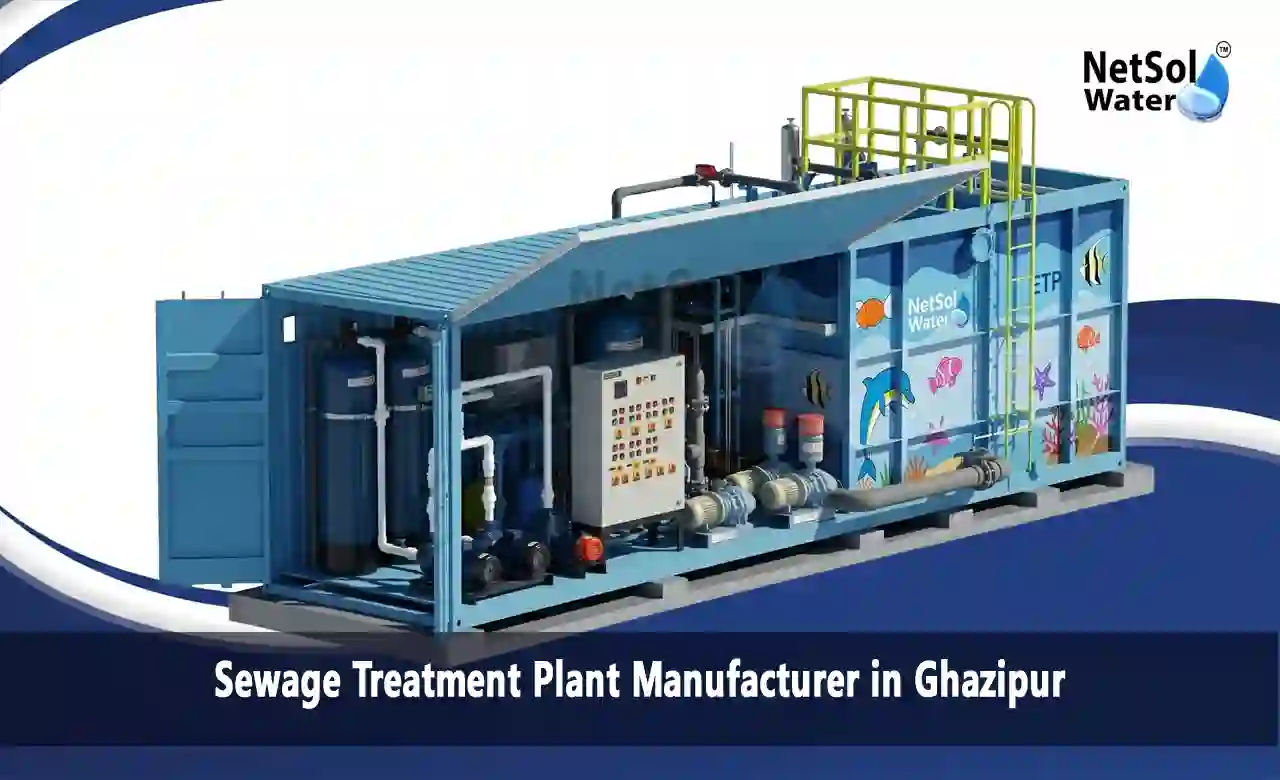
Sewage Treatment Plant Manufacturer in Ghazipur
Located on the banks of the holy Ganga, Ghazipur carries a special environmental responsibility. The National Mission for Clean Ganga (NMCG) and the National Green Tribunal (NGT) have placed Ganga basin cities under heightened scrutiny making proper sewage treatment not just a statutory obligation, but a civic and cultural imperative.
Yet rapid urbanisation in Ghazipur is outpacing sewage treatment capacity. Residential complexes, commercial hubs, hospitals and institutional campuses generate enormous volumes of domestic sewage daily much of which flows untreated into drains and ultimately into Ganga tributaries, violating NGT orders and UPPCB conditions.
Netsol Water is a leading Sewage Treatment Plant Manufacturer in Ghazipur helping housing societies, hospitals, institutions, industries and municipal bodies install compliant, efficient and long-running STP systems. We understand Ghazipur's regulatory environment, local civil conditions and the specific performance standards required for Ganga basin projects.
Why Ghazipur Urgently Needs Better Sewage Treatment
Under RERA regulations, real estate developers in Uttar Pradesh are required to provide sewage treatment infrastructure for residential projects above a specified scale. NGT directives make STPs mandatory for institutions, hospitals and commercial complexes generating above threshold wastewater volumes. NMCG guidelines prohibit direct sewage discharge into any Ganga tributary.
The consequence of non-compliance in Ghazipur is serious: UPPCB notices, occupation certificate delays for developers, reputational damage to institutions and, increasingly, public interest litigation. Installing a properly designed, NGT-compliant STP is not a delay to your project it is the fastest path to uninterrupted operation.
Our STP Solutions for Ghazipur
1. Residential Apartments and Housing Societies
For residential complexes ranging from 50 units to large township developments, Netsol Water designs compact, low-noise, low-odour STPs. We use MBBR or MBR technology for maximum space efficiency. Treated water from our residential STPs consistently meets standards for toilet flushing and garden irrigation reuse reducing the complex's municipal water bill by 30–50%.
2. Hospitals and Healthcare Facilities
Hospital sewage carries pathogens, pharmaceutical residues and chemical disinfectants that require specialised treatment. Netsol Water designs hospital STPs with enhanced disinfection stages (UV + chlorination), pathogen monitoring and pharmaceutical compound removal capabilities meeting the specific CPCB requirements for healthcare facility discharge in the Ganga basin.
3. Hotels, Resorts and Hospitality Projects
Hospitality properties in Ghazipur face variable, peak-heavy sewage loads from kitchens, laundry and guest rooms. Our hospitality STPs are designed to handle peak-to-average load ratios of up to 3:1 without system shock. Treated water is polished to reuse standard for garden irrigation and cooling tower makeup supporting environmental certification goals.
4. Industrial Campuses and SEZs
Industrial estates and SEZs in Ghazipur generate mixed sewage from workers, canteens and welfare facilities. Netsol Water designs campus-scale STPs with sufficient capacity for current use and phased expansion. Systems are automated and produce compliant treated water for reuse in facility maintenance, reducing freshwater consumption.
5. Municipal and Government Projects
Municipal STPs for Ghazipur's urban local bodies require robust, scalable design with low operating costs and minimal skilled staff dependency. Netsol Water designs municipal STPs using SBR technology with SCADA automation handling 50 KLD to 10 MLD flows, meeting NMCG's quality standards and providing easy data reporting for regulatory compliance.
Technology Selection for Ghazipur's STP Projects
We recommend the best technology based on your specific site, flow and reuse goals:
. MBBR (Moving Bed Biofilm Reactor): Best for medium-sized projects (50–500 KLD); compact, robust, low maintenance
. MBR (Membrane Bioreactor): Best for high-quality water reuse projects; smallest footprint; LEED/IGBC green building preference
. SBR (Sequencing Batch Reactor): Best for large flows (500 KLD+) and municipal applications; fully automated; handles variable loads well
. Packaged STP: Best for small projects (10–100 KLD); factory-built, fast installation, low civil cost
Conventional ASP: Best for large municipal projects where low capital cost and simple operation are priorities
Features of Every Netsol Water STP in Ghazipur
. NMCG and CPCB compliant treated water quality guaranteed
. Low noise and odour suitable for residential and hospital environments
. Underground or above-ground installation options
. Online monitoring with alarm and reporting capability
. Sludge management system dewatered sludge for easy, low-volume disposal
. Energy-efficient blowers and pumps with VSD drives
. Water reuse system for flushing, garden irrigation and cooling
Why Clients in Ghazipur Choose Netsol Water?
Ganga Basin Specialisation: We have designed STPs specifically for projects in Ganga basin districts. Our systems meet the enhanced standards required for Ghazipur's location.
RERA and NGT Documentation Support: We provide the technical documentation and compliance reports needed for developer approvals, occupation certificates and NGT filings.
End-to-End Project Delivery: Survey, design, fabrication, civil coordination, installation, commissioning, training and AMC all managed by Netsol Water.
Proven Water Reuse Results: Our STPs help housing societies reduce municipal water bills by INR50,000–INR2 lakhs per year through toilet flushing and garden reuse.
Also Read: STP Manufacturer U.P.
STP Installation Process in Ghazipur
1: Site survey, sewage flow measurement, population assessment, space mapping
2: Technology recommendation and process design
3: Proposal with layout drawings, specifications and transparent cost estimate
4: Client approval, regulatory documentation support (NOC, CTE filing)
5: Fabrication and factory testing of packaged components
6: Civil construction, equipment installation, piping and electrical work
7: Biological startup, performance testing and water quality verification
8: Operator training, O&M manual handover, NMCG compliance documentation and AMC activation
Cost of STP in Ghazipur
STP costs in Ghazipur depend on daily sewage volume (KLD), technology chosen, site conditions and reuse requirements. Indicative ranges: Compact packaged MBBR STP (1–100 KLD): INR5–70 lakhs; Medium modular MBR system (1–100 KLD): INR8–80 lakhs; Large SBR municipal system (100 KLD–5 MLD): INR1 crore–INR3 crores. Netsol Water provides free site assessments and detailed itemised proposals.
Frequently Asked Questions
Q1: Is an STP mandatory for residential projects in Ghazipur?
A: Yes. RERA regulations for Uttar Pradesh require residential developments above specified scales to provide sewage treatment infrastructure. NGT directives also mandate STPs for complexes discharging into Ganga basin drainage. Netsol Water helps Ghazipur developers navigate these requirements and install compliant systems before occupation certificate applications.
Q2: What treated water quality standards must an STP in Ghazipur meet?
A: STPs in Ghazipur discharging into Ganga tributaries must meet CPCB Ganga basin standards: BOD ≤10 mg/L, COD ≤50 mg/L, SS ≤20 mg/L, Total Coliform ≤1000 MPN/100 mL. Netsol Water designs STPs to achieve these standards consistently, with performance testing reports provided at commissioning.
Q3: What is the difference between a packaged STP and a civil-constructed STP?
A: A packaged STP is pre-manufactured at a factory in compact modules requiring minimal civil work and offering faster installation. Civil-constructed STPs use in-situ concrete tanks better suited for large municipal flows or challenging site geometries. Netsol Water advises which approach suits your project scale and timeline.
Q4: Can an STP be installed underground in Ghazipur residential projects?
A: Yes. Netsol Water designs underground STP installations particularly popular in housing societies where surface space is valuable. Underground STPs eliminate noise and odour concerns for residents. We assess soil conditions and water table depth in Ghazipur before recommending underground or above-ground installation.
Q5: How much water can a residential STP save in a housing society?
A: A properly designed STP with reuse for toilet flushing and gardening can reduce a housing society's municipal water consumption by 35–55%. For a typical 200-unit society in Ghazipur generating 30–40 KLD of sewage, water reuse savings can translate to annual utility savings of INR75,000–INR2 lakhs.
Q6: What ongoing maintenance does an STP require in Ghazipur?
A: Key STP maintenance activities include daily monitoring of blowers and dosing systems, weekly checks on mixed liquor suspended solids (MLSS) and settling quality, monthly sludge removal and dewatering, and quarterly performance audits. Netsol Water provides AMC contracts for Ghazipur projects covering all scheduled maintenance visits.
Q7: Does Netsol Water provide NMCG compliance documentation for STPs?
A: Yes. For Ghazipur's Ganga basin projects, Netsol Water prepares NMCG compliance documentation including treated water quality test reports, process flow diagrams and operational performance data. This documentation supports compliance reporting to NMCG and UPPCB as required under Namami Gange programme conditions.