

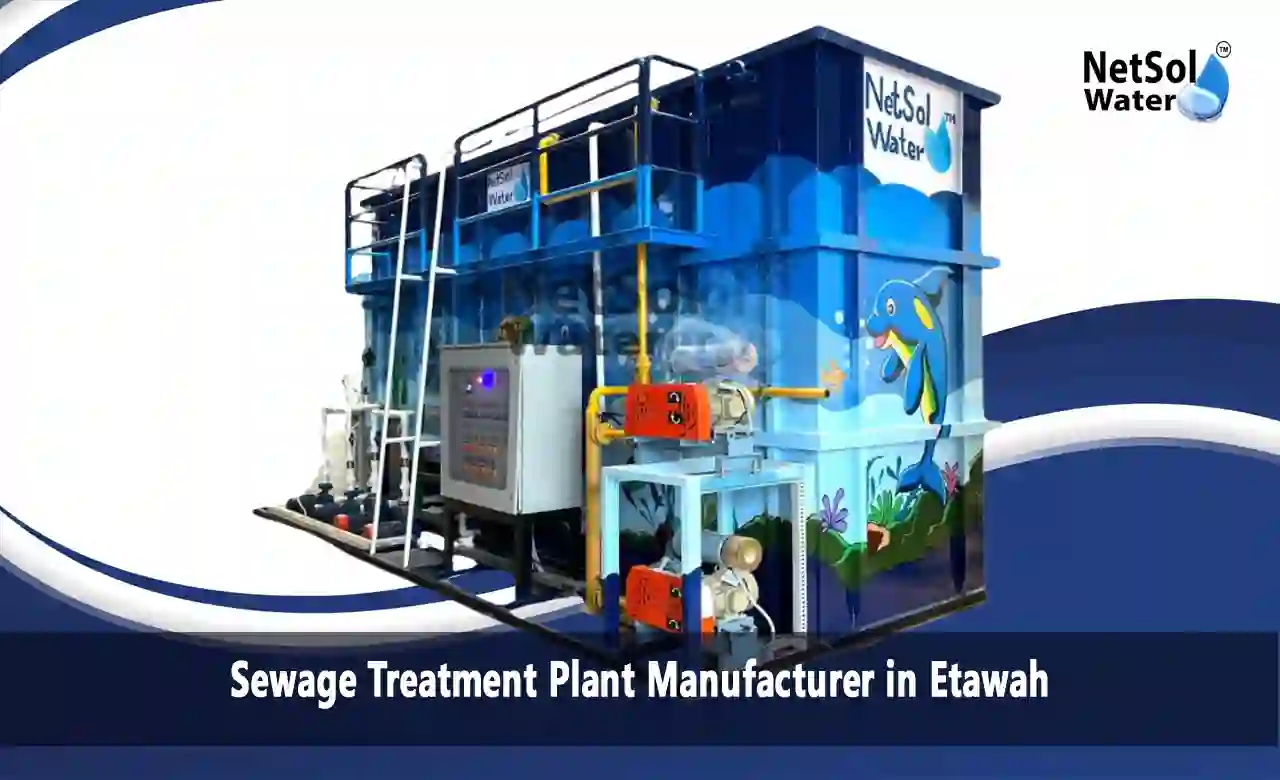
Sewage Treatment Plant Manufacturer in Etawah
Rapid urbanisation in Etawah is putting pressure on existing drainage and sewerage infrastructure. Residential complexes, hospitals, hotels and municipal projects are generating increasing volumes of domestic sewage and the gap between wastewater generated and wastewater treated is widening.
The National Green Tribunal (NGT) and the Ministry of Environment, Forests and Climate Change (MoEF) have issued strict orders on sewage treatment for urban and peri-urban developments. Buildings, colonies and institutions that fail to install and operate compliant Sewage Treatment Plants (STPs) face significant penalties and environmental liability.
Netsol Water is a proven Sewage Treatment Plant Manufacturer in Etawah. We design, build and commission STP systems that meet CPHEEO guidelines, achieve 95%+ BOD removal and enable treated water reuse for flushing, landscaping and cooling.
What Is a Sewage Treatment Plant (STP)?
A Sewage Treatment Plant treats domestic sewage the wastewater from toilets, bathrooms, kitchens and laundry to remove pathogens, organic matter, suspended solids and nutrients before the treated water is discharged or reused. A well-operated STP protects groundwater, local water bodies and public health.
Modern STPs in Etawah use biological treatment technologies that are efficient, compact and cost-effective to operate. The treated water, known as 'reclaimed water', can be safely reused for toilet flushing, garden irrigation, road washing and cooling tower makeup reducing freshwater demand by 40–60% in residential complexes.
Our STP Solutions for Etawah
1. Compact Packaged STPs
For residential societies, hostels, small hotels and schools with sewage flows from 1 KLD to 100 KLD, Netsol Water offers factory-built packaged STPs. These units arrive pre-assembled, pre-wired and ready to connect. They require minimal civil work, fit in tight spaces (including underground) and operate with very low noise and odour.
2. MBBR-Based STP Systems
Moving Bed Biofilm Reactor (MBBR) technology is one of the most space-efficient and reliable biological treatment methods for STPs. Our MBBR systems achieve excellent BOD and COD removal in a compact footprint, making them ideal for housing complexes, hospitals and commercial developments where space is at a premium in Etawah.
3. MBR Technology for Reuse-Quality Treated Water
Membrane Bioreactor (MBR) STPs combine biological treatment with membrane filtration to produce treated water of near-drinking quality suitable for direct reuse in flushing and irrigation without further polishing. MBR systems are the technology of choice for IGBC/LEED-certified green buildings and projects targeting high water reuse ratios.
4. SBR Systems for Municipal Applications
Sequencing Batch Reactor (SBR) technology is ideal for larger flows municipal colonies, townships and government housing projects. SBR plants are highly automated, handle variable flow effectively and produce consistent treated water quality throughout the day.
Who We Serve in Etawah?
. Residential Apartments & Housing Societies Compact, low-maintenance STPs for everyday domestic sewage
. Hotels, Resorts & Hospitality Venues Systems that handle variable loads from kitchen, laundry and bathroom waste
. Hospitals & Clinics STP with advanced disinfection stages (UV/chlorination) to safely neutralise pathogens
. Educational Institutions & Hostels Reliable, low-odour systems with easy operator training
. Industrial Campuses & SEZs High-capacity modular STPs with water reuse for gardening and toilet flushing
. Municipal Bodies & Urban Local Bodies Large-scale STPs for town-wide sewage collection and treatment
Technology & Process Design
Our STP technology is selected based on your flow, space, reuse goals and budget. Every system includes:
. Preliminary Treatment: Bar screens and grit chambers to remove large solids and sand
. Primary Treatment: Primary settling or equalisation to reduce peak loads and suspended solids
. Biological Treatment: MBBR, MBR, SBR or ASP depending on space and performance targets
. Secondary Settling: Clarifiers or membrane separation for suspended biomass removal
. Tertiary Treatment: Sand filtration, activated carbon, UV disinfection for reuse-quality output
. Sludge Management: Mechanical dewatering to reduce sludge volume for easy disposal
. Automation: PLC controls, flow monitoring, automatic alarms and online data logging
Why Choose Netsol Water as Your STP Manufacturer in Etawah?
Experience Across Project Types: From 1 KLD apartment STPs to 500+ KLD municipal systems Netsol Water has delivered STPs across the full capacity range in Uttar Pradesh.
NGT & CPHEEO Compliance: Our designs meet the treated water standards specified by the CPHEEO manual and satisfy NGT conditions for sewage treatment in urban areas.
Water Reuse Focus: We design every STP with reuse in mind. Treated water from our plants is consistently within limits for irrigation and flushing reuse helping you reduce water bills.
End-to-End Delivery: Survey, design, civil coordination, mechanical & electrical installation, commissioning, training and ongoing AMC everything under one roof.
Also Read: STP Manufacturer in U.P.
STP Installation Process
1: Site survey, population/flow assessment, space mapping
2: Technology selection (MBBR / MBR / SBR) and system design
3: Proposal with layout drawings and transparent cost estimate
4: Fabrication and factory testing of packaged unit or modular components
5: Civil work, equipment installation and utility connections
6: Biological startup, system tuning and performance testing
7: Operator training, documentation handover and AMC activation
Cost of STP in Etawah
STP cost depends primarily on daily sewage volume (KLD), technology chosen, site conditions and automation level. Compact packaged STPs for 1–100 KLD apartments are significantly more affordable than large civil-constructed MBR systems. Netsol Water provides clear cost breakdowns, including capital cost, operating cost per KLD and expected payback from water reuse savings.
Frequently Asked Questions
Q1: Is installing an STP mandatory for residential complexes in Etawah?
A: Yes. NGT orders and state SPCB notifications require residential complexes above a certain population threshold to install and operate compliant STPs. The specific threshold varies by state; in Uttar Pradesh, complexes with 100 or more dwellings typically require an STP. Netsol Water advises on your specific obligation.
Q2: What is the difference between MBBR and MBR STP technology?
A: MBBR (Moving Bed Biofilm Reactor) uses plastic carrier media to grow biofilm for biological treatment compact, robust and cost-effective. MBR (Membrane Bioreactor) combines biological treatment with membrane filtration, producing near-drinking quality treated water ideal for direct reuse. MBR systems cost more but deliver higher water quality.
Q3: Can STP treated water be used for gardening and toilet flushing?
A: Yes. Treated water from STPs designed to tertiary standards can be safely reused for toilet flushing, garden irrigation and road washing. This reduces freshwater demand by 40–60% in residential complexes. Netsol Water designs STP systems specifically to produce reuse-quality treated water where required.
Q4: How much space does an STP require?
A: Packaged STPs for 20–50 KLD can fit in as little as 15–25 square metres. MBBR systems are compact. MBR systems have the smallest footprint for high-performance treatment. Underground installation is also possible for space-constrained projects. Netsol Water optimises the layout for your available space.
Q5: How do I manage odour from an STP in a residential complex?
A: Modern MBBR and MBR STP systems produce minimal odour when properly designed and maintained. Netsol Water includes odour control features covered tanks, proper ventilation and biological dosing in residential STP designs. Regular maintenance under an AMC contract prevents odour issues from developing.
Q6: What is the lifespan of a properly maintained STP?
A: A well-maintained STP can operate effectively for 15–25 years. Key maintenance activities include regular membrane inspection (for MBR), aeration equipment servicing, sludge removal and control system updates. Netsol Water's AMC contracts extend plant life by ensuring preventive maintenance is never missed.
Q7: Can Netsol Water upgrade our existing STP that is not performing well?
A: Yes. Netsol Water conducts performance audits on existing STPs and recommends upgrades whether it's additional biological media, membrane replacement, aeration improvement or control system upgrade. Retrofitting an underperforming STP is often more cost-effective than complete replacement.