

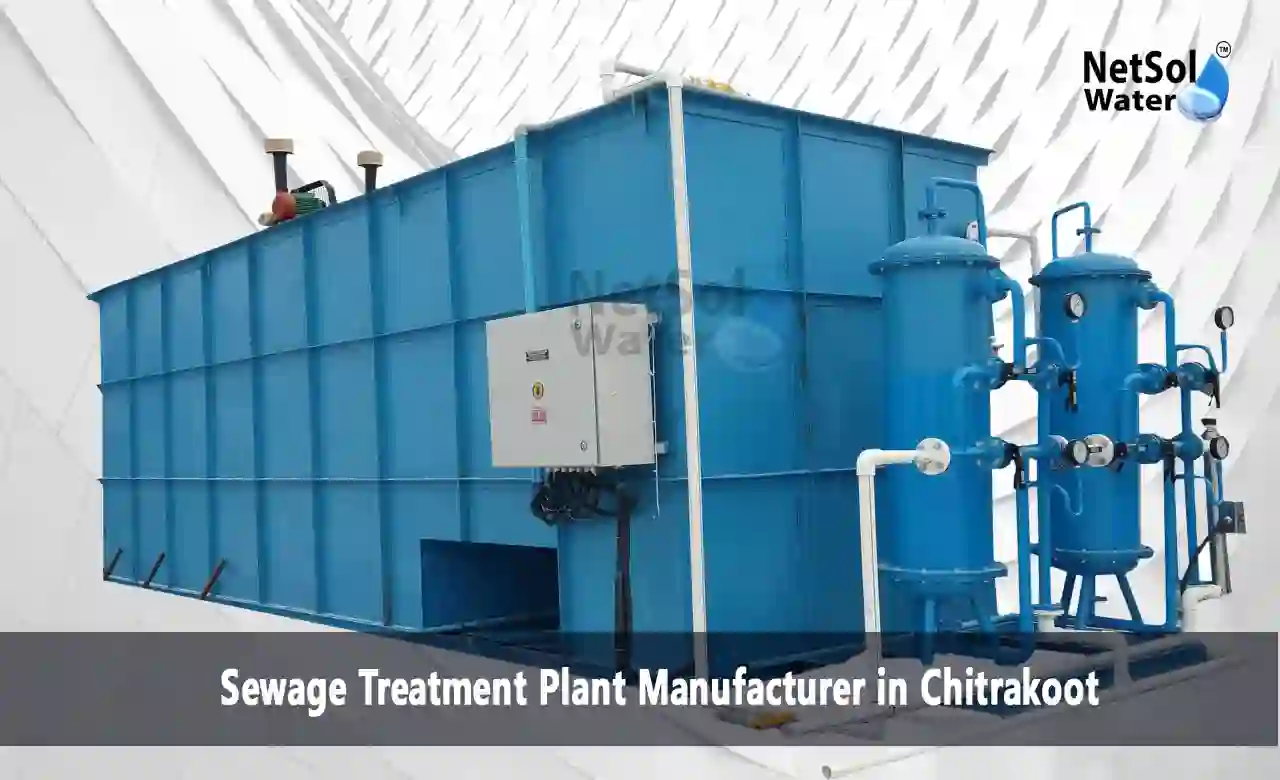
Sewage Treatment Plant Manufacturer in Chitrakoot
Chitrakoot means different things to different people. For most visitors, it is the Mandakini River, the Ram Ghat at dawn, the sound of bells echoing through the valley. For the people who actually live and work here, it is also a town dealing with the same pressures every growing Indian town faces. More people. More businesses. More waste. And infrastructure that has not quite kept up with any of it.
Let us talk about something that rarely comes up in conversations about Chitrakoot but absolutely should. Sewage. Specifically, what happens to it and what happens when nothing is done about it.
Every day this town generates thousands of litres of wastewater. Households, hotels, hospitals, dharamshalas, small factories, restaurants. All of it produces sewage. And if that sewage does not go through proper treatment before it reaches the ground or the river, you end up with problems that are very difficult to reverse. Contaminated groundwater. Waterborne diseases spreading through communities. A river that slowly stops being the living, sacred thing people travel from across India to see.
This is not a hypothetical concern. It is already happening in parts of Chitrakoot and across dozens of similar towns in central India. And this is exactly why the question of who is the right sewage treatment plant manufacturer in Chitrakoot is worth taking seriously.
The Real Picture on the Ground
Chitrakoot sits in the Satna district of Madhya Pradesh. It is not a metro. It does not have the infrastructure budget or the administrative capacity of a Bhopal or an Indore. What it does have is a rapidly growing population of permanent residents, a booming religious tourism economy, and civic systems that were built for a much smaller load.
During Ram Navami, Diwali and other major pilgrimage seasons, the town's population effectively multiplies. Tens of thousands of visitors arrive over a matter of days. The water demand spikes. The waste generation spikes. And the treatment infrastructure, such as it is, gets pushed well past its limits.
Here are a few numbers worth sitting with for a moment:
. India generates close to 62,000 million litres of sewage every single day across its urban areas
. Only about 37 percent of that total actually gets treated before it is discharged
. Smaller towns like Chitrakoot typically treat less than 20 percent of the sewage they generate
. Untreated sewage is the number one source of river contamination across India
. The Mandakini River receives untreated waste discharge on a daily basis
A properly functioning sewage treatment plant breaks this cycle. It takes the raw sewage, runs it through a series of treatment stages, removes the pathogens and organic load, and produces an output that meets pollution control standards. The treated water can go safely back into the environment or even be reused for irrigation and other non-potable purposes.
What Sewage Treatment Actually Involves?
A lot of people vaguely understand that an STP cleans wastewater but are not clear on what that actually involves. Understanding the process even at a basic level helps you ask better questions when you are talking to Sewage Treatment Plant Manufacturer in Chitrakoot and evaluating proposals.
1. Preliminary Treatment
This is the first stage and it is exactly what it sounds like. A basic cleanup before the serious treatment begins. Bar screens and grit chambers catch the large physical objects that come in with the sewage. Plastic, cloth, grit, sand, and anything else solid enough to cause damage to downstream equipment gets removed here.
2. Primary Treatment
The sewage moves into large settling tanks. Heavier solid matter sinks to the bottom and forms primary sludge. Oils and fats rise to the surface and get skimmed off. By the time the sewage leaves this stage, somewhere between 50 and 60 percent of the suspended solids are already gone.
3. Secondary or Biological Treatment
This is the core of the treatment process. Microorganisms go to work on the organic matter that is dissolved in the water. This is the stuff you cannot see but that does the most biological damage if it reaches a water body. Technologies like MBBR, SBR, and ASP are used here, each working a bit differently but all aimed at the same outcome. Reduce the BOD and COD to levels that are safe for discharge.
4. Tertiary Treatment
After the biological stage, the water goes through additional filtration and disinfection. Chlorination or UV treatment eliminates remaining pathogens. The output at this stage is what gets measured against CPCB discharge standards and should meet them comfortably if the plant is designed and operated well.
5. Sludge Management
Throughout this process of hiring Sewage Treatment Plant Manufacturer in Chitrakoot, solid waste accumulates at various stages. This sludge needs its own treatment pathway. It gets thickened, dewatered, and either disposed of safely or converted into something useful like agricultural compost. How a manufacturer approaches sludge management tells you a lot about how thoroughly they have thought through the full system.
Which Technology Actually Fits Chitrakoot?
This is where a lot of generic advice falls short. Chitrakoot is not a typical town and it does not need a typical plant design. The technology choice needs to account for some very specific local conditions.
Sewage volumes here are not constant. They swing dramatically between normal periods and peak pilgrimage seasons. Land near the river and the ghats is limited and sensitive. The availability of skilled local operators to run complex systems is not something you can assume. Power supply in smaller towns can be inconsistent. Any manufacturer who does not factor these realities into the design recommendation is not doing their job.
SBR technology suits Chitrakoot better than most other options for municipal and large institutional applications. Sequential Batch Reactors handle variable flow rates exceptionally well. When pilgrim footfall doubles the sewage load for a few weeks, an SBR system adapts without falling apart. This built-in flexibility is genuinely valuable here.
MBBR plants work well for hotels, dharamshalas, and medium-scale commercial establishments. They are compact enough to fit into constrained sites, they handle high organic loads without needing large footprints, and they produce less sludge than older conventional technologies. For a hotel near the ghats with limited outdoor space, MBBR is often the practical answer.
MBR systems are the right call for hospitals and larger healthcare facilities. The combination of biological treatment with membrane filtration produces very high-quality treated water. For healthcare settings where the sewage may contain pharmaceutical compounds and elevated pathogen loads, that quality level matters. The treated output from a well-run MBR can actually be reused for toilet flushing and garden irrigation within the facility.
Picking the Right Manufacturer: What Actually Matters
The difference between a good Sewage Treatment Plant Manufacturer in Chitrakoot and a mediocre one becomes very clear about two years after installation. By then, you know whether the plant performs as promised, whether the support is there when you need it, and whether the decision you made was actually sound.
Here is what separates the ones worth working with from the ones you will regret choosing.
1. Real experience in towns like Chitrakoot
This is the first thing to probe. A company that has only built plants in Delhi or Mumbai has not dealt with the specific challenges of smaller towns. Irregular power, limited skilled labor, sites near river floodplains, seasonal load variation. Ask them directly about projects in tier 3 towns. Ask for references you can actually call and speak to.
2. Technology range and honest recommendations
A manufacturer who only offers one treatment technology has a built-in incentive to push that technology regardless of whether it fits your situation. A manufacturer who genuinely has multiple options at their disposal will be honest about which one fits and why. Listen carefully to how they explain their recommendation. If they cannot explain it clearly, that is a problem.
3. Deep knowledge of local regulations
The MP Pollution Control Board and CPCB have specific discharge standards. BOD below 30 mg/L, TSS below 100 mg/L, pH between 6.5 and 8.5, coliform counts within permissible limits. Your manufacturer needs to know these standards without looking them up and needs to be able to show you test reports from running installations that prove compliance. Verbal assurances are not enough.
4. Honest approach to after-sales
Ask point blank: what happens when something breaks down six months after installation? Is there an AMC available? What does it cover? How quickly can a technician reach Chitrakoot? Do they stock common spare parts or is everything ordered on demand? A Sewage Treatment Plant Manufacturer in Chitrakoot who handles these questions vaguely is telling you something important about what post-installation support actually looks like.
5. Willingness to do a site assessment first
No legitimate manufacturer should be giving you a firm design and quote without visiting your site. Soil conditions, available space, groundwater depth, proximity to habitation and the river, slope and gradient of the land, local flood risk, these all directly affect how the plant should be designed and located. If a manufacturer sends you a detailed proposal without visiting the site, that proposal is built on assumptions, not facts.
Mistakes That Cost People a Lot of Money
These come up repeatedly in the real world and they are worth being aware of before you start talking to manufacturers.
Choosing purely on purchase price is the most common one. The lowest quote usually means lower grade components. Thinner structural steel. Cheaper media. Motors and pumps from manufacturers with no track record. Everything looks fine initially and then the problems start appearing in year two or three. Calculate total cost of ownership over ten years before making any comparison. A plant that costs 20 percent more upfront but runs reliably for 15 years without major failures is far cheaper in the long run.
Designing for average load rather than peak load is another one. In Chitrakoot specifically, the difference between average daily sewage generation and peak-season generation is enormous. A plant sized for the average will be completely overwhelmed during major festivals. Size for the peak. Always.
Not verifying compliance with third-party documentation is a mistake that creates regulatory exposure. Some manufacturers claim compliance with CPCB standards but cannot produce independent lab test reports from actual installations. Always ask for these before signing anything.
Skipping proper operator training creates a situation where a well-designed plant produces poor results simply because the people running it do not understand what they are doing. Training needs to be part of the contract, not an afterthought.
Ignoring the sludge question leads to operational headaches that nobody anticipated. Where does the sludge go? Who handles it? What are the disposal costs? Is it hazardous or non-hazardous? These questions need answers before the plant is built, not after it starts generating sludge.
NetSol Water: Who We Are
We are NetSol Water. We manufacture and supply sewage treatment plants, effluent treatment plants, RO plants, and water treatment systems across India. We are ISO certified and we have been doing this long enough to know that the work only starts when the installation is complete.
Every project our Sewage Treatment Plant Manufacturer in Chitrakoot takes on starts with a real conversation about what the client actually needs. We do not believe in quoting from a distance based on a capacity number. We ask about the site, the sewage source, the land available, the budget, the operating capacity of the people who will run the plant, and the regulatory requirements that apply. All of that goes into the design before we put a number on paper.
We have delivered sewage treatment plants, effluent treatment plants, and RO systems across towns in Uttar Pradesh and Madhya Pradesh. Our work spans municipal projects, large institutions, hotels, hospitals, and industrial facilities. We offer SBR, MBBR, MBR, and extended aeration technologies and we recommend based on what fits, not what is easiest for us to build.
After installation, we provide Annual Maintenance Contracts, operator training, and ongoing technical support. We know what it takes to keep a plant running properly in a smaller town where quick access to specialists and spare parts is not always guaranteed. We plan for that reality from the start.
Also Read: STP Plant Manufacturer in Uttar Pradesh
Conclusion
The Mandakini River has been part of this town's identity for centuries. The forests around Chitrakoot, the ecological balance of the region, the health of the people who live here year-round, all of it depends on taking wastewater management seriously.
If your establishment is generating sewage that is not being treated, the time to address that is right now. Regulations are tightening. Inspections are becoming more frequent. And the environmental and human cost of inaction compounds every single day.
We at NetSol Water are genuinely ready to help. Tell us your situation, your location, your capacity needs, and your constraints. Our Sewage Treatment Plant Manufacturer in Chitrakoot will do a proper assessment, recommend what actually fits, and stand behind the installation with the support it needs to run well for years.
Reach out to us. Let us talk about what Chitrakoot needs and what we can do together to deliver it.