

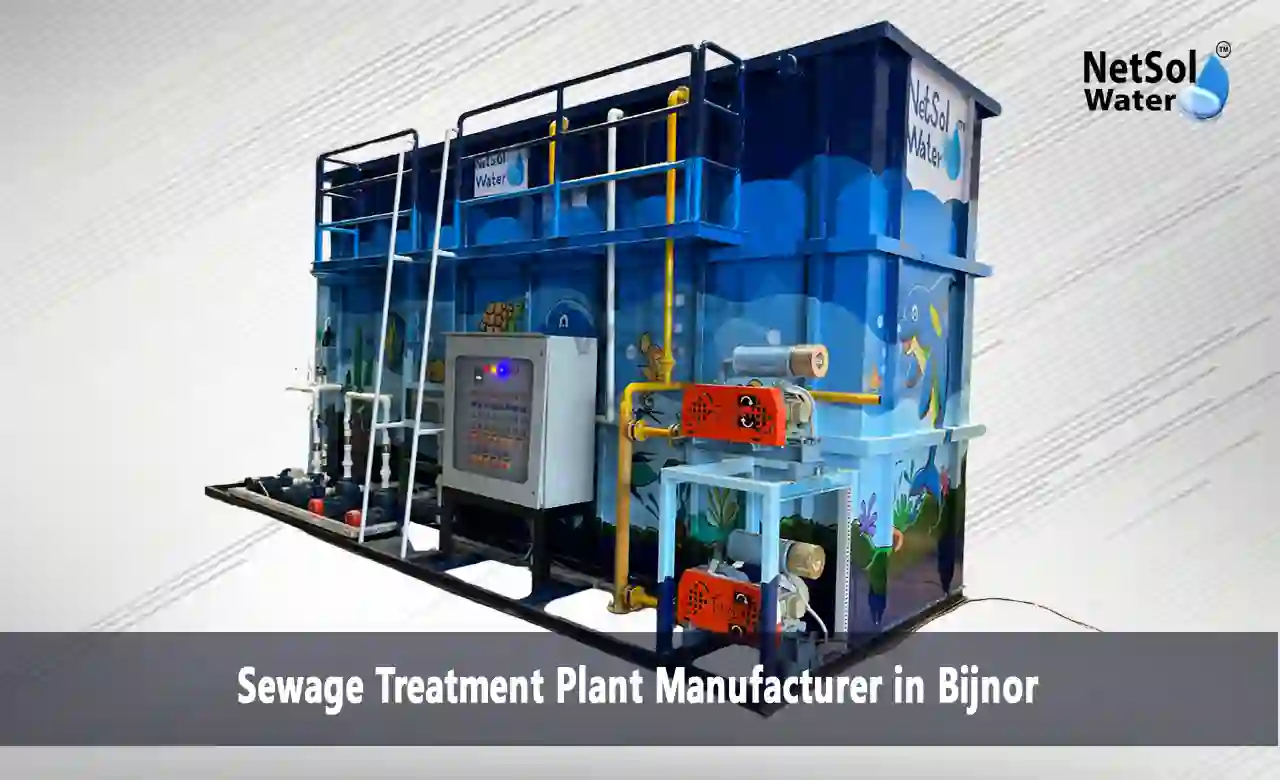
Sewage Treatment Plant Manufacturer in Bijnor
Every day, thousands of litres of untreated sewage flow out of housing colonies, hospitals, schools, and small industries across Bijnor - straight into drains and local water bodies. The result? Health risks, foul odour, and mounting pressure from the Uttar Pradesh Pollution Control Board (UPPCB).
If you're looking for a reliable sewage treatment plant manufacturer in Bijnor, you're already making the right move. The right STP doesn't just keep you compliant - it can also help you recycle treated water for flushing, gardening, or construction, cutting your freshwater costs significantly.
In this guide, we'll walk you through everything: how STPs work, which technologies suit different projects, what a plant will cost in 2025, and why Netsol Water has become the go-to STP manufacturer across Bijnor and Western Uttar Pradesh.
Why Sewage Treatment Is No Longer Optional in Bijnor?
Over the past three years, the National Green Tribunal (NGT) and UPPCB have significantly tightened discharge norms across Uttar Pradesh. Housing societies, commercial complexes, and industries with a wastewater generation above 10 KLD are now legally required to install a functional STP.
Beyond legal compliance, there's a practical case. Bijnor faces seasonal water stress, and treated water reuse can reduce dependency on borewells and municipal supply. For a 50-flat housing society, a properly working STP can generate 3,000–5,000 litres of reusable water daily.
• UPPCB mandates STP installation for projects generating 10 KLD+ of sewage
• Treated effluent must meet BOD < 10 mg/L and TSS < 10 mg/L for reuse
• Non-compliance can attract fines up to ?1 lakh/day and project shutdowns
• Reused treated water qualifies for reduced water cess under Environment (Protection) Act
About Netsol Water
Netsol Water is a specialized water and wastewater treatment company operating across North India. As a leading STP Manufacturer in Uttar Pradesh, they design, fabricate, supply, and install sewage treatment plants for a wide range of clients-from 10-unit hostels to large township projects.
What sets them apart is their end-to-end involvement. They don't just sell a plant - they study your site, design the right layout, handle UPPCB documentation, commission the plant, and train your operators. For facility managers who have no technical background, this matters enormously.
Key Credentials
• 200+ STP projects executed across Uttar Pradesh and nearby states
• Plants installed across residential, institutional, commercial, and industrial sectors
• In-house fabrication facility with quality-checked pumps, blowers, and control panels
• UPPCB-compliant designs with complete documentation support
• Post-installation AMC (Annual Maintenance Contracts) available
STP Technologies Offered - Which One Is Right for You?
Choosing the right technology is the single most important decision in your STP project. The wrong technology means higher running costs, operational headaches, and effluent quality failures. Here's a practical breakdown of what Netsol Water offers.
1. Package Compact STP (1 KLD – 10 KLD)
Best for: Small buildings, hostels, clinics, and standalone offices.
These are pre-fabricated, skid-mounted units that arrive nearly ready to install. Installation typically takes 3–5 days. They're compact, require minimal civil work, and are ideal when space is tight.
2. Modular STP - Sequential Batch Reactor (10 KLD – 50 KLD)
Best for: Housing colonies, schools, hotels, and mid-size commercial complexes.
Modular plants are flexible - you can start with one module and add more as your capacity needs grow. Sequential Batch Reactors (SBR) are highly efficient for varying loads, which is typical in residential projects where peak flows happen in the morning and evening.
3. MBBR (Moving Bed Biofilm Reactor) - 25 KLD to 500 KLD
Best for: Large residential complexes, industrial campuses, and municipal projects.
MBBR technology uses plastic media carriers inside the aeration tank. Bacteria form biofilms on these carriers, dramatically increasing the biological treatment surface area. MBBR systems handle load variations better than conventional activated sludge processes and require less land area.
4. Conventional Activated Sludge Process (ASP)
Best for: Municipal projects and larger industrial setups where land is not a constraint.
ASP is the time-tested biological treatment method. It's cost-effective at large scale but needs more operational attention. Netsol Water designs ASP systems for townships and cluster-level community STPs.
5. Tertiary Treatment + Reuse Systems
Best for: Any project where treated water will be reused for flushing, landscaping, or construction.
Tertiary units add sand filtration, activated carbon adsorption, and UV or chlorine disinfection after secondary treatment. The output water meets Class B reuse standards under IS 2490.
How a Sewage Treatment Plant Works - Step by Step
Understanding the treatment process helps you ask the right questions from your manufacturer and monitor plant performance confidently.
1. Preliminary Treatment (Screening & Grit Removal): Raw sewage first passes through bar screens that remove large solids like plastics, rags, and debris. A grit chamber then settles out sand and heavy particles that would otherwise damage pumps.
2. Primary Settling (Optional): In larger systems, a primary clarifier allows suspended organic solids to settle under gravity. This reduces the organic load on biological units.
3. Biological Treatment (Aerobic Process): This is the core of the STP. Microorganisms break down dissolved organic matter using oxygen supplied by blowers. MBBR and SBR systems do this especially efficiently.
4. Secondary Clarification: After biological treatment, the mixed liquor moves to a secondary clarifier where bacterial biomass settles. The clarified water moves forward; sludge is either recycled or sent to a sludge handling unit.
5. Sludge Dewatering: Settled sludge is thickened and dewatered using filter presses or drying beds. Dewatered sludge can be used as organic fertilizer or safely disposed of as per UPPCB guidelines.
6. Tertiary Polishing & Disinfection: For reuse applications, treated water passes through sand filters and UV units. This removes residual suspended solids and pathogens, making water safe for non-potable applications.
7. Online Monitoring & Control: Modern STPs from Netsol Water include control panels with flow meters, pH sensors, DO (dissolved oxygen) probes, and level indicators. Operators get a clear real-time view of plant health.
STP Capacity Range & Typical Applications
Choosing the right plant capacity is critical. Undersizing leads to effluent quality failures; oversizing inflates capital costs unnecessarily. Below is a quick reference guide.
|
Capacity (KLD) |
Typical Application |
Recommended Technology |
|
1 – 5 KLD |
Small hostel, clinic, standalone office |
Package Compact STP |
|
5 – 10 KLD |
Small apartment building (20–40 flats) |
Package STP / MBR |
|
10 – 25 KLD |
Group housing, medium hotel, school |
SBR / Modular STP |
|
25 – 50 KLD |
Large apartment complex, commercial building |
MBBR / SBR |
|
50 – 100 KLD |
Township, institutional campus, small town |
MBBR / Conventional ASP |
|
100+ KLD |
Municipal cluster, large industrial estate |
Conventional ASP / MBBR |
Rule of thumb: Calculate 90–120 litres per person per day (LPCD) for domestic sewage generation. Add 20% buffer for peak flow.
Sewage Treatment Plant Cost in Bijnor
STP pricing in Bijnor depends on capacity, technology type, automation level, and site-specific civil requirements. The prices below are indicative and include equipment, basic civil framework, electrical installation, and commissioning. Land cost and deep excavation are excluded.
|
Plant Capacity |
Approx. Cost (INR) |
Technology |
Civil Work Included |
|
5 KLD |
INR6,50,000 – INR7,50,000 |
Package STP |
Yes (basic) |
|
10 KLD |
INR8,50,000 – INR9,50,000 |
Package STP/SBR |
Yes |
|
25 KLD |
INR13,00,000 – INR18,00,000 |
SBR / MBBR |
Yes |
|
50 KLD |
INR30,00,000 – INR40,00,000 |
MBBR |
Yes |
|
100 KLD |
INR45,00,000 – INR65,00,000 |
MBBR / ASP |
Yes |
|
200 KLD |
INR85,00,000 – INR1,20,00,000 |
Conventional ASP |
Yes (partial) |
Prices are indicative for Bijnor region. Final cost depends on site survey, inlet quality, and discharge standards required. Request a site-specific quote from Netsol Water.
UPPCB Compliance & Regulatory Support
Getting your STP cleared by the Uttar Pradesh Pollution Control Board (UPPCB) is as important as installing the plant itself. Many projects face delays because their manufacturer didn't prepare the right documentation.
Netsol Water takes this off your plate entirely. Their team prepares the complete DPR (Detailed Project Report), process flow diagrams, equipment specs, and operation & maintenance manuals required for UPPCB consent applications.
Compliance Support Includes
• Preparation of DPR and process documentation for UPPCB submission
• Field testing and sampling during commissioning to generate compliance reports
• Guidance on sludge disposal protocols as per NGT directives
• Operator logbook formats and record-keeping systems for UPPCB audits
• Assistance with Consent to Establish (CTE) and Consent to Operate (CTO) applications
Applications - Where Sewage Treatment Plants Deliver Real Value
1. Residential Complexes & Apartment Buildings
For a 100-flat housing society generating 12,000–15,000 litres of sewage daily, a properly sized STP can produce treated water for toilet flushing (saving 6–8 KL/day), garden irrigation, and car washing - reducing freshwater demand by 30–40%.
2. Educational Institutions & Hospitals
Schools, colleges, and hospitals are high-usage, high-sensitivity environments. STPs here need redundancy (backup blowers, dual pumps) and consistent effluent quality. Netsol Water designs these systems with automated alarms and bypass arrangements to ensure zero operational disruptions.
3. Hotels & Commercial Complexes
Hotels in Bijnor increasingly use treated water for cooling towers, landscaping, and laundry pre-wash stages. This brings measurable cost savings while meeting UPPCB discharge norms - a dual business and compliance win.
4. Small Industries & Food Processing Units
Light industries generating mixed domestic and process wastewater benefit from MBBR-based combined ETP-STP systems. Netsol Water designs these hybrid systems to handle variable BOD/COD loads without operator fatigue.
5. Panchayats & Small Towns
Decentralized STPs for clusters of 500–5,000 people are gaining traction under the AMRUT 2.0 and Swachh Bharat Mission. Modular plants that can be phased over time offer the best value for gram panchayats and small urban bodies in Bijnor district.
Frequently Asked Questions
Q1. What is the cost of a sewage treatment plant in Bijnor?
The cost of a sewage treatment plant in Bijnor depends on capacity and technology. A 5 KLD package STP costs approximately ?6.5–7.5 lakh, while a 50 KLD MBBR plant costs ?19–21 lakh. Larger plants above 100 KLD are priced at ?28–32 lakh. These prices include equipment, basic civil work, and commissioning. Site-specific factors like inlet quality and discharge standards may affect the final quote.
Q2. Which sewage treatment plant technology is best for a housing society in Bijnor?
For housing societies in Bijnor generating 10–50 KLD of sewage, MBBR (Moving Bed Biofilm Reactor) or SBR (Sequential Batch Reactor) technology is most suitable. MBBR handles variable organic loads efficiently and requires less land area. SBR is ideal where treated water will be reused for flushing or gardening. Both technologies meet UPPCB discharge norms. Netsol Water recommends the right technology based on a free site assessment.
Q3. Is it mandatory to install a sewage treatment plant in Bijnor?
Yes. Under UPPCB regulations and NGT directives, any project in Uttar Pradesh generating more than 10 KLD of sewage must install a functional sewage treatment plant. This applies to housing societies, hospitals, hotels, schools, and industries. Non-compliance can lead to fines of up to ?1 lakh per day and project closure orders. Installing an STP also qualifies you for reduced water cess under environment protection rules.
Q4. How long does it take to install a sewage treatment plant in Bijnor?
Installation time depends on plant size and type. A package compact STP (up to 10 KLD) can be commissioned in 7–15 days. A modular MBBR or SBR system (25–100 KLD) typically takes 30–60 days including civil work, equipment erection, testing, and operator training. Netsol Water provides a project timeline at the quotation stage so clients can plan accordingly.
Q5. What is MBBR technology in sewage treatment?
MBBR stands for Moving Bed Biofilm Reactor. It is an advanced biological wastewater treatment process where bacteria grow on small plastic media carriers suspended in an aeration tank. These biofilms dramatically increase the active surface area for biological treatment, making MBBR systems more compact, more efficient, and more tolerant of load variations than conventional activated sludge processes. MBBR is widely used for mid to large-scale STP plants in India.
Q6. Can treated water from an STP be reused?
Yes. Treated water from a properly designed sewage treatment plant can be reused for toilet flushing, garden irrigation, car washing, construction, and cooling towers - provided the treatment includes a tertiary polishing stage with sand filtration and UV disinfection. The treated water must meet Class B reuse standards under IS 2490. For housing societies, water reuse from STP can reduce freshwater consumption by 30–40% per day.
Q7. What documents are required for UPPCB STP approval in Bijnor?
To obtain UPPCB Consent to Establish (CTE) and Consent to Operate (CTO) for an STP in Bijnor, you typically need: a Detailed Project Report (DPR), process flow diagram, equipment specifications, site layout plan, and an operation & maintenance manual. Netsol Water prepares all these documents as part of their project scope, significantly reducing the time and effort required for regulatory approvals.
Q8. How do I choose the right STP capacity for my project in Bijnor?
To calculate your STP capacity, multiply the number of persons by 90–120 litres per capita per day (LPCD). For example, a 200-person hostel would need a 18,000–24,000 litre/day (18–24 KLD) plant. Add 20% buffer for peak flow. Also consider future expansion. Netsol Water provides a free hydraulic load calculation as part of their initial site assessment, ensuring your plant is neither undersized nor oversized.
Ready to install your STP? Contact Netsol Water today for a site assessment and detailed quotation.
Phone: +91-9650608473 | Email: enquiry@netsolwater.com