

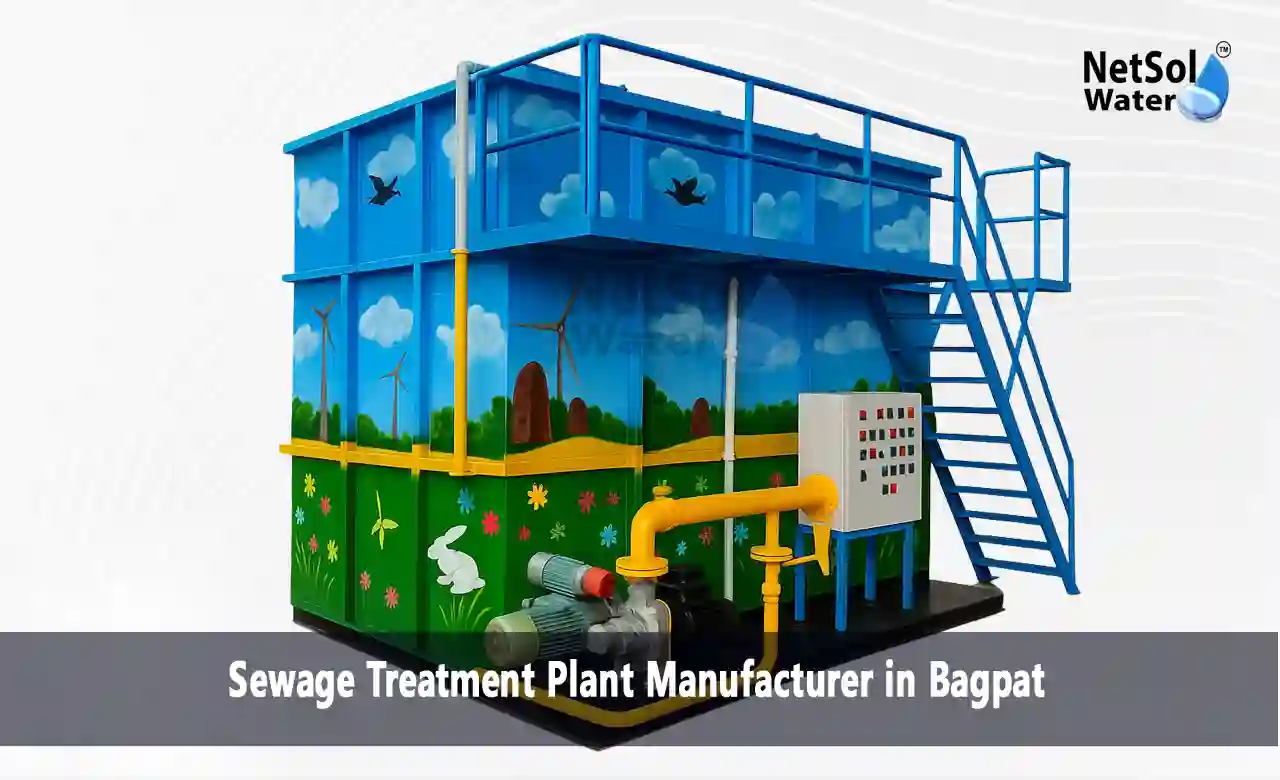
Sewage Treatment Plant Manufacturer in Bagpat
A significant portion of domestic sewage from residential colonies, housing societies, hospitals, hotels, and commercial buildings either goes into septic tanks that overflow during monsoon, flows into open drains that eventually reach agricultural land or water channels, or simply seeps untreated into the ground.
None of these outcomes are harmless. The district sits in the upper Ganga plains where groundwater is shallow and widely used. When untreated sewage moves into that groundwater, the effects ripple outward far beyond the property boundary. Families using borewells in nearby areas, farmers irrigating with contaminated canal water, and communities drawing water from open sources all end up paying the price for wastewater that was never properly treated.
This is the real reason why finding a reliable Sewage Treatment Plant Manufacturer in Bagpat matters. Not just as a regulatory checkbox, but as a practical responsibility that comes with building and operating any facility that generates sewage.
Bagpat's Sewage Reality: What the Situation Actually Looks Like
Bagpat is growing faster than its municipal wastewater infrastructure can keep up with. New residential colonies are coming up across the district. Apartment complexes, gated communities, hospitals, schools, and commercial complexes are being built at a pace that the existing drainage network was simply never designed to handle.
The Hindon river, which flows through parts of the region, has been under significant environmental stress for years due to untreated discharge from upstream urban and industrial areas. The National Green Tribunal has specifically targeted districts in the western UP belt, including those near the NCR, for stricter enforcement of wastewater discharge norms.
A few realities worth knowing:
. Housing societies with more than 20 residential units are required under UPPCB norms to have an operational on-site STP
. Hotels, hospitals, and commercial establishments beyond a defined daily wastewater threshold must treat sewage before discharge
. NGT orders covering Ganga and Hindon river basin protection directly apply to facilities in Bagpat
. Penalties for non-compliance include fines, legal notices, and in repeated cases, forced closure orders
The regulatory environment is not easing up. If anything, enforcement in NCR-adjacent districts has become noticeably more active over the last few years. Getting an STP installed properly now is considerably simpler and less disruptive than doing it under deadline pressure after a notice has already arrived.
What is a Sewage Treatment Plant and What Does it Actually Do?
A Sewage Treatment Plant is a system that takes domestic wastewater, the kind generated from bathrooms, kitchens, laundry, and washrooms in residential and commercial buildings, and cleans it through a structured multi-stage process until it is safe to discharge or reuse.
The output of a well-designed STP is treated water that meets CPCB and UPPCB discharge standards. That treated water is not drinking water, but it is clean enough for a wide range of reuse applications:
. Flushing toilets in the same building
. Watering gardens, lawns, and green areas
. Washing vehicles and common areas
. Cooling tower makeup water
. Construction activities nearby
For a large residential society or a hotel, this reuse potential is genuinely significant. A housing society of 200 flats generates roughly 40,000 to 60,000 litres of sewage per day. If 60 percent of that treated water gets reused for flushing and gardening, the society reduces its daily fresh water requirement by 24,000 to 36,000 litres. That translates to real monthly savings on water supply costs.
STP vs Septic Tank: Why One Simply Is Not Enough Anymore
This comparison comes up constantly in conversations with housing society managers and facility owners in smaller towns and semi-urban areas. Many properties have been running on septic tanks for years and the question is a fair one: if the septic tank is working, why spend money on an STP?
Here is an honest answer to that question.
A septic tank does one thing: it separates solids from liquid by allowing heavy material to settle at the bottom and lighter scum to float at the top. The clarified liquid in the middle, called effluent, flows out of the tank and into a soak pit or drain field where it is supposed to disperse into the soil.
The problem is that this effluent is not treated water. It still contains harmful bacteria, pathogens, dissolved organic matter, nitrates, and phosphates. In a low-density setting with adequate soil absorption area and no nearby groundwater vulnerability, a well-maintained septic system can function adequately for many years. But in a growing town like Bagpat, where:
. Properties are closer together and soil absorption is limited
. Groundwater tables are relatively shallow
. Multiple septic tanks in the same area collectively overwhelm the soil's natural filtering capacity
. Soak pits are often poorly constructed or too small for the actual wastewater load
The effluent does not disperse safely. It flows toward the nearest low point, which is usually a drain, an open channel, or a neighboring property's ground.
A sewage treatment plant, by contrast, actually treats the water through biological and physical processes, reducing BOD by over 90 percent, removing pathogens through disinfection, and producing output that is genuinely safe for reuse or discharge. It is not a more expensive version of a septic tank. It is a fundamentally different and far more effective solution.
How a Sewage Treatment Plant Works: Each Stage Explained
The treatment process follows a logical sequence where each stage prepares the water for the next. Here is how it works in a properly designed system:
Stage 1: Preliminary Treatment (Screening and Grit Removal)
Incoming sewage first passes through bar screens that physically remove large solids like rags, plastic pieces, and coarse debris. These would damage pumps and equipment in later stages if not removed first. Grit chambers then settle out sand, gravel, and small dense particles. This stage is unglamorous but essential.
Stage 2: Primary Sedimentation
The screened sewage flows into a primary clarifier or sedimentation tank where it is allowed to sit quietly. Heavy organic solids settle at the bottom as primary sludge. Lighter grease and scum float to the top and are skimmed off. The clarified liquid in the middle moves forward. This stage typically removes 50 to 60 percent of total suspended solids and about 30 percent of BOD from the incoming sewage.
Stage 3: Biological Treatment
This is the heart of the entire system and the stage that separates a properly engineered STP from a basic setup. Microorganisms, specifically bacteria, consume and break down dissolved organic matter in the wastewater. The right biological technology for your project depends on your sewage volume, available space, and performance requirements:
1. MBBR (Moving Bed Biofilm Reactor)
Bacteria grow on small plastic carrier media that float freely in aerated tanks. The carriers provide a large surface area for biofilm growth, making the process very space-efficient. MBBR is a strong choice for projects with limited space, fluctuating sewage loads, and where plant expansion may be needed later without major civil reconstruction.
2. SBR (Sequential Batch Reactor)
Treatment happens in timed cycles within the same tank: fill, react, settle, and decant. SBR systems are flexible and handle varying daily flow rates well, which makes them popular for residential societies and hotels where sewage generation is not constant throughout the day.
3. MBR (Membrane Bioreactor)
This combines biological treatment with membrane filtration in a single stage. The membranes filter out suspended solids and bacteria physically while the biological process runs simultaneously. MBR produces the highest quality treated water output among all STP technologies and is ideal when the treated water will be reused within the building. It requires more careful operation and has higher membrane replacement costs but delivers output that consistently meets the strictest discharge standards.
4. Extended Aeration ASP (Activated Sludge Process)
A proven and widely used method where sewage is continuously aerated in a tank with active sludge containing microorganisms. It is well understood, relatively simple to operate, and works reliably for mid to large scale municipal and institutional applications.
Stage 4: Secondary Clarification
After biological treatment, the water moves to a secondary settling tank where biological sludge settles out and is separated. A portion of this sludge is recycled back to the biological stage to maintain the active microbial population. The rest is sent to sludge handling.
Stage 5: Tertiary Filtration and Disinfection
The biologically treated water passes through sand filters and activated carbon filters to remove remaining fine particles and any residual colour or odour. It is then disinfected using UV lamps or chlorine dosing to destroy remaining pathogens. The output at this stage meets CPCB Class B treated water standards and is ready for reuse or discharge.
How Much Water Can Your STP Actually Save Every Month?
This is a section most STP pages skip, but it is one of the most practically useful things to understand before making a decision.
Let us work through a real example. Take a residential society of 150 flats in Bagpat, with an average occupancy of 3.5 people per flat. That is 525 residents generating approximately 90 to 100 litres of sewage per person per day. Daily sewage load: roughly 47,000 to 52,000 litres, which is approximately a 50 KLD plant.
A properly operating 50 KLD STP will recover around 80 to 85 percent of that as treated water, so approximately 40,000 to 42,000 litres of treated water per day.
Now consider where that treated water goes:
Toilet flushing typically accounts for 30 to 35 percent of a residential building's total water use
Garden and common area irrigation in a medium-sized society uses 5,000 to 8,000 litres per day
Vehicle washing and common area cleaning: 2,000 to 3,000 litres per day
If the society reuses treated water for flushing and gardening, it replaces roughly 20,000 to 25,000 litres of fresh water supply per day. At a water cost of Rs. 30 to 50 per kilolitre from tankers or municipal supply, that works out to Rs. 600 to Rs. 1,250 saved per day, or Rs. 18,000 to Rs. 37,500 per month. Over a year, that is Rs. 2.1 lakh to Rs. 4.5 lakh in water savings for a single mid-sized housing society.
The STP pays for itself. The timeline varies by plant size and local water costs but for most residential projects the payback period sits between 3 and 6 years on water savings alone, before accounting for avoided penalty costs.
How Long Does STP Installation Take in Bagpat?
Week 1: Site Assessment and Wastewater Characterization
We visit your site, measure available space, understand the nature and volume of sewage generated, and collect samples for laboratory testing. BOD, COD, TSS, TDS, pH, and flow rate data are gathered. This is not optional. The entire design depends on what the actual wastewater looks like.
Week 2: System Design and Proposal
Based on test data and site conditions, we prepare the process design, equipment selection, civil layout, and electrical plan. You receive a clear proposal with technology recommendation and rationale.
Week 3: Civil Construction
Tanks, chambers, and equipment bases are constructed on-site. This is typically the longest phase. For a 25 to 100 KLD plant, civil work takes 3 to 5 weeks depending on soil conditions, monsoon timing, and contractor availability.
Week 4: Equipment Installation
Blowers, pumps, MBBR media or SBR decanting systems, filter units, UV systems, and control panels are installed and connected.
Week 5: Commissioning and Biological Startup
The plant is started with actual sewage. Biological systems take 2 to 4 weeks to seed properly and reach stable treatment performance. This phase cannot be rushed. A biological system that has not been given adequate startup time will underperform for months.
Week 7: Performance Verification and Handover
Output water quality is tested against UPPCB standards. Parameters are verified, operator training is completed, and the plant is formally handed over with operating documentation.
Total Timeline: 5 to 7 weeks for most standard projects
MBR systems or larger capacity plants take 14 to 20 weeks. Projects that begin during heavy monsoon may face civil work delays.
About Netsol Water
We are Netsol Water, an ISO certified company and one of India's recognized names in water and wastewater treatment. Known across the country as a trusted RO Plant Manufacturer and Supplier, we bring the same engineering discipline and quality standards to every Sewage Treatment Plant we design and build.
As an established Sewage Treatment Plant Manufacturer in Bagpat and across Uttar Pradesh, we have delivered STP projects for housing societies, hospitals, hotels, educational institutions, and commercial complexes across the region. We understand the local regulatory environment, the specific challenges of the western UP groundwater zone, and what it takes to build a system that holds up reliably over years of operation.
Here is what working with us actually looks like:
. We test your sewage before designing anything. BOD, COD, TSS, flow rate, all of it gets measured so the system is built around your real numbers
. We recommend the right technology for your project, whether that is MBBR, SBR, or MBR, based on your space, budget, and output quality requirements
. We deliver complete turnkey projects: site assessment, process design, civil coordination, equipment manufacturing, installation, commissioning, and operator training
. Every plant we commission is designed to meet CPCB and UPPCB discharge norms with lab-verified output quality
. We offer Annual Maintenance Contracts and stay genuinely involved through the operational life of the plant
Our capacity range runs from 10 KLD compact systems for small residential buildings all the way to 1000 KLD and above for large townships and institutional campuses
We have seen what poorly built STPs look like two years after installation. We have been called in to fix or replace systems that were never designed properly from the start. We would rather not be that second call. Our goal is to build it right the first time and stay available to make sure it keeps working.
Conclusion:
Every month that passes without a proper sewage treatment system in place is a month of untreated wastewater going somewhere it should not. It is also a month of regulatory risk, groundwater contamination contribution, and missed water recycling savings.
Bagpat is growing. The regulatory environment around this growth is tightening. And the cost of getting an STP installed properly now is always lower than the cost of installing one under pressure, with penalties already on the table and a compliance deadline running down.
If you are a housing society, hospital, hotel, school, or commercial facility in Bagpat looking for a dependable Sewage Treatment Plant Manufacturer in Bagpat, we are ready to help you get this done properly.
Reach out to our team today. Share your project details and daily sewage volume estimate if you have one, and we will come back to you with an honest assessment, a clear technology recommendation, and a transparent project proposal. No vague quotes, no generic systems, and no disappearing after the sale.