

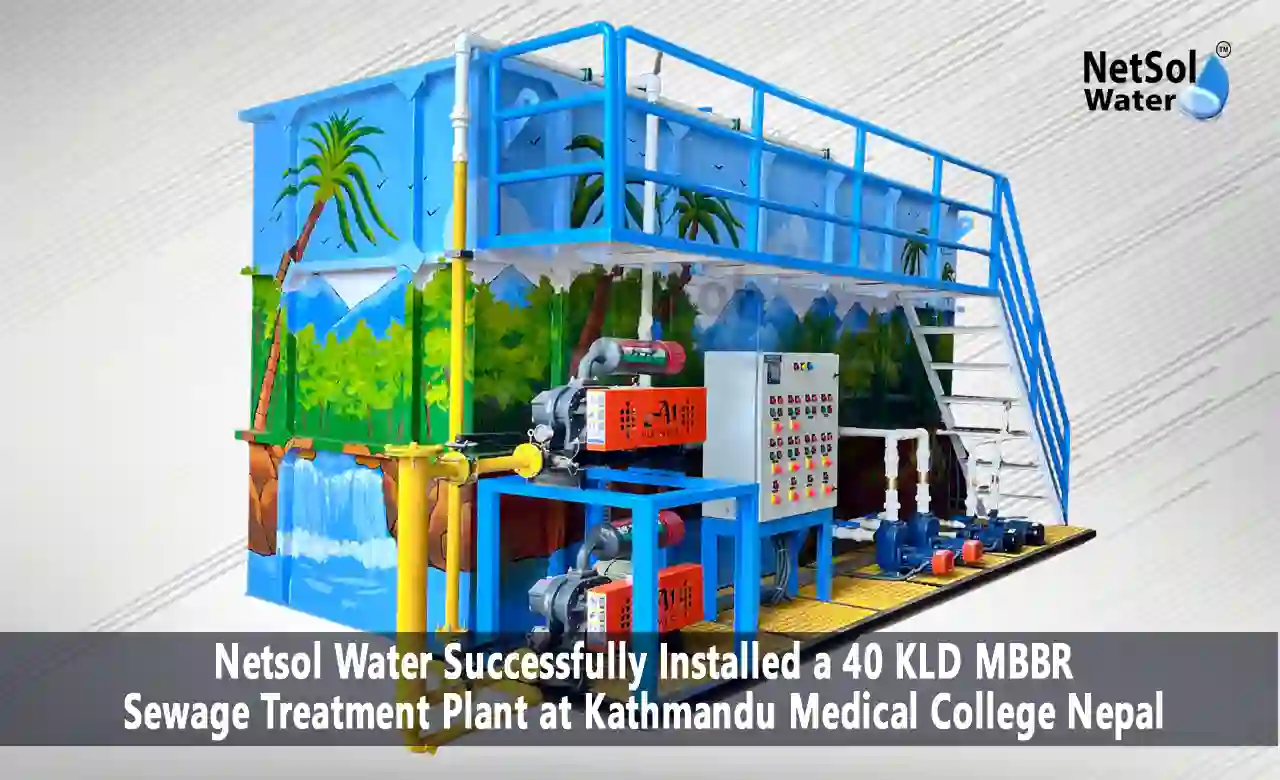
Case Study: 40 KLD MBBR STP Plant for KMC College, Kathmandu, Nepal
Project Summary
| Client Name | Kathmandu Medical College (KMC), Nepal |
| Location | Kathmandu, Nepal |
| Project Type | Sewage Treatment Plant (STP) |
| Treatment Capacity | 40 KLD (Kiloliters per Day) |
| Core Technology | Moving Bed Biofilm Reactor (MBBR) |
| Application | Hospital Wastewater Treatment |
| Treated Water Reuse | Horticulture / Gardening & Toilet Flushing |
| Compliance Standard | Nepal EPA Effluent Discharge Standards |
Project Overview
Hospitals are among the heaviest water users in any city - and, unfortunately, among the biggest sources of hazardous wastewater. Kathmandu Medical College (KMC), one of Nepal's most respected medical institutions, found itself at a crossroads: how do you responsibly manage the enormous volume of sewage a busy hospital campus produces every single day, without putting public health or the surrounding environment at risk?
That question led KMC to partner with an experienced sewage treatment plant manufacturer in Kathmandu to design and install a custom-built 40 KLD Sewage Treatment Plant (STP) powered by Moving Bed Biofilm Reactor (MBBR) technology. What started as an urgent environmental and compliance problem became something much more meaningful - a working model of sustainable water management that now serves the campus every day.
This case study walks you through the challenge KMC faced, how the solution was engineered by Netsol Water, and the real-world results it's delivering on the ground.
The Problem
Untreated Hospital Sewage Was a Ticking Time Bomb
Before the STP was installed, KMC was discharging raw hospital sewage directly into the municipal drainage network - with little to no pre-treatment. It's a practice that, regrettably, was common across many healthcare campuses in South Asia. But the risks it carried were anything but ordinary:
• Dangerously high BOD and COD levels: Hospital wastewater is far more polluted than typical domestic sewage. The raw effluent from KMC far exceeded Nepal's permissible discharge limits under the Environment Protection Act.
• A cocktail of pathogens: The wastewater contained pharmaceuticals, disinfectants, blood, and clinical waste - a direct pathway for waterborne disease to spread into surrounding neighbourhoods.
• Odour and suspended solids: Untreated sewage created significant nuisance odour and high TSS levels, affecting both the campus environment and nearby residential areas.
• Zero water recovery: Every litre of wastewater that could have been cleaned and reused was instead lost - a serious problem in a city already facing freshwater stress.
• Growing regulatory risk: Tightening enforcement of environmental discharge standards meant KMC was increasingly exposed to penalties, operational restrictions, and reputational damage.
The Challenges
Building a Treatment Plant Inside a Live Hospital - Not as Simple as It Sounds
Designing and commissioning a wastewater treatment system within an active medical campus is genuinely difficult. There's no room for disruption, no downtime tolerance, and no margin for error. Here's what the engineering team had to navigate:
• Tight space, no flexibility: Hospital campuses have little spare land. The STP had to be compact enough to fit without displacing existing infrastructure or encroaching on patient areas.
• Around-the-clock, unpredictable flow: Unlike industrial plants, hospital wastewater doesn't follow a predictable schedule. Volume and composition shift constantly - across shifts, procedures, and emergencies. The system had to handle that variability without faltering.
• Complex, mixed wastewater: The effluent isn't just domestic sewage. It's a mix of clinical waste, kitchen runoff, disinfectants, pharmaceuticals, and heavy organics - all arriving together, all needing treatment.
• Day-one compliance: There was no grace period. The system had to meet Nepal EPA standards for BOD, COD, TSS, pH, and faecal coliforms from the moment it went live.
• Minimal maintenance burden: A hospital's maintenance team can't dedicate significant time to running a wastewater plant. The system had to be largely self-managing.
• Working around existing infrastructure: Gravity-fed sewage lines, drainage corridors, and utility layouts all had to be factored in - without interrupting any campus services during construction.
The Solution
A Purpose-Built 40 KLD MBBR Sewage Treatment Plant
After a detailed site assessment, wastewater characterisation, and hydraulic load analysis, Netsol Water, a leading Sewage Treatment Plant Manufacturer and Supplier in Kathmandu, Nepal, designed a 40 KLD STP built around Moving Bed Biofilm Reactor (MBBR) technology - one of the most effective biological treatment processes available for complex, variable wastewater streams like hospital effluent.
Here's the core idea behind MBBR: thousands of small HDPE plastic carriers are suspended inside the aeration tank, moving freely through the wastewater. Beneficial bacteria colonise the protected inner surfaces of these carriers, forming dense biofilms that break down organic pollutants at a much faster rate than conventional activated sludge systems - and in a fraction of the space.
The result is a compact, high-performance treatment system that punches well above its weight - delivering consistently high-quality treated water while fitting neatly into the constrained footprint of an active hospital campus.
Technical Specifications
| Treatment Capacity | 40 KLD (40,000 Litres per Day) |
| Core Technology | Moving Bed Biofilm Reactor (MBBR) |
| Application | Hospital / Healthcare Wastewater Treatment |
| Inlet BOD | 250–350 mg/L (Typical Hospital Sewage) |
| Outlet BOD Target | < 30 mg/L (Nepal EPA Discharge Standard) |
| Aeration System | Fine Bubble Diffused Aeration |
| Media Type | HDPE MBBR Biofilm Carriers (K-series / Equivalent) |
| Disinfection | Chlorination / UV Disinfection Unit |
| Sludge Handling | Sludge Drying Beds / Filter Press |
| Power Requirement | Approx. 3–5 kW (Energy Efficient Operation) |
| Treated Water Reuse | Gardening / Landscaping & Toilet Flushing |
| Construction Type | Civil RCC Underground / Semi-underground Unit |
| Automation | PLC-based Auto Control with Manual Override |
Treatment Process
How the System Cleans Hospital Sewage - Step by Step
The 40 KLD MBBR STP at KMC by Netsol Water works through a carefully sequenced, multi-stage treatment process. Each stage builds on the last, progressively removing contaminants until the treated water is clean enough for safe reuse.
Stage 1: Screening & Primary Treatment
Raw sewage first passes through mechanical bar screens and fine mesh screens to strip out large debris - rags, plastics, wipes, and grit. This physical pre-treatment step is straightforward but critical: it protects every piece of downstream equipment and reduces the suspended solids load before any biological treatment begins.
Stage 2: Equalisation Tank
Hospital wastewater doesn't arrive at a steady, predictable rate. The equalisation tank acts as a buffer, smoothing out the peaks and troughs in flow and concentration before the wastewater enters the biological treatment stage. Coarse aeration keeps the contents mixed and prevents septicity. The result: a consistent, controlled feed to the MBBR - which is exactly what the biology needs to perform at its best.
Stage 3: MBBR Biological Treatment (The Heart of the System)
This is where the real work happens. Inside the MBBR reactor tank, thousands of HDPE biofilm carriers tumble continuously through the aeration zone, driven by fine-bubble diffusers. Aerobic bacteria colonise the protected inner surfaces of these carriers, breaking down dissolved BOD and COD at impressive rates. Because the biomass stays attached to the carriers - not suspended in the water - there's no sludge return required, and the system remains stable and self-regulating even as conditions fluctuate.
Stage 4: Secondary Clarification
Biologically treated effluent flows into a secondary clarifier, where a tube settler or lamella plate design separates residual biological solids from the clean water through gravity. Clear, low-TSS effluent rises and overflows to the next stage; settled sludge is drawn off for dewatering on drying beds.
Stage 5: Filtration & Disinfection
Clarified effluent passes through a sand-anthracite multimedia filter for a final polish - removing residual turbidity and fine suspended matter. It then enters the disinfection stage, where sodium hypochlorite dosing eliminates any remaining pathogens, faecal coliforms, and viruses. At this point, the treated water is safe for landscape irrigation and toilet flushing.
Stage 6: Treated Water Storage & Reuse
Disinfected water collects in a dedicated clear water sump. From there, it's pumped back into the campus for two reuse applications: irrigating the gardens, lawns, and landscaped areas across the KMC campus, and supplying toilet flushing water throughout the hospital building. Every litre reused is a litre saved from the municipal freshwater supply.
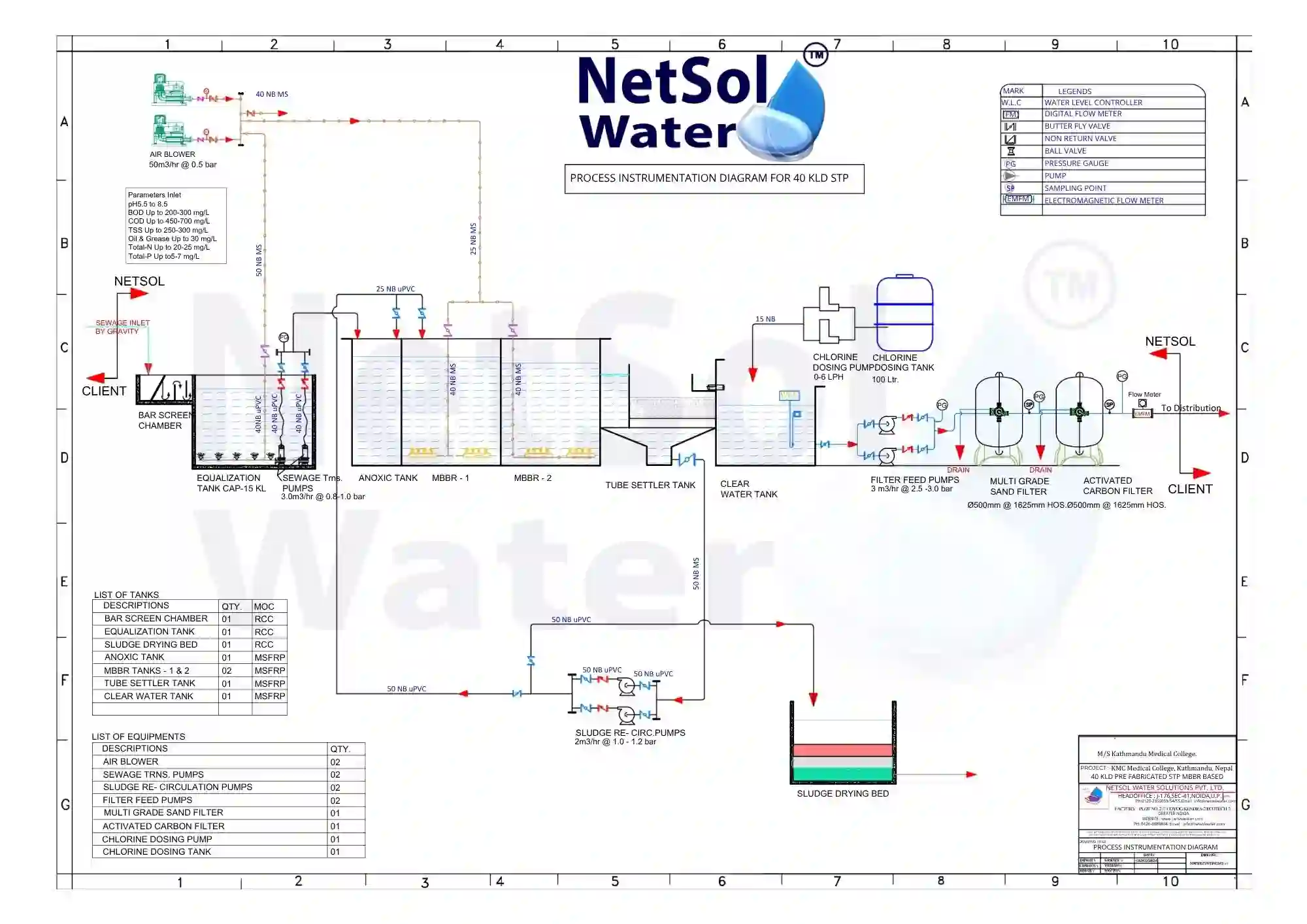
Figure: Process Instrumentation Diagram of STP by Netsol Water
Results & Performance
The Numbers Speak for Themselves
The 40 KLD MBBR STP consistently delivers treated effluent that meets - and in most parameters, comfortably exceeds - Nepal EPA discharge standards, demonstrating the engineering effectiveness of Netsol Water:
| Parameter | Unit | Before Treatment | After Treatment | % Reduction |
|---|---|---|---|---|
| BOD (Biochemical Oxygen Demand) | mg/L | 250–350 | < 30 | 90–95% |
| COD (Chemical Oxygen Demand) | mg/L | 400–600 | < 100 | 80–85% |
| Total Suspended Solids (TSS) | mg/L | 200–300 | < 30 | 88–93% |
| Total Dissolved Solids (TDS) | mg/L | 700–900 | < 500 | 40–50% |
| pH | – | 6.5–8.5 | 6.5–8.0 | Neutral ? |
| Faecal Coliform | MPN/100 mL | > 10,000 | < 100 | > 99% |
* All outlet values comply with Nepal EPA Effluent Discharge Standards for hospital wastewater.
Completed Project Video
Watch the successfully completed 40 KLD MBBR Sewage Treatment Plant installed by Netsol Water at Kathmandu Medical College, Nepal. This video showcases the final setup, plant operation, and treated water output.
Client Benefits
What This Means for Kathmandu Medical College?
• Full regulatory compliance: KMC now meets all Nepal EPA environmental discharge standards - no more exposure to penalties, fines, or operational suspensions.
• Real water cost savings: Treated water reuse for gardening and toilet flushing directly reduces KMC's dependence on municipal freshwater supply. As water tariffs increase, those savings grow.
• A cleaner environment around campus: Eliminating untreated sewage discharge protects local groundwater, nearby water bodies, and the communities surrounding the college.
• Low operational burden: The MBBR system's automated PLC controls and self-regulating biofilm process require minimal day-to-day operator attention - a practical fit for a hospital's existing team.
• Stronger institutional reputation: Active environmental stewardship isn't just the right thing to do - it matters for accreditations, partnerships, and how patients and staff perceive the institution.
• Room to grow: The modular MBBR architecture means capacity can be expanded as KMC grows, without major civil or mechanical disruption to the existing plant.
• A healthier campus environment: Effective sewage containment and treatment eliminates odour nuisance, creating a cleaner and more hygienic space for patients, visitors, and staff.
Conclusion
Turning a Wastewater Problem Into a Sustainability Asset
The 40 KLD MBBR Sewage Treatment Plant at Kathmandu Medical College, designed and installed by Netsol Water, is more than a compliance solution. It's proof that with the right engineering approach, a hospital's biggest environmental liability can become a genuine long-term asset - saving water, cutting costs, protecting public health, and demonstrating the kind of environmental responsibility that defines a leading institution.
As regulatory pressure intensifies and water scarcity becomes a more pressing reality across South Asia, the KMC model offers a clear, replicable blueprint for healthcare facilities of all sizes. The technology is proven, the results are measurable, and the benefits compound over time.
If your hospital or healthcare campus is facing similar wastewater challenges, the KMC experience shows what's possible - and what a well-engineered STP can deliver when the brief is taken seriously from day one.
Planning a Hospital Wastewater Treatment Project?
We design, manufacture, and commission custom STP solutions for healthcare, commercial, industrial, and municipal clients across South Asia.
Contact our STP experts today for a free site assessment and customised proposal.