

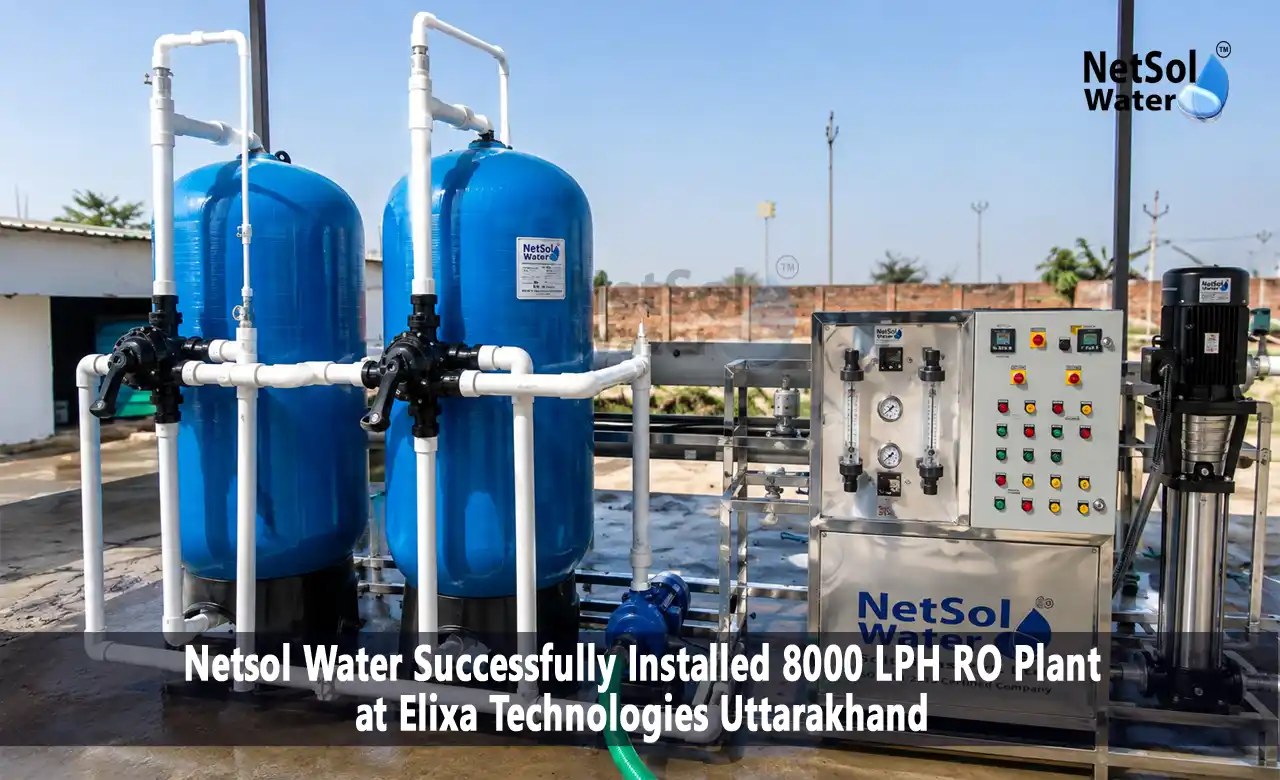
Case Study: Installed 8000 LPH RO Plant at Elixa Technologies, Uttarakhand
Netsol Water designed, installed and commissioned an 8000 LPH RO Plant at Elixa Technologies in Uttarakhand. The project was undertaken to give the client a dependable source of treated water at a capacity suited to its daily operational needs.
The installation is a Reverse Osmosis based water treatment system, engineered to reduce dissolved solids and impurities from raw water and deliver consistent, good quality treated water. The scope of work covered system design, supply of equipment, on-site installation, piping and electrical integration, testing and final commissioning.
As the executing partner, Netsol Water's role covered the complete project lifecycle, from initial requirement assessment to handover of a functioning 8000 LPH RO Plant ready for daily operation.
About Elixa Technologies
Elixa Technologies is the client for this project, based in Uttarakhand. The facility required a higher capacity water treatment system to support its day-to-day water usage. Elixa Technologies is a technology-driven cleantech company serving industrial applications, with solutions focused on water management, process efficiency and wastewater treatment. The company has worked with industries where efficient water use and wastewater management are important operational requirements.
Reliable treated water matters for any facility that depends on consistent water quality for its daily functioning, whether for process use, utility use or general facility requirements. For Elixa Technologies, having a plant capable of producing 8000 litres of treated water per hour was central to meeting that requirement without interruption.
Client's Water Treatment Requirement
Before the project, Elixa Technologies needed a water treatment system that could match its operational water demand while delivering water of consistent quality. The requirement can be summarized as follows:
. Required water capacity: a treatment system capable of producing approximately 8000 litres of treated water per hour.
. Water quality requirement: reduction of dissolved solids and impurities to a level suitable for the client's intended use.
. Raw water source: borewell Water.
. Intended use of treated water: process use, utility use, general facility use.
. Consistent water quality: the client needed treated water output that did not fluctuate significantly with changes in raw water condition.
. Operational requirements: a system that could run reliably on a daily basis with manageable monitoring and maintenance needs.
Given this combination of capacity and consistency requirements, an 8000 LPH RO Plant was identified as the appropriate scale of system for the facility's daily water demand.
Challenges Before RO Plant Installation
Every water treatment project begins with an assessment of the raw water condition and site constraints. For this project, the challenges considered during planning included:
. Raw water quality: High TDS.
. Requirement for consistent treated water output despite possible variation in raw water quality over time.
. Need for a system sized correctly for the facility's actual water demand, avoiding both under-capacity and unnecessary over-sizing.
. Space and layout considerations for equipment placement within the available site area.
. Operational requirement for a system that the client's team could monitor and run without complex intervention.
Only the challenges confirmed as part of the project scope are listed here. Where specific raw water quality data such as TDS or hardness values has not been documented for this site, it should be added from the actual project or laboratory records before publishing.
Proposed 8000 LPH RO Plant Solution
To meet Elixa Technologies' requirement, Netsol Water proposed a complete 8000 LPH RO Plant solution built around the following stages:
. RO capacity: a system rated for 8000 litres per hour, sized to match the client's daily water demand.
. Pretreatment: removal of suspended solids and larger impurities before the water reaches the RO membranes, which protects the membranes from fouling and extends their working life.
. Cartridge filtration: fine filtration stage that removes finer particulate matter that pretreatment filters may not capture, safeguarding the high-pressure pump and membranes.
. High-pressure pumping: generates the pressure needed to push water through the semi-permeable RO membranes.
. RO membrane system: the core treatment stage where dissolved salts and impurities are separated from the water, producing purified permeate.
. Control and monitoring: instrumentation and control panel to track flow, pressure and system performance during operation.
. Treated water storage: a storage tank to hold treated water for the client's use as required.
. Reject water management: a defined path for the RO reject stream so it can be discharged or reused as per site requirements.
Each of these stages plays a specific role. Skipping or under-sizing pretreatment, for example, tends to shorten membrane life, while inadequate monitoring makes it harder to catch performance drift early. The system for Elixa Technologies was configured to address these considerations at the 8000 LPH scale.
RO Plant Process Flow
The treatment process at Elixa Technologies follows a standard RO sequence, adapted to the 8000 LPH capacity of the plant:
Raw Water
↓
Pretreatment
↓
Fine Filtration
↓
High-Pressure Pump
↓
RO Membrane System
↓
RO Permeate
↓
Treated Water Storage
Pretreatment: raw water first passes through stages such as sand filtration to remove suspended solids and, where required, activated carbon filtration to reduce chlorine and organic matter.
Why filtration is required before RO: RO membranes are sensitive to particulate matter and certain chemicals. Filtering the water beforehand prevents premature fouling and damage to the membranes.
Role of the high-pressure pump: it supplies the pressure needed to push water across the RO membrane surface, overcoming the natural osmotic pressure of the dissolved salts.
How RO membranes remove dissolved impurities: the semi-permeable membrane allows water molecules to pass through while blocking a large proportion of dissolved salts, minerals and other impurities.
Permeate versus reject: permeate is the purified water that has passed through the membrane, while reject is the concentrated stream that carries the separated salts and impurities away from the system.
This sequence reflects the general configuration used for the project. The exact pretreatment stages and instrumentation should be confirmed against the actual site drawings and equipment list before publishing.
Major Components of the 8000 LPH RO Plant
The table below summarizes the primary components typically used in a plant of this type and their function within the system. Confirm against the actual bill of materials for this project before publishing.
| Component | Function |
|---|---|
| Raw Water Pump | Draws raw water from the source and feeds it into the pretreatment stage. |
| Pressure Sand Filter | Removes suspended solids, turbidity and larger particulate matter from raw water. |
| Activated Carbon Filter | Reduces chlorine, odour and organic impurities before water reaches the membranes. |
| Cartridge Filter | Provides fine filtration to protect the high-pressure pump and RO membranes from fine particles. |
| High-Pressure Pump | Generates the pressure required to push water through the RO membranes. |
| RO Membranes | Separate dissolved salts and impurities from water, producing purified permeate. |
| Control Panel | Operates and monitors the plant, including pump control and system interlocks. |
| Flow and Pressure Instruments | Measure flow rate and system pressure at key points for performance monitoring. |
| Treated Water Tank | Stores RO treated water for the client's use. |
| Reject System | Manages and directs the RO reject or concentrate stream away from the treated water line. |
Installation and Commissioning
The installation followed a structured project sequence, typical of an RO plant of this capacity:
1.Site preparation: clearing and preparing the installation area at the Elixa Technologies facility for equipment placement.
2.Equipment placement: positioning the pretreatment units, pumps, membrane housings and storage tank at their designated locations.
3.Piping: connecting raw water intake, inter-stage piping, permeate lines and reject lines.
4.Electrical connections: wiring pumps, the control panel and associated instrumentation to the facility's power supply.
5.Instrumentation: installing flow meters, pressure gauges and other monitoring instruments at key points in the system.
6.Membrane installation: fitting the RO membrane elements into their housings as per the design configuration.
7.System testing: checking piping integrity, electrical connections and instrumentation readings before startup.
8.Trial operation: running the plant under supervision to verify flow rates, pressure and treated water output.
9.Commissioning: handing over the plant to Elixa Technologies for regular operation after successful trial runs.
Project Installation Video
Watch the 8000 LPH RO Plant Installation at Elixa Technologies
The video below gives a visual overview of the installation at Elixa Technologies, including the equipment arrangement and the general site execution of the project. It is intended to complement the written details covered in this case study.
Technical Specifications
| Parameter | Project Details |
|---|---|
| Client | Elixa Technologies |
| Location | Uttarakhand |
| Plant Type | RO Plant |
| Capacity | 8000 LPH |
| Technology | Reverse Osmosis |
| Raw Water Source | Borewell Water |
| Raw Water TDS | 2800 |
| Product Water TDS | 80 |
| Recovery | 70% |
| RO Membranes | LG |
| Application | Used in process |
| Installation | Netsol Water |
Performance After Installation
Following commissioning, the 8000 LPH RO Plant has been operating at the Elixa Technologies facility to meet the client's daily treated water requirement. Specific measured figures for treated water production, TDS reduction, recovery percentage and operational uptime should be sourced from the plant's actual performance logs and inserted here.
. Treated water production: 8,000 litres per hour (8 m³/hr)
. TDS reduction: 97% TDS reduction
. Product water quality: 80 mg/L TDS
. Recovery: 70% to 75% recovery
Where actual performance data has not yet been recorded or shared, this section should be updated only once verified figures are available, rather than populated with assumed numbers.
Water Quality Before and After Treatment
Values in the table below must be taken from actual laboratory reports or project records for this installation. Placeholder cells should not be filled with assumed figures.
| Parameter | Raw Water | RO Treated Water |
|---|---|---|
| TDS | 2800 | 80 |
| pH | 18 | 6 |
| Hardness | 600 | 90 |
| Chloride | 850 | 25 |
| Sulphate | 350 | 15 |
| Conductivity | 4200 | 120 |
Benefits of the 8000 LPH RO Plant
. A reliable, in-house source of treated water sized to the facility's daily requirement.
. More consistent water quality compared to relying on raw water alone.
. Reduction of dissolved impurities through the RO membrane stage.
. Treatment capacity suited to the client's actual water demand, avoiding under-capacity issues.
. Better operational control through dedicated instrumentation and a control panel.
. More efficient day-to-day water treatment, supported by a defined pretreatment and filtration sequence.
. Easier monitoring and maintenance through clearly identified system stages and instrumentation.
Why Netsol Water Was Selected
Netsol Water Solutions Pvt. Ltd. was engaged for this project based on its experience in designing and delivering water treatment systems for commercial and industrial clients. Relevant capabilities include:
. Water treatment engineering experience across RO plants of varying capacities.
. In-house RO plant design and manufacturing.
. End-to-end installation and commissioning support, from planning through handover.
. Site-specific system design, adapting plant configuration to the client's raw water and space conditions.
. After-sales support for the operating plant.
. AMC (Annual Maintenance Contract) and maintenance support to help clients sustain performance over time.
Project Outcome
Elixa Technologies required a dependable water treatment system capable of supporting its daily operations. Netsol Water addressed this by designing, installing and commissioning an 8000 LPH RO Plant using Reverse Osmosis technology, matched to the client's capacity and quality requirements.
The project moved from requirement assessment through equipment installation, testing and trial operation to final commissioning. The practical outcome is a functioning RO system intended to give Elixa Technologies a consistent, in-house source of treated water for its facility in Uttarakhand.
Frequently Asked Questions (FAQs)
1. What is the capacity of the RO plant installed at Elixa Technologies?
Netsol Water installed an 8000 LPH RO Plant at Elixa Technologies, which means the system is designed to produce 8000 litres of treated water per hour under standard operating conditions.
2. Where was the 8000 LPH RO plant installed?
The plant was installed at the Elixa Technologies facility in Uttarakhand, as part of the client's requirement for a dependable, higher-capacity water treatment source.
3. What does 8000 LPH mean in an RO plant?
LPH stands for Litres Per Hour. An 8000 LPH RO plant is rated to treat and deliver 8000 litres of RO purified water every hour, making it suitable for facilities with moderate to high daily water demand.
4. How does an 8000 LPH RO plant work?
Raw water first passes through pretreatment and fine filtration stages to remove suspended solids, chlorine and other impurities. A high-pressure pump then forces the pretreated water through semi-permeable RO membranes, which separate dissolved salts and impurities from the water, producing purified permeate and a concentrated reject stream.
5. What are the major components of an 8000 LPH RO plant?
Typical components include a raw water pump, pressure sand filter, activated carbon filter, cartridge filter, high-pressure pump, RO membranes, a control panel with flow and pressure instruments, a treated water storage tank and a reject water management system.
6. What factors should be considered before installing an RO plant?
Key factors include raw water quality and source, required treated water capacity, intended application, available installation space, power supply, recovery expectations and long-term maintenance requirements. A site-specific assessment helps determine the right plant configuration.
7. What is the difference between RO permeate and RO reject?
RO permeate is the purified water that passes through the membrane after dissolved salts and impurities are filtered out. RO reject, also called concentrate, is the leftover stream that carries the rejected salts and impurities and is separated from the treated water.
8. How often should an RO plant be maintained?
Maintenance frequency depends on raw water quality and usage pattern, but routine checks of pretreatment filters, membrane performance, pressure readings and instrumentation are generally recommended on a periodic basis, along with scheduled cartridge and membrane cleaning or replacement as needed.
9. Can an 8000 LPH RO plant be customized?
Yes. An 8000 LPH RO plant can be customized based on raw water characteristics, available space, automation requirements and the client's specific application, allowing the pretreatment and membrane configuration to be adapted to site conditions.
10. Does Netsol Water provide RO plant installation and AMC services?
Yes. Netsol Water provides RO plant design, manufacturing, installation, commissioning and Annual Maintenance Contract (AMC) support to help clients maintain consistent water treatment performance after installation.