

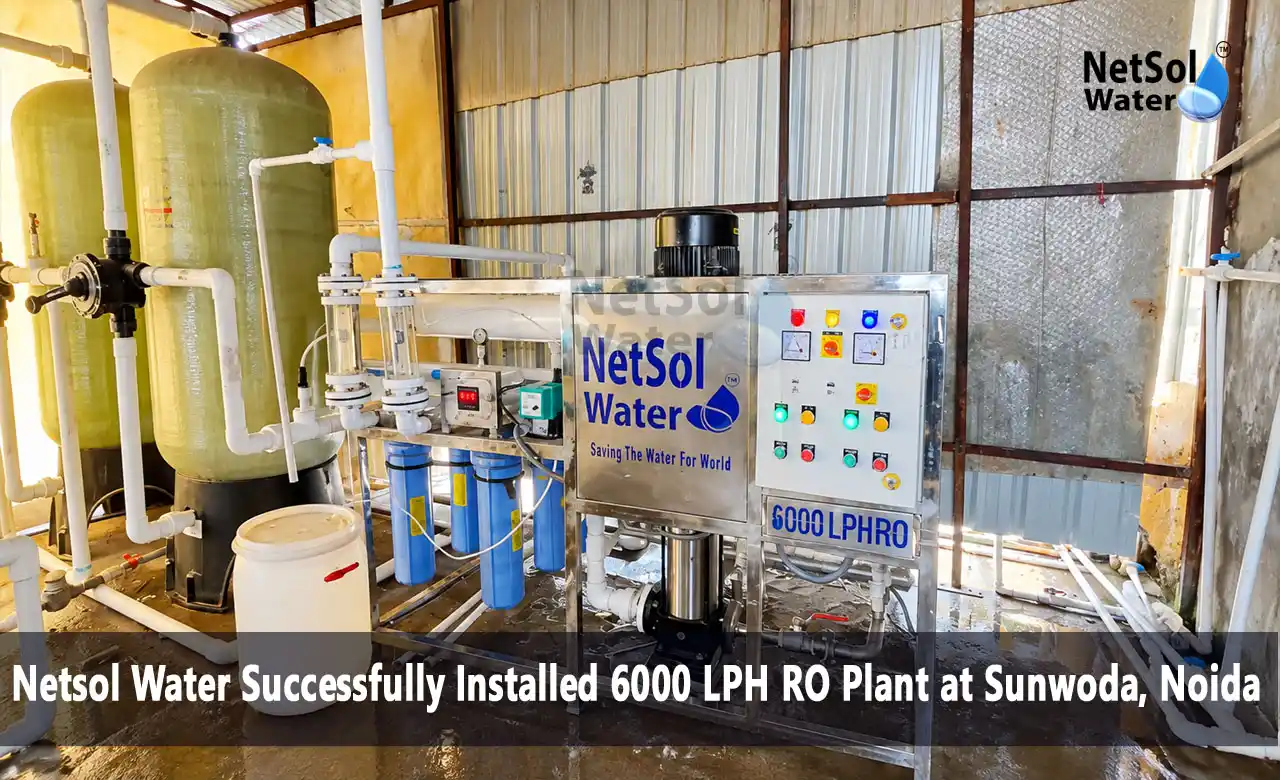
Case Study: Installed 6000 LPH RO Plant at Sunwoda, Noida
Netsol Water installed a 6000 LPH RO plant at Sunwoda in Noida, Uttar Pradesh, in 2025. The plant sits after the existing Effluent Treatment Plant (ETP). Its job is to treat the ETP-treated water further so that it can be reused in the industrial process.
The site had limited space, and the installation was completed in three days. The water entering the RO plant had a TDS of 7000 mg/L. The treated water TDS was reported at 140 mg/L.
This case study covers the project specifications, plant configuration, treatment sequence and the installation challenge. It is written for factory managers, environmental engineers and industrial buyers who are looking at ETP treated water reuse, or who are planning a step-by-step move towards Zero Liquid Discharge (ZLD). Project facts come from our supplied project record. General RO explanations are marked as such, so you can tell the two apart.
Project Overview and Key Specifications
Sunwoda is an industrial client in Noida. The industrial RO plant was added after the ETP, with one clear purpose: further treatment of ETP-treated water for reuse in the process. Sunwoda is gradually moving towards ZLD, and this plant is one part of that direction.
| Parameter | Details |
|---|---|
| Client | Sunwoda |
| Location | Noida, Uttar Pradesh, India |
| Installation Year | 2025 |
| Plant Capacity | 6000 LPH |
| Plant Type | MSFRP RO Plant |
| RO Membrane Brand | Toray |
| Water Source | ETP-Treated Water |
| TDS Before RO | 7000 mg/L |
| TDS After RO | 140 mg/L |
| Pretreatment | Pressure Sand Filter (PSF), Activated Carbon Filter (ACF), Micron Filter |
| Application | Industrial Process Water |
| Main Challenge | Limited Space |
| Installation Duration | 3 Days |
Why Was Further Treatment of ETP-Treated Water Required?
. Need for Better Water Quality in Industrial Processes
An ETP treats industrial effluent, but treated effluent can still carry a high level of dissolved salts. In this project, the water going into the RO plant had a TDS of 7000 mg/L. That is a lot of dissolved material for a process that needs cleaner water.
In general, high dissolved solids can cause scaling, corrosion or quality problems, depending on the process. The exact water quality Sunwoda needs for each use is their own requirement, and we do not comment on their internal operations. What we can say is that a RO stage was added so the ETP-treated water could be brought to a much lower TDS before reuse.
. Water Reuse and the Move Towards ZLD
Zero Liquid Discharge is an approach where a factory works to reduce liquid waste leaving the site, by treating and reusing as much water as possible. It is usually reached in stages, not in one step.
Sunwoda is gradually moving towards ZLD. Adding a RO plant after the ETP is one practical step on that path, because it makes ETP-treated water usable again in the process. We are not saying that complete ZLD has been achieved at this site. This project is a stage in that journey, not the end of it.
Technical Configuration of the 6000 LPH RO Plant
. 6000 LPH Plant Capacity
LPH means litres per hour. The plant is rated at 6000 LPH. We have not been given feed, permeate or reject flow figures, so this article does not state any recovery percentage.
. MSFRP Plant Construction
This is an MSFRP RO plant. In water treatment, MSFRP is generally understood as mild steel combined with fibre reinforced plastic, a build commonly chosen for strength and corrosion resistance. The exact construction details were not part of the supplied information, so please refer to the project drawings for them.
. Toray RO Membranes
The plant uses Toray RO membranes. The membrane is the heart of any RO system, because it is where dissolved salts are separated from water. We have not been given the membrane model or quantity, so we do not state them here.
. Pretreatment Equipment: PSF, ACF and Micron Filter
Pretreatment protects the RO membranes. In general terms:
. Pressure Sand Filter (PSF): removes suspended particles and turbidity.
. Activated Carbon Filter (ACF): removes organic matter, residual chlorine, colour and odour.
. Micron Filter: acts as a final safety filter, catching fine particles before water reaches the membranes.
How the RO Plant Works After ETP Treatment?
. Water Flow from ETP to the RO System
The indicative process sequence is:
ETP-Treated Water → PSF → ACF → Micron Filter → RO System → Treated Water for Process Reuse
This sequence is based on the supplied project information. It should be checked against the actual piping diagram of the plant.
It is important to separate the two treatment stages. The ETP is the first stage. It treats the effluent. The RO plant comes after it and works on the ETP-treated water. RO does not replace the ETP. It builds on it.
. How Reverse Osmosis Further Treats the Water?
This part is a general technical explanation, not a project-specific measurement.
In reverse osmosis, water is pushed under pressure against a semi-permeable membrane. Water molecules pass through. Most dissolved salts do not. The water that passes through is called permeate. This is the cleaner stream that goes for reuse.
The salts that are held back leave as the reject stream, also called concentrate. It carries a higher salt level than the incoming water. Every RO plant produces both streams. How the reject is handled depends on the site's overall water management plan.
Raw Water Quality and RO Treatment Results
. Inlet TDS of 7000 mg/L
The water entering the RO system was ETP-treated water with a reported TDS of 7000 mg/L. It was not groundwater or municipal water. This is an important point, because treated effluent behaves differently from fresh water sources, and the pretreatment has to be chosen with that in mind.
. Treated Water TDS of 140 mg/L
After RO treatment, the reported TDS was 140 mg/L. Based on these two figures, the TDS reduction is approximately 98%.
Please read this number carefully. It is a measure of salt reduction. It is not RO recovery and not total water recovery. Recovery tells you how much of the feed water comes out as permeate, and that needs feed, permeate and reject flow data. We do not have that data for this project, so we do not calculate it. Also, whether 140 mg/L suits a particular application must be checked against the quality that application needs.
Installation Challenge: Limited Space at the Site
. Planning the Plant Layout
Limited space was the main challenge at Sunwoda. In industrial sites, this is common. Older facilities and ETP areas are often tight, and a new plant has to fit around existing equipment.
In general, a compact layout needs careful thought about where the filters, RO skid and piping will sit, and whether operators can still reach them for daily checks and maintenance. We have not been given the specific layout changes made at this site, so we do not describe them.
. Completing Installation in Three Days
The installation was completed in three days. For a plant of this size, working on a site with little free area, that is a short window. It shows what proper planning before the team reaches the site can do.
We are not listing day-wise activities, as those details were not supplied.
Benefits of Further-Treated Water for Process Reuse
. Reusing Treated Water in Industrial Operations
When ETP-treated water is brought to a lower TDS, it becomes a usable water source again. A factory can reduce how much fresh water it depends on for suitable process uses. The right use depends on the water quality each process needs, so that should always be confirmed first.
We have not been given any savings, cost or environmental figures for this project, so none are stated here.
. Supporting the Gradual ZLD Transition
Water reuse is a core part of any ZLD plan. By treating ETP water further, a RO plant helps the site recover water that would otherwise need disposal. This supports the gradual direction Sunwoda is taking. Complete ZLD usually needs more stages, and this article does not claim it has been reached.
Watch the 6000 LPH RO Plant Installation Video
Our video of the project is below.
Project Outcome and Key Takeaways
. Netsol Water installed a 6000 LPH MSFRP RO plant with Toray membranes at Sunwoda, Noida, in 2025.
. The plant treats ETP-treated water after the existing ETP, using PSF, ACF and a micron filter as pretreatment.
. Reported TDS was 7000 mg/L before RO and 140 mg/L after RO, a reduction of about 98%.
. Installation was completed in three days despite limited space.
. The plant supports process reuse and is one step in Sunwoda's gradual move towards ZLD.
Frequently Asked Questions (FAQs)
Q1. What is the capacity of the RO plant installed at Sunwoda, Noida?
The plant capacity is 6000 LPH.
Q2. When was the 6000 LPH RO plant installed at Sunwoda?
It was installed in 2025, and the installation took three days.
Q3. What was the TDS of the water entering the RO plant?
The inlet water was ETP-treated water with a TDS of 7000 mg/L.
Q4. What was the treated water TDS after RO treatment?
The reported TDS after RO treatment was 140 mg/L, a reduction of about 98%. This is a TDS reduction, not a recovery figure.
Q5. Which RO membrane brand was used in the Sunwoda project?
Toray RO membranes were used.
Q6. Why was a RO plant installed after the ETP?
The ETP treats the effluent, but the treated water can still have high dissolved salts. The RO plant was added to treat that water further so it can be reused in the industrial process.
Q7. How does a RO plant support the gradual move towards ZLD?
RO helps recover usable water from ETP-treated water, which reduces what needs to be discharged. It is one stage in a ZLD journey. It does not mean complete ZLD has been achieved.
Discuss Your Industrial Water Treatment Requirement
Are you planning a RO plant after your ETP, or looking at ETP treated water reuse for your factory? Talk to the Netsol Water team about your water quality and space conditions. You can also explore our industrial RO and wastewater treatment solutions on netsolwater.com.