

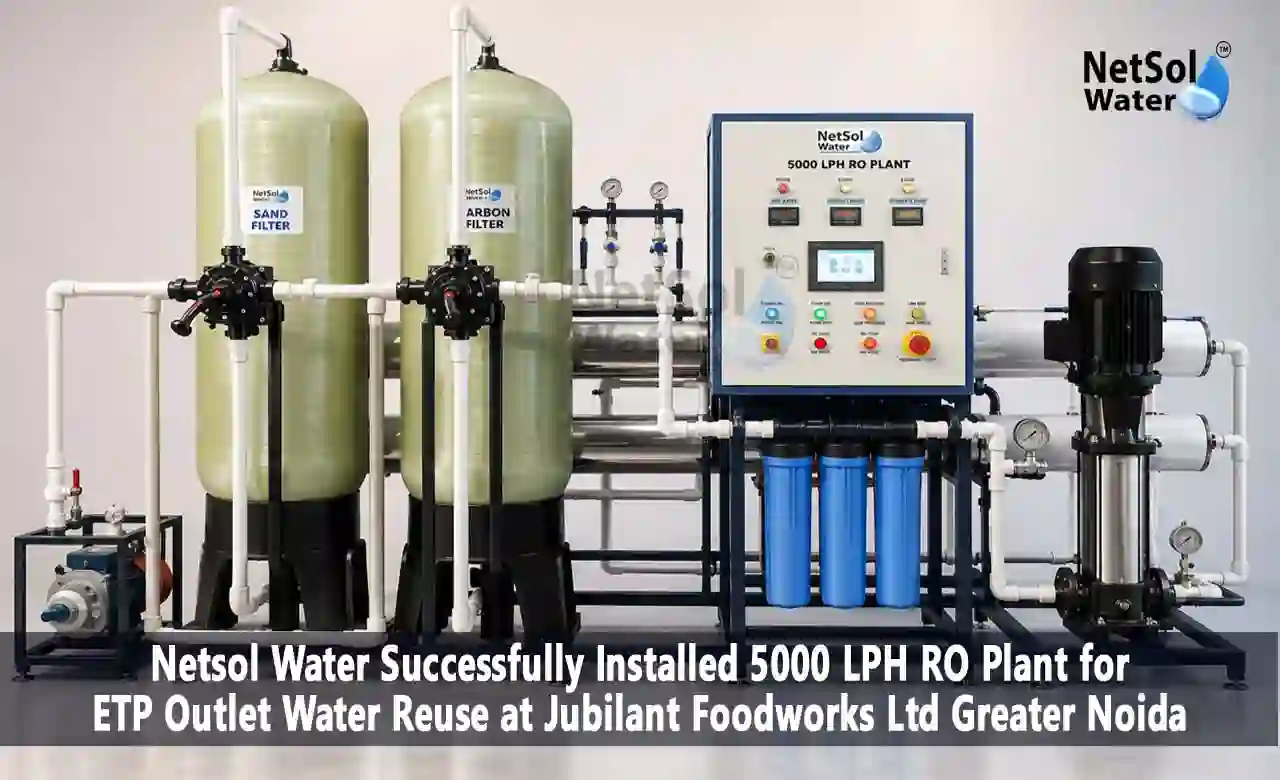
Case Study: 5000 LPH RO Plant for ETP Outlet Water Reuse at Jubilant Foodworks Ltd Greater Noida
Executive Summary
| Project Detail | Information |
|---|---|
| Client | Jubilant |
| Industry | Pharmaceutical / Chemical Manufacturing |
| Project Location | Greater Noida, Uttar Pradesh |
| Plant Capacity | 5000 Litres Per Hour (LPH) |
| Feed Water Source | ETP (Effluent Treatment Plant) Outlet Water |
| End Use of Treated Water | Reuse in Plant Operations |
| Technology Used | Industrial Reverse Osmosis (RO) System |
| Installed By | Netsol Water |
Netsol Water designed, engineered, and commissioned a 5000 LPH Industrial RO Plant at Jubilant’s Greater Noida facility to enable the reuse of treated ETP outlet water within the plant’s operational processes. The project was undertaken with the objective of reducing freshwater dependency, improving overall water-use efficiency, and supporting the client’s sustainability commitments.
This case study documents the engineering approach, pretreatment strategy, RO system design, and operational outcomes of the project, offering a technical reference for industries evaluating ETP outlet water reuse through industrial RO plant technology.
About the Client
Jubilant operates a manufacturing facility in Greater Noida, Uttar Pradesh, as part of a broader industrial operation involved in chemical and process manufacturing activities. Facilities of this nature typically rely on continuous water supply for multiple stages of production, equipment cooling, cleaning-in-place (CIP) operations, and utility support systems.
1. Industry Profile
Manufacturing units in this category generally operate with strict internal quality protocols and are subject to regulatory oversight from state pollution control boards regarding effluent discharge and water usage. Water is typically consumed across several functions, including:
• Process water for manufacturing operations
• Utility and cooling water requirements
• Washing and cleaning operations
• Boiler feed and steam generation support
• General facility usage
2. Water Consumption Requirements
Facilities of this scale generate a proportionate volume of wastewater as a byproduct of manufacturing activity. This wastewater is directed to an on-site Effluent Treatment Plant (ETP) for treatment before discharge, in accordance with regulatory norms.
3. Sustainability Initiatives
Many manufacturing units operating in the National Capital Region (NCR), including Greater Noida, are increasingly adopting water conservation measures in response to regional groundwater stress, regulatory tightening on freshwater extraction, and corporate sustainability goals. Reusing treated ETP outlet water instead of discharging it is one of the most effective methods available to industrial units for reducing their freshwater footprint.
4. Existing ETP System
Prior to this project, the client’s facility was already operating an Effluent Treatment Plant to treat wastewater generated from manufacturing activities. The ETP was designed to bring the effluent within permissible discharge limits. However, the treated ETP outlet water still carried a level of Total Dissolved Solids (TDS) and other residual parameters that made it unsuitable for direct reuse in sensitive plant applications without further polishing through a Reverse Osmosis system.
Project Background
1. Why ETP Outlet Water Reuse Was Required?
Although the client’s ETP was functioning effectively to treat effluent to dischargeable standards, the treated water was not being reused within the facility. This meant that despite investing in effluent treatment infrastructure, the plant continued to draw fresh water for its operational needs while simultaneously discharging or disposing of treated ETP outlet water.
This represented an opportunity for water-cycle optimization - one that Netsol Water identified and addressed through the design and installation of a dedicated RO polishing system for the ETP outlet stream.
2. Existing Water Management Challenges
The client’s facility faced a common set of challenges observed across process manufacturing industries:
• Continued dependency on freshwater sources despite having a functional ETP
• Treated ETP outlet water not meeting the quality standards required for reuse in plant operations
• Absence of a dedicated system to bridge the gap between “dischargeable quality” and “reusable quality” water
• Rising cost of freshwater procurement and, in some cases, tanker-based supplementation
• Regulatory and environmental pressure to demonstrate responsible water stewardship
3. Freshwater Dependency
Before the RO plant was installed, all process, utility, and auxiliary water requirements were met through freshwater sources, whether municipal supply, borewell extraction, or tanker supply. This dependency increased both operating costs and the facility’s environmental footprint.
4. Wastewater Generation
As with most process manufacturing operations, a significant volume of wastewater was generated daily and routed to the ETP. While the ETP treated this water to meet discharge norms, the treated stream was not further processed to a quality level suitable for return into the production cycle.
5. Water Conservation Objectives
The client’s core objective was to close this loop to take the ETP outlet stream, further polish it through Reverse Osmosis, and route the resulting permeate back into plant operations, thereby reducing overall freshwater intake.
6. Environmental Compliance Requirements
State Pollution Control Board norms in Uttar Pradesh, along with Central Pollution Control Board (CPCB) guidelines, increasingly encourage or mandate industrial water reuse, particularly in water-stressed regions such as the NCR belt. Installing a RO system for ETP outlet water reuse helps industrial units align with these evolving compliance expectations while also reducing the volume of treated effluent requiring disposal.
Challenges Before RO Installation
Before the installation of the 5000 LPH RO plant, the client’s facility experienced several operational and technical challenges:
• High TDS in ETP Outlet Water: Treated ETP water, while compliant for discharge, still carried dissolved solids at levels unsuitable for reuse in sensitive process or utility applications.
• Variable Feed Water Quality: ETP outlet quality can fluctuate depending on the upstream effluent load, treatment efficiency, and seasonal variation, requiring a robust and adaptable pretreatment design.
• High Freshwater Consumption: With no reuse mechanism in place, the facility remained fully dependent on external freshwater sources for its operational needs.
• Rising Water Costs: Freshwater procurement, especially in NCR industrial belts, has become increasingly expensive due to regulatory restrictions on groundwater extraction and rising municipal water tariffs.
• Limited Reuse Capability: Without a polishing RO system, the treated ETP outlet water had limited practical reuse applications within the plant.
• Sustainability Targets: The client, like many manufacturing organizations today, had internal sustainability benchmarks that could not be met without a structured water reuse initiative.
Project Objectives
The primary objectives defined for this project were:
1. Reuse ETP Outlet Water - Establish a reliable system to convert treated ETP outlet water into reusable process/utility-grade water.
2. Reduce Freshwater Consumption - Lower the facility’s reliance on external freshwater sources by substituting a portion of demand with recycled water.
3. Improve Water Recovery - Maximize the recovery percentage of usable permeate water from the ETP outlet feed.
4. Lower Operating Costs - Reduce long-term water procurement and effluent disposal costs through in-house treatment and reuse.
5. Support Sustainable Water Management - Align the facility’s water usage practices with broader environmental and corporate sustainability goals.
6. Minimize Wastewater Discharge - Reduce the net volume of treated effluent that would otherwise require discharge or disposal.
ETP Outlet Water Characteristics
The quality of ETP outlet water is central to the design of any downstream RO polishing system. Since ETP outlet water has already passed through biological and/or chemical treatment stages, it typically meets basic discharge norms but may still contain residual TDS, hardness, silica, and trace organics that need to be addressed through pretreatment before entering the RO membranes.
1. Design Considerations
• The RO system pretreatment train had to be designed to handle variability in ETP outlet quality, since effluent treatment plant performance can fluctuate with influent load.
• Adequate multimedia and carbon filtration stages were essential to protect the RO membranes from suspended solids, colloidal matter, and residual organics.
• Antiscalant dosing was required to manage scaling potential from hardness and silica in the feed stream.
• A cartridge filtration stage was included as a final safeguard before the high-pressure pump and RO membranes.
2. Feed Water Quality Variations
ETP outlet water quality can vary based on production schedules, effluent composition, and treatment plant loading. The RO system pretreatment design accounts for this variability by incorporating multiple filtration barriers and continuous monitoring instrumentation.
3. Importance of Pretreatment
Pretreatment is the single most important factor in ensuring long-term RO membrane life and consistent permeate quality when treating ETP outlet water. Without adequate pretreatment, membranes are vulnerable to fouling, scaling, and premature degradation, leading to higher maintenance costs and reduced system reliability.
4. Indicative ETP Outlet Water Parameters (Design Basis)
Note: The following table presents general design-basis parameters typical for ETP outlet water in process manufacturing facilities. Actual site-specific values are recorded during the water quality assessment stage and may vary. These figures are indicative and used for illustrative/design-reference purposes.
| Parameter | Typical ETP Outlet Range (Indicative) | Unit |
|---|---|---|
| pH | 6.5 – 8.5 | - |
| TDS | 800 – 2500 | mg/L |
| Conductivity | 1200 – 4000 | µS/cm |
| Turbidity | 2 – 10 | NTU |
| COD | 50 – 150 | mg/L |
| BOD | 10 – 30 | mg/L |
| TSS | 5 – 20 | mg/L |
| Total Hardness | 150 – 400 | mg/L as CaCO? |
| Silica | 5 – 25 | mg/L |
| Oil & Grease | <10 | mg/L |
Solution Provided by Netsol Water
1. Why RO Technology Was Selected
Reverse Osmosis was selected as the core polishing technology because of its proven capability to remove dissolved solids, hardness, and residual contaminants from pretreated ETP outlet water to a quality level suitable for reuse. Compared to alternative polishing technologies, RO offers a favorable balance of capital cost, operational simplicity, recovery efficiency, and scalability for a 5000 LPH capacity requirement.
2. Design Philosophy
Netsol Water’s design approach for this project was centered on three principles:
• Robust Pretreatment: Ensuring the RO membranes receive consistently filtered, low-turbidity, and scale-controlled feed water regardless of variability in ETP outlet quality.
• Operational Reliability: Selecting equipment and instrumentation that would allow the plant to run with minimal manual intervention while maintaining consistent permeate output.
• Scalable Architecture: Designing the skid and piping layout in a manner that allows for future capacity expansion if the client’s water reuse requirements grow.
3. Pretreatment Strategy
The pretreatment train for this project was designed in multiple stages:
• Raw water collection and equalization in a dedicated collection tank
• Pressure Sand Filtration to remove suspended solids and turbidity
• Activated Carbon Filtration to remove residual organics, color, and odor-causing compounds
• Micron Cartridge Filtration as a final polishing barrier before the high-pressure pump
• Antiscalant dosing to control scale formation on membrane surfaces
4. Recovery Concept
The system was engineered to achieve an optimum recovery percentage from the ETP outlet feed, balancing permeate output against reject volume. The recovery rate was determined based on feed water TDS, hardness, and silica levels to protect membrane life while maximizing usable water output.
5. Automation
The RO plant was equipped with a PLC-based control panel, allowing for automated operation, monitoring, and safety interlocks, minimizing the need for constant manual supervision while improving operational consistency.
6. Future Scalability
The skid design and piping layout allow for future capacity augmentation, should the client wish to scale up the reuse system to cover additional applications within the facility.
Process Flow Diagram
The following process flow outlines the treatment sequence for the 5000 LPH RO Plant installed at Jubilant, Greater Noida:
|
↓
Permeate Tank
↓
Reuse in Plant Operations
|
↓
RO Reject Collection Tank
|
This flow reflects a standard industrial RO configuration adapted specifically for ETP outlet water reuse applications, incorporating multiple protective filtration stages ahead of the membrane system to ensure consistent performance and membrane longevity.
Technical Specifications
| Specification | Details |
|---|---|
| Capacity | 5000 LPH (Litres Per Hour) |
| Feed Water Source | ETP Outlet Water |
| Technology | Industrial Reverse Osmosis (RO) |
| Membrane Type | Thin-Film Composite (TFC) Polyamide RO Membranes |
| Recovery Rate | Designed for optimum recovery based on feed water quality (site-specific, determined during commissioning) |
| Pumps | Multistage Centrifugal Feed Pump and High-Pressure Pump |
| Electrical Panel | Dedicated control panel with motor protection and interlocks |
| Instrumentation | Flow meters, pressure gauges, conductivity/TDS monitors |
| Automation | PLC-based control with auto flush and safety interlocks |
| Skid Material | Corrosion-resistant frame construction (MS powder-coated / SS as per design) |
| Piping | UPVC/CPVC and SS piping as per process stage requirements |
Working Principle of the RO Plant
1. Collection of ETP Outlet Water
Treated water discharged from the client’s ETP is directed into a dedicated Raw Water Collection Tank, which acts as a buffer and equalization stage, smoothing out short-term fluctuations in ETP outlet flow and quality before it enters the RO pretreatment system.
2. Feed Pump
A feed pump draws water from the collection tank and delivers it at a consistent, controlled flow rate to the pretreatment filtration stages, ensuring stable hydraulic conditions throughout the system.
3. Cartridge Filter
A Micron Cartridge Filter serves as the final safeguard stage before the high-pressure pump, capturing any fine particulate matter that may have passed through the earlier filtration stages, thereby protecting the RO membrane elements from physical fouling.
4. Chemical Dosing
Antiscalant dosing is introduced ahead of the high-pressure pump to inhibit scale formation on the membrane surface, particularly from hardness salts and silica present in the ETP outlet water. Dosing rates are calibrated based on feed water characteristics.
5. High Pressure Pump
The high-pressure pump elevates the pretreated feed water to the pressure required for the Reverse Osmosis process, enabling water molecules to pass through the semi-permeable membrane while rejecting dissolved solids and contaminants.
6. Reverse Osmosis Membranes
The core RO membrane stage separates the pretreated feed water into two streams:
• Permeate: Purified water with significantly reduced TDS, hardness, and dissolved contaminants
• Reject (Concentrate): A concentrated stream containing the rejected dissolved solids and impurities
. Permeate Water Collection
The permeate stream is collected in a dedicated Permeate Tank, from which it is distributed for reuse within the client’s plant operations.
7. Reject Water Management
The RO reject stream is directed to a Reject Collection system for appropriate handling, in line with the client’s overall water and effluent management protocols.
Major Equipment Installed
| Equipment | Function |
|---|---|
| Raw Water Collection Tank | Buffer storage and equalization of ETP outlet water. |
| Feed Pump | Delivers feed water to pretreatment stages at a controlled flow rate. |
| Pressure Sand Filter (PSF) | Removes suspended solids and reduces turbidity. |
| Activated Carbon Filter (ACF) | Removes organics, colour, odour, chlorine, and residual oxidants. |
| Micron Cartridge Filter | Provides final fine-particle filtration before the RO membranes. |
| Antiscalant Dosing System | Prevents scale formation on RO membrane surfaces. |
| High Pressure Pump | Supplies the operating pressure required for the RO membrane process. |
| RO Membrane Skid | Separates dissolved salts to produce permeate and reject streams. |
| Permeate Storage Tank | Stores treated water for reuse in plant operations. |
| Reject Collection System | Collects and manages the RO reject (concentrate) stream. |
| Electrical Control Panel | Provides power distribution and protection for plant equipment. |
| PLC-Based Automation Panel | Monitors, controls, and automates the complete RO plant operation. |
Instrumentation & Automation
To ensure consistent performance, safety, and ease of operation, the 5000 LPH RO Plant is equipped with the following instrumentation and automation features:
• Flow Meter: Continuously monitors feed, permeate, and reject flow rates, allowing operators to track system recovery and performance in real time.
• Pressure Gauges: Installed at critical points across the pretreatment and RO stages to monitor pressure drops, which can indicate filter fouling or membrane scaling.
• Conductivity Meter: Measures permeate and feed water conductivity to verify treatment performance and detect any deviation in membrane rejection efficiency.
• TDS Monitoring: Provides continuous tracking of dissolved solids concentration in the permeate stream to confirm water quality suitability for reuse.
• Auto Flush System: Automatically flushes the RO membranes during shutdown cycles to prevent scaling and fouling during idle periods.
• Low Pressure Protection: Safeguards the high-pressure pump from dry-run conditions or insufficient feed pressure, protecting equipment from damage.
• High Pressure Protection: Prevents membrane and system damage due to excessive operating pressure.
• PLC / Control Panel: Centralizes system control, enabling automated sequencing of pumps, valves, and dosing systems, along with alarm indication for abnormal operating conditions.
This level of instrumentation ensures that the plant can operate reliably with reduced manual oversight while maintaining consistent water quality output.
Water Quality Improvement
Note: The following table presents indicative before-and-after values based on typical performance ranges for RO systems treating ETP outlet water of comparable characteristics. Actual site-recorded values are captured during commissioning and operational monitoring at the client’s facility.
| Parameter | Before RO (ETP Outlet) | After RO (Permeate) - Indicative |
|---|---|---|
| pH | 6.5 – 8.5 | 6.0 – 7.5 |
| TDS (mg/L) | 800 – 2500 | 20 – 100 |
| Conductivity (µS/cm) | 1200 – 4000 | 40 – 200 |
| Turbidity (NTU) | 2 – 10 | <1 |
| Total Hardness (mg/L as CaCO?) | 150 – 400 | <10 |
| Silica (mg/L) | 5 – 25 | <1 |
The substantial reduction in TDS, hardness, and silica levels achieved through the RO process makes the treated permeate suitable for reuse in the client’s plant operations, addressing the quality gap that previously existed between “dischargeable” ETP outlet water and “reusable-grade” water.
Project Video Walkthrough
To provide a comprehensive, real-world view of the installed system, Netsol Water has documented the complete 5000 LPH RO Plant setup at Jubilant, Greater Noida, through a detailed project video walkthrough.
The video showcases:
• The complete 5000 LPH RO Plant setup
• ETP Outlet Water collection system
• Pretreatment units, including the Pressure Sand Filter and Activated Carbon Filter
• The Industrial RO membrane system
• High Pressure Pump installation
• Instrumentation and control panel
• Permeate Water Tank
• Overall plant layout
• Live plant operation
This walkthrough offers viewers a practical, on-ground perspective of how the system functions in an operational industrial environment.
Watch the full project video here:
Project Results & Performance
Following commissioning, the 5000 LPH RO Plant has enabled the client’s facility to reuse treated ETP outlet water within its operations, contributing to a measurable reduction in freshwater dependency. Key performance outcomes include:
• Water Recovery: The system operates at a recovery rate optimized for the specific characteristics of the ETP outlet feed water, balancing permeate output with membrane protection.
• Reduction in Freshwater Usage: By substituting a portion of the facility’s water demand with treated, reused water, the plant has reduced its reliance on external freshwater sources.
• Water Reuse Achieved: Permeate water produced by the RO system is now channeled back into plant operations, closing a portion of the facility’s water cycle that was previously open.
• Stable Plant Operation: The robust pretreatment design and automation features have supported consistent, low-maintenance operation of the RO system since commissioning.
• Operational Improvements: The client’s facility now benefits from a structured water reuse mechanism that supports both operational efficiency and long-term sustainability planning.
Specific numerical performance figures, such as exact recovery percentages and daily reuse volumes, are tracked through the client’s internal monitoring systems and can be documented in future performance reviews as operational data accumulates.
Benefits Achieved
1. Operational Benefits
• Reliable, automated RO plant operation with minimal manual intervention
• Consistent permeate water quality for reuse applications
• Reduced strain on freshwater supply infrastructure
2. Financial Benefits
• Reduced freshwater procurement costs over the long term
• Lower dependency on external water tankers or municipal supply during periods of scarcity
• Improved cost predictability for water-related operating expenses
3. Environmental Benefits
• Reduced volume of treated effluent requiring disposal
• Lower net freshwater extraction from local sources
• Reduced environmental footprint associated with water sourcing and discharge
4. Sustainability Benefits
• Alignment with corporate sustainability and water stewardship goals
• Support for responsible industrial water management practices
• Contribution to regional water conservation efforts in a water-stressed NCR belt
5. Maintenance Benefits
• Automated auto-flush and protection systems reduce membrane fouling risk
• Structured pretreatment design minimizes wear on RO membranes
• Simplified troubleshooting through integrated instrumentation and monitoring
Water Conservation & Sustainability Impact
The installation of the 5000 LPH RO Plant at Jubilant’s Greater Noida facility reflects a broader shift within the industrial sector toward closed-loop water management. By treating and reusing ETP outlet water rather than allowing it to remain a one-way output of the manufacturing process, the facility contributes meaningfully to:
• Industrial Water Recycling: Demonstrating a practical, replicable model for converting treated effluent into a usable process resource.
• Reduced Freshwater Extraction: Lowering the burden placed on regional groundwater and municipal water resources.
• Reduced Wastewater Discharge: Minimizing the net volume of treated effluent released into the environment.
• Sustainable Manufacturing: Supporting the client’s broader operational sustainability objectives through measurable water efficiency gains.
• Responsible Water Management: Establishing a long-term framework for water accountability that can be expanded or replicated across other facilities.
Projects of this nature are particularly significant in industrial clusters such as Greater Noida, where groundwater stress and regulatory scrutiny make water reuse not just an environmental consideration, but an operational necessity.
Why Netsol Water?
Netsol Water has established itself as a trusted industrial RO plant manufacturer, delivering customized water and wastewater treatment solutions across a range of industries. Key strengths demonstrated through this project include:
• Customized Design: Every RO system is engineered around the specific feed water characteristics and operational requirements of the client, rather than relying on generic, off-the-shelf configurations.
• In-House Manufacturing: Netsol Water manufactures its RO systems in-house, ensuring quality control across every stage of production, from skid fabrication to final assembly.
• Installation & Commissioning: The company provides end-to-end project execution, from initial design through installation, commissioning, and performance validation.
• Experienced Engineering Team: Netsol Water’s technical team brings deep expertise in industrial RO systems, ETP integration, and water reuse engineering.
• AMC Support: Annual Maintenance Contracts (AMC) are available to ensure long-term system reliability, membrane performance, and operational continuity.
• PAN India Services: Netsol Water supports clients across India with installation, commissioning, and after-sales service capabilities.
Client Benefits
Through this project, Jubilant has gained access to the following long-term benefits:
• Reduced Operating Costs: Lower freshwater procurement expenses through the reuse of treated ETP outlet water.
• Reliable Water Reuse: A dependable, automated system that consistently converts ETP outlet water into reusable process-grade water.
• Improved Sustainability: Measurable progress toward corporate water conservation and environmental responsibility goals.
• Lower Environmental Impact: Reduced freshwater extraction and reduced discharge volumes, supporting the facility’s environmental compliance posture.
• Long-Term ROI: A capital investment in RO infrastructure that continues to generate operational savings and sustainability value over its service life.
Conclusion
The 5000 LPH RO Plant for ETP Outlet Water Reuse at Jubilant’s Greater Noida facility, engineered and commissioned by Netsol Water, represents a practical and effective solution to a challenge faced by many industrial units: the gap between treating wastewater to dischargeable standards and actually reusing that water within plant operations.
By combining a robust, multi-stage pretreatment system with a well-engineered Reverse Osmosis membrane process, Netsol Water was able to bridge this gap, enabling the client to convert treated ETP outlet water into a genuinely reusable resource. The result is a facility that now operates with reduced freshwater dependency, lower long-term operating costs, and a stronger sustainability profile.
This project reflects Netsol Water’s broader capability in delivering industrial water treatment, industrial water recycling, and water reuse solutions tailored to the specific operational needs of manufacturing facilities across India. As industries continue to face rising water costs and tightening environmental regulations, projects like this one demonstrate a clear, replicable pathway toward more sustainable industrial water management.
Frequently Asked Questions (FAQs)
Q1. Why is RO treatment required after an ETP, if the ETP already treats the wastewater?
An ETP treats wastewater to meet regulatory discharge norms, but the treated water often still contains dissolved solids, hardness, and other residual parameters that make it unsuitable for direct reuse in plant operations. An RO system polishes this ETP outlet water further, reducing TDS and other contaminants to a level suitable for reuse.
Q2. What is the typical recovery rate of an industrial RO plant treating ETP outlet water?
Recovery rates depend on the specific characteristics of the feed water, including TDS, hardness, and silica levels. Netsol Water designs each system’s recovery target based on a detailed water quality assessment to balance permeate output with long-term membrane protection.
Q3. How often do RO membranes need to be cleaned when treating ETP outlet water?
Membrane cleaning frequency depends on feed water quality, pretreatment effectiveness, and operating conditions. A well-designed pretreatment system, including sand filtration, carbon filtration, and antiscalant dosing, significantly extends the interval between cleaning cycles.
Q4. What quality of water can be expected from RO plant treating ETP outlet water?
With effective pretreatment and properly functioning RO membranes, permeate water typically shows substantial reductions in TDS, hardness, and silica compared to the ETP outlet feed, making it suitable for reuse in various plant applications such as utility water, washing, and non-critical process functions.
Q5. Can ETP outlet water be reused directly without RO treatment?
In most cases, direct reuse without further treatment is not advisable, as ETP outlet water can still contain dissolved solids and residual contaminants that may affect equipment, process quality, or downstream applications. RO treatment provides the necessary polishing step for safe and effective reuse.
Q6. What industries benefit most from ETP outlet water reuse through RO systems?
Pharmaceutical, chemical, textile, food processing, and other process manufacturing industries that generate significant wastewater volumes and consume large quantities of freshwater are strong candidates for ETP outlet water reuse projects.
Q7. What pretreatment is necessary before RO system treating ETP outlet water?
A typical pretreatment train includes pressure sand filtration, activated carbon filtration, micron cartridge filtration, and antiscalant dosing, each designed to protect the RO membranes from fouling, scaling, and organic contamination.
Q8. How does industrial water recycling through RO reduce operating costs?
By reducing dependency on external freshwater sources and minimizing the volume of effluent requiring disposal, industrial water recycling lowers both water procurement costs and, in some cases, effluent handling costs, contributing to long-term operational savings.
Q9. Is automation necessary for a 5000 LPH RO plant?
While not strictly mandatory, automation through a PLC-based control panel significantly improves operational reliability, reduces manual oversight requirements, and helps protect the system through features like auto-flush, low-pressure protection, and high-pressure protection.
Q10. Who can install a customized RO plant for ETP outlet water reuse?
Netsol Water, as an experienced industrial RO plant manufacturer, specializes in designing and installing customized RO systems for ETP outlet water reuse applications, backed by in-house manufacturing, engineering expertise, and PAN India service support.
This case study documents the engineering approach and outcomes of the 5000 LPH RO Plant project for ETP outlet water reuse at Jubilant, Greater Noida, executed by Netsol Water. For inquiries about customized industrial RO plants, water recycling systems, or ETP outlet water reuse solutions, contact Netsol Water’s engineering team at +91-9650608473.