

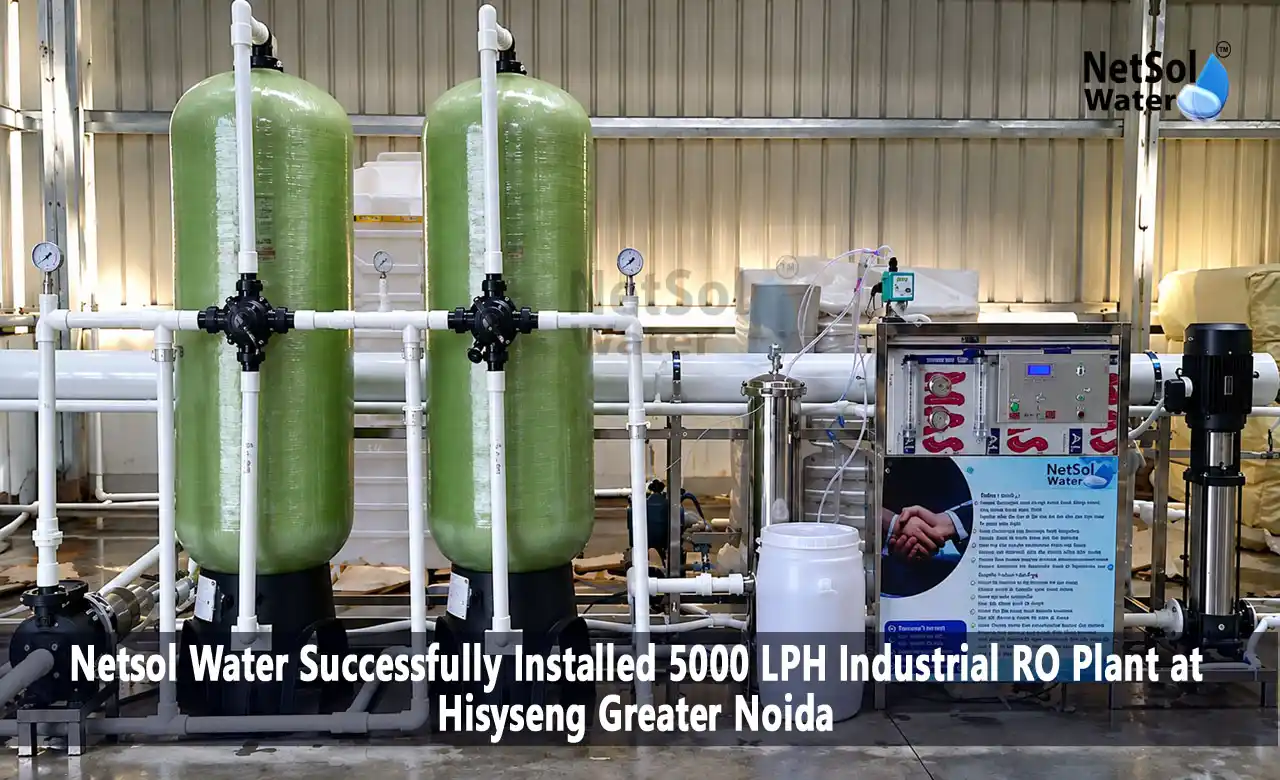
Case Study: Installed 5000 LPH Industrial RO Plant at Hisyseng, Greater Noida
In 2023, Netsol Water manufactured, supplied, installed and commissioned an Industrial RO Plant at Hisyseng in Greater Noida, Uttar Pradesh. The plant has a capacity of 5000 LPH and treats groundwater with a raw water TDS of 12,000 mg/L. After RO treatment, the water has a TDS of approximately 80 mg/L, at a system recovery of 60%. The treated water is used in manufacturing and process applications.
This case study documents how the system was configured, what the installation team dealt with on site, and what the plant delivers.
| Item | Detail |
|---|---|
| Client | Hisyseng |
| Location | Greater Noida, Uttar Pradesh, India |
| Capacity | 5000 LPH |
| Raw Water Source | Groundwater |
| Raw Water TDS | 12,000 mg/L |
| Treated Water TDS | 80 mg/L |
| RO Recovery | 60% |
| Application | Manufacturing / Process |
| Netsol Water Scope | Manufacturing, Supply, Installation and Commissioning |
About the Hisyseng RO Plant Project
Hisyseng needed a dependable supply of treated water for its manufacturing and process operations. Its only source was groundwater, and the dissolved salt content of that water was far too high to use directly.
Process water has to be consistent, because the quality of water going into a manufacturing operation can affect equipment, routine operation and the day-to-day running of the facility. For a requirement of this kind, an Industrial RO Plant was the practical route: it separates dissolved salts from the groundwater and gives the plant a usable treated water stream.
Client Requirement and Water Quality Challenge
The requirement was clear: roughly 50,000 litres of treated water per day for manufacturing/process use, produced from a groundwater source with a TDS of 12,000 mg/L.
TDS (total dissolved solids) is the measure of dissolved salts and minerals in water. At 12,000 mg/L, the groundwater at this site is very high in dissolved content. That creates three practical problems for an industrial user:
. The water cannot be used for process purposes in its raw state.
. A high dissolved load puts heavy demand on the RO membranes, so the system needs proper pretreatment and scale control.
. The system has to run at a higher operating pressure than it would on low-TDS water, so pump selection matters.
We did not have any other water analysis parameters for this project, so this case study deals only with TDS, which was the main problem identified at the site.
Netsol Water's Proposed Solution
Netsol Water configured the plant around the site conditions and the daily requirement. The system uses:
. 5000 LPH capacity to meet the daily demand of approximately 50,000 litres
. Pretreatment with a pressure sand filter and an activated carbon filter
. Antiscalant dosing to protect the membranes from scaling
. Micron/cartridge filtration as the final protection before the high-pressure pump
. Five Toray RO membranes in FRP housings
. A CRI 10 HP high-pressure pump
. MSFRP construction for the plant skid and vessels
. Manual operation, which keeps the plant simple to run
No water softener was included in this configuration. Scale control is handled by antiscalant dosing ahead of the RO stage.
Technical Specifications of the 5000 LPH Industrial RO Plant
| Parameter | Specification |
|---|---|
| Client | Hisyseng |
| Location | Greater Noida, Uttar Pradesh |
| Plant Capacity | 5000 LPH |
| Plant Type | Industrial RO Plant |
| Installation Year | 2023 |
| Raw Water Source | Groundwater |
| Raw Water TDS | 12,000 mg/L |
| Treated Water TDS | 80 mg/L |
| RO Recovery | 60% |
| RO Membranes | 5 |
| Membrane Brand | Toray |
| Membrane Housing | FRP |
| High Pressure Pump | CRI 10 HP |
| Construction | MSFRP |
| Automation | Manual |
| Chemical Dosing | Antiscalant |
| Application | Manufacturing / Process |
| Daily Requirement | Approximately 50,000 litres |
| Installation Duration | 7 days |
Water Treatment Process
Raw Water Tank → Raw Water Pump → Pressure Sand Filter → Activated Carbon Filter → Micron/Cartridge Filter → High Pressure Pump → RO → Treated Water Tank
. Raw Water Tank: Groundwater is collected here first. It acts as the buffer between the water source and the plant, so the treatment train receives a steady feed.
. Raw Water Pump: This pump moves water from the tank through the pretreatment filters at the flow and pressure the filters need.
. Pressure Sand Filter: The pressure sand filter uses a sand bed to remove suspended particles and turbidity. This protects the downstream equipment from fouling.
. Activated Carbon Filter: Activated carbon is used to remove chlorine and organic matter, which can damage RO membranes or foul them over time.
. Antiscalant Dosing: Antiscalant is dosed into the feed before the RO stage. It slows the formation of scale on the membrane surface as salts become concentrated during the RO process. With 12,000 mg/L raw water TDS, this step is important for stable operation.
. Micron/Cartridge Filter: This is the last filtration step before the high-pressure pump. It catches fine particles that may have passed through the earlier stages, so they do not reach the RO membranes.
. High Pressure Pump: The CRI 10 HP pump raises the feed water to the pressure needed to push water through the RO membranes.
. RO Membranes: Five Toray membranes in FRP housings separate dissolved salts from the water. Treated water (permeate) passes through, while the concentrated reject stream is separated.
. Treated Water Tank: RO-treated water is collected here, ready to be supplied to the manufacturing/process application.
How the 5000 LPH Industrial RO Plant Works?
Here is how the Hisyseng plant works, from groundwater to treated water:
1. Groundwater enters the raw water tank.
2. The raw water pump sends it through the pressure sand filter, where suspended particles are removed.
3. The water then flows through the activated carbon filter for chlorine and organic matter removal.
4. Antiscalant is dosed into the water to protect the membranes from scaling.
5. The cartridge filter polishes the water before it reaches the pump.
6. The CRI 10 HP pump pressurizes the water and feeds the five RO membranes.
7. Inside the membranes, water passes through while dissolved salts are rejected. At 60% recovery, about 60% of the feed becomes treated water and the remaining portion leaves as reject.
8. Treated water at approximately 80 mg/L TDS goes to the treated water tank.
As a reference point, 5000 LPH running over about 10 hours corresponds to roughly 50,000 litres. The actual running schedule depends on the client's production routine.
For a general walkthrough of the stages ahead of the membranes, read our guide on how sand filtration, carbon filtration, cartridge filtration and high-pressure RO work together. Netsol Water also builds Industrial RO Plants in a range of capacities to suit different daily requirements.
Managing 12,000 TDS Groundwater
A raw water TDS of 12,000 mg/L is a serious challenge for industrial water treatment. The dissolved salt content is high enough that the RO system has to work hard, and a poorly planned system would face scaling, fouling and unstable output.
Several parts of this design work together to handle that:
. Pretreatment: The sand and carbon filters and the cartridge filter remove suspended matter, chlorine and organic matter, and fine particles, so the membranes see cleaner feed water.
. Antiscalant dosing: At 60% recovery, the reject stream carries a more concentrated salt load than the incoming water. Antiscalant helps control scale formation under those conditions.
. High-pressure pumping: High-TDS water requires higher pressure to push water through the membranes. The CRI 10 HP pump supplies this.
. RO membrane treatment: The five Toray membranes carry out the salt separation.
The result is a drop from 12,000 mg/L to approximately 80 mg/L, which is a TDS reduction of roughly 99%. RO is a very effective method for dissolved salts, but it is not a method that removes every possible contaminant, and we do not claim that here. Plant performance continues to depend on proper operation and maintenance.
Installation Challenges at Hisyseng
The main difficulties on this project were practical ones:
. Limited site space: The available area was restricted, so equipment placement had to be planned before the units arrived. The sand filter, carbon filter, RO skid and tanks all had to fit in a layout that still allowed access for operation and maintenance.
. Piping arrangement: With limited space, the pipework between stages had to be routed carefully so that the process flow remained correct and connections remained accessible.
. Equipment shifting and lifting: Pressure vessels and the RO skid are heavy and bulky. Moving them into position needed careful handling and coordination.
. High-TDS raw water: This was a design challenge as much as an installation one. It influenced the choice of pretreatment, antiscalant dosing and the pump.
. Site coordination: The work was done at an operating client location, so the team had to coordinate with the client's staff on timing and access.
Because the plant was built in MSFRP, it suited a compact skid-style arrangement, which helped in a site with limited room.
Installation and Commissioning Process
The project followed this sequence:
1. Manufacturing: Netsol Water manufactured the plant, including the MSFRP vessels and the skid.
2. Supply: The manufactured equipment was supplied to the Hisyseng site in Greater Noida.
3. Equipment placement: Vessels, pumps, the RO skid and tanks were shifted, lifted and positioned.
4. Piping: Interconnecting pipework was installed between the stages.
5. Pretreatment installation: The pressure sand filter, activated carbon filter, antiscalant dosing and cartridge filter were installed.
6. RO system installation: The Toray membranes, FRP housings and the CRI 10 HP pump were installed and connected.
7. Connections: Hydraulic and electrical connections were completed.
8. Testing: The system was checked before startup.
9. Trial operation: The plant was run on groundwater to confirm it was operating as intended.
10. Commissioning: The plant was handed over for use.
The installation and commissioning process was completed in 7 days.
Project Results and Water Quality Improvement
| Parameter | Value |
|---|---|
| Raw Water TDS | 12,000 mg/L |
| RO Treated Water TDS | 80 mg/L |
| RO Recovery | 60% |
| Plant Capacity | 5000 LPH |
| Daily Requirement | Approximately 50,000 litres |
The most important number is the TDS drop from 12,000 mg/L to 80 mg/L. It turns groundwater that was unsuitable for direct use into water that can serve manufacturing and process requirements. The 60% recovery shows that a good share of the raw water becomes usable output, which matters when the water source is limited. The 5000 LPH capacity matches the daily requirement of approximately 50,000 litres.
YouTube Video: 5000 LPH Industrial RO Plant Installation
To see the installed plant, watch the project video below. It gives a visual view of the Industrial RO Plant installed at the Hisyseng.
Watch the Hisyseng RO plant video on YouTube
Why This Industrial RO Solution Was Suitable for Hisyseng?
. The configuration was matched to the site's needs:
. It addresses high-TDS groundwater with a full pretreatment train and RO.
. It supports the manufacturing/process water requirement.
. The 5000 LPH capacity fits the daily need of approximately 50,000 litres.
. Antiscalant dosing and cartridge filtration protect the membranes.
. 60% recovery makes good use of the raw water.
. Approximately 80 mg/L treated-water TDS gives a usable process water supply.
Manual operation and MSFRP construction keep the plant simple and suited to the available space.
For a broader view of why industries choose this technology, see the benefits of Industrial RO Plants.
Frequently Asked Questions (FAQs)
Q1. What was the capacity of the RO plant installed at Hisyseng?
5000 LPH.
Q2. Where was the Industrial RO Plant installed?
At Hisyseng, Greater Noida, Uttar Pradesh, India.
Q3. What was the raw water source?
Groundwater.
Q4. What was the raw water TDS?
12,000 mg/L.
Q5. What was the TDS after RO treatment?
Approximately 80 mg/L.
Q6. What was the RO recovery?
60%.
Q7. How many RO membranes were used?
Five Toray RO membranes in FRP housings.
Q8. What high-pressure pump was used?
A CRI 10 HP pump.
Q9. How long did the installation take?
Installation and commissioning took 7 days.
Q10. What was the treated water used for?
Manufacturing and process applications.
Conclusion
At Hisyseng, the path was straightforward: 12,000 mg/L groundwater TDS → pretreatment → antiscalant dosing → high-pressure RO → 80 mg/L treated water. The 5000 LPH plant, with 60% recovery, now supplies water for manufacturing and process use, and it was installed and commissioned in 7 days despite limited space and heavy equipment handling.
If you are looking for an Industrial RO Plant for high-TDS groundwater, contact Netsol Water, an Industrial RO Plant Manufacturer in Noida that also serves clients as an Industrial RO Plant Manufacturer in Uttar Pradesh. Share your water source, TDS and daily requirement, and our team will help you plan a suitable system. Call +91-9650608473 or write to enquiry@netsolwater.com.