
Case Study: Installed 500 LPH RO Plant Installation at Blue Bird Solar
In May 2026, Netsol Water completed a 500 LPH RO plant installation at Blue Bird Solar in Greater Noida, Uttar Pradesh. The plant treats groundwater with a TDS of 3,600 mg/L and delivers treated water at 80 mg/L, a calculated TDS reduction of 97.78%. The treated water goes to drinking and process applications.
Groundwater at 3,600 mg/L cannot go straight to either use. It carries a heavy load of dissolved salts, tastes salty, and leaves scale on anything that heats or evaporates it. Process lines need controlled water chemistry, and drinking water needs a far lower salt level before any other quality check begins. A groundwater RO plant fixes the salinity problem at the source.
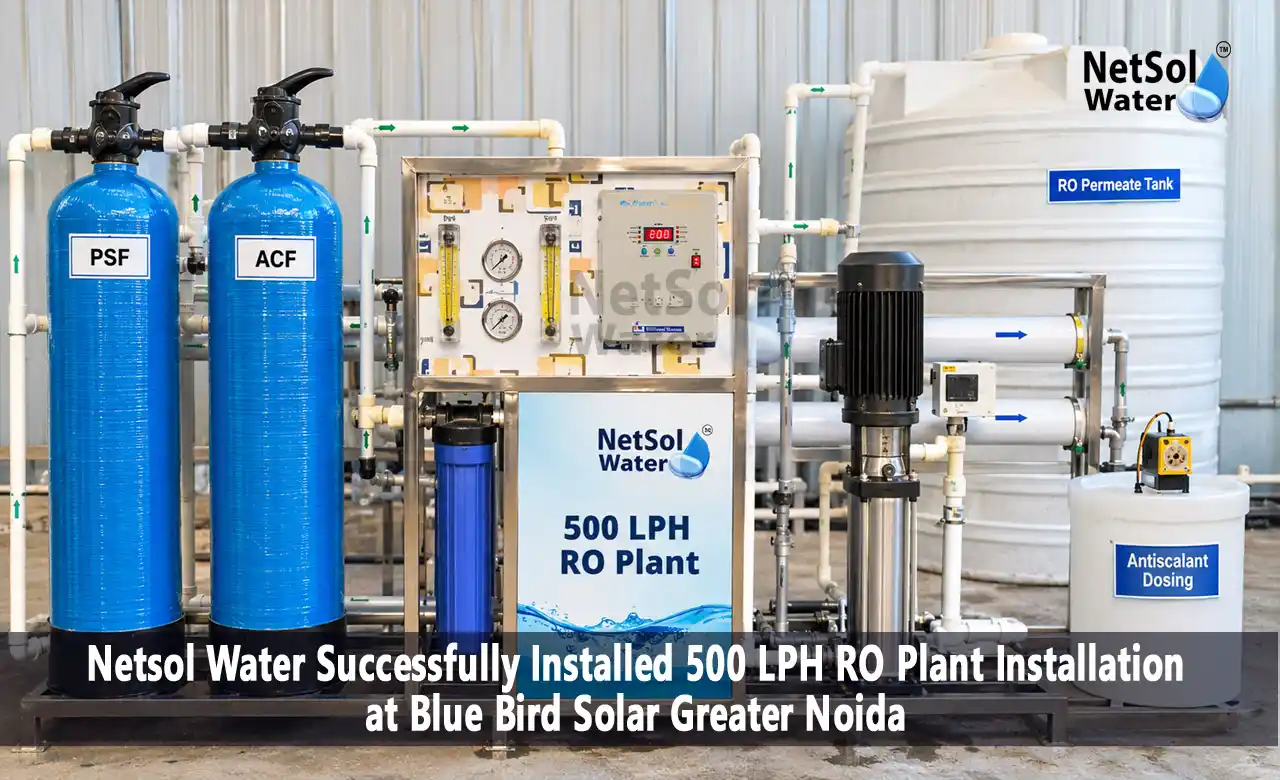
The plant has MSFRP construction, LG membranes, 60% recovery and semi-automatic controls. Installation took three days in a space-constrained site.
Project Overview – Blue Bird Solar, Greater Noida
| Parameter | Details |
|---|---|
| Project | 500 LPH RO Plant Installation at Blue Bird Solar |
| Client and Location | Blue Bird Solar, Greater Noida, Uttar Pradesh |
| Installation Month | May 2026 |
| RO Plant Capacity | 500 LPH |
| Plant Construction | MSFRP |
| Raw Water Source | Groundwater |
| Raw Water TDS | 3,600 mg/L |
| Treated Water TDS | 80 mg/L |
| RO Membrane Brand | LG |
| RO Recovery Rate | 60% |
| Automation | Semi-Automatic |
| Installation Duration | 3 Days, followed by commissioning |
Watch the Installation Video
The video below is the installation record for this project. It shows the plant at the Blue Bird Solar site, so you can see the equipment as installed and compare it with the specifications here.
Client Requirement and Water Treatment Challenge
Groundwater picks up dissolved minerals as it moves through soil and rock. The Blue Bird Solar borewell water measured 3,600 mg/L TDS, mostly salts such as calcium, magnesium, sodium, chloride, sulphate and bicarbonate. The exact mix changes from one borewell to another. A TDS this high brings specific problems:
1. Usability. Water at this salinity is unsuitable for drinking, and dissolved salts can upset processes that depend on water chemistry.
2. Scaling risk. Salts stay behind as water crosses the membrane and concentrate in the reject stream. Sparingly soluble salts such as calcium carbonate and calcium sulphate can then crystallise on the membrane.
3. Fouling risk. Groundwater can also carry silt, iron and organic matter that coat membranes and cut output.
A bare membrane cannot handle water like this. It needs a pretreatment train ahead of it and a way to manage scale inside it. At Blue Bird Solar, that meant a pressure sand filter, an activated carbon filter, a micron filter and antiscalant dosing before the RO stage. Drinking water must meet health-based standards and process water must meet process limits, and untreated groundwater at 3,600 mg/L is a poor starting point for either.
Why Was a 500 LPH RO Plant Selected for Blue Bird Solar?
LPH means litres per hour. A 500 LPH RO plant is rated to produce 500 litres of treated water, called permeate, per hour of running. RO capacity is measured on this permeate output under standard test conditions of feed salinity, temperature and pressure, so real output moves with feed water temperature and quality.
Reverse osmosis suits high-TDS groundwater because sand filters, carbon filters and softeners cannot remove the bulk of dissolved salts. RO pushes water through a semi-permeable membrane under pressure and holds most of the salts back. That is how 3,600 mg/L feed water reaches 80 mg/L.
A semi-automatic design suits a plant of this size. Semi-automatic plants generally automate routine running and leave selected tasks, such as some valve operations, to a trained operator.
Technical Specifications of the 500 LPH RO Plant
| Specification | Details |
|---|---|
| Plant Capacity | 500 LPH (Permeate Output) |
| Construction | MSFRP |
| Feed Water | Groundwater, 3,600 mg/L TDS |
| Treated Water | 80 mg/L TDS |
| RO Membrane | LG |
| Recovery Rate | 60% |
| Automation | Semi-Automatic |
| Pretreatment | Pressure Sand Filter, Activated Carbon Filter, Micron Filter, Antiscalant Dosing System |
| Treated Water Use | Drinking Water and Process Water |
1. MSFRP construction. In water treatment, MSFRP usually means a mild steel frame carrying FRP (fibre reinforced plastic) pressure vessels. The skid holds the equipment in a fixed layout and FRP resists corrosion from water and salts.
2. LG RO membranes. The membrane separates salt from water. Correct selection for the feed water matters most, and a recognised manufacturer such as LG publishes performance data that helps with design and troubleshooting.
3. 60% recovery. Recovery is the share of feed water that becomes permeate. At 500 LPH output and 60% recovery, simple arithmetic gives a feed flow of about 833 LPH and a reject flow of about 333 LPH. These are calculated from the stated capacity and recovery.
How Does the RO Plant Work? Complete Treatment Process
Water moves through the plant in a fixed order, and each stage protects the next.
1. Groundwater is fed into the plant.
2. The pressure sand filter removes suspended solids and turbidity.
3. The activated carbon filter removes organics, chlorine where present, and taste and odour.
4. The micron filter catches fine particles that passed earlier stages.
5. The antiscalant dosing system adds a controlled dose of scale inhibitor.
6. A high-pressure pump drives the water through the LG RO membranes.
7. Permeate leaves as treated water and the concentrated reject goes to drain.
Reverse osmosis works against natural osmosis. Left alone, water moves across a membrane toward the saltier side. Pressure above the osmotic pressure of the feed forces it the other way. Water molecules pass through and most dissolved salts stay behind. The water that crosses is permeate. The water that stays behind carries the rejected salts and leaves as reject, also called concentrate. Feed at 3,600 mg/L has a high osmotic pressure, which is why the system needs a high-pressure pump.
Role of Pretreatment Equipment in the RO System
1. Pressure Sand Filter (PSF)
Water passes down through a bed of graded sand inside a pressure vessel. Silt and fine sediment get trapped and turbidity drops. Without this step, particles would travel on and shorten the life of the carbon filter, micron filter and membranes. The bed is cleaned by backwashing when the pressure drop across it rises.
2. Activated Carbon Filter (ACF)
Carbon has a very large internal surface area that adsorbs organic compounds and removes taste and odour. Where chlorine is present, carbon removes it, which matters because chlorine damages RO membranes. Borewell water often has little chlorine, but the carbon stage still cuts organic matter that would foul the membrane.
3. Micron Filter
This cartridge filter sits just ahead of the high-pressure pump. It catches fine particles, including carbon fines and any sand that slipped through. Cartridges are rated in microns, and RO systems commonly use around 5 micron. A rising pressure drop shows the cartridge needs replacement.
4. Antiscalant Dosing System
Antiscalant keeps hardness salts from forming scale on the membrane. At 60% recovery the reject stream is theoretically about 2.5 times as concentrated as the feed. With 3,600 mg/L feed, that pushes sparingly soluble salts toward their solubility limit. Antiscalant delays crystal growth, so the salts stay dissolved and leave with the reject. A tank and metering pump inject a small, controlled dose, and the type and dose come from the water analysis and the membrane supplier's guidance.
Installation Process of the 500 LPH RO Plant
Netsol Water installed the plant at Blue Bird Solar in three days, and it was then commissioned. A skid-mounted RO plant of this kind is typically installed in this order:
1. Site inspection and space assessment. Check floor area, access route, raw water point, drain and power supply.
2. Layout planning. Fix positions for the skid, vessels, dosing tank and panel with working space in mind.
3. MSFRP plant placement. Move the skid into position and level it.
4. Pretreatment connections. Connect the sand filter, carbon filter, micron filter and dosing line in sequence.
5. RO membrane and piping. Load membranes into housings and fit the high-pressure piping.
6. Electrical and control panel connections. Complete and check power, pump and panel wiring.
7. Water pipeline connections. Connect the raw water inlet, treated water outlet and reject line.
8. Initial system checks. Check for leaks, confirm pump rotation and set valves.
9. Trial run and commissioning. Run the plant, observe flows and pressures, and settleit into normal operation.
Space Constraint During RO Plant Installation
Space was the main installation challenge at Blue Bird Solar. People must reach every valve, vessel and cartridge housing later, so key points on a tight site are:
Equipment positioning. Place the skid where inlet, outlet and drain connect with short runs.
1. Maintenance access. Leave room to open housings, change cartridges and read gauges.
2. Filter placement. Sand and carbon filters need headroom and side room for backwashing and media changes.
3. Pipeline routing. Fewer bends cut pressure loss and keep walkways clear.
4. Safe operation. Keep the panel away from water and drain points, with clear space around the pump.
5. Space utilisation. Line equipment along a wall and keep the dosing tank within reach.
A skid-mounted MSFRP plant helps because its main components sit on one frame in a planned arrangement. The aim is to fit the plant in the available area while keeping cleaning, cartridge changes and inspection possible.
RO Plant Commissioning and Water Quality Results
| Parameter | Raw Water | Treated Water |
|---|---|---|
| TDS | 3,600 mg/L | 80 mg/L |
TDS reduction is calculated as:
TDS Reduction (%) = [(Raw Water TDS - Treated Water TDS) / Raw Water TDS] × 100
[(3600 - 80) / 3600] × 100 = 97.78%
The treated water carries about one forty-fifth of the dissolved solids in the raw groundwater (3,600 divided by 80 is 45).
For recovery, every 100 litres of feed water produces approximately 60 litres of permeate and 40 litres of reject water at the stated recovery. The reject carries the salts the membrane held back. Three terms are often mixed up:
| Term | What It Describes | Basis |
|---|---|---|
| TDS Reduction | How much lower treated water TDS is than raw water. | Raw water against permeate. 97.78% calculated reduction. |
| Salt Rejection | How effectively the RO membrane prevents dissolved salts from passing into treated water. | Based on feed and permeate salt concentrations under defined test conditions. |
| Recovery | How much feed water is converted into treated permeate. | Permeate flow divided by feed flow. 60% recovery. |
Reduction describes water quality, rejection describes the membrane and recovery describes water use.
Applications of Treated Water at Blue Bird Solar
Drinking water. Low-TDS water removes the salty taste of the groundwater. TDS alone does not establish potability, though. Drinking water must also meet microbiological and chemical requirements under applicable standards, such as IS 10500 in India.
Process water. Dissolved salts can cause scaling, deposits and variation in a process, so many processes set a salt limit for incoming water. Lower TDS gives the process more room to meet it, and the right limit comes from the process itself.
Project Outcome and Benefits
1. 500 LPH RO treatment capacity.
2. TDS reduced from 3,600 mg/L to 80 mg/L, about 97.78% calculated reduction.
3. 60% RO recovery with LG membranes.
4. Semi-automatic operation.
5. Installation completed in three days.
6. Groundwater treated for drinking and process use.
Pretreatment protects the membranes, antiscalant manages scale risk, and the semi-automatic panel keeps operation simple. Long-term performance depends on feed water changes, regular cleaning and timely replacement of consumables.
Why Choose Netsol Water for RO Plant Installation?
Netsol Water is a water and wastewater treatment company with its own manufacturing facility in Greater Noida, working since 2012. As an industrial RO plant manufacturer, it builds RO systems in many capacities, along with commercial RO plants, groundwater treatment plants and customised industrial water treatment plants. For a project like this, the work covers technical consultation on feed water and end use, equipment selection, and on-site installation and commissioning. Buyers comparing sizes can also read the industrial RO plant price list for different capacities.
Frequently Asked Questions (FAQs)
Q1. What is the capacity of the RO plant installed at Blue Bird Solar, Greater Noida?
The plant has a capacity of 500 LPH, meaning it is rated to produce 500 litres of treated water per hour. It uses MSFRP construction and treats groundwater.
Q2. What was the raw water TDS before RO treatment?
The raw groundwater TDS was 3,600 mg/L.
Q3. What was the treated water TDS after RO treatment?
The treated water TDS was 80 mg/L, a calculated TDS reduction of 97.78%.
Q4. Which membrane brand was used in the Blue Bird Solar RO plant?
The plant uses LG RO membranes.
Q5. What is the recovery rate of the 500 LPH RO plant?
The recovery rate is 60%. For every 100 litres of feed water, approximately 60 litres become treated water and 40 litres leave as reject.
Q6. How many days did the installation take?
The installation took three days, after which the plant was commissioned.
Q7. Why was an MSFRP RO plant used?
MSFRP usually means a mild steel frame carrying FRP pressure vessels. The frame keeps the equipment in a planned layout and FRP resists corrosion, which suits a site with limited space.
Q8. Can a 500 LPH RO plant treat high-TDS groundwater?
Yes, when it is designed for the water. At Blue Bird Solar, a 500 LPH plant with pretreatment and antiscalant dosing took groundwater from 3,600 mg/L to 80 mg/L. A new design should start from a water analysis.
Q9. What pretreatment equipment is used in the Blue Bird Solar RO plant?
A pressure sand filter, an activated carbon filter, a micron filter and an antiscalant dosing system.
Q10. What is the difference between RO recovery and TDS reduction?
Recovery is the share of feed water that becomes treated water (60% here). TDS reduction compares raw and treated water quality (97.78% here).
Conclusion
The 500 LPH RO plant installation at Blue Bird Solar shows how a groundwater RO plant can take 3,600 mg/L water down to 80 mg/L, a calculated reduction of 97.78%, in an MSFRP plant built for a tight site. Pretreatment protects the LG membranes, antiscalant manages scale risk at 60% recovery, and the plant was installed in three days and commissioned for drinking and process water.
RO earns its place in groundwater treatment because it removes dissolved salts that filters cannot touch. For an industrial or commercial RO plant, contact Netsol Water on +91-9650608473 or enquiry@netsolwater.com with your water analysis and site details, and our team will help you select a suitable system.