

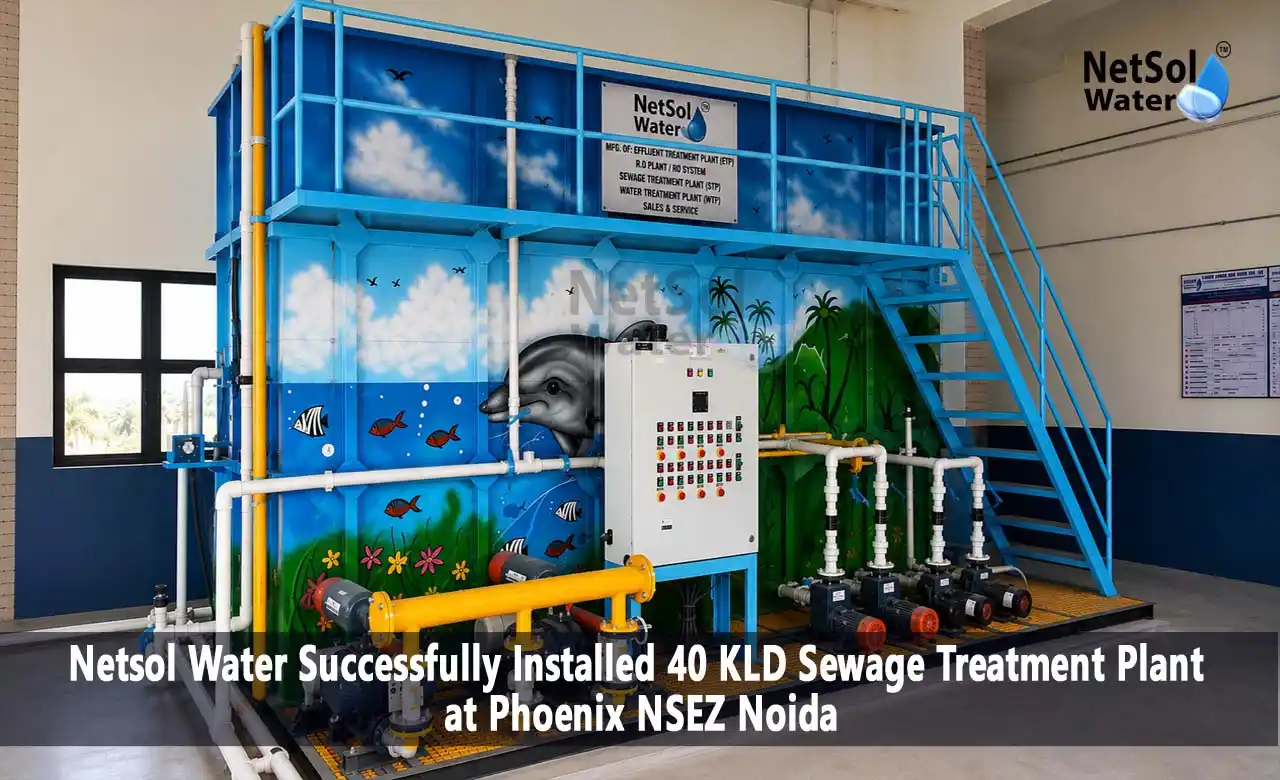
Case Study: 40 KLD STP Plant Installed at Phoenix, NSEZ Noida
Manufacturing facilities operating inside a special economic zone generate wastewater as part of their daily operations, and that wastewater has to go somewhere responsible. This case study looks at the 40 KLD STP plant installation at Phoenix, NSEZ Noida a project undertaken by Netsol Water to help the facility treat its sewage on-site and reuse the treated water for gardening, toilet flushing and washing applications.
Phoenix is the Phoenix Lamps Division of Suprajit Engineering Limited, located inside the Noida Special Economic Zone (NSEZ), Phase II. Like most facilities of its size, the site generates a steady volume of domestic and process-related sewage that needs to be collected, treated and either discharged safely or reused. Netsol Water was engaged to design, supply and install a sewage treatment plant (STP) with a capacity of 40 KLD to meet this requirement. The following sections walk through the project background, the technical approach, the installation process and the outcomes.
Project Overview
| Parameter | Details |
|---|---|
| Project | 40 KLD STP Plant Installation |
| Location | Phoenix, NSEZ Noida |
| Capacity | 40 KLD |
| Application | Sewage Treatment |
| Technology | Biological wastewater treatment process, selected based on site requirements |
| Treated Water Reuse | Gardening, Flushing & Washing |
| Project Execution | Netsol Water |
About Suprajit
Suprajit Engineering Limited is an automotive component manufacturer, and its Phoenix Lamps Division operates a halogen lamp manufacturing unit inside the Noida Special Economic Zone. As an export-oriented manufacturing unit, the facility runs continuous operations that generate domestic sewage from staff amenities, washrooms and allied utility areas.
For a facility of this scale, unmanaged wastewater is not a minor operational detail it has direct implications for regulatory compliance, site hygiene and water availability. Responsible wastewater management means treating sewage before it leaves the premises and, wherever feasible, putting that treated water back to use rather than letting it go to waste. This is the operational context in which the 40 KLD STP requirement arose.
About Phoenix, NSEZ Noida
The Noida Special Economic Zone is a designated industrial zone that houses several export-oriented manufacturing units, including Phoenix Lamps Division's facility in Phase II. Facilities operating within an SEZ are expected to maintain a high standard of environmental compliance, and wastewater handling is one of the areas regulators pay close attention to.
For a manufacturing unit inside NSEZ Noida, systematic sewage treatment isn't optional it's a basic requirement of running a compliant, well-managed facility. A functioning STP ensures that sewage generated on-site is treated to a standard suitable for reuse or safe discharge, rather than being sent out untreated. It also gives the facility a degree of self-sufficiency: treated water can support non-potable needs within the campus itself, reducing dependence on external freshwater sources for tasks that don't require potable-grade water.
About Netsol Water
Netsol Water is a Greater Noida-based water and wastewater treatment company that designs, manufactures and installs sewage treatment plants (STP), effluent treatment plants (ETP), and RO Plant-based water treatment systems for residential, commercial and industrial clients across Noida, Greater Noida, Delhi NCR and beyond. As an established Sewage Treatment Plant Manufacturer in Noida and STP Plant Manufacturer in Noida, the company designs each system around the site it is built for rather than offering a single standard configuration.
For the Phoenix, NSEZ Noida project, Netsol Water's scope covered the full project lifecycle from evaluating the site's sewage generation pattern and space constraints, through system design, equipment supply, installation, piping and electrical integration, to testing, commissioning and handover. Based on the site requirement, the installation team configured a 40 KLD plant sized to the facility's daily sewage flow and worked through the practical constraints of fitting the system into existing infrastructure.
Netsol Water also offers after-sales support and annual maintenance contracts (AMC) for STP systems, so that plants continue to perform reliably well beyond the commissioning stage an important consideration for any facility that depends on its STP for ongoing regulatory compliance and water reuse.
Why Was a 40 KLD STP Required at Phoenix, NSEZ Noida?
A 40 KLD STP is designed to treat up to approximately 40,000 litres of sewage per day "KLD" stands for kilolitres per day, and one kilolitre equals 1,000 litres. In other words, this 40 KLD Sewage Treatment Plant is engineered around the facility's estimated daily wastewater generation; the figure does not mean that exactly 40,000 litres are treated every single day, since actual flow varies with staff strength, working hours and operational patterns.
The requirement for a dedicated STP at Phoenix, NSEZ Noida stemmed from a few practical considerations:
. A manufacturing facility with washroom and utility discharge needs a systematic way to treat sewage rather than let it accumulate or discharge untreated.
. Facilities operating within an SEZ are expected to manage their environmental footprint responsibly, and an on-site STP is a direct way to do that.
. Treated water opens up the possibility of reuse for non-potable applications, easing pressure on freshwater sources used for gardening, flushing and washing.
. A reliably operating STP reduces the operational and compliance risk associated with ad-hoc wastewater handling.
. As a Commercial STP Plant in Noida, the system also needed to meet the facility's regulatory and operational expectations without disrupting day-to-day work.
Netsol Water's role was to translate this requirement into a working plant sized correctly for the site.
Design and Capacity of the 40 KLD STP Plant
Sizing an STP correctly starts with understanding the site's actual sewage flow pattern. For the Phoenix, NSEZ Noida project, this meant accounting for:
. Hydraulic loading - the volume of wastewater entering the system across a working day, including peak-hour variation.
. Organic loading - the concentration of biodegradable organic matter in the sewage, which determines how much biological treatment capacity the plant needs.
. Site conditions and space availability - the plant footprint had to fit within the space allocated at the facility without disrupting existing operations.
. Treated water reuse requirements - since the treated output was intended for gardening, flushing and washing, the design had to deliver water suitable for these non-potable applications.
. Ease of operation and maintenance - a plant that facility staff can monitor and maintain without constant specialist intervention.
Based on these factors, the plant was designed around a straightforward treatment flow:
Sewage Collection → Preliminary Treatment → Biological Treatment → Clarification → Filtration and Disinfection → Treated Water Storage → Reuse
|
Sewage
Collection |
→ |
Preliminary
Treatment |
→ |
Biological
Treatment |
→ |
Clarification
|
→ |
Filtration &
Disinfection |
→ |
Treated Water
Storage |
→ |
Reuse
|
How the 40 KLD STP Plant Works?
| Stage | What Happens |
|---|---|
| Sewage Collection | Wastewater from washrooms and utility areas enters the STP's collection/equalization tank through the site's drainage network. |
| Preliminary Treatment | Larger solids, debris and floating material are screened out to protect downstream equipment. |
| Equalization | Fluctuating sewage flow through the day is balanced so biological treatment units receive a steady load. |
| Biological Treatment | Microorganisms break down biodegradable organic pollutants present in the sewage. |
| Clarification | Treated solids settle and separate from the liquid, leaving clearer water to move forward. |
| Filtration & Disinfection | Clarified water is filtered and disinfected to a standard suitable for non-potable reuse. |
| Treated Water Storage | Treated water is collected in a storage tank, ready for reuse applications. |
1. Sewage Collection
Wastewater generated at the facility from washrooms and utility areas is collected through the site's drainage network and directed into the STP's collection or equalization tank, which serves as the entry point for the treatment process.
2. Preliminary Treatment
Before biological treatment can begin, larger solids, debris and floating material are screened out. This preliminary step protects downstream equipment and keeps the biological treatment stage working on wastewater that's been cleared of coarse contaminants.
3. Equalization
Sewage flow through the day is rarely constant it peaks during certain hours and drops off at others. An equalization stage helps balance this variation, so the biological treatment units receive a steadier flow rather than sudden surges.
4. Biological Treatment
This is the core of the process. Naturally occurring microorganisms are used to break down biodegradable organic pollutants present in the sewage. These microorganisms consume organic matter as a food source, which reduces the pollutant load in the wastewater over the course of the treatment cycle.
5. Secondary Treatment / Clarification
Following biological treatment, the water passes through a clarification stage where treated solids are allowed to settle and separate from the liquid, leaving clearer water to move forward in the process.
6. Tertiary Treatment and Disinfection
Depending on the reuse application, the clarified water may go through additional filtration and disinfection to bring it to a standard suitable for non-potable reuse such as gardening, flushing or washing.
7. Treated Water Storage
Once treated, the water is collected in a storage tank, ready to be drawn for its intended reuse applications rather than being discharged as waste.
Treated Water Reuse at Phoenix, NSEZ Noida
One of the central goals of this project was ensuring that treated sewage water didn't just meet discharge norms it could actually be put to productive use on-site. This is what Treated Sewage Water Reuse, or STP Treated Water Reuse, means in practice at Phoenix, NSEZ Noida.
1. Gardening
This is an example of Treated Water Reuse for Gardening in action: treated water suitable for non-potable use can support landscaping and gardening needs within the facility premises, reducing the amount of fresh or municipal water drawn for this purpose.
2. Toilet Flushing
Flushing is a high-volume, non-potable water use in any commercial or industrial facility, which makes Treated Water Reuse for Flushing one of the most direct ways an STP reduces a facility's freshwater demand.
3. Washing
Suitable non-potable washing applications such as floor washing or external area cleaning represent another practical form of Treated Water Reuse for Washing, further reducing reliance on fresh water for tasks that don't require potable quality.
The reuse cycle at Phoenix, NSEZ Noida follows a simple loop:
Sewage → Treatment → Treated Water → Storage → Gardening + Flushing + Washing → Freshwater Conservation
|
Sewage
|
→ |
Treatment
|
→ |
Treated Water
|
→ |
Storage
|
→ |
Gardening
+ Flushing + Washing |
→ |
Freshwater
Conservation |
Reuse Application Benefit Gardening Reduces fresh/municipal water draw for landscaping within the premises Toilet Flushing Offsets a high-volume, routine non-potable water use Washing Covers floor and external area cleaning without using fresh water
CPCB and SPCB Norms for Treated Sewage Water
Sewage treatment plants in India are governed by discharge and reuse standards set by the Central Pollution Control Board (CPCB) and enforced locally by the State Pollution Control Board (SPCB) in this case, the Uttar Pradesh Pollution Control Board (UPPCB). These norms define the quality that treated water must meet before it can be discharged or reused, and they are the general regulatory benchmark an STP is designed and operated against not a claim of specific test results for this project.
The table below summarises the general parameters commonly referenced under CPCB norms for treated sewage water:
| Parameter | General CPCB Norm (Typical Range) |
|---|---|
| pH | 6.5 – 9.0 |
| BOD (Biochemical Oxygen Demand) | ≤ 10–30 mg/L, depending on discharge/reuse point |
| COD (Chemical Oxygen Demand) | ≤ 50–250 mg/L, depending on discharge/reuse point |
| TSS (Total Suspended Solids) | ≤ 10–100 mg/L, depending on discharge/reuse point |
| Fecal Coliform | ≤ 100 MPN/100 mL (for reuse/on-land application) |
These figures are the general, publicly stated CPCB benchmarks and can vary based on where the treated water goes reuse on land, discharge into a drain, or discharge into a river or water body typically carries a stricter limit than discharge into a sewer. The SPCB/UPPCB Consent to Operate issued for a specific facility is the binding document, and it can prescribe limits tighter than the national baseline. Netsol Water designs its STP systems, including the plant at Phoenix, NSEZ Noida, to work toward these regulatory benchmarks, with the exact consent conditions applicable to a given site determined by the SPCB/UPPCB.
Installation Process of the 40 KLD STP Plant
As with any STP Plant Installation in Noida, execution quality determines how the system performs once handed over. The following steps outline how this Sewage Treatment Plant Installation in Noida was carried out at Phoenix, NSEZ Noida.
1. Site Assessment
The project began with Netsol Water's team assessing the facility's sewage generation pattern, available installation space, existing drainage layout and points of connection for the new plant.
2. Design & Engineering
Based on the site assessment, the plant was engineered to a 40 KLD capacity, with the treatment stages and tank sizing worked out to match the facility's flow and organic loading characteristics.
3. Equipment Preparation
Once the design was finalized, the required tanks, pumps, blowers, piping components and treatment units were prepared for the project ahead of installation.
4. Transportation & Installation
Equipment was transported to the Phoenix, NSEZ Noida site and installed at the designated location, with the installation team working within the space constraints identified during the site assessment.
5. Piping & Electrical Connections
The STP was integrated with the facility's existing sewage collection network through piping connections, and the necessary electrical connections were completed for pumps, blowers and other powered components.
6. Testing & Commissioning
Once installed, the system was tested across its treatment stages to confirm that it was functioning as designed before being handed over for regular operation.
7. Final Handover
Following successful commissioning, the plant was handed over to the facility, along with guidance on day-to-day operation and access to after-sales support from Netsol Water.
40 KLD STP Plant Installation Video at Phoenix, NSEZ Noida
The video below provides a visual overview of the 40 KLD STP plant installed at Phoenix, NSEZ Noida, giving readers a closer look at the installed system and how the project came together.
Project Challenges and Netsol Water's Solution
Every industrial STP installation involves working around an existing facility rather than a blank site, and this project was no exception.
. Space optimization - Fitting a 40 KLD treatment system into the space allocated within an active manufacturing facility required careful layout planning so the plant didn't interfere with existing operations.
. Integration with existing infrastructure - The new STP had to tie into the facility's existing drainage and utility network, which meant piping routes and connection points had to be planned around what was already in place.
. Treated water reuse arrangement - Setting up separate lines for gardening, flushing and washing reuse required additional planning beyond just treating and discharging the water.
. Installation coordination - Working within an operational facility meant coordinating installation activity to minimize disruption to daily operations.
Netsol Water's approach to each of these was practical: assess the constraint at the site assessment stage, design around it rather than after the fact, and keep the installation team's work sequenced so the facility could continue functioning through the project.
Results and Benefits of the 40 KLD STP Installation
The completed project gave Phoenix, NSEZ Noida a functioning on-site sewage treatment system with the following outcomes:
. A 40 KLD Sewage Treatment Plant Installation matched to the facility's daily wastewater generation.
. A structured, systematic approach to wastewater management in place of untreated discharge.
. Treated water made available for reuse in gardening, toilet flushing and washing.
. Reduced dependency on freshwater sources for these specific non-potable applications.
. A facility better positioned to manage its wastewater responsibly as part of ongoing operations.
Environmental Benefits of the Project
Treating sewage on-site and reusing the output has environmental value beyond simple compliance:
. Wastewater recycling keeps a portion of the facility's water use within a closed loop rather than drawing exclusively on fresh sources.
. Water conservation results from redirecting treated water to gardening, flushing and washing instead of relying solely on freshwater for these uses.
. Reduced untreated sewage discharge risk comes from having a dedicated, functioning treatment system in place rather than depending on ad-hoc handling.
. Sustainable facility management is supported when wastewater treatment is built into standard site operations rather than treated as an afterthought.
Why Netsol Water for STP Plant Installation?
The Phoenix, NSEZ Noida project reflects the kind of work Netsol Water does across its STP installations - site-specific design rather than a one-size-fits-all approach, whether the requirement is a compact residential system or a Sewage Treatment Plant for Commercial Facilities like this one. For this project, that meant:
. Assessing the site's actual sewage flow and space constraints before finalizing a design.
. Engineering, manufacturing and supplying the treatment equipment for the 40 KLD capacity required.
. Installing the plant and integrating it with existing site infrastructure.
. Commissioning the system and testing it before handover.
. Structuring the treated water output for reuse in gardening, flushing and washing.
. Providing after-sales and AMC support so the plant continues to perform over time.
Conclusion
The 40 KLD STP Plant Installation at Phoenix, NSEZ Noida gave the facility a dedicated, appropriately sized system for treating its daily sewage on-site. Executed by Netsol Water, the project covered site assessment, design, equipment supply, installation and commissioning, resulting in a plant that treats wastewater and channels the treated output into gardening, toilet flushing and washing applications. For a facility operating within NSEZ Noida, this kind of on-site treatment and reuse setup supports both regulatory compliance and more responsible, longer-term water management.
FAQs
Q1. What is the capacity of the STP installed at Phoenix, NSEZ Noida?
The plant installed at Phoenix, NSEZ Noida a 40 KLD STP Plant in Noida has a design capacity of 40 KLD, meaning it is built to treat up to approximately 40,000 litres of sewage per day generated at the facility.
Q2. What does a 40 KLD STP mean?
KLD stands for kilolitres per day. A 40 KLD STP, or 40 KLD Sewage Treatment Plant, is designed to treat up to 40 kilolitres, or roughly 40,000 litres, of wastewater every day based on its engineered capacity.
Q3. Why was a 40 KLD STP required at Phoenix, NSEZ Noida?
The facility, operating within NSEZ Noida, generates domestic sewage from its operations that needs systematic treatment rather than untreated discharge. A 40 KLD STP was sized to match this daily wastewater generation and support responsible on-site water management.
Q4. Where can treated STP water be reused?
At Phoenix, NSEZ Noida, treated water from the STP is reused for gardening, toilet flushing and washing applications, reducing the facility's dependence on freshwater for these specific non-potable uses.
Q5. Can treated wastewater be used for gardening and toilet flushing?
Treated wastewater that meets the required non-potable quality standard can be used for gardening and toilet flushing. Both are common, practical Treated Sewage Water Reuse applications in commercial and industrial facilities.
Q6. Who installed the 40 KLD STP Plant at Phoenix, NSEZ Noida?
The 40 KLD STP Plant Installation at Phoenix, NSEZ Noida was designed, supplied and installed by Netsol Water, covering the project from site assessment through to commissioning and handover.
Q7. What are the benefits of reusing treated sewage water?
Reusing treated sewage water reduces a facility's reliance on freshwater for non-potable applications like gardening, flushing and washing, supports more sustainable water management, and reduces the volume of wastewater that would otherwise need external discharge.
Q8. Why is STP important for commercial and industrial facilities?
An STP allows commercial and industrial facilities to treat sewage generated on-site rather than discharging it untreated, supporting regulatory compliance, reducing environmental impact, and enabling STP Treated Water Reuse for suitable non-potable applications.