

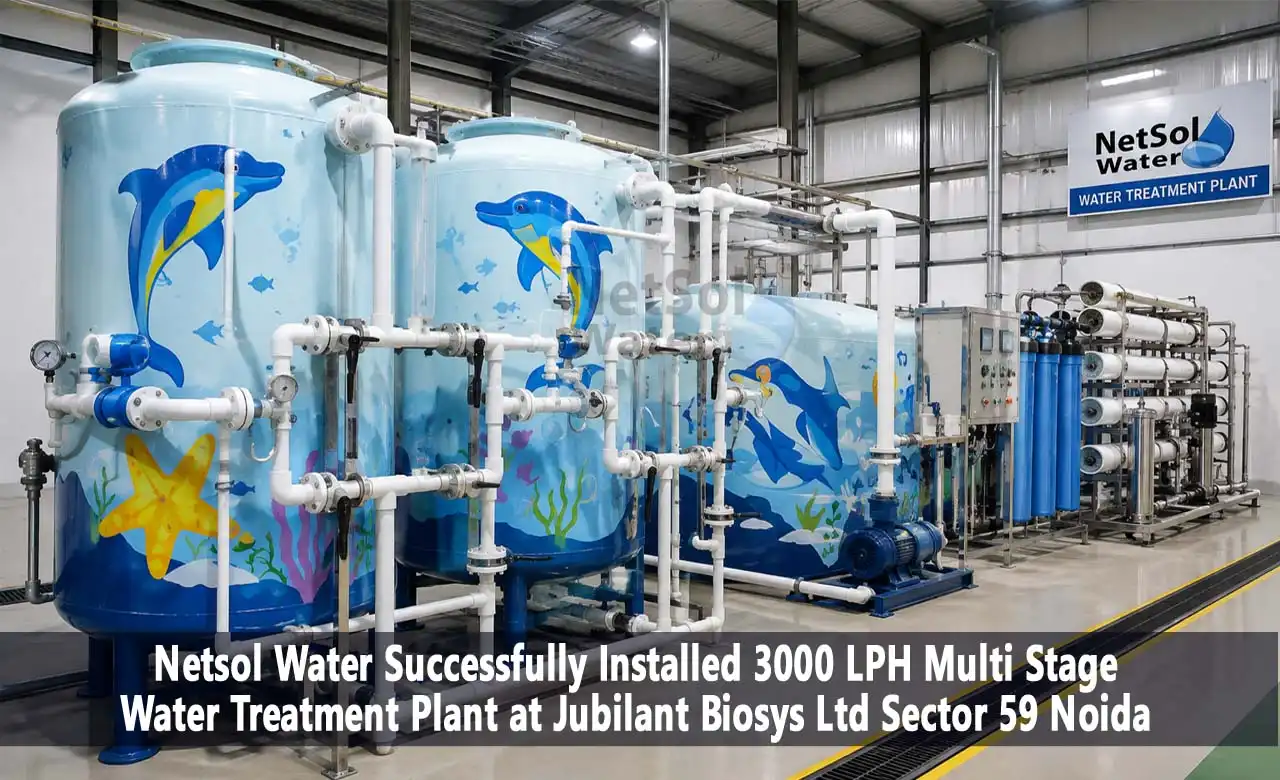
Case Study: 3000 LPH RO + DM + MB WTP Plant at Jubilant Biosys, Noida
When a pharmaceutical research facility talks about water, it isn’t talking about the same water that fills a household tap. It’s talking about a raw material one that has to be free of dissolved solids, hardness, organic contamination, and microbial load before it can touch a single test tube, reactor, or piece of lab glassware. That’s the challenge Netsol Water was brought in to solve at Jubilant Biosys Ltd., a pharmaceutical and drug research company operating out of Sector-59, Noida, Uttar Pradesh.
Netsol Water is an ISO-certified Water Treatment Plant Manufacturer with more than 14+ years of hands-on experience designing, manufacturing, installing, and servicing Industrial Water Treatment Plant systems across India. For this project, the brief was clear: deliver a 3000 LPH Multi-Stage Water Treatment Plant capable of converting variable-quality raw water into consistent, near-zero TDS water suitable for pharmaceutical and laboratory use.
This case study walks through the entire journey of the project from the challenges Jubilant Biosys faced before installation, to the engineering logic behind every stage of the treatment process, to the measurable improvements the client now experiences in daily operations. Whether you’re a plant manager, a procurement lead, or an engineer evaluating a Water Treatment Plant Manufacturer for a similar Pharmaceutical Water Treatment Plant application, this project offers a practical, real-world reference point.
Project Snapshot
| Parameter | Details |
|---|---|
| Client | Jubilant Biosys Ltd. |
| Industry | Pharmaceutical & Drug Research |
| Location | Sector-59, Noida, Uttar Pradesh |
| Plant Capacity | 3000 LPH |
| Water Source | Municipal / Borewell Raw Water Supply |
| Treatment Technology | Multi-Stage Pretreatment + Double Stage RO + DM Plant + Mixed Bed Polishing |
| Final Water Quality | Near Zero TDS, Laboratory & Pharma Grade |
| Application | Laboratory Use, Research, Pharmaceutical Manufacturing Support |
About Jubilant Biosys Ltd.
Jubilant Biosys Ltd. operates in the pharmaceutical and drug research space, where day-to-day work involves formulation research, analytical testing, and process development all activities that are directly dependent on water purity. In this industry, water isn’t a support utility; it’s practically a raw material and a quality-control variable.
Even trace-level contamination a few extra ppm of dissolved solids, a slightly elevated hardness reading, or inconsistent conductivity can throw off analytical results, damage sensitive lab instruments, or compromise formulation stability. That’s why pharmaceutical facilities like Jubilant Biosys need water that isn’t just “clean” in a general sense, but purified to a defined, repeatable, and verifiable standard, batch after batch.
This is precisely where a properly engineered multi-stage treatment system rather than a single filtration unit becomes essential.
Client Challenges
Before the new system was installed, Jubilant Biosys was dealing with a set of water quality issues that are common in facilities relying on standard municipal or borewell supply without dedicated high-purity treatment:
• High TDS levels in the incoming raw water, making it unsuitable for direct lab or pharma use
• Hardness and scaling tendencies, which threatened to damage downstream equipment and reduce membrane life
• Variable water quality from the source, meaning output couldn’t be trusted to stay consistent day to day
• A hard requirement for laboratory-grade water general “purified” water wasn’t good enough; the facility needed water meeting pharmaceutical-use standards
• Continuous production demand, since research and testing schedules don’t pause for water quality dips or equipment downtime
Individually, each of these is manageable. Together, they represented a real operational risk for a facility where water quality directly touches research outcomes.
Project Objectives
Working closely with the Jubilant Biosys team, Netsol Water defined the following core objectives for the plant:
• Deliver high-purity water suitable for laboratory and pharmaceutical applications
• Maintain stable, consistent water quality regardless of fluctuations in raw water input
• Achieve near-zero TDS output through a combination of RO, DM, and Mixed Bed polishing
• Keep operating costs manageable through efficient recovery and reduced chemical/resin consumption
• Ensure reliable, continuous operation capable of supporting uninterrupted lab and research work
These objectives shaped every design decision in the plant, from pretreatment sizing to the choice of a double-pass RO configuration.
Why Netsol Water?
Jubilant Biosys selected Netsol Water after evaluating the company’s full-cycle capability not just as an equipment supplier, but as an engineering partner for the entire project lifecycle:
| Stage | What It Covers |
|---|---|
| Water Analysis | Testing the raw water source to understand TDS, hardness, pH, and contaminant load before designing the treatment system. |
| Site Survey | Assessing available space, utility connections, and layout constraints at the Sector-59 facility. |
| Customized Engineering | Designing a treatment train tailored to pharmaceutical water quality requirements instead of using a standard off-the-shelf solution. |
| In-house Manufacturing | Manufacturing key plant components under strict quality control to ensure long-term reliability and performance. |
| Installation & Commissioning | Complete on-site installation, piping, electrical integration, testing, and successful commissioning of the system. |
| After-Sales Support & AMC | Scheduled preventive maintenance, technical support, and AMC services to ensure consistent plant performance. |
This turnkey approach water analysis to AMC is what makes Netsol Water a preferred Water Treatment Plant Manufacturer for pharmaceutical and other high-purity applications across India. Beyond this specific installation, Netsol Water is also recognized as a trusted Industrial RO Plant Manufacturer and DM Plant Manufacturer, supplying RO DM Plant systems, High Purity Water System solutions, and Multi-Stage Water Treatment Plant installations for pharmaceutical, industrial, and laboratory clients including several Water Treatment Plant in Noida and across the wider NCR region.
Complete Process Flow
The 3000 LPH plant at Jubilant Biosys follows a carefully sequenced multi-stage process. Each stage exists to remove a specific category of impurity, protecting the stages that follow it and progressively refining water quality until it reaches near-zero TDS.
The table below summarizes the role of each stage before we go through them in detail:
| Stage | Primary Function |
|---|---|
| Raw Water Tank | Buffers and stabilizes incoming raw water supply. |
| Feed Pump | Delivers a consistent flow of raw water to the pretreatment system. |
| Pressure Sand Filter (PSF) | Removes turbidity, suspended solids, and larger particulate matter. |
| Activated Carbon Filter (ACF) | Removes chlorine, organic compounds, colour, and odour. |
| Water Softener | Removes hardness-causing minerals to prevent membrane scaling. |
| Micron Cartridge Filter | Provides final fine-particle filtration before the RO system. |
| High Pressure Pump | Supplies the pressure required for efficient reverse osmosis operation. |
| Double Stage RO Plant | Reduces dissolved salts through two-pass reverse osmosis treatment. |
| Demineralization (DM) Plant | Removes remaining dissolved ions through ion exchange resins. |
| Mixed Bed (MB) Polishing Unit | Provides final polishing to achieve near-zero TDS and high-purity water. |
| Zero TDS Storage Tank | Stores treated high-purity water for continuous laboratory and process use. |
Let’s go through each stage in detail.
1. Raw Water Tank
This is the starting point of the system a storage tank that buffers incoming raw water from the municipal or borewell source. Its purpose is simple but important: it decouples the treatment plant from fluctuations in source water supply pressure and flow, giving the system a stable feed to draw from at all times. Without this buffer, any interruption or pressure drop at the source would directly disrupt downstream treatment.
2. Feed Pump
The feed pump draws water from the raw water tank and pushes it through the pretreatment train at a controlled, consistent flow rate. Sizing this pump correctly is critical too much flow and the downstream filters don’t get adequate contact time; too little and the plant can’t hit its 3000 LPH capacity target. It’s the mechanical heartbeat that keeps water moving through every subsequent stage.
3. Pressure Sand Filter (PSF)
The PSF is the plant’s first line of physical defense. Water passes through graded layers of sand and gravel media under pressure, which traps suspended solids, silt, turbidity-causing particles, and larger debris.
Working Principle: As water flows downward through the sand bed, particles larger than the media’s effective pore size get physically trapped, while cleaner water passes through.
Technical Benefits: Reduces turbidity and suspended solid load significantly before water reaches more sensitive downstream equipment like carbon filters and RO membranes.
Importance: Without this stage, suspended particles would quickly foul the activated carbon bed and clog RO membranes, driving up maintenance frequency and cost.
4. Activated Carbon Filter (ACF)
Once suspended solids are removed, the water passes through the activated carbon filter, which targets chlorine, organic compounds, color, and odor.
Working Principle: Activated carbon has an enormous internal surface area, and contaminants adsorb onto this surface as water passes through the media bed.
Technical Benefits: Removes free chlorine (which would otherwise damage RO membranes), along with organic matter and taste/odor-causing compounds.
Importance: RO membranes are highly sensitive to chlorine exposure even low residual levels can degrade membrane performance over time. The ACF stage protects membrane life downstream in the Double Stage RO system.
5. Water Softener
Hardness dissolved calcium and magnesium was one of the specific challenges flagged before installation. The water softener addresses this directly.
Working Principle: Water passes through a bed of ion-exchange resin, where calcium and magnesium ions are exchanged for sodium ions, effectively removing hardness from the water.
Technical Benefits: Prevents scale formation on RO membranes and downstream piping, which would otherwise reduce system efficiency and increase cleaning frequency.
Importance: Scaling is one of the most common causes of premature RO membrane failure. Softening the water before it reaches the high-pressure RO stage is a critical protective step.
6. Micron Cartridge Filter
Before water reaches the high-pressure pump and RO membranes, it passes through a fine micron cartridge filter for final polish filtration.
Working Principle: Water is forced through a tightly wound or pleated filter element that captures fine particulates down to a specified micron rating.
Technical Benefits: Removes any residual fine particles that made it through earlier stages, protecting the RO membranes from physical fouling.
Importance: RO membranes have very tight tolerances even micron-scale particles can cause fouling or physical damage if they’re not filtered out beforehand.
7. High Pressure Pump
RO membranes require significant pressure to force water molecules through the semi-permeable membrane while rejecting dissolved salts and impurities. The high-pressure pump supplies exactly that.
Working Principle: The pump elevates water pressure to the level required to overcome the osmotic pressure of the dissolved salts, enabling reverse osmosis to occur.
Technical Benefits: Ensures consistent membrane performance and predictable permeate output at the plant’s rated 3000 LPH capacity.
Importance: Without adequate and stable pressure, RO recovery and rejection rates would be inconsistent, directly affecting final water quality.
8. Double Stage Reverse Osmosis (RO)
This is the core purification stage of the plant, and it deserves its own detailed breakdown below.
9. Demineralization (DM) Plant
After RO, water still carries trace dissolved ions. The DM plant removes these almost entirely.
10. Mixed Bed (MB) Polishing Unit
The final polishing stage, bringing water to near-zero TDS for pharmaceutical-grade use.
11. Zero TDS Water Storage Tank
Treated water is stored here before distribution, ensuring a ready supply for continuous lab and research operations without waiting on real-time production.
Double Stage RO System
Given how central it is to achieving pharmaceutical-grade water quality, the Double Stage RO Plant merits a dedicated explanation.
| Element | Details |
|---|---|
| First Pass RO | Raw pretreated water passes through the first-stage RO membranes under high pressure, removing the majority of dissolved salts and impurities. |
| Second Pass RO | Permeate from the first pass is treated again through a second RO stage to further reduce TDS and improve overall water purity. |
| Membrane Technology | Thin-Film Composite (TFC) membranes provide high salt rejection, excellent durability, and consistent long-term performance. |
| High-Pressure Pumps | Dedicated high-pressure pumps maintain the operating pressure required for efficient performance of both RO stages. |
| Salt Rejection & Recovery | The double-stage RO configuration delivers higher overall salt rejection and improved treated water quality compared to a single-pass RO system. |
| Benefits for Pharma Use | Produces high-purity water with consistently low TDS, making it suitable for laboratory, pharmaceutical, and research applications. |
DM Plant
Even after the Double Stage RO Plant, trace dissolved ions remain in the water. The DM Plant removes these using ion-exchange technology.
| Component | Function |
|---|---|
| Cation Unit | Removes positively charged ions such as calcium, magnesium, and sodium by exchanging them with hydrogen ions. |
| Anion Unit | Removes negatively charged ions such as chlorides, sulfates, and nitrates by exchanging them with hydroxide ions. |
| Regeneration Process | Restores the ion exchange capacity of the resins using acid for the cation unit and caustic soda for the anion unit. |
| Conductivity Reduction | Significantly reduces water conductivity by removing the remaining dissolved ionic impurities. |
| Water Polishing | Further purifies the RO permeate, producing high-quality water suitable for pharmaceutical and laboratory applications. |
Mixed Bed Plant
The Mixed Bed Plant is the final polishing stage before water is considered ready for pharmaceutical and laboratory use.
| Aspect | Details |
|---|---|
| Resin Composition | A homogeneous mixture of cation and anion exchange resins is packed in a single vessel to provide superior final water polishing. |
| Final Polishing | Removes the remaining trace ions after the DM Plant, producing ultra-high purity water suitable for critical applications. |
| Zero TDS Water Production | Delivers near-zero TDS water with extremely low conductivity for pharmaceutical, laboratory, and research applications. |
| Importance in Pharmaceutical Industry | Ensures consistently high-purity water required for analytical testing, formulation development, glassware washing, and other critical pharmaceutical processes. |
Instrumentation & Automation
A treatment plant is only as reliable as its ability to be monitored and controlled. The system at Jubilant Biosys includes:
| Instrument | Purpose |
|---|---|
| Online TDS Meter | Continuously monitors Total Dissolved Solids (TDS) to ensure consistent water quality throughout the treatment process. |
| Conductivity Meter | Measures water conductivity to verify the effectiveness of the DM Plant and Mixed Bed polishing unit. |
| Pressure Gauges | Monitor operating pressure across filters, pumps, and RO membranes to identify fouling or pressure loss. |
| Flow Meter | Measures the water flow rate to ensure the plant consistently delivers its designed 3000 LPH capacity. |
| Control Panel | Provides centralized monitoring and control of the complete water treatment system for safe and efficient operation. |
| Safety Features | Includes protective alarms and automatic shutdown functions to safeguard the plant against low-water levels, pressure fluctuations, and equipment faults. |
This instrumentation layer is what turns a set of treatment stages into an actual manageable, auditable system something that matters a great deal in a pharmaceutical operating environment.
Water Quality Improvement
While exact site-specific readings vary based on raw water source conditions, the table below illustrates the general purification trend water undergoes as it moves through each stage of this treatment train:
| Treatment Stage | Water Quality Focus |
|---|---|
| Raw Water | Baseline water quality with variable TDS, hardness, turbidity, chlorine, and dissolved impurities. |
| After Pressure Sand Filter (PSF) | Turbidity, suspended solids, and coarse particles are significantly reduced. |
| After Activated Carbon Filter (ACF) | Chlorine, organic compounds, colour, and odour are effectively removed. |
| After Water Softener | Hardness-causing minerals are removed, minimizing the risk of RO membrane scaling. |
| After Cartridge Filter | Fine suspended particles are removed, ensuring clean feed water for the RO system. |
| After First Pass RO | Most dissolved salts (TDS), heavy metals, and contaminants are rejected. |
| After Second Pass RO | Additional TDS reduction provides higher purity water suitable for pharmaceutical applications. |
| After DM Plant | Remaining dissolved ions are removed, resulting in very low conductivity water. |
| After Mixed Bed Plant | Final polishing produces near-zero TDS, pharmaceutical-grade, and laboratory-quality water. |
This progressive improvement is exactly why a multi-stage approach rather than relying on RO alone is necessary for pharmaceutical-grade water requirements.
Applications of Treated Water
The near-zero TDS water produced by this High Purity Water System supports multiple critical functions at Jubilant Biosys:
| Application | How It's Used |
|---|---|
| Laboratory Use | Supplies high-purity water for laboratory analysis, testing, and daily research activities. |
| Research | Provides ultra-pure water for analytical testing, formulation development, and pharmaceutical research. |
| Pharmaceutical Manufacturing | Supports critical process water requirements for pharmaceutical production and quality assurance. |
| Glassware Washing | Ensures residue-free cleaning of laboratory glassware and equipment without mineral deposits. |
| Process Water | Delivers consistent high-quality water for various pharmaceutical process and utility applications. |
Engineering Challenges & Solutions
Every industrial water treatment installation comes with site-specific realities that need practical engineering solutions. At Jubilant Biosys, the Netsol Water team addressed several such challenges:
Challenge — Variable Raw Water Quality: Since incoming water quality wasn’t perfectly consistent, the pretreatment stages (PSF, ACF, softener) were sized with enough capacity margin to handle fluctuations without compromising downstream RO performance.
Challenge — Space Constraints: Like many facilities operating within an established industrial layout, available floor space for the treatment plant was limited. The system was engineered with a compact, efficient footprint that fit within the site’s existing infrastructure without requiring major civil work.
Challenge — Continuous Operation Requirement: Since research schedules can’t accommodate unpredictable downtime, the plant was designed with reliable, well-protected components (softener ahead of RO, adequate pretreatment margins) specifically to minimize unplanned maintenance interruptions.
Solution Approach: In each case, the guiding principle was the same protect the more expensive, sensitive downstream equipment (RO membranes, DM resin, Mixed Bed resin) by ensuring upstream stages were sized and specified correctly the first time.
Project Results
Since commissioning, the plant has delivered measurable operational improvements for Jubilant Biosys:
| Result Area | Outcome |
|---|---|
| Improved Water Quality | Consistently delivers near-zero TDS water suitable for pharmaceutical laboratories, research, and critical process applications. |
| Stable Operation | Ensures reliable plant performance with minimal variation in treated water quality despite fluctuations in raw water conditions. |
| Reduced Maintenance | Efficient pretreatment minimizes membrane fouling and resin exhaustion, reducing maintenance frequency and downtime. |
| Longer Membrane Life | Proper filtration and water softening protect RO membranes from scaling, extending their operational life. |
| Lower Operating Costs | Optimized system design and efficient recovery help reduce operating expenses and maintenance costs. |
| Reliable Production Support | Provides a continuous supply of high-purity water to support uninterrupted laboratory and pharmaceutical operations. |
| Customer Satisfaction | Successfully fulfilled Jubilant Biosys' requirement for a dependable, high-purity water treatment solution with consistent performance. |
Project Video
To see how this system was actually installed and how it operates in practice, Netsol Water has documented the project on video. Watching a plant like this in motion the RO skids, the piping layout, the control panel in action often makes the engineering easier to understand than any written description.
Watch the complete installation and working of this project here:
Why Choose Netsol Water?
Projects like the one at Jubilant Biosys reflect the broader capabilities Netsol Water brings to every installation:
| Strength | Why It Matters |
|---|---|
| ISO Certified Company | Follows internationally recognized quality management standards to deliver reliable water treatment solutions. |
| 14+ Years of Experience | Extensive expertise in designing, manufacturing, installing, and maintaining water and wastewater treatment systems. |
| In-house Manufacturing | Ensures strict quality control, faster production, and reliable performance of every system. |
| PAN India Installation | Successfully executed projects across India with comprehensive installation and commissioning support. |
| Experienced Engineers | Skilled technical professionals manage everything from water analysis and design to commissioning and after-sales support. |
| Customized Solutions | Every plant is engineered according to the client's water quality, process requirements, and available site conditions. |
| AMC Support | Preventive maintenance and annual service contracts help ensure long-term plant efficiency and reliability. |
| Complete Turnkey Projects | End-to-end project execution, including design, manufacturing, installation, commissioning, and post-installation support. |
Conclusion
The 3000 LPH Multi-Stage Water Treatment Plant at Jubilant Biosys Ltd. is a practical example of how thoughtful, multi-stage engineering pretreatment, Double Stage RO Plant, DM Plant, and Mixed Bed Plant polishing working together can consistently deliver the near-zero TDS water that pharmaceutical research demands.
Rather than relying on a single treatment technology, this project shows the value of a layered approach, where each stage protects and enhances the performance of the ones that follow it. The result is a system that doesn’t just meet a one-time water quality target, but sustains it reliably, day after day, under real operating conditions.
For Jubilant Biosys, this translates into dependable water quality that supports critical research and lab work without interruption. For Netsol Water, it’s another demonstration of what a full-cycle water treatment plant manufacturer one that handles everything from water analysis to AMC can deliver for pharmaceutical clients across India.
Frequently Asked Questions (FAQs)
Q1. What is a Double Stage RO Plant, and why is it used in pharmaceutical water treatment?
A Double Stage RO Plant passes water through two sequential reverse osmosis membrane passes. The first pass removes the bulk of dissolved salts, while the second pass further polishes the water, achieving the high rejection rates required for pharmaceutical and laboratory-grade purity.
Q2. What is the role of a DM Plant in a water treatment system?
A DM Plant (Demineralization Plant) uses cation and anion ion-exchange resins to remove dissolved ionic impurities from water, significantly reducing conductivity and preparing water for final polishing.
Q3. How does a Mixed Bed Plant differ from a DM Plant?
While a DM plant uses separate cation and anion resin beds, a Mixed Bed Plant combines both resin types in a single vessel, allowing for more thorough ion exchange and producing near-zero TDS water as a final polishing step.
Q4. Why is pharmaceutical water treatment different from standard industrial water treatment?
Pharmaceutical Water Treatment Plant applications require extremely low TDS and consistent water quality, since even trace impurities can affect analytical results, formulation stability, and product quality. This typically demands multi-stage treatment beyond a standard Industrial Water Treatment Plant setup.
Q5. What does “high purity water” mean in a lab or pharma context?
High purity water refers to water with minimal dissolved solids, low conductivity, and negligible organic or ionic contamination typically achieved through combined RO, DM, and Mixed Bed treatment.
Q6. How often does a water treatment plant like this need maintenance?
Maintenance frequency depends on raw water quality and usage patterns, but proper pretreatment (softening, carbon filtration) significantly reduces how often RO membranes need cleaning and how often DM/Mixed Bed resin needs regeneration.
Q7. What is the significance of “Zero TDS” water storage?
A Zero TDS storage tank holds fully treated, near-zero TDS water so it’s readily available for laboratory and pharmaceutical use without waiting on real-time plant output, ensuring continuity for time-sensitive research work.
Q8. What capacity range do Netsol Water’s industrial RO plants cover?
Netsol Water designs and manufactures industrial RO plants across a wide capacity range, customized to the specific flow and purity requirements of each client from smaller lab-scale systems to large industrial capacities.
Q9. Does Netsol Water provide AMC (Annual Maintenance Contract) support after installation?
Yes. Netsol Water offers AMC services to ensure plants continue operating at their designed specification, covering scheduled maintenance, resin regeneration, and membrane servicing.
Q10. Why should pharmaceutical companies choose an ISO-certified water treatment plant manufacturer?
ISO certification reflects adherence to recognized quality management standards throughout design, manufacturing, and service an important factor for pharmaceutical clients who need documented, reliable process partners for critical utilities like water treatment.