

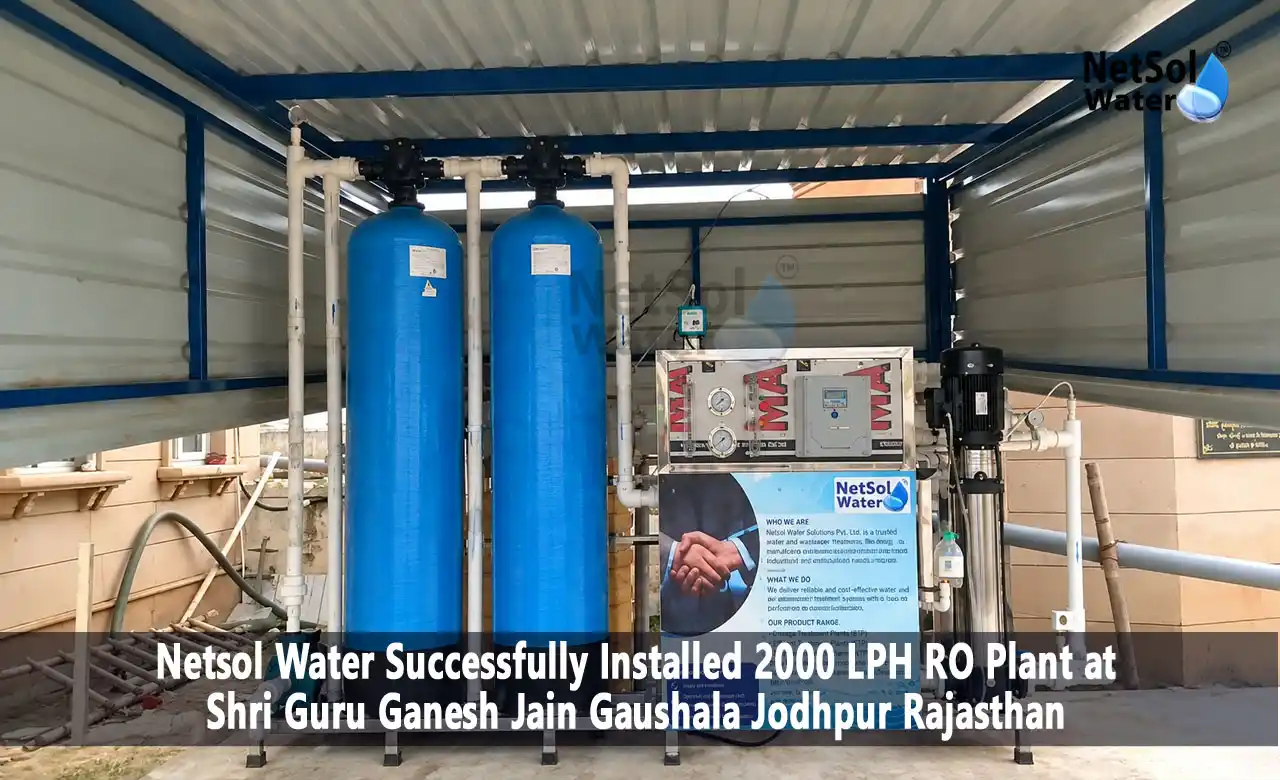
Case Study: Installed 2000 LPH RO Plant at Jain Gaushala, Jodhpur
In 2025, Netsol Water installed a 2000 LPH RO plant at Shri Guru Ganesh Jain Gaushala in Jodhpur, Rajasthan. The plant treats borewell water with a recorded inlet TDS of 2200 mg/L and a treated water TDS of 90 mg/L. This case study documents the project as it was recorded: the plant configuration, the water quality figures, the installation challenge, and the stated uses of the treated water. It is written for gaushala administrators, institutional facility managers, and buyers of commercial RO plants who want to see how a borewell water treatment plant is built and what its numbers mean in practice.
Project Overview
The table below summarises the project at a glance. Every entry comes from the confirmed project record.
| Parameter | Details |
|---|---|
| Client | Shri Guru Ganesh Jain Gaushala |
| Location | Jodhpur, Rajasthan, India |
| Installation year | 2025 |
| Plant capacity | 2000 LPH |
| Raw water source | Borewell |
| Raw water TDS | 2200 mg/L |
| Treated water TDS | 90 mg/L |
| Reported RO recovery | 65% |
| Membrane brand | LG |
| Plant construction | MSFRP |
| Pretreatment | Pressure Sand Filter (PSF), Activated Carbon Filter (ACF), micron filter |
| Main installation challenge | Piping problem |
Client Requirement and Project Background
A gaushala depends on a steady supply of water every day. Cows need drinking water, and the staff, volunteers and visitors who run the premises need water for drinking and cooking. Borewells are a common source in Jodhpur, and groundwater in arid regions can carry dissolved salts.
At this site, the borewell water measured 2200 mg/L TDS. That is a high level of dissolved solids, and it is the main reason RO treatment is relevant here. Reverse osmosis is widely used to reduce dissolved salts in borewell water, which is why it is a common choice for RO plant for drinking water in institutions.
The stated uses of the treated water at this gaushala are cows’ drinking water, human drinking water, and cooking. We do not have a record of the client’s original complaint or the reasons behind the purchase, so this case study does not speculate about them. It focuses on what was installed and what was measured.
Raw Water Quality and Treatment Requirement
TDS stands for total dissolved solids. It is the combined amount of dissolved minerals, salts and some organic matter in water, usually expressed in milligrams per litre (mg/L). A TDS meter gives a quick indication of how much material is dissolved, but it does not identify what that material is.
Borewell water quality can differ from one site to another and can change over time, so it should be assessed before a treatment plant is selected. A laboratory analysis gives a fuller picture than a TDS reading alone.
In this project, the inlet water measured 2200 mg/L TDS and the treated water measured 90 mg/L TDS. The inlet value describes the water before treatment, and the outlet value describes the RO permeate. These are two different measurements and should not be mixed up.
Low TDS alone does not establish that water is safe to drink. Safety also depends on microbiological quality and on specific chemical parameters that a TDS reading cannot show.
RO Plant Treatment Process
A borewell RO plant treats water in a sequence. The stages below are described in their usual order as a general explanation, subject to confirmation against the actual installed piping arrangement.
1. Borewell water and raw water pump. Water is drawn from the borewell, and the raw water pump delivers it to the pretreatment stages at the required flow.
2. Pressure Sand Filter (PSF). A sand bed holds back suspended particles, which protects the stages that follow.
3. Activated Carbon Filter (ACF). Activated carbon is commonly used to reduce chlorine and organic matter that can harm RO membranes and affect taste and odour.
4. Micron filter. A cartridge filter catches fine particles that pass through earlier stages and acts as a last safeguard before the membrane.
5. High-pressure pump. RO works only when water is pushed against the membrane at a pressure above the osmotic pressure of the feed water. The high-pressure pump supplies this.
6. LG RO membrane. The semi-permeable membrane lets water pass while holding back most dissolved salts.
7. Permeate and reject streams. The water that passes through the membrane is the treated permeate. The remaining stream carries the concentrated salts the membrane has held back. No reject-water disposal or reuse method is documented for this project, so none is described here.
Simple process flow:
Borewell → Raw water pump → PSF → ACF → Micron filter → High-pressure pump → LG RO membrane → Treated water (permeate) and reject stream
This case study does not claim the removal of any specific contaminant at this site, because contaminant-level test data is not available.
Technical Specifications of the 2000 LPH RO Plant
| Specification | Details |
|---|---|
| Plant capacity | 2000 LPH |
| Raw water source | Borewell |
| Raw water TDS | 2200 mg/L |
| Treated water TDS | 90 mg/L |
| TDS reduction (calculated) | Approximately 95.9% |
| Reported RO recovery | 65% |
| Membrane brand | LG |
| Construction | MSFRP |
| Pretreatment | Pressure Sand Filter (PSF), Activated Carbon Filter (ACF), micron filter |
| Pumps | Raw water pump, high-pressure pump |
LPH means litres per hour, the rated hourly output of the plant. TDS is total dissolved solids. RO recovery is the share of feed water that becomes treated water. At 65% recovery, about 65 litres of every 100 litres of feed become permeate, and the rest leaves as reject.
Information not available for this project: membrane quantity, pump horsepower, operating pressure, electrical load, installation duration and project cost. We have not filled these gaps with assumptions.
Installation Challenge and Site Work
The main challenge reported during this installation was a piping problem. The available project record does not describe the exact fault or how it was addressed, so we do not present details that cannot be verified.
What can be explained is why piping matters in RO plant. Water moves through several stages in sequence, and every connection between stages affects whether the plant performs as designed. Correct pipe routing keeps flow paths clear and avoids unnecessary restrictions. Secure joints reduce the risk of leaks, which matters especially on the high-pressure side. Proper flow between the PSF, ACF, micron filter, high-pressure pump and membrane helps each stage receive water at its intended rate.
For buyers, the practical learning is that piping layout deserves attention during planning, installation and commissioning, and not only the choice of filters and membranes. Site layout generally influences how piping is arranged, so it is worth reviewing early.
Commissioning and Water Quality Results
The recorded water quality figures for this plant are an inlet TDS of 2200 mg/L and a treated water TDS of 90 mg/L. The difference is 2110 mg/L, which is a TDS reduction of approximately 95.9%. This is a calculated figure based on the two recorded values. It describes the change in TDS only and is not a measure of total contaminant removal.
The reported RO recovery is 65%. This figure is as reported for the project and has not been independently verified.
Some details are not available and are not stated here: the commissioning date, laboratory methods, independent certification, pressure readings and confirmed continuous output.
Actual water quality should be assessed with appropriate testing for the intended use. Drinking water for people, drinking water for cattle and water for cooking may each call for different parameters, so a TDS reading is a useful starting check and not a complete assessment.
Treated Water Applications at the Gaushala
The stated uses of the treated water at Shri Guru Ganesh Jain Gaushala are cows’ drinking water, human drinking water, and cooking. A reliable supply of treated water for these daily needs is the reason a plant of this kind is installed in an institution.
Whether the water is suitable for each use depends on more than its TDS. Microbiological quality matters for any water that is consumed or used in food preparation. Specific chemical parameters, such as fluoride, nitrate or hardness, also matter, and a TDS reading does not show them. For this reason, periodic testing by a qualified laboratory is advisable. This case study does not claim that the treated water meets any particular drinking-water standard, as test reports are not available.
Key Project Outcomes and Practical Learnings
Verified project details
. A 2000 LPH RO plant was installed in 2025 in Jodhpur, Rajasthan.
. The plant uses borewell water, PSF, ACF and micron filter pretreatment, an LG membrane and MSFRP construction.
. Recorded TDS was 2200 mg/L at the inlet and 90 mg/L in treated water, an approximately 95.9% TDS reduction.
. Reported RO recovery is 65%.
. A piping problem was the main installation challenge.
General learnings that may depend on site conditions
. Pretreatment helps protect the RO membrane.
. Piping planning deserves attention from the start.
. TDS reduction is one indicator, so test water for its intended use.
. Recovery affects how much reject water a plant produces.
RO Plant Operation and Maintenance Considerations
This is general guidance for RO plants. It is not the gaushala’s actual maintenance history or a prescribed schedule.
. Check feed and treated water TDS periodically to notice changes in membrane performance.
. Maintain the PSF and ACF as per their design, including backwashing and media replacement when needed.
. Replace the micron filter cartridge when it clogs or at the interval the manufacturer suggests.
. Monitor pressure and flow, since changes can point to fouling, scaling or leaks. Our guide on how to evaluate the performance of 2000 LPH RO plants covers flow rate, water quality, pressure and energy use.
. Clean the membrane when performance drops, following the membrane manufacturer’s guidance.
. Test water for relevant chemical and microbiological parameters at suitable intervals.
A maintenance plan should be set according to the site’s water quality and the plant’s operating data.
Watch the 2000 LPH RO Plant Installation Video
2000 LPH RO Plant Installation at Shri Guru Ganesh Jain Gaushala, Jodhpur
Frequently Asked Questions (FAQs)
Q1. What is the capacity of the RO plant installed at Shri Guru Ganesh Jain Gaushala?
The plant has a capacity of 2000 LPH.
Q2. Where was the 2000 LPH RO plant installed?
It was installed at Shri Guru Ganesh Jain Gaushala in Jodhpur, Rajasthan, India.
Q3. When was the plant installed?
The installation year was 2025. An exact date is not available.
Q4. What was the TDS of the borewell water?
The raw borewell water measured 2200 mg/L TDS.
Q5. What was the treated water TDS?
The treated water measured 90 mg/L TDS, an approximately 95.9% reduction in TDS.
Q6. Which filtration stages and membrane brand were used?
Pretreatment uses a Pressure Sand Filter, an Activated Carbon Filter and a micron filter. The RO membrane is from LG.
Q7. What was the reported RO recovery?
The reported recovery is 65%.
Q8. What was the main installation challenge?
The main challenge was a piping problem. Further details are not available.
Conclusion
In 2025, Netsol Water installed a 2000 LPH RO plant at Shri Guru Ganesh Jain Gaushala, Jodhpur, to treat borewell water using PSF, ACF, micron filtration and an LG RO membrane. Recorded TDS fell from 2200 mg/L to 90 mg/L, an approximately 95.9% TDS reduction, with a reported recovery of 65%. Every site has different water and requirements, so results will vary. If you are planning a borewell water treatment plant or a commercial RO plant for your institution, contact Netsol Water for an assessment of your water treatment requirements.