

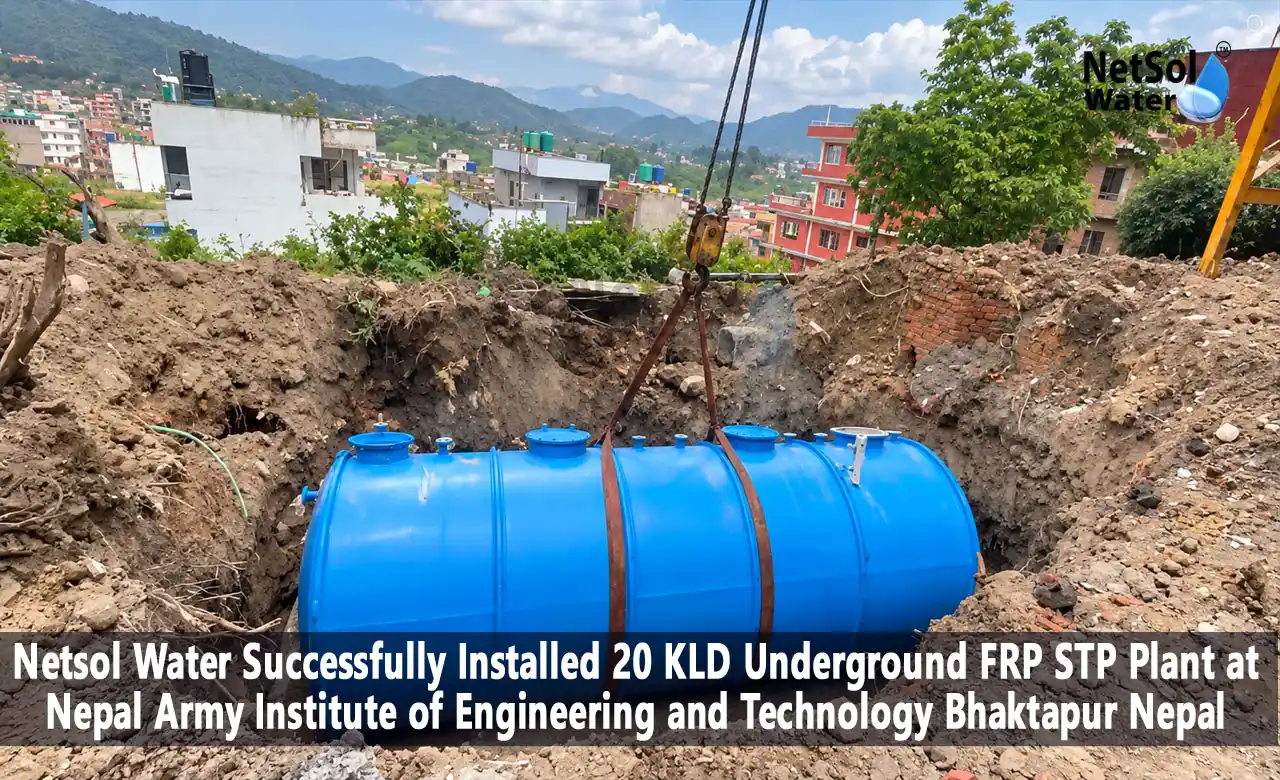
Case Study: Installed 20 KLD Underground FRP STP Plant in Bhaktapur, Nepal
In 2026, Netsol Water installed a 20 KLD underground sewage treatment plant at the Nepal Army Institute of Engineering & Technology in Bhaktapur, Nepal. The plant treats wastewater from the institute's kitchen and washrooms using a two-stage Moving Bed Biofilm Reactor (MBBR) process inside an underground FRP tank.
The campus setting shaped the project. The institute wanted the surface above the installation to remain available for parking, so an open plant yard was not the right answer. Going underground was. The project also carried a second task: the plant had to be shifted from one location to another within the same campus, so access, handling and placement mattered as much as the treatment process.
This case study covers what has been confirmed, how the treatment sequence works, and which facts still need a verified laboratory report.
Project Brief at a Glance
The table records only confirmed facts. Items that were not supplied, such as tank dimensions and laboratory readings, are left out instead of estimated.
| Item | Confirmed Detail |
|---|---|
| Client | Nepal Army Institute of Engineering & Technology |
| Location | Bhaktapur, Nepal |
| Installation Year | 2026 |
| Capacity | 20 KLD (20,000 litres per day) |
| Plant Type | Underground FRP Sewage Treatment Plant |
| Technology | Two-stage MBBR |
| Wastewater Sources | Kitchen and Washrooms |
| Site Requirement | Surface above the plant kept available for parking |
| Installation Duration | Three days |
| Commissioning | 2026, with operator training and handover |
| Supplier | Netsol Water |
Kitchen and Washroom Wastewater: What the Plant Has to Handle
Kitchen and washroom wastewater behave differently, and treatment planning has to respect both. Kitchen water usually carries food residue, suspended solids and cooking oils. Washroom water carries organic load from human waste, along with solids and cleaning products. Together they form a mixed stream with a meaningful biological load.
Oil and grease deserve early attention. Fats that reach a biological stage can coat surfaces, interfere with oxygen transfer and upset treatment stability. That is why Oil & Grease sits alongside BOD, COD, TSS and pH among the parameters relevant to this project. The screening and equalization stages at the front of the plant help condition the mixed stream before it meets the reactors.
Two sources also mean uneven flow. Kitchens tend to peak around meal times, while washrooms follow the rhythm of the campus day. A 20 KLD plant has to absorb those swings without shocking the biology downstream, which is where equalization earns its place.
Planning for both streams together, instead of treating them as separate problems, keeps the design honest about what actually reaches the inlet. No pre-treatment unit such as a grease trap has been confirmed for this project, so none is assumed here.
Moving the Plant, Not the Parking: The Key Site Decision
The confirmed site requirement was simple to state: keep the surface above the plant available for parking. The confirmed installation challenge was different. The plant had to be shifted from one location to another within the same campus.
An underground FRP arrangement suits a requirement like this. With the tank below grade, the ground above can keep its intended use, and the treatment system stays out of the way of vehicles and pedestrians. FRP is a common choice for buried tanks because it is light for its size and does not rust like unprotected steel. The actual design details of this tank were not supplied.
Shifting a plant within a campus raises practical questions that any team has to settle. How do vehicles and lifting equipment reach the new position? How do the inlet and outlet lines connect to the campus drainage and to the treated water destination? Who coordinates civil work with the installation team? These are normal considerations for an in-campus relocation, and they are presented as considerations, not as a record of specific events.
This case study does not claim structural approval for vehicle loading, and it does not claim that the parking area is already in use. Neither has been documented.
Placement also affects later use. Access covers need to stay reachable for inspection, which is a reason to agree the plant position with campus planners before the pit is finalised.
How the Two-Stage MBBR System Works
The plant follows this confirmed sequence: Screening → Equalization → MBBR 1 → MBBR 2 → Settling → Disinfection → Treated Water Tank.
Screening. Wastewater from the kitchen and washrooms first passes through screening, which removes coarse solids such as food particles and floating debris. Keeping this material out of later tanks lets the biological stages work on organic load instead of rubbish.
Equalization. This stage holds and blends the incoming flow. Because kitchen and washroom discharge varies through the day, the buffer smooths the load so the reactors receive a steadier feed.
MBBR 1 and MBBR 2. An MBBR uses small plastic carriers that move freely in the tank while air keeps them in suspension. Bacteria grow as a biofilm on these carriers and consume organic matter in the water. In a two-stage arrangement, the first reactor takes the heavier organic load and the second treats what remains, with a biofilm population suited to the lower load. Two stages give the process more resilience when incoming strength varies, as it can with mixed kitchen and washroom flow. The carrier type, media quantity and aeration equipment for this plant were not supplied and are not stated.
Settling. After the reactors, biological solids that have detached from the carriers settle out, leaving clearer water.
Disinfection. This stage reduces pathogens in the clarified water before storage. The disinfection method used at this plant has not been confirmed, so none is named.
Treated Water Tank. The final flow collects here, ready for the institute's chosen reuse or discharge route. That route has not been documented.
Three Days on Site: Installation and Coordination
The confirmed installation duration was three days, and the plant was shifted within the same campus. That means an underground plant was positioned at a new location instead of its first one.
A three-day window points to a system that arrives largely prefabricated and is fitted into a prepared position. That is an interpretation of the schedule, not a documented method. The actual excavation, lifting and backfilling steps for this site were not supplied.
Confirmed: installation took three days, the plant moved from one campus location to another, and commissioning took place in 2026.
Normal engineering considerations for a job like this:
. A prepared, stable base for the underground tank
. Correct positioning and orientation of the tank
. Inlet and outlet connections to campus drainage and the treated water point
. Power supply for any mechanical equipment
. Access covers and ventilation for later maintenance
. Civil coordination so surface finishing for parking follows the plant work
These points explain what a relocation like this normally involves. They are not claims about what happened on each of the three days. A day-by-day account cannot be written without site records.
Treatment Parameters and Water Quality Verification
Five parameters are relevant to this project. Actual laboratory results have not been provided, so the table records what each parameter shows and marks every result as not provided.
| Parameter | Relevance | Verified Reference Standard | Actual Result |
|---|---|---|---|
| BOD | Biodegradable organic load in the water | To be verified for Nepal | 25 mg/l |
| COD | Total oxidisable organic load | To be verified for Nepal | 85 mg/l |
| TSS | Suspended particles carried by the flow | To be verified for Nepal | 24 mg/l |
| pH | Acidity or alkalinity, which affects biological activity | To be verified for Nepal | 7.0 |
| Oil & Grease | Kitchen fats that can disturb biological treatment | To be verified for Nepal | 6 mg/l |
Indian CPCB values are sometimes used as illustrative benchmarks for sewage plants, but CPCB is an Indian authority and is not Nepal's regulator. The applicable Nepal requirement must be verified separately. Until a laboratory report from the installed plant is available, no claim is made that any standard was achieved.
Commissioning, Operator Training and Handover in 2026
The plant was commissioned in 2026. Commissioning is the stage where a newly installed plant is brought into operation and checked as a working system. Exact commissioning dates and test results were not supplied, so none are quoted.
Operator training and handover were also confirmed. Training matters for a biological plant because the people running it daily need a working routine: routine checks, recognising a change in plant condition and knowing when to call for technical support. Handover then passes daily operation to the institute's team. The content of the training and the handover documents was not provided, so this case study confirms that both took place without describing their details.
Project Outcomes and Continuing Operational Requirements
The confirmed outcome is an installed 20 KLD underground FRP sewage treatment plant serving kitchen and washroom wastewater at the institute, with the surface above intended to remain available for parking. That mix of treatment capacity and preserved surface space defines the project. The design intent is a treatment system that stays out of sight while the surface above serves its everyday purpose.
Long-term performance depends on operation after handover. An MBBR plant benefits from regular checks of flow, aeration and visible condition, periodic laboratory testing of the treated water, and routine maintenance of mechanical parts. Kitchen wastewater adds a reason to watch screen cleanliness and oil and grease. These are standard operating practices for this type of plant. No maintenance contract has been confirmed for this project, and none is implied.
Project Video
The project video is embedded below. Watch it alongside the sections above to connect the treatment sequence and site requirements with the installed plant.
Video:
What This Bhaktapur Project Demonstrates
. Underground siting can protect valuable surface space, but access, positioning and connections need agreement early.
. Relocating a plant within a campus is a planning task as much as a construction task.
. Kitchen and washroom wastewater call for attention to oil and grease and to flow variation before the biology.
. A two-stage MBBR gives a compact biological process with built-in staging.
. Performance claims need laboratory evidence, and this project's reports are still to be added.
Frequently Asked Questions (FAQs)
Q1. What is the capacity of the Bhaktapur plant?
The plant is rated at 20 KLD, or 20,000 litres per day. It treats wastewater from the kitchen and washrooms of the Nepal Army Institute of Engineering & Technology.
Q2. What was the main installation challenge?
The plant had to be shifted from one location to another within the same campus. Installation itself took three days, with commissioning in 2026.
Q3. Why was a two-stage MBBR used?
Two reactors in series let the first handle the heavier organic load while the second treats what remains. This suits mixed kitchen and washroom wastewater, whose strength can vary through the day.
Q4. Why is the plant underground?
The institute wanted the surface above to stay available for parking, so the FRP plant sits below grade. Suitability for vehicle loading needs separate structural confirmation.
Q5. What stages does the wastewater pass through?
It moves through Screening, Equalization, MBBR 1, MBBR 2, Settling, Disinfection and finally the Treated Water Tank.
Related Reading
For the wider range, see Netsol Water's sewage treatment plant solutions and its work on sewage treatment plants in Nepal. For a comparable MBBR installation, read the 25 KLD MBBR STP plant at Bajaj Energy, Balarampur case study.