

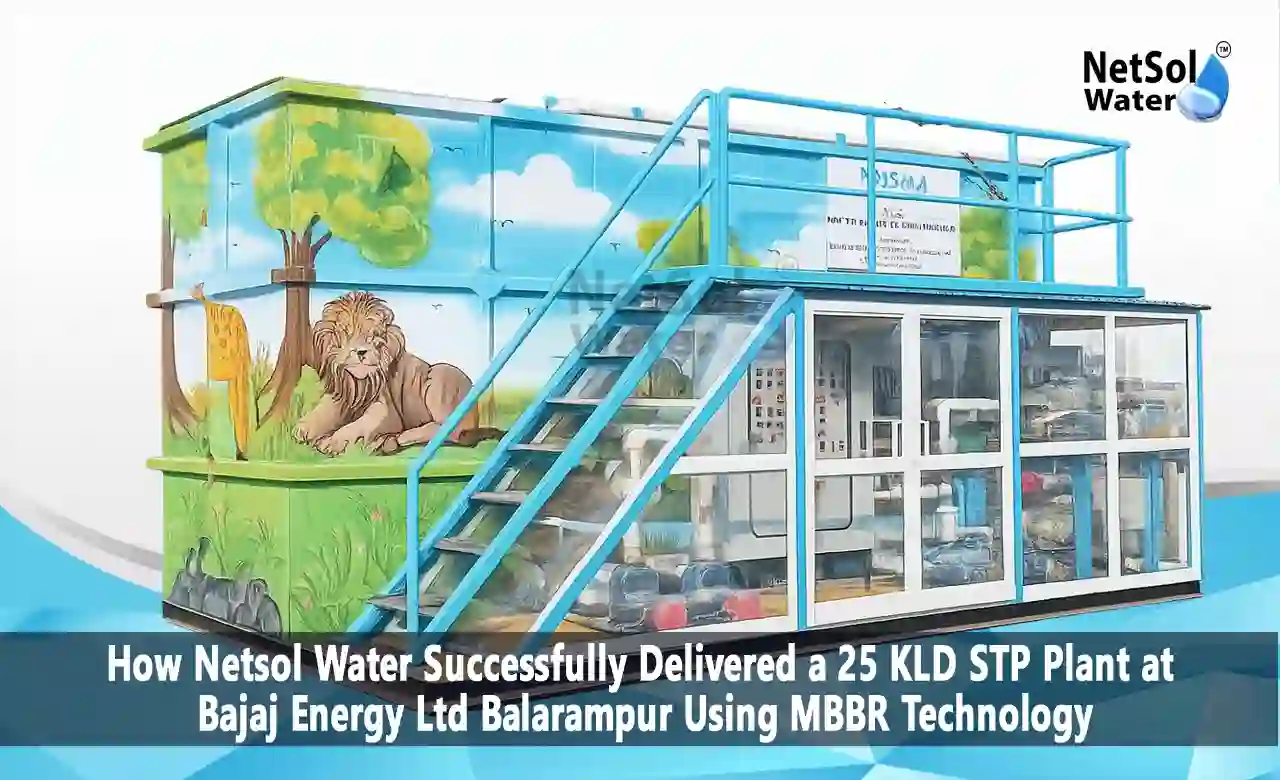
Case Study: 25 KLD MBBR STP Plant at Bajaj Energy Balarampur by Netsol Water
Netsol Water successfully designed and commissioned a 25 KLD STP Plant at Bajaj Energy Ltd's facility in Balarampur, Uttar Pradesh. Using Moving Bed Biofilm Reactor (MBBR) technology, the plant treats in-plant wastewater to comply with CPCB/UPPCB discharge norms while enabling treated water reuse - reducing freshwater dependency and operational costs.
Introduction
Industrial facilities across Uttar Pradesh face mounting pressure to manage their wastewater responsibly. Regulatory norms, environmental consciousness, and the need for water conservation have pushed industries to invest in reliable, technology-driven sewage treatment solutions.
This case study presents how Netsol Water - a trusted sewage treatment plant manufacturer in Uttar Pradesh - delivered a fully operational 25 KLD STP plant installation in Balarampur for Bajaj Energy Ltd. The project demonstrates how the right technology choice, proper engineering, and timely execution can convert a wastewater challenge into a sustainable operational advantage.
About Client: Bajaj Energy Ltd, Balarampur
Bajaj Energy Ltd is one of India's prominent power generation companies with operations in Uttar Pradesh. Their Balarampur plant is a large-scale thermal power facility that requires substantial water for in-plant operations, including cooling, equipment washdowns, sanitation, and utility services.
Like many industrial establishments of this scale, the facility generates domestic and utility wastewater as a by-product of daily plant operations. Responsible management of this wastewater is not just a regulatory necessity - it aligns with Bajaj Energy's sustainability commitments and corporate environmental responsibility goals.
About Netsol Water:
Netsol Water is an India-based water and wastewater treatment company specializing in designing, manufacturing, and installing a wide range of treatment systems - including Sewage Treatment Plants (STP), Effluent Treatment Plants (ETP), Reverse Osmosis (RO) systems and related water purification solutions.
With a strong presence in Uttar Pradesh and projects spanning across industrial, commercial, institutional, and residential sectors, Netsol Water serves clients who need reliable, compliant, and cost-effective water management systems. Their technology portfolio covers established processes like MBBR, SBR, MBR and conventional activated sludge systems, allowing them to tailor solutions to each client's specific wastewater characteristics and regulatory requirements.
What Wastewater Challenge Did the Plant Face?
Industrial plants like Bajaj Energy's Balarampur facility generate wastewater continuously from in-plant activities - not as a product output, but from the water used within the plant itself for sanitation, utility operations, cooling tower blowdown, and employee welfare facilities.
What problems did untreated wastewater create?
Without an on-site treatment system, this wastewater carried high Biochemical Oxygen Demand (BOD), Chemical Oxygen Demand (COD), and suspended solids - making it unsuitable for discharge into local water bodies or reuse. Direct discharge would have violated UPPCB (Uttar Pradesh Pollution Control Board) norms, risking legal penalties and reputational damage.
The facility also lacked a structured mechanism for wastewater reuse, which meant higher freshwater procurement costs and missed opportunities for circular water management. What was needed was an efficient, low-footprint industrial STP plant capable of treating 25,000 litres of wastewater per day - reliably and within compliance limits.
Solution Provided by Netsol Water
Netsol Water proposed and implemented an MBBR-based 25 KLD sewage treatment plant - a proven, space-efficient technology widely adopted in industrial wastewater treatment across India.
Why was MBBR technology chosen for this industrial STP plant?
Moving Bed Biofilm Reactor (MBBR) technology was selected because it offers superior biological treatment performance in a compact footprint. Unlike conventional activated sludge processes, MBBR uses specially designed plastic media carriers that float within the aeration tank. Microorganisms form a biofilm on these carriers and continuously break down organic pollutants in the wastewater.
Key reasons MBBR was the right fit for this project:
• Handles fluctuating wastewater loads without major operational adjustments
• Delivers consistent BOD and COD reduction even during peak generation hours
• Requires less land area compared to conventional treatment systems
• Low sludge generation reduces disposal burden
• Minimal operator intervention - suitable for industrial settings
Treatment Process:
The 25 KLD STP plant at Bajaj Energy, Balarampur follows a multi-stage treatment sequence designed to progressively remove contaminants and produce treated water that meets discharge and reuse standards.
What are the stages of the MBBR-based STP treatment process?
1. Screening and Collection: Raw wastewater from in-plant sources enters through a bar screen that removes large floating solids and debris, protecting downstream equipment.
2. Equalization Tank: The screened wastewater collects in an equalization tank where flow rates are balanced to prevent hydraulic shock loads on the biological treatment system.
3. Primary Treatment (Clarification): Suspended solids settle out through gravity in the primary clarifier. This reduces the organic load before biological treatment begins.
4. MBBR Biological Reactor (Core Treatment Stage): The heart of the system. Wastewater enters the MBBR reactor, which is filled with high-surface-area plastic media. Aerobic microorganisms colonize the media and break down dissolved BOD and COD through biological oxidation. Air diffusers maintain oxygen supply and keep the media in constant motion.
5. Secondary Clarifier (Settling): Treated water from the MBBR moves to the secondary clarifier where biological solids and residual suspended matter settle out. The clarified water rises to the top.
6. Sludge Management: Settled sludge from both clarifiers undergoes thickening and is periodically removed for safe, authorized disposal.
7. Tertiary / Disinfection Stage: Treated water passes through a filtration unit (pressure sand and activated carbon filters) for polishing, followed by disinfection using sodium hypochlorite or UV disinfection to eliminate pathogenic microorganisms.
8. Treated Water Storage and Reuse: Final treated water meeting CPCB/UPPCB standards is stored in a dedicated tank for reuse in plant horticulture, floor washing, dust suppression, or safe discharge.
TREATMENT FLOW SUMMARY
Raw Wastewater → Screening → Equalization → Primary Clarifier → MBBR Reactor → Secondary Clarifier → Filtration → Disinfection → Treated Water Reuse
Key Features of the Installed 25 KLD STP Plant
The plant combines technical robustness with operational simplicity:
| Technical Feature | Details |
|---|---|
| Treatment Technology | MBBR (Moving Bed Biofilm Reactor) |
| Plant Capacity | 25 KLD (Kilolitres per Day) |
| Process Type | Aerobic Biological Treatment |
| BOD Removal Efficiency | Greater than 90% |
| COD Removal Efficiency | Greater than 85% |
| Media Type | High-density polyethylene (HDPE) plastic carriers |
| Aeration System | Fine bubble diffusers with blowers |
| Disinfection Method | Chlorination / UV |
| Footprint | Compact - suitable for industrial premises |
| Compliance Standard | CPCB / UPPCB discharge norms |
| Automation Level | Semi-automated with monitoring provisions |
Results & Performance: What Outcomes Were Achieved?
Since commissioning, the MBBR-based industrial STP plant has consistently delivered measurable water quality improvements that keep the facility well within statutory discharge limits.
| Parameter | Inlet (Raw Wastewater) | Outlet (Treated Water) |
|---|---|---|
| BOD (mg/L) | High (Typical Industrial Range) | < 10 mg/L |
| COD (mg/L) | Elevated (Typical Range) | < 50 mg/L |
| TSS (mg/L) | Moderate to High | < 30 mg/L |
| pH | Variable | 6.5 – 8.5 (Compliant) |
| Turbidity | Turbid / Cloudy | Clear / Low |
| Coliform Count | Present | Eliminated post-disinfection |
The treated water quality consistently meets CPCB General Standards for discharge into inland surface waters, enabling both safe disposal and productive reuse within the plant premises.
Has the plant maintained regulatory compliance?
Yes. The plant operates within the discharge norms set by the Uttar Pradesh Pollution Control Board (UPPCB). Regular monitoring and periodic process adjustments ensure that the effluent quality remains stable, reducing the risk of regulatory notices or penalties.
Benefits to the Client
The 25 KLD STP plant installation delivered both environmental and business value to Bajaj Energy Ltd beyond just compliance.
How does this wastewater treatment solution benefit Bajaj Energy operationally?
• Regulatory Compliance: The plant meets UPPCB / CPCB discharge norms, eliminating legal risk from untreated wastewater disposal.
• Reduced Freshwater Consumption: Treated water is reused for in-plant non-potable purposes such as gardening, dust suppression, and floor washing - reducing freshwater procurement costs.
• Low Operating Cost: MBBR systems consume less energy and generate less sludge compared to older treatment technologies, keeping day-to-day running expenses manageable.
• Minimal Space Requirement: The compact design fits within the existing industrial premises without requiring major civil modification.
• Sustainability Goals: The project directly contributes to Bajaj Energy's environmental commitment by reducing the plant's water footprint and carbon-equivalent impact of freshwater treatment.
• Improved Plant Hygiene: Proper wastewater management prevents stagnation, odour problems, and groundwater contamination within the facility boundary.
Why Choose Netsol Water for Your Industrial STP Plant?
Netsol Water is a leading sewage treatment plant manufacturer in Uttar Pradesh with a proven track record of delivering customised wastewater treatment solutions across industrial, commercial, and institutional sectors.
• End-to-End Services: From site assessment and engineering design to installation, commissioning, and annual maintenance contracts (AMC), Netsol Water manages the full project lifecycle.
• Technology Expertise: The team specialises in MBBR, SBR, MBR, and conventional activated sludge systems - recommending the right technology based on the client's wastewater characteristics and reuse goals.
• Regulatory Knowledge: Deep familiarity with CPCB, UPPCB, and state-specific environmental norms ensures that every plant is designed and operated for compliance.
• Pan-UP Presence: Multiple successful installations across Lucknow, Kanpur, Noida, Agra, and now Balarampur reflect the company's geographic reach and operational maturity.
• After-Sales Support: Trained service engineers provide regular maintenance checks, operator training, and performance monitoring to ensure sustained treatment efficiency.
Conclusion
The 25 KLD STP plant installation in Balarampur for Bajaj Energy Ltd is a clear example of how industrial facilities can tackle wastewater challenges with the right technology partner and the right approach. The MBBR-based sewage treatment plant has transformed a compliance liability into an operational asset - delivering clean, reusable treated water day after day.
Netsol Water's role as a sewage treatment plant manufacturer in Uttar Pradesh goes beyond building plants. The team brings engineering precision, regulatory expertise, and long-term service commitment to every project - ensuring that clients like Bajaj Energy stay compliant, cost-efficient, and environmentally responsible.
If your industrial facility in Uttar Pradesh or surrounding regions needs a reliable wastewater treatment solution, Netsol Water is ready to assess your requirements and deliver a plant that works - not just at commissioning, but every single day after.
Frequently Asked Questions (FAQs)
Q1. What does a 25 KLD STP plant mean?
A 25 KLD STP (Sewage Treatment Plant) is designed to treat 25,000 litres (25 kilolitres) of wastewater per day. The capacity is matched to the daily wastewater generation volume of the facility. For industrial plants like Bajaj Energy's Balarampur unit, this capacity covers the domestic and utility wastewater generated from in-plant water usage across shifts.
Q2. Why is MBBR technology used in industrial STP plants?
MBBR (Moving Bed Biofilm Reactor) is preferred for industrial STP plants because it delivers high biological treatment efficiency in a compact reactor volume. The plastic media carriers provide a large surface area for microbial biofilm growth, enabling effective BOD and COD removal even under variable load conditions. It also produces less sludge and requires lower maintenance compared to conventional systems.
Q3. Does the treated water from the STP meet UPPCB/CPCB discharge standards?
Yes. The treated water from the 25 KLD MBBR STP plant at Bajaj Energy Ltd consistently meets the discharge standards set by the Uttar Pradesh Pollution Control Board (UPPCB) and the Central Pollution Control Board (CPCB) for inland surface water discharge. Regular water quality testing verifies compliance with parameters including BOD, COD, TSS, and pH.
Q4. Can the treated water from an industrial STP plant be reused?
Yes. After full treatment including filtration and disinfection, treated water from industrial STP plants can be reused for non-potable applications such as landscaping and horticulture, floor cleaning and dust suppression, flushing, and cooling tower makeup water (after additional treatment). This reduces the facility's dependence on freshwater sources and lowers overall water procurement costs.
Q5. How does Netsol Water support clients after STP plant commissioning?
Netsol Water provides comprehensive after-sales support that includes operator training, scheduled preventive maintenance, process performance monitoring, spare parts supply, and annual maintenance contracts (AMC). This ensures the STP plant continues operating at peak efficiency, maintains compliance, and delivers consistent treated water quality throughout its operational life.