

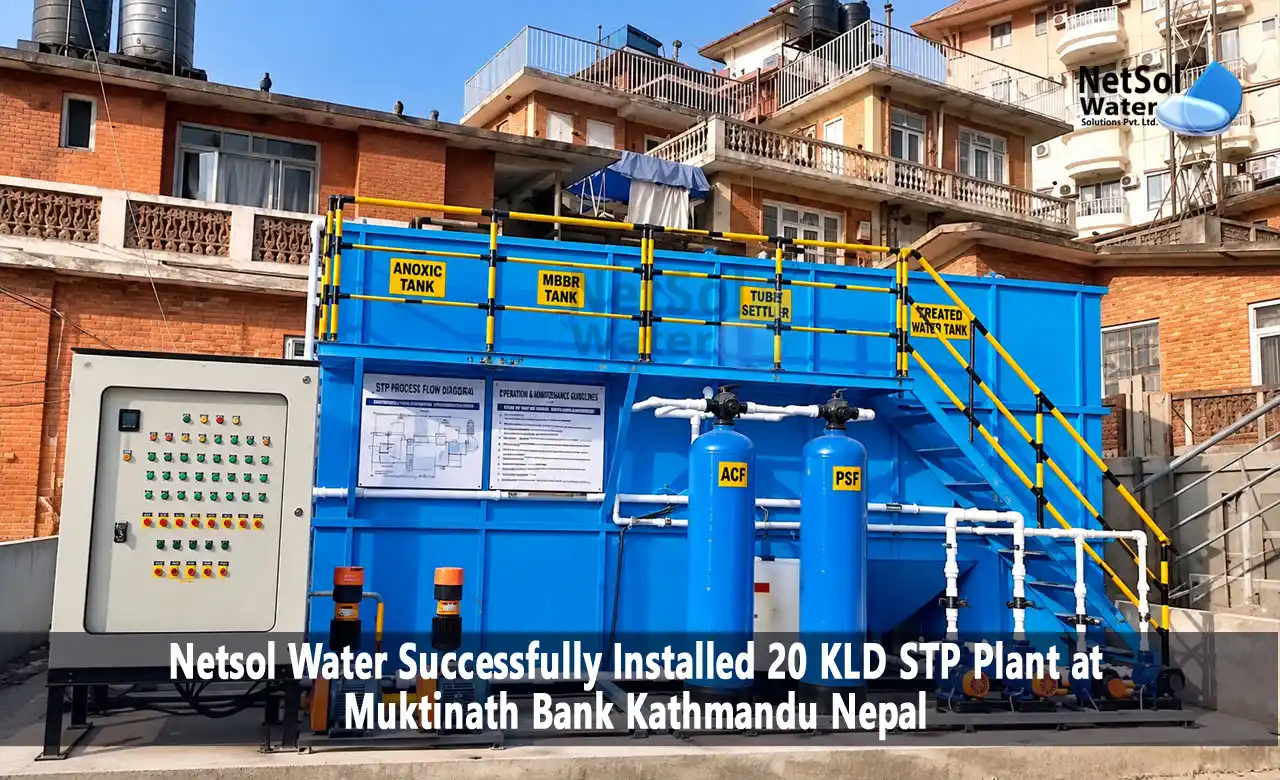
Case Study: Installed 20 KLD STP Plant for Muktinath Bank, Kathmandu
Netsol Water installed a 20 KLD STP Plant for Muktinath Bikas Bank at its facility in Kathmandu, Nepal. The project involved supplying and commissioning a Sewage Treatment Plant designed to treat the day-to-day wastewater generated by a busy commercial banking premises. A 20 KLD capacity means the plant is built to handle up to 20,000 litres of sewage in a single day, a scale suited to office-type facilities with staff washrooms, pantry areas, and general sanitary discharge. Netsol Water managed the project scope, from design guidance to installation support, giving the client a dependable Sewage Treatment Plant Installation tailored to its operational needs. The plant now forms part of the bank's regular facility management, supporting organized wastewater handling on-site.
| Project Overview | Details |
|---|---|
| Client | Muktinath Bikas Bank |
| Location | Kathmandu, Nepal |
| Plant Capacity | 20 KLD (20,000 litres per day) |
| Application | Commercial banking facility |
| Executing Company | Netsol Water Solutions Pvt. Ltd. |
| Project Type | Installation of Sewage Treatment Plant |
About Muktinath Bikas Bank
Muktinath Bikas Bank is a commercial banking institution operating in Nepal, serving customers through branch and administrative premises across the country. Like any commercial establishment with regular staff presence and visiting customers, its facilities generate daily wastewater from washrooms, kitchens, and general housekeeping activities. For a banking premises, uncontrolled discharge of this wastewater is not a viable option, both from a hygiene standpoint and from the perspective of responsible facility upkeep. This makes an on-site Sewage Treatment Plant a practical requirement rather than an optional addition. By installing dedicated treatment infrastructure, Muktinath Bikas Bank ensured its Kathmandu, Nepal premises could manage sewage discharge in an organized and controlled manner, in line with the operational standards expected of a modern commercial institution.
Project Requirement and Background
Commercial buildings such as bank branches and administrative offices are often overlooked when people think about sewage treatment, yet they generate consistent volumes of wastewater every working day. Washrooms used by staff and visitors, pantry drainage, and cleaning activities all contribute to a steady stream of sewage that needs a defined outlet. Without a treatment system in place, this wastewater is typically discharged directly into municipal drains or septic systems, which can create hygiene concerns and place pressure on local infrastructure, particularly in urban centres like Kathmandu.
For Muktinath Bikas Bank, the requirement was straightforward: a compact, reliable Sewage Treatment Plant that could be installed within the constraints of a commercial building and treat sewage generated by daily operations. A 20 KLD capacity was identified as appropriate for the scale of wastewater generation typical of a banking facility of this nature, a range common for office buildings and similar commercial establishments where the sewage load is moderate but still requires structured treatment rather than informal disposal.
Sewage Treatment Challenge
Commercial facilities present a particular set of practical considerations when it comes to sewage treatment. Space is often limited, since a plant has to fit within the existing footprint of the building or its immediate surroundings without disrupting daily banking operations. Sewage flow from a commercial premises is also not constant, tending to follow office hours with peaks during the morning and midday periods, which means a treatment system needs to handle variable inflow without a drop in performance.
Biological treatment needs to function reliably even with these fluctuations, and treated water needs a clear, manageable outlet once processing is complete. Odour control matters too, given the plant's proximity to an occupied commercial building, and ease of maintenance is important since a bank's facility team generally lacks specialised wastewater treatment expertise.
20 KLD STP Plant Design and Treatment Process
A Sewage Treatment Plant is built around a sequence of stages, each performing a specific role in bringing raw sewage to a treated condition. While the exact technology configuration at the Muktinath Bank site should be confirmed from Netsol Water's project documentation, the general process logic of a 20 KLD STP Plant follows stages common to commercial-scale sewage treatment.
. Inlet and Collection
Raw sewage from the building's washrooms, kitchen, and other sanitary outlets is first collected and directed into the treatment system through an inlet chamber. This stage acts as the entry point for all wastewater generated on the premises before any treatment begins.
. Screening
Screening removes larger solid particles and debris from the incoming sewage. This protects downstream equipment such as pumps and aeration systems from damage or blockage and ensures the treatment process runs smoothly.
. Equalization
An equalization tank balances out the variations in flow rate and sewage strength that occur over the course of a working day. Since a commercial premises like a bank does not generate wastewater at a constant rate, this stage helps maintain steady conditions for the biological treatment that follows.
. Biological Treatment
This is the core of the treatment process, where naturally occurring microorganisms break down organic matter present in the sewage. Biological treatment reduces the pollutant load significantly and is the stage most responsible for transforming raw sewage into a cleaner effluent.
. Clarification
After biological treatment, the water passes through a clarification stage where suspended solids settle out, separating treated water from residual sludge.
. Filtration and Disinfection
Filtration further polishes treated water by removing fine particles, while disinfection addresses pathogens before final discharge. Exact filtration and disinfection methods used at this site should be verified against project documentation.
. Sludge Handling
Sludge generated during treatment is collected and managed separately, requiring periodic removal as part of routine maintenance.
Together, these stages allow a 20 KLD STP Plant to convert daily sewage output into a treated stream that can be handled in a controlled, organized manner.
Major Components of the 20 KLD STP
A Sewage Treatment Plant of this scale is built from several interconnected components, each contributing to a specific part of the treatment sequence.
| Component | Purpose |
|---|---|
| Inlet Chamber | Receives raw sewage from the building and directs it into the treatment system. |
| Screen Chamber | Removes large solids and debris before further processing. |
| Equalization Tank | Balances fluctuating flow and sewage strength throughout the day. |
| Aeration System | Supports biological treatment by maintaining conditions needed by microorganisms. |
| Clarifier | Separates treated water from settled sludge. |
| Filtration Unit | Removes fine suspended particles from treated water. |
| Disinfection Unit | Reduces pathogens in the treated water before discharge or further use. |
| Sludge Handling Unit | Collects and manages sludge generated during the treatment process. |
Each of these components plays a defined role, and their coordinated operation is what allows the plant to consistently process the sewage load generated by the bank's premises. Component specifications for this particular installation should be referenced from Netsol Water's project engineering records.
Installation of the 20 KLD STP at Muktinath Bank
Installing a Sewage Treatment Plant at an operational commercial facility requires careful sequencing so that ongoing banking activities are not disrupted. Site preparation typically begins with identifying suitable space for the treatment units, followed by civil work where required to accommodate tanks and chambers. Equipment is then placed according to the treatment sequence, from the inlet chamber through to the final disinfection and discharge points.
Piping and interconnections link each stage of the plant, ensuring sewage moves through the system in correct order, while electrical work supports the pumps, blowers, and other powered components. Once physical installation is complete, the plant undergoes testing to confirm each stage functions as intended before commissioning, the point where the STP Plant becomes operational. Exact installation dates, manpower deployed, and equipment specifications for this project should be confirmed from Netsol Water's internal project records.
Project Execution by Netsol Water
Netsol Water supported the Muktinath Bank project across the key stages of delivering a working Sewage Treatment Plant, from technical evaluation through to supply and installation support for the 20 KLD system. As an STP Plant Manufacturer, Netsol Water's role centred on ensuring the treatment plant was suited to the scale of a commercial banking facility, with attention to space constraints and ease of operation, reflecting its broader experience in Sewage Treatment Plant Installation Services for commercial clients.
20 KLD STP Plant Project Video
A video documenting the 20 KLD STP Plant Project at Muktinath Bank is available for viewing:
The video offers a visual overview of the installed Sewage Treatment Plant at the Kathmandu, Nepal premises, giving viewers a sense of the completed installation. For those interested in seeing how a compact commercial STP Plant fits into a working facility, this footage provides useful visual context alongside the written details covered in this case study.
Benefits of the Installed 20 KLD STP
Installing a dedicated Sewage Treatment Plant brought several practical advantages to the Muktinath Bank premises. The most immediate benefit is organized sewage treatment, replacing informal or unmanaged discharge with a structured process. This supports better hygiene standards across the facility, an important consideration for any premises with regular staff and customer footfall.
Controlled discharge of treated wastewater also reduces the burden on local drainage infrastructure, which matters in a dense urban setting like Kathmandu. The plant gives the bank's facility team a defined system to monitor and maintain, positioning wastewater handling as a routine, well-managed part of daily operations rather than an afterthought.
Operation and Maintenance
Routine operation of a 20 KLD STP Plant involves regular inspection of key components such as pumps and blowers to confirm they are functioning correctly. Screens need periodic cleaning to prevent blockages from accumulated solids, and the biological treatment stage benefits from consistent monitoring to ensure conditions remain favourable for effective breakdown of organic matter.
Sludge management is an ongoing task, with periodic removal required to keep the system operating efficiently, alongside general cleaning of tanks and process monitoring to catch irregularities early. Periodic servicing of mechanical and electrical components helps maintain consistent performance. Specific maintenance schedules and any AMC arrangements for this installation should be confirmed directly with Netsol Water.
Project Outcome
The installation of the 20 KLD STP Plant gave Muktinath Bikas Bank a functioning, on-site Sewage Treatment Plant capable of handling the daily wastewater generated by its Kathmandu, Nepal facility. The project moved the bank from a position without dedicated treatment infrastructure to one with a structured system in place for managing sewage as part of routine facility operations. This outcome reflects the core objective of the project: providing a commercial banking premises with a workable, appropriately sized solution for wastewater management, executed with support from Netsol Water Solutions Pvt. Ltd.
Why Choose Netsol Water for STP Projects
Netsol Water Solutions Pvt. Ltd. brings experience as an STP Plant Manufacturer serving commercial, institutional, and industrial clients across varied project scales. The company's capabilities span design guidance, manufacturing, installation support, and commissioning of Sewage Treatment Plant systems suited to specific site conditions. For facilities such as commercial banking premises, this means a Package Sewage Treatment Plant approach that can be adapted to available space and operational requirements, backed by after-sales support for ongoing operation and maintenance needs.
Frequently Asked Questions (FAQs)
Q1: What is the capacity of the STP installed at Muktinath Bank?
The Sewage Treatment Plant installed at Muktinath Bank has a capacity of 20 KLD, meaning it is designed to treat up to 20,000 litres of sewage per day generated by the commercial banking facility.
Q2: Where was the 20 KLD STP installed?
The 20 KLD STP Plant was installed at the Muktinath Bikas Bank premises in Kathmandu, Nepal, as part of the facility's wastewater management infrastructure.
Q3: What does 20 KLD mean in an STP?
KLD stands for kilolitres per day. A 20 KLD STP Plant is built to treat up to 20,000 litres, or 20 cubic metres, of sewage within a 24-hour period, a scale commonly used for commercial and institutional buildings.
Q4: Why does a commercial facility need an STP?
Commercial facilities such as banks generate daily wastewater from washrooms, pantries, and cleaning activities. An STP Plant allows this sewage to be treated on-site in an organized manner rather than being discharged untreated into local drainage systems.
Q5: What type of wastewater is treated by an STP?
An STP Plant primarily treats domestic-type sewage, including wastewater from washrooms, kitchens, and general sanitary use, which is the typical wastewater profile generated by a commercial banking premises.
Q6: What treatment technology is used in the Muktinath Bank STP?
The specific treatment technology configuration used for this installation should be confirmed from Netsol Water's project-specific technical documentation, as exact process details can vary based on site assessment.
Q7: Who installed the STP at Muktinath Bank?
The 20 KLD STP Plant at Muktinath Bank was installed with support from Netsol Water Solutions Pvt. Ltd., which handled the project's technical and installation aspects.
Q8: Can a 20 KLD STP be customized according to site requirements?
Yes, a 20 KLD STP Plant can generally be configured to match specific site conditions, including available space and layout, as part of a Package Sewage Treatment Plant approach offered by manufacturers such as Netsol Water.