

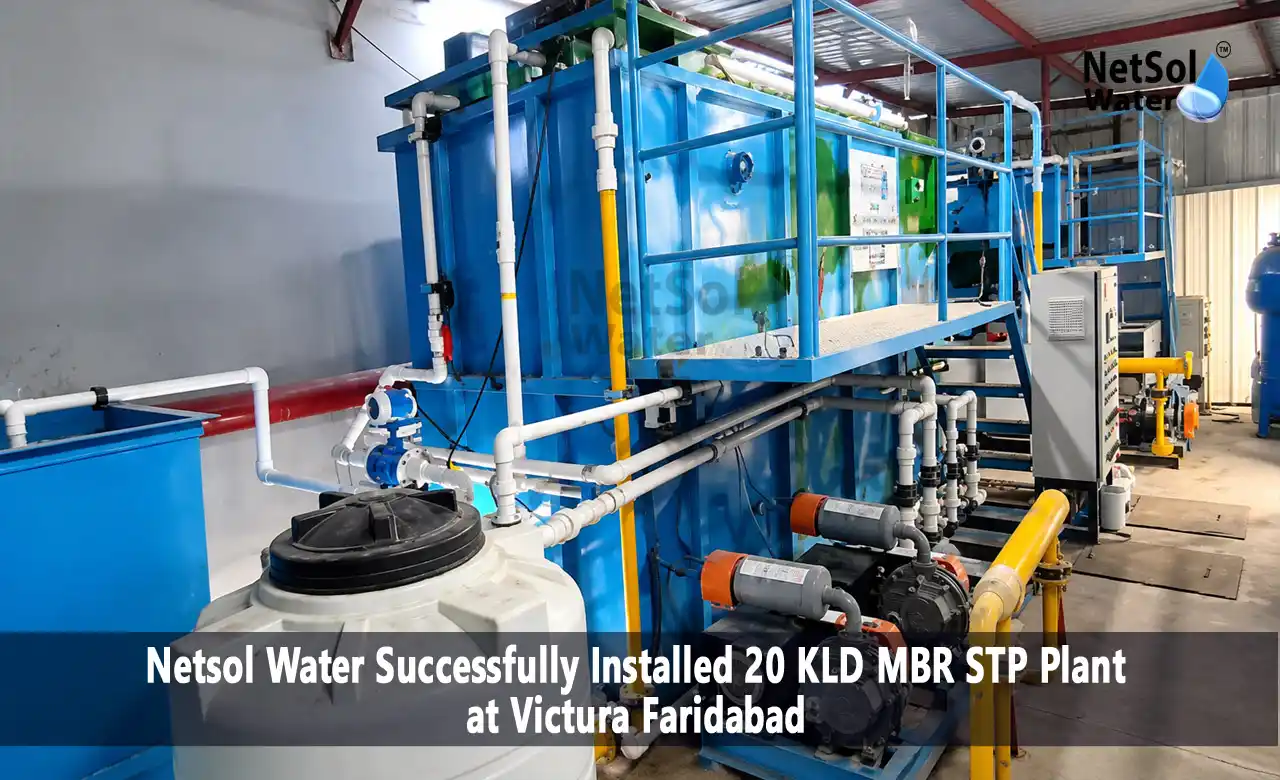
Case Study: Installed 20 KLD MBR STP Plant at Victura, Faridabad
Netsol Water installed a 20 KLD MBR STP plant at Victura in Faridabad, Haryana, in 2026. KLD means kilolitres per day, so the plant is rated for 20,000 litres of wastewater every day.
It is a package STP plant built in MSFRP and uses Membrane Bioreactor (MBR) technology to treat industrial wastewater. The treated water is intended for gardening and landscaping. Limited space was the main installation challenge at the site.
| Detail | Information |
|---|---|
| Project | 20 KLD MBR STP Plant, Victura |
| Location | Faridabad, Haryana, India |
| Company | Netsol Water Solutions Pvt Ltd |
| Installation Year | 2026 |
| Capacity | 20 KLD (20,000 litres per day) |
| Plant Type | Package Type |
| Technology | Membrane Bioreactor (MBR) |
| Construction Material | MSFRP |
| Wastewater Type | Industrial Wastewater |
| Intended Use of Treated Water | Gardening and Landscaping |
| Main Challenge | Limited Available Space |
| Installation Duration | 4–7 Days (Reported) |
Client Requirement and Treatment Need
Industrial wastewater can't be released or reused without treatment. An industrial effluent treatment plant is the usual answer. What it contains depends on the processes that produce it. It may carry organic matter, suspended solids, oil or chemical residues. Victura's wastewater test data is not published here, so this section describes the need in general terms.
Flow is the first thing to handle. Wastewater rarely arrives at a steady rate. It comes in surges during working hours and slows down at night. An equalization tank holds the incoming water and evens out the flow, so the treatment units get a steadier feed.
Technology selection comes next. An industrial wastewater treatment plant should be chosen after looking at the wastewater, the daily volume and the space available. A poor match shows up later as weak treated water quality or high running costs.
At Victura, the treated water is intended for gardening and landscaping. That sets the target: clear water with low suspended solids, acceptable chemical quality and safe microbial levels. Laboratory testing of the actual treated water is how that target gets confirmed.
Why MBR Technology Was Considered?
The project record doesn't state why MBR was selected, so this section explains what an MBR sewage treatment plant offers in general.
A Membrane Bioreactor STP combines two processes. First, bacteria in an aerated tank feed on the organic matter in the wastewater and break it down. This is biological treatment, the same principle used in conventional activated sludge plants.
Second, membranes separate the treated water from the biomass. The membranes have very small pores. Water passes through while solids and most bacteria stay behind. In a conventional plant, a clarifier does this job by letting solids settle, and it takes up a lot of floor area.
Without a clarifier, an MBR plant can be built in a smaller footprint. The aeration tank can also hold more biomass, which allows compact biological treatment. That is why MBR is often considered for sites with limited space, like Victura. The treated water is usually clearer too, which suits reuse applications.
MBR has its own demands. Membranes need regular cleaning. Aeration uses power. The wastewater may need pretreatment to protect the membranes. Performance depends on the design, the wastewater and how well the plant is run, so the technology alone guarantees no particular result.
20 KLD MBR STP Plant Design Considerations
Confirmed for Victura: this MSFRP STP plant has a 20 KLD capacity, package type design and MBR technology. Everything below is general engineering practice for plants of this kind. Tank sizes, membrane type, pump capacities and electrical ratings for Victura are not part of this case study.
1. Design capacity: 20 KLD is a daily volume. The designer also checks the peak hourly flow, because the plant must handle its busiest hour.
2. Wastewater characteristics: organic load, oil and grease, chemicals and pH decide how much pretreatment is needed before the MBR.
3. Flow variation and equalization: the equalization volume should suit how flow changes through the day.
4. Membrane filtration: membrane area, cleaning access and protection from fibres and grit all matter. Fine screening ahead of the membranes is common.
5. Aeration: bacteria need oxygen. Blowers must supply enough air, and the air system often helps keep membranes clean as well.
6. Maintenance access: operators need room to inspect, clean and lift membranes.
7. Treated water storage: the tank should hold enough volume for the reuse schedule.
8. Sludge management: excess sludge builds up and has to be withdrawn, stored and disposed of properly.
Treatment Process and Working Principle
The sequence below is the general order used for this type of plant. The exact configuration at Victura should be confirmed against the final design by the project engineer. Four points need that confirmation: the type of screening, whether any pretreatment sits ahead of equalization, the layout of the biological and membrane tanks, and the disinfection method.
Illustrative process flow (not verified as built):
Industrial wastewater
↓
Screening
↓
Equalization
↓
MBR treatment (biological treatment + membrane separation)
↓
Disinfection
↓
Treated water storage
↓
Intended reuse: gardening and landscaping
Screening removes coarse solids such as plastics, fibres and debris. This protects pumps, pipes and membranes.
Equalization holds the wastewater and mixes it. The result is a steadier flow and a more even load for the next stage.
MBR treatment is where the main cleaning happens. Bacteria break down dissolved organic matter in an aerated zone. Membranes then filter the mixed liquid and release clear treated water.
Disinfection reduces the microbes left in the treated water. The method could be chlorine, UV or another system. The one used at Victura needs confirmation.
Treated water storage holds the water until it is used. Reuse for gardening and landscaping is the intended end point.
Industrial wastewater needs extra care. Depending on its chemical composition and how well it breaks down biologically, it may need additional pretreatment such as oil separation, pH correction or chemical treatment. Bacteria can't treat what poisons them, so wastewater testing comes before design.
Installation of the MBR STP Plant at Victura, Faridabad
Package sewage treatment plants are largely prefabricated. The treatment units are built and assembled before they reach the site, so MBR STP plant installation can take days rather than weeks. The reported installation duration for the Victura plant is 4 to 7 days.
What that range covers has not been confirmed. It may exclude civil work, such as a foundation or platform, and commissioning. Read it as the time taken to install the plant only.
For a package MBR plant, installation usually follows this order. These are typical steps for such plants.
1. Site preparation: clearing and levelling the area, and checking that the base is ready.
2. Equipment placement: positioning the plant units, with lifting equipment where needed.
3. Piping: connecting inlet, interconnecting, outlet and drain lines.
4. Electrical connections: power supply, control panel, blowers and pumps.
5. Commissioning: filling with water, trial runs and testing. In a biological plant, stable performance can take longer than the mechanical installation, because the bacteria need time to build up.
The installation video linked further down this page is the best record of the actual work at Victura. Readers who want to see the site conditions and how the plant was set up can watch it there.
Managing the Space Constraint
Limited space was the main installation challenge at Victura. The project record doesn't describe the specific layout solution, so this section covers what planners generally look at on tight sites.
Footprint planning comes first. The designer has to fit tanks, blowers, pumps and the control panel into the available area. Package designs help because the units are built compactly.
Piping routes matter as well. Short, simple runs reduce pressure loss and leave fewer joints to leak.
Maintenance clearance is easy to overlook on paper. Membranes have to be inspected, cleaned and sometimes lifted out. Blowers and pumps need service access. If the layout leaves no room for this, even routine maintenance becomes difficult.
Safe access is the last point. Operators need clear walkways, secure covers over tanks, ventilation and a way to take sludge out. A compact plant needs every one of these.
Anyone planning an STP on a tight plot should share the site drawing with the plant supplier early.
Treated Water Reuse for Gardening and Landscaping
Treated wastewater reuse can replace freshwater for gardening and landscaping where the water is suitable. That reduces dependence on freshwater for those uses. No savings figure is quoted for Victura, because none has been measured or documented.
Before reuse, the water has to be checked. Suspended solids should be low so that sprinklers and drip lines don't clog. Chemical parameters such as pH, BOD, COD and dissolved salts affect plants and soil. Microbial quality, usually checked through coliform tests, shows whether disinfection is working.
Whether the water is suitable depends on verified test results and on the requirements that apply to the site. Industrial wastewater can carry contaminants that need specific testing. Get the treated water tested by a qualified laboratory and confirm the applicable norms with the state pollution control authority. Netsol Water also provides water recycling and reuse solutions for other applications.
Operation and Maintenance Considerations
These are general MBR maintenance needs. Victura's own maintenance history is not part of this case study.
1. Operating parameters: monitor flow, dissolved oxygen, pH and membrane pressure.
2. Aeration: blowers and diffusers must deliver air steadily.
3. Membrane cleaning: membranes foul over time and need cleaning as per the supplier's procedure.
4. Equipment inspections: pumps, valves, level switches and the control panel need routine checks.
5. Sludge management: withdraw excess sludge at planned intervals and dispose of it properly.
6. Treated water testing: periodic tests show whether the plant is meeting the reuse requirement.
A written schedule and a trained operator keep small problems small.
Project Outcomes and Practical Learnings
Confirmed details for this MBR STP plant in Faridabad: 20 KLD capacity, package type, MSFRP construction, installed in 2026 to treat industrial wastewater. Space was limited. The reported installation duration is 4 to 7 days. The treated water is intended for gardening and landscaping.
Commissioning status, treated water results and long-term performance are not reported here, because they are not part of the verified project information.
The practical learnings are general ones. Match the technology to the wastewater, capacity and space. Plan maintenance access from day one. Test treated water before reuse.
Watch the MBR STP Plant Installation Video
Conclusion
The Victura project is a 20 KLD MBR STP plant of package type, built in MSFRP and installed in 2026 to treat industrial wastewater on a site with limited space. It shows why treatment technology should match the wastewater, the capacity and the available space.
If you are planning a treatment plant for your factory or facility, Netsol Water, a sewage treatment plant manufacturer, can assess your site and wastewater. Contact us for a site-specific wastewater treatment assessment.
Frequently Asked Questions (FAQs)
Q1. What is the capacity of the MBR STP plant installed at Victura?
20 KLD, which is 20,000 litres of wastewater per day.
Q2. What is MBR technology?
Membrane Bioreactor technology combines biological treatment with membrane filtration. The membranes replace the settling tank and keep solids in the system.
Q3. How much space does a 20 KLD MBR STP plant require?
It depends on the design and layout. The footprint of the Victura plant is not stated here. A site visit and drawing give a reliable figure.
Q4. Can MBR technology treat industrial wastewater?
Often yes, if the wastewater can be treated biologically. Some wastewater needs pretreatment first. Laboratory testing decides the right design.
Q5. Can treated water from an MBR plant be used for gardening?
It can be, if test results show the water is suitable and meets the applicable requirements. Disinfection and regular testing are needed.
Q6. How long does a package-type MBR STP installation take?
The reported duration for Victura is 4 to 7 days. Other sites vary with civil work, site readiness and commissioning.
Q7. What maintenance does an MBR STP require?
Regular monitoring, aeration checks, membrane cleaning, equipment inspections, sludge removal and treated water testing.