
Case Study: Installed 1000 LPH RO Plant at Acquaviva, Sector 80, Noida
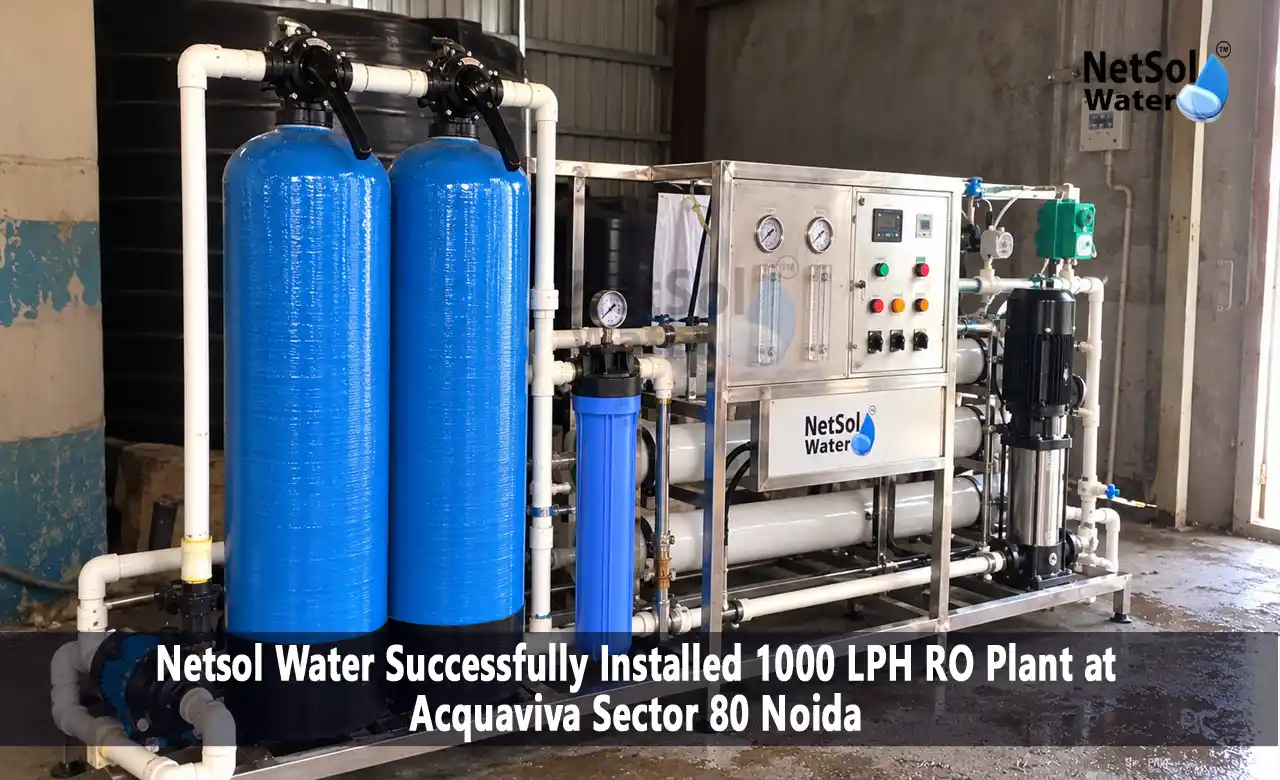
Netsol Water installed a 1000 LPH RO plant at Acquaviva, Sector 80, Noida, Uttar Pradesh, for borewell water treatment and process use. The raw water had a TDS of 3,600 mg/L. The treated water was reported at 85 mg/L. The plant is built on an MSFRP structure, uses four LG RO membranes and operates at a reported recovery of 65%.
Project Overview
| Item | Details |
|---|---|
| Project | Installed 1000 LPH RO Plant at Acquaviva, Sector 80, Noida |
| Client | Acquaviva |
| Location | Sector 80, Noida, Uttar Pradesh, India |
| RO Plant Capacity | 1000 LPH |
| Construction | MSFRP |
| Raw Water Source | Borewell |
| Raw Water TDS | 3,600 mg/L |
| Treated Water TDS | 85 mg/L |
| RO Membranes | 4 LG Membranes |
| Reported RO Recovery | 65% |
| Treated Water Application | Process Water |
| Control System | Manual |
| Installation Duration | 3 Days |
| Installation Year | Not confirmed |
Client Requirement and Water Treatment Need
Acquaviva needed borewell water treatment for process use. Netsol Water supplied and installed a 1000 LPH RO plant for this purpose at the Sector 80 site in Noida.
Borewell water can carry a high load of dissolved salts, depending on the aquifer it is drawn from. In industrial and commercial settings, water with high dissolved solids can leave scale on equipment and pipework, and it may not suit processes that depend on consistent water quality. Reverse osmosis is a common step in process water treatment, where it lowers dissolved solids before the water is used.
This page does not describe the specific processes at Acquaviva or the problems the client faced with its earlier water supply, because those details were not part of the confirmed project information. What is confirmed is the source, the intended use and the plant that was installed.
Raw Water Quality and Treatment Objective
The reported raw water TDS was 3,600 mg/L. TDS, or total dissolved solids, is a measure of the dissolved minerals and salts in water. At this level, borewell water has a heavy dissolved load, which is why a membrane-based system was used.
The treated water TDS was reported at 85 mg/L. The treatment objective was to bring dissolved solids down to a level suitable for process use. The actual quality requirement set by the client has not been confirmed for this write-up.
A TDS figure should be read carefully. It shows the reduction in dissolved solids overall. It does not mean that every contaminant has been removed, and it says nothing by itself about parameters such as hardness, silica, iron, chlorides, sulphates, bacteria or organic matter. Those parameters can matter for process water and for membrane life, but no test results for them are available for this project. They are mentioned here only as considerations that a full feed-water analysis would normally cover.
Technical Specifications of the RO Plant
| Specification | Detail |
|---|---|
| Capacity | 1000 LPH |
| Plant Construction | MSFRP |
| Pretreatment and Equipment | Pressure Sand Filter (PSF), Activated Carbon Filter (ACF), Micron Filter, High-Pressure Pump, Low-Pressure Switch and High-Pressure Switch |
| RO Membrane Brand | LG |
| Number of RO Membranes | 4 |
| Reported Recovery | 65% |
| Control System | Manual |
The equipment list is confirmed, but the exact order of the components in the installed plant has not been verified, so none is implied here. The general purpose of each item is as follows.
. Pressure Sand Filter (PSF): removes suspended particles such as silt and fine sediment from the feed water, which protects the equipment downstream.
. Activated Carbon Filter (ACF): uses activated carbon to adsorb chlorine and some organic compounds. Chlorine can damage polyamide RO membranes, so carbon filtration is a common part of RO pretreatment.
. Micron filter: a cartridge filter that acts as a final barrier against fine particles before the water reaches the membranes.
. High-pressure pump: raises the feed pressure to the level the membranes need for separation.
. Low-pressure switch and high-pressure switch: protective devices. A low-pressure switch helps guard the pump against running with insufficient inlet pressure, while a high-pressure switch helps guard the system against excessive pressure. Their actual set points for this plant are not confirmed.
. LG RO membranes: the four membranes carry out the actual separation, allowing water to pass while holding back most dissolved salts. The specific membrane model is not confirmed.
The plant is built on an MSFRP structure and is manually controlled. In a manual system, the operator starts, stops and monitors the plant, so regular attention to readings matters.
RO Plant Treatment Process
The description below covers how RO plants work in general. It is not a verified flow diagram of the Acquaviva installation, and no process-flow diagram has been included until the actual sequence is confirmed.
In a typical RO plant, feed water first passes through pretreatment. This stage removes suspended solids and chlorine and prepares the water so that the membranes are not fouled or damaged. A high-pressure pump then pushes the pretreated water across the RO membranes.
At the membranes, a portion of the water passes through as permeate, which is the low-TDS treated water. The rest of the water, carrying the rejected salts, leaves as concentrate, also called reject. Because the concentrate carries the salts the membranes have held back, it has a higher TDS than the feed.
The share of feed water that becomes permeate is the recovery. At Acquaviva, the reported recovery is 65%.
Space Challenge and Installation Approach
The confirmed installation challenge at this site was limited space. This is common in commercial and industrial premises, where utility areas are often planned around other priorities.
Space limits affect more than the footprint of the equipment. The layout decides how easily operators can reach the filters, gauges and switches. It also decides whether pipework can be routed cleanly, and whether there is enough clearance to open a filter, replace a cartridge or remove a membrane during maintenance. A plant that fits on day one but cannot be serviced comfortably can become a problem later.
The exact arrangement adopted at Acquaviva, including equipment positions and piping routes, has not been confirmed in the project information, so it is not described here. It can be added once project photographs or installation records are available.
Installation and Commissioning Completed in Three Days
This RO plant installation in Noida was completed in three days. That is the confirmed duration. A day-wise breakdown of the work has not been provided, so this page does not assign particular tasks to particular days.
A short installation period depends on planning before the team reaches the site. Equipment ready for assembly, a clear site and a well-defined layout all help, which is especially relevant when space is limited. Commissioning steps and test records for this project have not been supplied, so none are described.
Performance Results and Water Quality
The reported figures for the plant are:
| Parameter | Reported Value |
|---|---|
| Feed (Raw Water) TDS | 3,600 mg/L |
| Treated Water TDS | 85 mg/L |
| Reported RO Recovery | 65% |
. TDS reduction. The reduction is (3,600 minus 85) divided by 3,600, which gives 3,515 divided by 3,600, or about 97.6%. This is a calculation of TDS reduction between the two reported readings. It is not a universal contaminant-removal percentage, and it should not be read as removal of every substance in the water.
. Recovery. Recovery is the share of feed water that is converted into permeate. At 65%, 1,000 litres of feed water would produce roughly 650 litres of permeate and 350 litres of concentrate. This assumes a volume-based recovery calculation and stable operation.
The 1000 LPH rating may refer to permeate output or to feed flow. That basis has not been confirmed for this project, so no feed or reject flow rate is stated.
These are reported figures. No independent test report or long-term performance record is available for this write-up, so it does not claim verified or sustained results. In practice, output and quality depend on operating conditions, feed-water characteristics, water temperature and the condition of the pretreatment and membranes.
Watch the Acquaviva RO Plant Video
The video below gives visual context for the project.
Customer Testimonial
“Netsol Water installed a 1000 LPH RO plant at our Sector 80 site despite limited space. The installation was completed in three days. Our borewell water had a TDS of 3,600 mg/L, and the treated water measured 85 mg/L. We use the plant to supply process water.”
Feedback, GM, Acquaviva, Sector 80, Noida
Maintenance and Operating Considerations
This section is general operating guidance for RO plants of this kind. It is not a record of maintenance carried out at Acquaviva.
A manually controlled plant relies on regular checks by the operator. Useful practices include the following.
. Monitor feed-water quality. Borewell water can change over time, so periodic testing helps confirm that the pretreatment and membranes remain suited to the water.
. Watch the pretreatment filters. Pressure differences across the PSF, ACF and micron filter can show when backwashing, media replacement or cartridge changes are due.
. Track permeate TDS. A steady rise in permeate TDS compared with earlier readings can point to scaling, fouling or membrane wear.
. Check recovery and flow. Keeping a log of permeate and reject flows allows operators to see whether the plant is holding its intended recovery.
. Keep a membrane record. Noting pressure, flow and TDS readings regularly makes it easier to decide when cleaning or replacement is needed.
The correct schedules and limits depend on the water and the equipment specification, so they should be confirmed with the plant supplier.
Relevance for Similar Commercial and Industrial Facilities
This case may be useful to facilities that are evaluating borewell water treatment for process use. It shows that a 1000 LPH plant can be installed in limited space within three days, and it shows what readings to ask about: feed TDS, treated TDS and recovery.
It should not be treated as a template. The right capacity and design for any facility depend on actual daily water demand, a proper feed-water analysis, operating hours and the quality the process requires. Two borewells in the same area can give very different water, and a plant sized for one site may not suit another. Netsol Water also explains the advantages of an industrial RO plant for readers who want general background.
Frequently Asked Questions About the Acquaviva RO Plant
Q1. What was the capacity of the RO plant installed at Acquaviva?
The plant has a capacity of 1000 LPH.
Q2. Where was the RO plant installed?
It was installed at Acquaviva, Sector 80, Noida, Uttar Pradesh, India.
Q3. What was the raw water TDS?
The raw water, drawn from a borewell, had a TDS of 3,600 mg/L.
Q4. What was the reported treated water TDS?
The reported treated water TDS was 85 mg/L.
Q5. What was the reported RO recovery rate?
The reported recovery rate was 65%.
Q6. How long did the installation take?
The installation took 3 days.
Conclusion
The 1000 LPH RO plant at Acquaviva, Sector 80, Noida treats borewell water with a TDS of 3,600 mg/L and delivers treated water reported at 85 mg/L for process use. It uses four LG RO membranes, runs at a reported recovery of 65% and is built on MSFRP with manual control. The limited installation space was the main site challenge, and the installation was completed in three days.
If you are planning an industrial RO plant for borewell water treatment, share your water analysis, daily requirement and quality target with Netsol Water Our team can review them and suggest a suitable plant for your facility. You can also read about our industrial RO plant solutions in Uttar Pradesh. Contact Netsol Water to start your enquiry.