

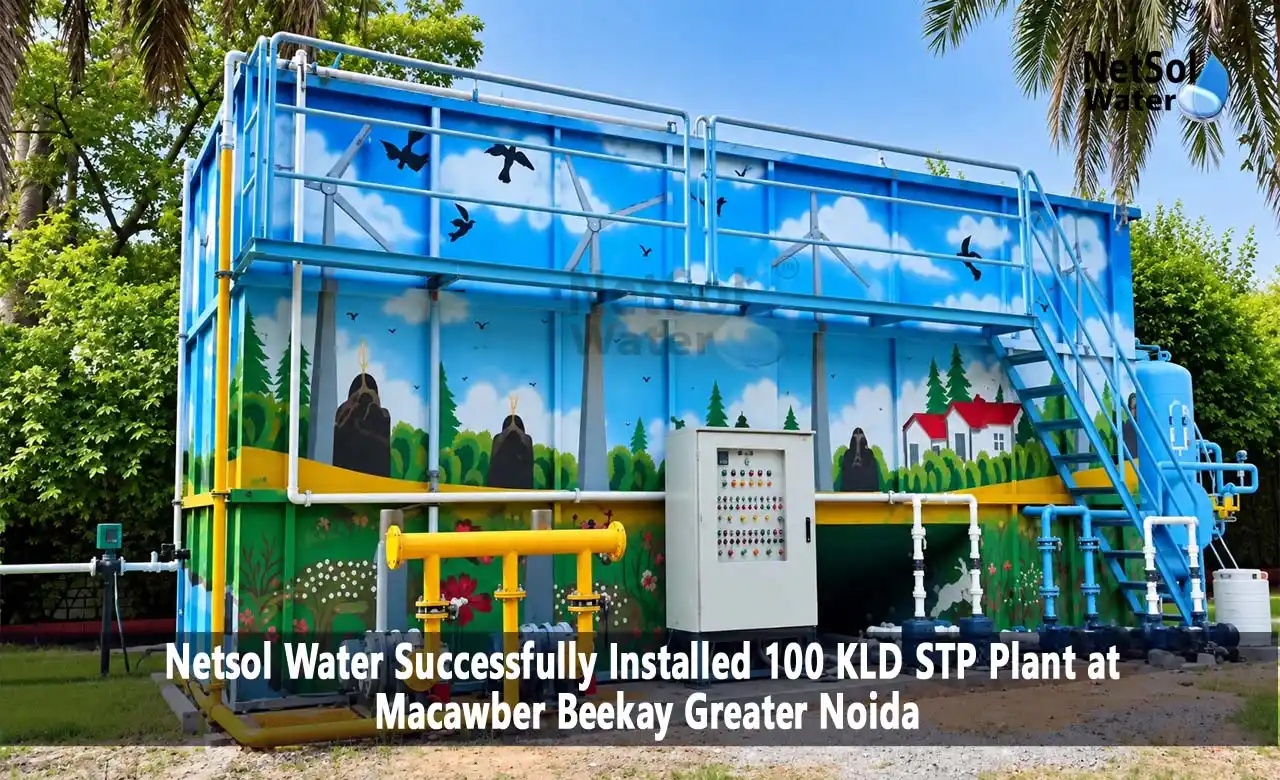
Case Study: 100 KLD STP Plant Installed at Macawber Beekay, Greater Noida
Effective sewage management is an essential part of responsible facility operations, and Macawber Beekay's site in Greater Noida, Uttar Pradesh, required a dependable, space-efficient solution to treat the sewage generated on its premises. To meet this requirement, a Prefabricated 100 KLD STP Plant was supplied, installed, and commissioned, giving the facility dedicated sewage treatment infrastructure suited to its operational needs.
As an Industrial Sewage Treatment Plant, the system is designed to process sewage through a structured treatment sequence before the treated water is routed to the site's designated ground discharge/recharge arrangement. This case study outlines the project background, the reasoning behind the prefabricated STP approach, the installation process, and how treated water is managed responsibly at the facility.
Project at a Glance
| Project Name | Prefabricated 100 KLD STP Plant Installation |
| Client | Macawber Beekay |
| Location | Greater Noida, Uttar Pradesh, India |
| Plant Capacity | 100 KLD (approx. 100,000 litres/day) |
| Plant Type | Prefabricated Sewage Treatment Plant (STP) |
| Application | Sewage Treatment |
| Treated Water Management | Ground discharge/recharge through the designated arrangement, subject to applicable standards, site conditions and regulatory permissions. |
| Scope of Work | Supply, Installation & Commissioning |
About Macawber Beekay
Macawber Beekay operates a facility in Greater Noida, Uttar Pradesh, where day-to-day operations generate sewage that needs to be managed in a structured and compliant manner. For any industrial or commercial establishment, reliable wastewater management is not an optional add-on; it directly affects site hygiene, environmental responsibility, and long-term regulatory compliance. Investing in a dedicated, well-planned sewage treatment plant reflects an organisation's commitment to sound environmental practices.
This project reflects a broader, growing need for dependable STP Plant Installation in Greater Noida, where industrial and commercial facilities increasingly require structured, professionally executed sewage treatment infrastructure rather than temporary or informal arrangements.
Project Requirement & Challenge
Facilities of this nature require a systematic approach to sewage treatment rather than ad-hoc arrangements. Untreated or partially treated sewage can create hygiene concerns, environmental risk, and regulatory exposure, which is why Macawber Beekay identified the need for a dedicated treatment system with an approximate capacity of 100 KLD.
Beyond simply treating sewage, the facility needed a solution that could be installed within practical space and time constraints, without the extended civil construction typically associated with conventional STPs. At the same time, the treated water generated by the plant had to be managed responsibly, in line with the designated ground discharge/recharge arrangement applicable to the site.
Key considerations for the project included:
. The need for systematic, ongoing sewage treatment rather than temporary measures
. An approximate treatment capacity requirement of 100 KLD
. Treating sewage adequately before any final discharge
. A compact, practical footprint suited to the available site area
. A construction approach that minimises on-site civil work
. A responsible pathway for managing the treated water generated by the plant
Why a Prefabricated 100 KLD STP Was Selected
A Prefabricated STP Plant was chosen for the Macawber Beekay project because it directly addresses the space, timeline, and quality considerations identified during project planning. Unlike conventional civil-structure STPs, a prefabricated unit is manufactured largely under controlled factory conditions and brought to site as a ready, or near-ready, assembly.
For this project, the prefabricated approach offered several practical advantages:
. Compact design that makes efficient use of the available site footprint
. Faster on-site installation compared to conventional built-in-place structures
. Factory-fabricated components manufactured under controlled conditions
. Improved fabrication quality control before the unit reaches site
. Reduced on-site civil construction requirements
. Easier transportation and placement of the treatment unit
. Efficient use of space, well suited to industrial facility layouts
. Overall suitability for industrial and commercial sewage treatment needs
For Macawber Beekay specifically, this meant a treatment system that could be positioned on site and integrated into the facility's utilities with considerably less disruption than a conventional STP construction project would involve.
The 100 KLD STP Solution
A 100 KLD STP Plant is designed to treat approximately 100,000 litres of sewage per day. In practical terms, "KLD" stands for kilolitres per day, and a 100 KLD rating indicates the plant's designed treatment capacity, representing the volume of sewage the system is engineered to process under normal operating conditions.
The prefabricated STP installed at Macawber Beekay's Greater Noida facility is intended to provide a systematic, dependable approach to sewage treatment, replacing informal or inadequate handling of wastewater with a purpose-built treatment system. The exact treatment configuration within the plant is engineered to suit site requirements; the sections below describe the treatment sequence in general terms.
How the 100 KLD STP Works
While the precise internal configuration of any STP is tailored to the project, sewage treatment plants of this type generally follow a structured, multi-stage process. The stages below represent a general treatment sequence and are presented to help explain the overall approach rather than to describe the exact process configuration of the installed plant.
| Project Name | Prefabricated 100 KLD STP Plant Installation |
| Client | Macawber Beekay |
| Location | Greater Noida, Uttar Pradesh, India |
| Plant Capacity | 100 KLD (approx. 100,000 litres/day) |
| Plant Type | Prefabricated Sewage Treatment Plant (STP) |
| Application | Sewage Treatment |
| Treated Water Management | Ground discharge/recharge through the designated arrangement, subject to applicable standards, site conditions and regulatory permissions. |
| Scope of Work | Supply, Installation & Commissioning |
Raw Sewage → Screening → Equalization → Biological Treatment → Secondary Clarification → Tertiary Treatment/Filtration → Disinfection → Treated Water → Designated Ground Discharge/Recharge.
Installation & Project Execution
The installation of the prefabricated STP at Macawber Beekay's facility followed a structured execution process, moving from site preparation through to testing and commissioning.
| Stage | Description |
|---|---|
| Site Preparation | The installation area was prepared, including readiness of the foundation/base required to receive the prefabricated unit. |
| Prefabricated STP Placement | The prefabricated unit was transported to the site and positioned and aligned at the designated location. |
| Mechanical Installation | Major mechanical equipment associated with the treatment system was installed and integrated into the unit. |
| Piping Connections | Inlet piping, interconnecting pipework between treatment stages, and treated-water outlet piping were connected. |
| Electrical Work | Electrical connections and control systems were installed and integrated with the plant equipment. |
| Testing & Commissioning | The system was tested, connections were checked, and the plant was commissioned following trial operation. |
This structured, stage-wise execution reflects the general advantage of the prefabricated approach: much of the fabrication work is completed before the unit arrives on site, so on-site activity is more focused on placement, connection, and commissioning rather than extended construction.
Treated Water Management & Ground Discharge/Recharge
One of the most important aspects of this project is how the treated water generated by the STP is managed. The general pathway is as follows: sewage enters the STP, undergoes treatment, and the resulting treated water is subject to quality monitoring before being directed to the designated ground discharge/recharge arrangement for the site.
It is important to distinguish between "ground discharge" and "groundwater recharge." Ground discharge refers to the release of treated water to a designated point or area on the site in line with applicable requirements, while groundwater recharge specifically refers to water that is directed into the ground with the intention of replenishing groundwater resources. Which of these applies, and under what conditions, depends on site-specific arrangements, applicable standards, and the regulatory permissions in force for the facility.
Treating sewage before any discharge is essential: it reduces pollutant load, improves water quality relative to untreated sewage, and forms the basis for responsible disposal or reuse. However, treatment through STP does not, by itself, make the treated water automatically suitable or approved for groundwater recharge. Its final use or disposal route is governed by the designated arrangement for the site, ongoing quality monitoring, and compliance with applicable regulatory standards and permissions.
The overall approach to treated-water management at Macawber Beekay's facility includes:
. Treatment of sewage through the prefabricated STP prior to any discharge
. Quality monitoring of treated water as part of ongoing operations
. Routing of treated water to the designated ground discharge/recharge arrangement
. Adherence to applicable regulatory standards governing discharge/recharge
. Recognition that site-specific permissions and conditions govern the final application of treated water
Environmental Benefits of the Project
The installation of a dedicated sewage treatment system at Macawber Beekay's Greater Noida facility supports several environmental objectives associated with responsible industrial operation.
. Reduces the risk of untreated sewage being discharged from the facility
. Helps lower the overall pollution load associated with facility wastewater
. Supports more structured and consistent wastewater management practices
. Contributes to a more sustainable approach to water management on site
. Enables more responsible handling and disposal of treated water
. Supports the facility's broader environmental compliance objectives
. Improves the facility's overall wastewater treatment infrastructure
Project Outcome
With the prefabricated 100 KLD STP now supplied, installed, and commissioned, Macawber Beekay's Greater Noida facility has dedicated sewage-treatment infrastructure in place. The plant provides a systematic, structured approach to sewage treatment and treated-water management, replacing ad-hoc handling with a purpose-built system aligned to the site's designated ground discharge/recharge arrangement, subject to applicable standards and regulatory requirements.
Project Highlights
| Capacity | 100 KLD |
| Plant Type | Prefabricated STP |
| Client | Macawber Beekay |
| Location | Greater Noida, Uttar Pradesh |
| Application | Sewage Treatment |
| Scope | Supply, Installation & Commissioning |
| Treated Water Management | Designated ground discharge/recharge arrangement, subject to applicable requirements |
Project Video – Prefabricated 100 KLD STP Installation
To see the prefabricated 100 KLD STP installation at Macawber Beekay's Greater Noida facility, watch the project video below. The video offers a closer look at the plant setup and installation process at the site.
Watch the Project Video: Prefabricated 100 KLD STP:
Conclusion
The Prefabricated 100 KLD STP Plant installed at Macawber Beekay's facility in Greater Noida, Uttar Pradesh, demonstrates a practical, space-efficient approach to industrial sewage treatment. Through supply, installation, and commissioning of a prefabricated 100 KLD STP, the facility now has a dedicated system capable of treating approximately 100,000 litres of sewage per day.
Just as importantly, the project reflects a responsible approach to treated-water management: routing treated water to the designated ground discharge/recharge arrangement, subject to applicable standards, site conditions, and regulatory permissions, rather than making unsupported claims about its end use. For industrial and commercial facilities alike, reliable sewage treatment infrastructure of this kind is a foundational part of sustainable, compliant, and responsible site operations.
Frequently Asked Questions (FAQs)
Q1. What is the capacity of the STP installed at Macawber Beekay?
The STP installed at Macawber Beekay's Greater Noida facility has a capacity of 100 KLD, designed to treat approximately 100,000 litres of sewage per day.
Q2. What does 100 KLD mean in STP?
KLD stands for kilolitres per day. A 100 KLD STP is designed with a treatment capacity of approximately 100,000 litres of sewage per day.
Q3. Why was a prefabricated STP selected for this project?
A prefabricated STP was selected for its compact design, faster on-site installation, factory-controlled fabrication quality, and reduced on-site civil construction requirements, all of which suited the practical needs of the Macawber Beekay project.
Q4. How does a 100 KLD sewage treatment plant work?
A 100 KLD STP generally treats sewage through a sequence of stages such as screening, equalization, biological treatment, secondary clarification, tertiary treatment/filtration, and disinfection, before the treated water is directed to its designated discharge or recharge arrangement.
Q5. What happens to sewage after it enters the STP?
Sewage passes through a structured treatment sequence designed to remove solids, reduce organic pollutants, separate biological solids, filter fine suspended matter, and reduce harmful microorganisms before the resulting treated water is managed further.
Q6. Where is the treated water discharged?
Treated water from the plant is routed to the designated ground discharge/recharge arrangement applicable to the site, subject to quality monitoring and applicable regulatory standards and permissions.
Q7. Can treated STP water be used for groundwater recharge?
Treatment through STP does not automatically qualify water for groundwater recharge. Whether treated water is used for ground discharge or groundwater recharge depends on site-specific conditions, quality monitoring, and the applicable regulatory permissions in force for the facility.
Q8. What are the environmental benefits of installing a 100 KLD STP?
A 100 KLD STP helps reduce untreated sewage discharge, lowers pollution load, supports structured wastewater management, and contributes to more sustainable and compliant water management practices at the facility.