

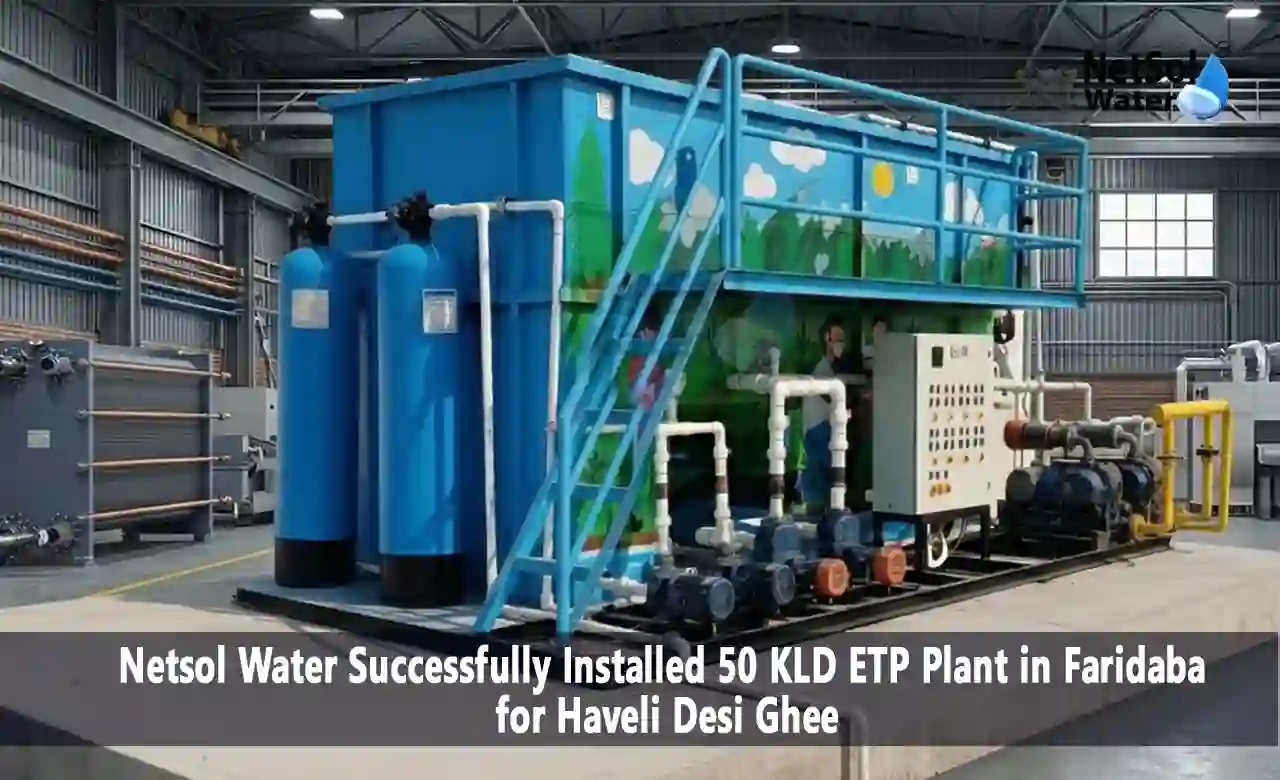
Dairy Case Study: 50 KLD ETP Plant for Haveli Desi Ghee in Faridabad
When it comes to responsible industrial growth, wastewater management is no longer optional - it is a regulatory and environmental imperative. Netsol Water, one of India's leading ETP plant manufacturers, recently executed a landmark project: a fully operational 50 KLD ETP Plant in Faridabad for Haveli Desi Ghee, a prominent dairy product manufacturer.
This case study explores how Netsol Water designed, engineered, and installed a high-performance Effluent Treatment Plant in Faridabad that meets CPCB (Central Pollution Control Board) discharge norms while helping the client achieve zero regulatory risk and maximum operational efficiency.
Project Overview
| Client Name | Haveli Desi Ghee |
| Industry | Dairy – Ghee Manufacturing |
| Location | Faridabad, Haryana |
| Plant Capacity | 50 KLD (Kilolitres per Day) |
| Project Type | Effluent Treatment Plant (ETP) |
| Solution Provider | Netsol Water |
| Project Status | Commissioned & Operational |
| Compliance Standard | CPCB / HSPCB Discharge Norms |
Haveli Desi Ghee runs a mid-size ghee manufacturing facility in Faridabad, Haryana. As their production grew, so did the amount of wastewater generated from cleaning, processing, and washing operations. The effluent was strong - high in fats, BOD, and COD - and the existing setup was not equipped to handle it properly. That is when they reached out to us.
Challenges Faced
Dairy effluent, particularly from ghee manufacturing, is not easy to treat. Before we came on board, Haveli Desi Ghee was struggling with a mix of technical, operational, and regulatory problems:
• Very high BOD and COD in the wastewater from ghee processing - fats, oils, proteins, and lactose all contribute to an extremely high organic load.
• Inconsistent flow across shifts, which made it hard to maintain stable treatment conditions.
• Persistent foul odour from untreated or partially treated effluent, which was affecting the surrounding area.
• Formal notices from the Haryana State Pollution Control Board (HSPCB) for violating discharge norms.
• Limited space at the facility, which meant the treatment system had to be compact and efficient.
• No in-house expertise to operate a treatment plant, so we also had to think about simplicity of operation from day one.
Project Objectives
Before proposing any solution, our engineering team carried out a detailed site visit, collected wastewater samples for lab analysis, and reviewed the applicable regulatory standards. Based on that, the following goals were set out:
• Treat 50,000 litres of dairy effluent every day, reliably and consistently.
• Achieve treated water quality within CPCB and HSPCB permissible limits.
• Reduce BOD to below 30 mg/L and COD to below 250 mg/L.
• Keep sludge generation as low as possible, and handle what is produced in a compliant manner.
• Design a compact plant layout that fits within the available site area.
• Enable reuse of treated water for gardening, floor washing, and cooling tower makeup.
• Make the plant straightforward to operate, even without highly specialised staff.
Solution Provided by Netsol Water
After reviewing the wastewater characteristics, site conditions, and client requirements, Netsol Water designed a conventional multi-stage Effluent Treatment Plant tailored specifically for ghee manufacturing wastewater. The system uses a combination of physical, chemical, and biological treatment processes to bring the effluent well within discharge norms.
Rather than going with any single advanced technology, the approach here was to use a proven, well-understood treatment train that is robust, cost-effective, and easy to operate. The system includes upstream physico-chemical treatment, conventional aerobic biological treatment using an Extended Aeration process, and downstream polishing. This combination works particularly well for dairy effluent where the organic load is high but the wastewater is largely biodegradable.
Netsol Water managed the entire project in-house - from initial design and detailed engineering to civil construction, equipment supply, installation, commissioning and operator training.
Treatment Process - Step by Step
Step 1: Bar Screen and Grit Removal
All incoming raw effluent first passes through a bar screen chamber where large solids like food scraps, fibrous material, and packaging fragments are removed manually or mechanically. From there, the flow moves to a grit chamber that settles out sand and heavy inorganic particles. This protects the downstream pumps and equipment from wear and clogging.
Step 2: Oil and Grease Trap
Ghee manufacturing wastewater contains substantial amounts of fats, oils, and grease (FOG). A dedicated OG trap is installed immediately after screening to skim off and remove this floating layer before it reaches the biological treatment stage. Skipping or undersizing this step is one of the most common reasons biological systems fail in dairy ETPs - so we sized it generously.
Step 3: Equalisation Tank
The effluent is collected in an equalisation tank, which serves as a buffer to absorb variations in flow rate and pollutant strength across different production shifts. Coarse bubble diffusers keep the contents mixed and prevent septic conditions from developing. This step ensures a consistent, stable feed to the treatment units that follow.
Step 4: Flash Mixer and Clariflocculator
Coagulants - typically alum and polyelectrolyte - are dosed in a flash mixer to destabilise the colloidal particles suspended in the effluent. The water then enters a clariflocculator where these particles clump together into larger flocs that settle to the bottom. This step removes a significant portion of suspended solids, turbidity, and COD before biological treatment begins.
Step 5: Aeration Tank (Extended Aeration)
The heart of the biological treatment system is a conventional Extended Aeration tank. Here, a healthy culture of aerobic microorganisms breaks down the dissolved organic matter in the effluent. Surface aerators or fine bubble diffusers provide the oxygen needed for this process. The extended retention time in this tank ensures thorough breakdown of even the more stubborn organic compounds, consistently bringing BOD down to well within the permissible limit.
Extended Aeration is a well-established, reliable technology for high-BOD dairy wastewater. It does not require complex controls or sequencing logic, which makes it easier to operate and maintain over the long term.
Step 6: Secondary Clarifier
The mixed liquor from the aeration tank flows into a secondary clarifier where the biological sludge separates from the treated water by gravity settling. The clear effluent overflows from the top, while the settled sludge collects at the bottom. A portion of this sludge is pumped back to the aeration tank as Return Activated Sludge (RAS) to maintain the required biomass concentration, and the rest is sent to the sludge handling section.
Step 7: Tertiary Polishing - Sand Filter and Activated Carbon Filter
After biological treatment, the effluent goes through a Pressure Sand Filter to remove any residual suspended solids, followed by an Activated Carbon Filter to take care of colour, odour, and trace organic contaminants. These polishing steps ensure the treated water is clean enough for safe discharge or reuse within the facility.
Step 8: Disinfection
The final step before discharge or reuse is disinfection using UV irradiation and/or chlorination. This eliminates any remaining pathogens and ensures the treated water is microbiologically safe, meeting the standards required for non-potable reuse applications.
Step 9: Sludge Management
Biological sludge from the secondary clarifier is first thickened in a sludge thickener to reduce its volume, then dewatered using a filter press. The resulting sludge cake is handled and disposed of as per HSPCB guidelines. The liquid filtrate from the filter press is recycled back to the equalisation tank so nothing goes to waste.
Key Components Installed
• Bar Screen Chamber with Manual Raking
• Oil & Grease Trap with Skimmer Arrangement
• Equalisation Tank with Coarse Bubble Diffusers
• Flash Mixer and Clariflocculator
• Extended Aeration Tank with Surface Aerators / Fine Bubble Diffusers
• Air Blowers (Energy-Efficient)
• Secondary Clarifier with Sludge Scraper
• Pressure Sand Filter (PSF)
• Activated Carbon Filter (ACF)
• UV Disinfection System
• Chemical Dosing Systems (Alum, Polyelectrolyte, Chlorine)
• Sludge Thickener and Filter Press
• Electrical Control Panel with Online Monitoring Instruments
• All interconnecting pipelines, pumps, and valves
Installation & Execution
The project was executed in a phased manner to minimise disruption to the client’s production activities:
• Phase 1 - Site Survey & Design (Day 1): Wastewater characterisation, site survey, finalisation of process design, and preparation of P&ID drawings and equipment layout.
• Phase 2 - Civil Construction (Days 2–10): RCC tank construction, equipment foundations, and civil layout as per approved drawings.
• Phase 3 - Mechanical Installation (Days 11–16): Equipment mounting, piping, and structural work.
• Phase 4 - Electrical & Instrumentation (Days 17–19): Control panel installation, cabling, and instrument integration.
• Phase 5 - Commissioning & Trial Runs (Days 20–22): Biological seeding of the aeration tank, trial runs, performance testing, and parameter optimisation.
• Phase 6 - Handover & Training (Days 23–24): Operator training, O&M manual handover, and final regulatory documentation.
The entire project was completed in 24 Days, within the agreed schedule, which kept production disruption to a minimum.
Results & Performance
After commissioning and a 30-day stabilisation period, the plant has been consistently meeting and exceeding CPCB discharge standards. Here is a summary of the actual performance data:
| Parameter | Influent (Raw) | Treated Effluent | CPCB Limit |
|---|---|---|---|
| pH | 4.5 – 6.0 | 7.2 – 7.8 | 6.5 – 9.0 |
| BOD (mg/L) | 1,200 – 1,800 | 18 – 22 | ≤ 30 |
| COD (mg/L) | 3,500 – 5,000 | 180 – 210 | ≤ 250 |
| TSS (mg/L) | 800 – 1,200 | 28 – 35 | ≤ 100 |
| Oil & Grease (mg/L) | 400 – 600 | 4 – 6 | ≤ 10 |
| TDS (mg/L) | 2,000 – 3,000 | 1,100 – 1,400 | ≤ 2,100 |
| Colour | Dark Brown | Colourless / Light | Within Norms |
Before vs. After Comparison
| Aspect | Before ETP Installation | After ETP Installation |
|---|---|---|
| Regulatory Status | Notices from HSPCB, non-compliant | Fully compliant, no pending notices |
| BOD Level | 1,200–1,800 mg/L | 18–22 mg/L |
| COD Level | 3,500–5,000 mg/L | 180–210 mg/L |
| Odour Issue | Severe odour complaints | Odour-free operations |
| Water Reuse | Zero reuse | ~30–35% treated water reused |
| Sludge Handling | Unmanaged, open dumping | Controlled dewatering, legal disposal |
| Operational Cost | High (penalties + fines) | Optimised and predictable |
| Environmental Impact | High (direct discharge risk) | Minimal, environmentally responsible |
| Plant Monitoring | No real-time monitoring | Online monitoring with control panel |
What the Client Gained
• Regulatory Compliance: The HSPCB notices are behind them. The plant is fully compliant with CPCB and HSPCB discharge norms, with no risk of fines, shutdowns, or legal action.
• Water Savings: Around 15,000–17,000 litres of treated water per day is now reused within the facility for floor washing, gardening, and other non-potable applications, cutting down on freshwater procurement.
• Lower Costs: Penalty payments have stopped, freshwater bills have reduced, and the energy-efficient system design keeps operating costs predictable.
• Better Brand Image: Haveli Desi Ghee can now genuinely call itself an environmentally responsible dairy operation - which matters increasingly to their buyers and business partners.
• Built to Scale: The plant layout is designed so that capacity can be expanded to 100 KLD in the future without major civil modifications.
• Simple to Operate: The control panel and operator training provided ensure the plant runs smoothly day to day, even without specialised technical staff on site.
Why Choose Netsol Water?
There are many Effluent Treatmet Plant Manufacturer in Faridabad, India. What sets Netsol Water apart is not just technical capability but a genuine commitment to making sure the plant works long after the commissioning team has left. Here is what we bring to the table:
• 15+ years of experience designing and installing ETP, STP, and WTP plants across a wide range of industries.
• Deep, proven expertise in dairy wastewater treatment, with multiple successful projects across India.
• End-to-end project delivery - from the first site visit to commissioning, operator training, and ongoing AMC support.
• An in-house engineering team that understands both the biological and physico-chemical sides of wastewater treatment.
• All systems designed and guaranteed to meet CPCB, SPCB, and NGT norms.
• Transparent, competitive project pricing - no hidden costs.
• Dedicated AMC and 24×7 technical helpline for post-commissioning support.
• Projects delivered across Faridabad, Delhi NCR, Noida, UP, Rajasthan, Punjab, and beyond.
50 KLD ETP Plant Installed at Haveli Desi Ghee (Video)
Conclusion
The 50 KLD ETP Plant at Haveli Desi Ghee’s Faridabad facility is a good example of what a well-designed, properly executed effluent treatment system can deliver - not just regulatory compliance, but real operational and financial benefits for the client.
If you run a dairy unit, food processing plant, or any industrial facility in Faridabad or elsewhere in India that is struggling with wastewater management, take this as a reference point. A well-designed ETP is not a liability. It protects your licence to operate, it can help you reuse water, and it puts you on the right side of an increasingly strict regulatory environment.
Talk to Netsol Water. We will tell you honestly what you need and what it will cost.
Get a Free Consultation from Netsol Water
Looking for a reliable ETP solution in Faridabad or anywhere across India? Contact Netsol Water for a free site assessment and project proposal.
Call: +91-9650608473, Email: inquiry@netsolwater.com
Don’t wait for a pollution control notice to act. Build compliance. Build sustainability. Build with Netsol Water.
Frequently Asked Questions (FAQs)
Q1. What is a 50 KLD ETP Plant and how does it work for the dairy industry?
A 50 KLD ETP is a wastewater treatment system designed to treat 50,000 litres of effluent per day. For dairy units, it typically involves multiple stages - bar screening, oil and grease removal, equalisation, physico-chemical treatment, biological treatment (aerobic), secondary clarification, and tertiary polishing - to bring high-BOD dairy effluent within CPCB discharge norms before it is discharged or reused.
Q2. What does a 50 KLD ETP Plant cost in India?
The cost typically ranges from INR25 lakhs to INR55 lakhs depending on the type of effluent, the treatment technology selected, the level of automation, the scope of civil construction, and site-specific conditions. For dairy industries with high BOD and COD, biological treatment is essential and adds to the cost, but it is non-negotiable for compliance. Contact Netsol Water for a detailed project-specific quote.
Q3. Why is an ETP mandatory for ghee manufacturing units in Faridabad?
Ghee and dairy processing units generate high-strength organic wastewater rich in fats, BOD, COD, and suspended solids. Under the Environment Protection Act, 1986 and guidelines from CPCB and HSPCB, all such units are required to install and operate a functional ETP before discharging any wastewater. Non-compliance can lead to factory closure, heavy fines, and legal action.
Q4. How long does it take to install a 50 KLD ETP Plant for a dairy unit?
A typical installation takes between 20 to 28 days from project kick-off to commissioning, depending on site readiness, equipment lead times, and the complexity of civil work. The Haveli Desi Ghee project in Faridabad was completed in 24 days, covering all civil, mechanical, electrical, and commissioning phases.
Q5. What water quality must a dairy ETP achieve to meet CPCB norms?
The treated effluent must meet these minimum standards: pH between 6.5 and 9.0, BOD ≤ 30 mg/L, COD ≤ 250 mg/L, TSS ≤ 100 mg/L, and Oil & Grease ≤ 10 mg/L. The ETP installed at Haveli Desi Ghee consistently achieves all of these parameters.
Q6. Can treated water from a dairy ETP be reused?
Yes. With proper tertiary treatment - sand filtration, activated carbon filtration, and UV disinfection - treated effluent can be safely reused for non-potable purposes like floor washing, gardening, toilet flushing, and cooling tower makeup. At the Haveli Desi Ghee facility, approximately 30–35% of treated water is recycled back into daily operations.
Q7. Is Netsol Water a good choice for ETP installation in Faridabad?
Netsol Water has been working in wastewater treatment for over 15 years and has completed ETP projects across dairy, food processing, textile, pharmaceutical, and chemical industries throughout the Delhi NCR region and beyond. Our focus is on building systems that work reliably over time, not just pass a commissioning test. We offer full post-commissioning support, AMC contracts, and a 24×7 technical helpline.