

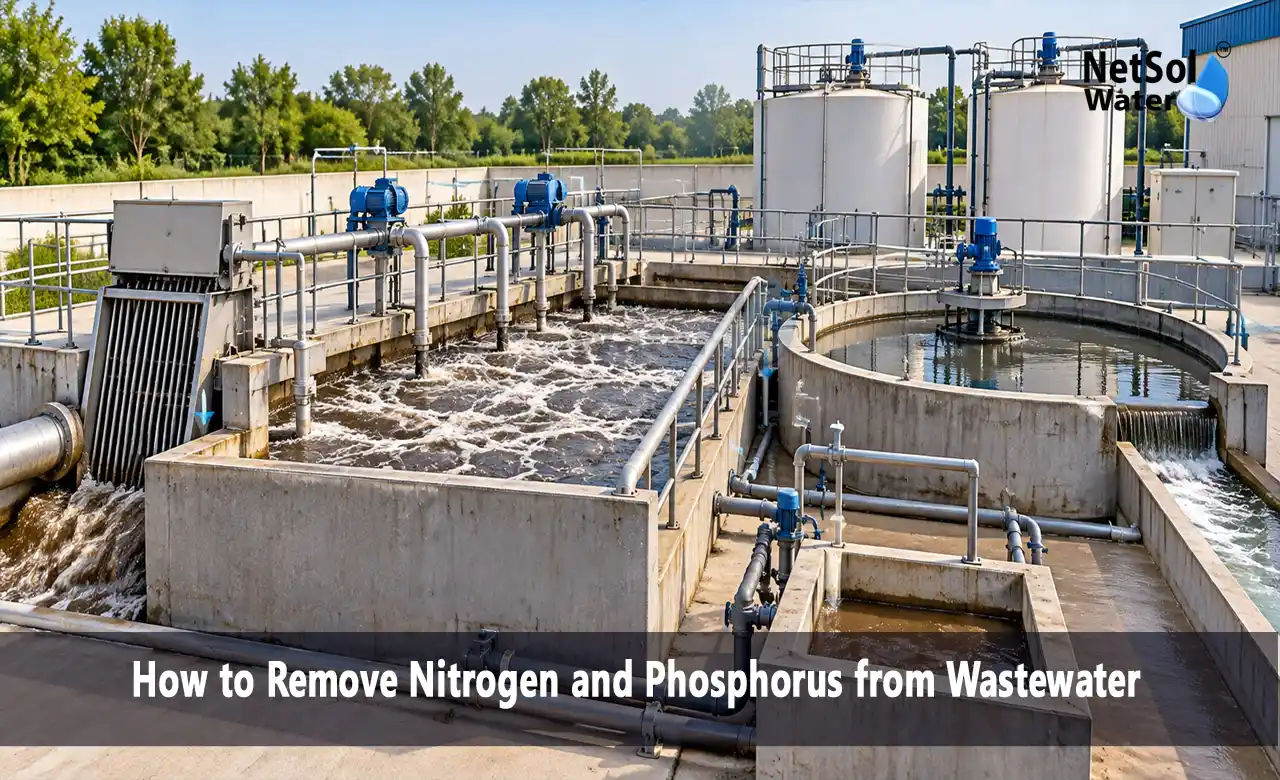
How to Remove Nitrogen and Phosphorus from Wastewater?
Clear water can still be a problem. Treated wastewater that carries nitrogen and phosphorus feeds algae the moment it reaches a river or lake. The algae bloom fast, die, and rot, and the rotting strips dissolved oxygen out of the water. Fish and other aquatic life pay for it. The name for this whole chain of events is eutrophication.
Both nutrients arrive by the same routes: human waste, food waste, detergents and industrial process water. Sewage from a housing society is rich in ammonia. A dairy or a fertiliser unit can send far more.
Two different strategies are needed, because the two nutrients behave differently. Nitrogen can leave the water as a gas. Phosphorus has no gas form, so it has to leave with the sludge. Every method below follows from that one fact.
The plant itself matters too. A housing complex or hotel usually needs a sewage treatment plant built around ammonia and organic load. A factory with swinging process flows usually needs an effluent treatment plant with equalisation and tighter chemical control.
1. Biological nitrogen removal
Bacteria do the work here, in two steps.
Nitrification happens in the aeration tank. Nitrifying bacteria oxidise ammonia to nitrite and then to nitrate. They are hungry for oxygen (roughly 4.6 kg of oxygen for every 1 kg of ammonia nitrogen) and they eat alkalinity too, around 7 mg as CaCO3 per 1 mg of ammonia nitrogen. When alkalinity runs out, pH drops and nitrification stalls.
Denitrification happens in an anoxic zone, where dissolved oxygen sits close to zero. Here bacteria breathe nitrate instead of oxygen, feed on the organic matter in the sewage, and release nitrogen gas. About half the lost alkalinity comes back.
Nitrification only turns ammonia into nitrate. Total nitrogen stays the same until denitrification runs. The usual layout puts an anoxic tank ahead of the aeration tank and pumps nitrate-rich liquid back to it with an internal recycle.
One trap catches many plants. When the incoming sewage is weak, the anoxic zone runs out of carbon first and the nitrate walks straight out with the treated water.
2. Biological phosphorus removal
Special bacteria called phosphorus accumulating organisms (PAOs) do this job, and they need a particular sequence of conditions.
First comes an anaerobic zone with no oxygen and no nitrate. PAOs grab simple organic acids and release phosphate into the water. Next the flow moves to an aerobic zone, where the same bacteria take up far more phosphate than they released. The phosphorus is now locked inside their cells.
The sludge must then be wasted. If it sits and decays, the phosphorus leaks right back out. And if nitrate leaks into the anaerobic zone, it steals the organic acids PAOs depend on, which is why good denitrification and good phosphorus removal go together. The A2O process (anaerobic, anoxic, oxic) is built on this logic.
3. Chemical phosphorus removal
Aluminium salts such as alum, iron salts such as ferric chloride, and lime all bind dissolved phosphate into solid particles. Those particles settle in a clarifier or get caught in a filter, and leave as sludge.
Dose is the tricky part. Metal salts also react with other things in the water, so the real dose runs higher than the textbook 1:1 ratio, and a jar test on your own wastewater beats any rule of thumb. Alum works best around pH 6 to 7. Lime needs pH above 10, makes a lot of sludge, and the pH has to be brought back down before discharge.
Underdose and phosphorus slips through. Overdose and you pay for extra chemical and extra sludge. Metal salts also use up alkalinity, which can hurt nitrification further down the line. Many plants run chemical dosing as a backup to biological removal, and some use it as the main route.
What decides whether a plant hits its numbers?
1. Test the wastewater first. Ammonia, total Kjeldahl nitrogen, nitrate, total phosphorus, orthophosphate, BOD, COD, alkalinity and pH, sampled at different hours, since flows swing through the day. Engineers size the tanks, sludge age and recycle ratios from these numbers.
2. Pick the process to suit the site. MBBR fits plants with tight space. SBR runs anoxic and aerobic phases in one tank by timing alone. MBR membranes give very low suspended solids, which matters because a good share of effluent phosphorus rides on solid particles. A tertiary filter does a similar job.
3. Watch the plant every day. A decent routine: dissolved oxygen and pH every shift, sludge wasting on a schedule, and ammonia, nitrate and phosphate in the lab at least weekly. Aeration needs about 2 mg/L dissolved oxygen for nitrification, so a blower fault or a clogged diffuser shows up fast in the ammonia result.
4. Know your consent limits. Limits for ammoniacal nitrogen, total nitrogen and phosphate depend on the state, the discharge point and whether the water is reused. Check the consent conditions from your State Pollution Control Board before you design anything.
Get the right system for your wastewater
Netsol Water designs and builds sewage and effluent treatment systems for housing societies, hotels, hospitals and industry. Send your wastewater test report and daily flow, and the team will tell you which combination of biological and chemical steps fits, and what it will cost.
Contact Netsol Water
Phone: +91-9650608473, Email: enquiry@netsolwater.com