

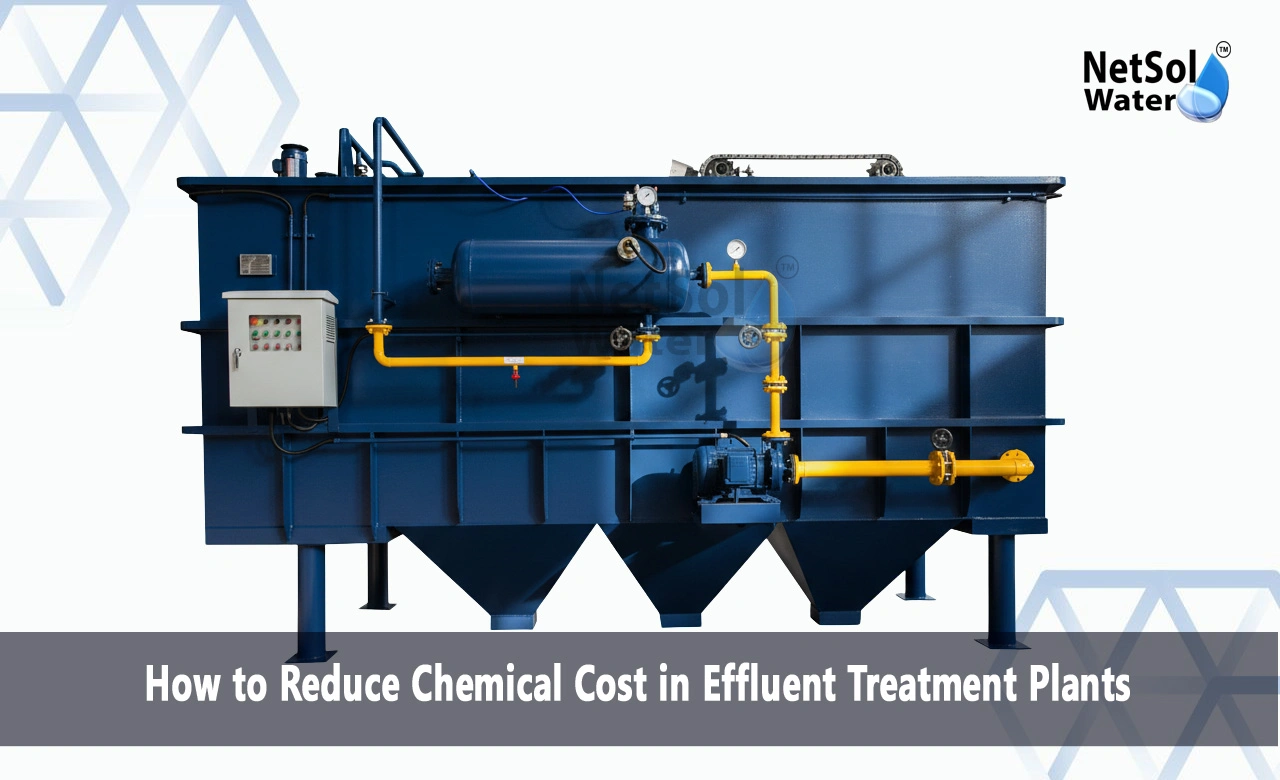
How to Reduce Chemical Cost in Effluent Treatment Plants?
One of the biggest recurrent operating costs in effluent treatment plants is chemical consumption. Coagulants, flocculants, pH corrective chemicals, oxidants and disinfectants are commonly used in everyday life to ensure that the treatment is effective and compliant with regulations. Chemical use however, in most plants does not increase proportionally with improvement in the performance of treatment of the water. This not only elevates the operating costs but also the generation of the sludge and complexity of the operations. Learning how to reduce chemical cost in effluent treatment plants requires a shift from reactive dosing practices to process-driven optimization and control.
Why Chemical Costs Run High in Effluent Treatment Plants?
1: Due to Conservative Operation, overdosing
Conservative dosing is one of the most prevalent causes of excessive consumption of chemicals. Chemical dosage is usually raised by the operators as a precaution against the varying quality of the effluents. Although this can help stabilize the parameters of outlets in the short term, it leads to chronic overdosing and unjustified chemical consumption.
2: Poor Influent Equalization
Those treatment units do not get equal concentrations of pollutants without adequate hydraulic and load equalization. These abrupt variations compel operators to vary chemical doses often, and usually on the higher side, lest compliance risks arise. This instability directly causes chemical consumption.
3: Poor Characterization of Effluent
Numerous ETPs do not possess a close understanding of the chemistry of the influenti. In situations where the parameters like alkalinity, buffering capacity, or treatability are not clearly known, chemical dosing is more of a blindfold then a scientific process. This ambiguity contributes to the poor use of chemicals.
4: Technology Mismatch
Subjecting the effluents which may be endured through either biological treatment or hybrid treatment to chemical-heavy treatment processes leads to unnecessary expenditure on chemicals. Root cause treatment is not done but rather chemicals are applied to correct the design constraint of some plants.
Process-Level Strategies to Reduce Chemical Cost in Effluent Treatment Plants
1: Test and Monitor Chemical Dosing
Periodic testing of the jar and pilot assessments will assist in establishing the minimum effective dose of the chemical to be used in the treatment. Considerable performance in reducing the amount of chemicals used without undermining the quality of effluent can be attained when the dosing is made with reference to actual influent properties and not through predetermined assumptions.
2: Enhancing Process Stability and Equalization
Well constructed and well functioning equalization tank smoothers out the fluctuation of flow and pollutant loads. Constant influent conditions enable regular chemical dosage and avoid the frequent corrective overdosing. Achieving cost reduction of chemicals is one of the best through process stability.
3: Improving the Biological Treatment performance
Enhanced biological treatment minimises chemical reliance on chemical treatment to eliminate COD, colour and nutrient control. Aging of sludge, nutrient balance, and proper aeration of microbes will reduce the high level of chemical intervention.
4: Harmonizing pH with the help of natural buffers
Rather than using only acids and alkalis in correcting the pH, one can learn about the inherent buffering of effluent in order to limit the amount of chemicals used. Dosing that is done according to the trends of alkalinity will avoid over-correction, and stabilize the down-stream treatment.
Chemical Cost Reduction Operational Practices
1: Feedback-Based Dosing and Automation
Real-time control of chemical feed rates is possible using automated dosing systems that are connected to online sensors. This helps to avoid underdosing and overdosing and enhances its consistency. Automation makes the operators less dependent and the chemicals are used only when necessary.
2: Minimizing the use of Emergency Chemicals
The use of emergency dosing usually uses enormous amounts of chemicals in brief intervals. Through early warning systems; operators can be able to intervene slowly, rather than shock dosing, by monitoring increasing turbidity, changes in COD, or drifting pH.
3: Improved Sludge Management
Economical sludge removal enhances the functioning of reactors and demands less chemicals. The build-up of the sludge also raises the chemical needs of settling and clarification. Periodic sludge wasting enhances the entire process efficiency, and it reduces the use of chemicals indirectly.
Technology and Design Choices Which Impact Chemical Usage
1: The use of Hybrid Treatment Systems
Biological and physico-chemical processes are combined to enable every system to perform optimally. The hybrid designs minimize the reliance on chemicals by maximizing natural treatments prior to the use of chemicals to polish.
2: Selective Treatment with Advanced Treatment
The use of advanced oxidation or adsorption must be yielded when needed and be specific to pollutants. The implementation of advanced treatment over the whole flow is an unnecessary increase in the cost of chemicals and energies.
3: Retrofitting to Be Efficient, Not Capacity
Most plants are putting more chemicals in to meet the loss or inefficient equipment due to ageing. Adding chemicals can also decrease chemical requirement more efficiently than adding dosage through retrofitting mixers, aeration systems, or clarifiers.
Cost-Saving in the Long-term of Reducing Chemicals
1: Reduced Cost of Sludge Generation and Disposal
Less chemical consumption results in a reduction in the sludge of chemicals. This makes the process of sludge management easier, and lightens the loads of disposal, as well as lowers the total expense of waste management.
2: Improved Process Stability
Plants that are run with the optimum chemical dosage exhibit lower upsets and a uniform quality in the effluent. More stable processes involve reduced correctives and less chemical interventions.
3: Greater Sustainability and Compliance
A reduced amount of the chemicals decreases the environmental footprint of effluent treatment. It also enhances the compliance in the long-term since it prevents secondary pollution that comes along with excessive use of chemicals.
Conclusion
To reduce chemical cost in effluent treatment plants, operators and designers must move beyond reactive dosing and focus on process understanding, stability, and optimization. Overuse of chemicals is frequently a sign of underlying problems of bad equalization, inefficient biological functioning or ineffective monitoring. The ETPs can obtain an important reduction in the chemical costs and guarantee the efficiency of treatment and the compliance with regulation by enhancing the use of influent control, developing the biological systems, and automating them, as well as choosing the right technologies. Sustainable effluent treatment cannot be provided by adding more chemicals rather it can be offered by wisely applying the chemicals.
Do you need an advice or assistance on selecting the best water and waste water treatment unit? We have solutions for all your problems!
Let us know your problem, our experts will make sure that it goes away.
For an assistance or related query,
Call on +91-9650608473
Or write us at enquiry@netsolwater.com