

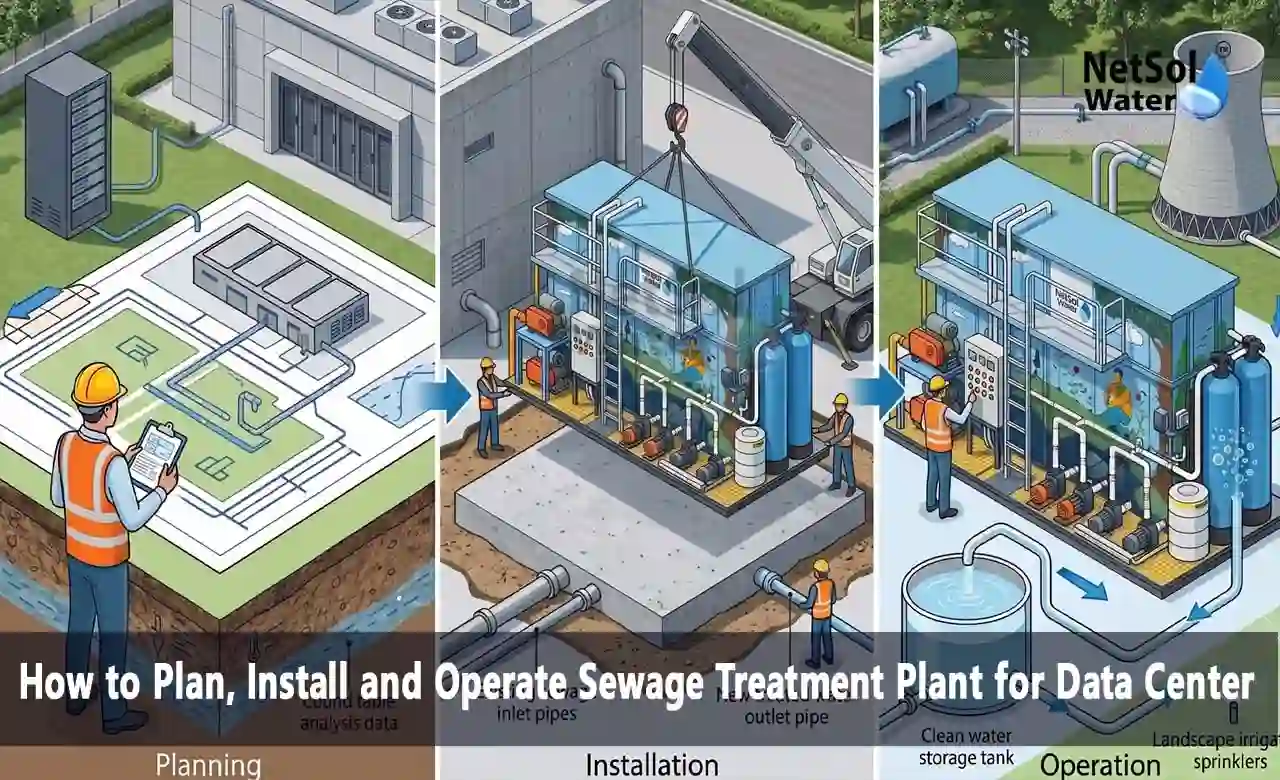
How to Plan, Install & Operate STP Plant for Data Center?
If one asks people walking inside a data center what they see that leaves them impressed, there would be server rows, cooling towers, maybe backup generators standing at attention. No one would ask about sewage disposal. Still, every single day, hundreds of employees on rotating shifts, the non-stop canteen, as well as housekeeping teams cleaning all day, produce lots of wastewater that has to be disposed of somewhere in a proper manner. Not so long ago, that "somewhere" meant a tanker or an open drain with no one asking many questions. It is impossible today, especially with pollution boards making new norms stricter and residents voicing their concerns regarding groundwater pollution near such campuses.
The problem is that STP construction is not a simple procedure to fulfill the necessary conditions to start operation of a facility. Constructed in the correct way, a STP can function as a small-scale recycling unit right on the premises of the campus and thus reduce reliance on tankers and provide the needed statistics for proving the company's sustainability claims.
Getting this right means treating planning, installation, and operation as three separate phases that each deserve real attention, not one afterthought stitched together the week before launch.
Why Do Data Centers Need Sewage Treatment Plant?
Data center campuses run staff across shifts almost around the clock, and all those people generate wastewater just by existing on site, washrooms, canteens, cleaning operations. Releasing that untreated isn't legal in most places anymore, and honestly, it shouldn't be. A proper Sewage Treatment Plant Manufacturer builds systems that handle this wastewater on site, turning what used to be a liability into something a facility can actually manage responsibly.
What Are the Benefits of Installing STP in Data Center?
Beyond just staying compliant, a STP cuts down tanker calls dramatically, especially during peak summer when half the neighborhood seems to be fighting for the same limited water supply. It also gives facility teams something concrete to show auditors, actual liters recycled over a year, rather than a vague sustainability sentence nobody can verify. Over five or ten years, these savings and the reputation earned really do add up.
How Does STP Reduce the Environmental Impact of Data Centers?
Untreated sewage doesn't just vanish once it leaves a campus boundary. It seeps into soil, works its way into groundwater, and travels further than most people assume. A properly running STP stops that right at the source, treating wastewater before it can do any damage to the surrounding environment, which matters a lot more in dense urban areas where groundwater contamination affects far more than just the one facility responsible for it.
How Do Data Centers Meet Sustainability Goals Through Wastewater Recycling?
Sustainability reporting has moved well past vague language about environmental commitment. Investors and clients now want actual numbers, and a working STP with visible reuse data gives a campus something real to report. Recycling wastewater back into cooling towers, irrigation, or flushing systems directly reduces a facility's fresh water footprint, and that reduction shows up clearly in year-over-year sustainability metrics.
What Is the Daily Sewage Generation in Data Center?
Daily generation comes down mostly to headcount and shift patterns rather than the size of the server halls themselves. A campus running three shifts back to back produces wastewater nearly around the clock, unlike a typical office that sees water use concentrated into one working day. Calculating this accurately means accounting for total headcount across every shift, including security and housekeeping staff, not just the engineers working the floor.
How Do You Calculate STP Capacity for Data Center Campus?
Engineers typically start with peak shift occupancy, multiply by an accepted per capita wastewater figure, then build in a safety margin for future growth. Data centers rarely stay the same size for long, so experienced planners working with an established Sewage Treatment Plant Manufacturer usually leave room for at least one expansion phase, rather than sizing the plant exactly to today's headcount and running into capacity problems within a few years.
| Step | What It Involves |
|---|---|
| 1. Peak shift occupancy | Start with the highest headcount on site at any one time. |
| 2. Per capita wastewater figure | Multiply occupancy by an accepted per capita wastewater generation figure. |
| 3. Safety margin | Build in a safety margin for future growth. |
| 4. Expansion phase | Leave room for at least one expansion phase rather than sizing exactly to today's headcount. |
Which STP Technology Provides the Highest Treated Water Quality?
Membrane Bio Reactor systems generally deliver the cleanest output among common STP technologies, filtering out fine particles that other systems tend to let through. This matters especially when the treated water is meant for something sensitive like cooling tower makeup, where water quality directly affects equipment performance and lifespan.
| Technology | Treated Water Quality | Footprint | Best Suited For |
|---|---|---|---|
| Membrane Bio Reactor (MBR) | Highest filters out fine particles other systems let through | Compact | Cooling tower makeup and other sensitive reuse needs |
| Sequencing Batch Reactor (SBR) | Good, handles variable loads well | Moderate | Facilities with fluctuating occupancy and flow |
| Moving Bed Biofilm Reactor (MBBR) | Good | Compact | Sites with limited land where a smaller footprint helps |
| Extended Aeration (Conventional ASP) | Moderate | Larger | Sites where space isn't a major constraint |
Can a Modular STP Be Installed in an Existing Data Center?
Yes, and it's often the more sensible route for campuses that can't afford long disruptions to ongoing operations. Modular units come largely pre built, meaning most of the engineering happens off site at the manufacturer's facility. Once delivered, the unit mainly needs connecting to existing plumbing, power, and a foundation pad, which cuts down site work considerably compared to a full conventional build.
Which Approvals Are Required Before Installing STP in Data Center?
Before anyone breaks ground, most states require consent from the pollution control board covering both establishment and later operation. Fire safety clearance for the STP structure, land use approval confirming the location matches the sanctioned building plan, and effluent discharge permission if any treated water leaves the campus all typically come into play too. Skipping or delaying these invites a stop work order right in the middle of construction, so starting approvals early alongside final design saves a lot of grief later.
| Approval | Purpose |
|---|---|
| Pollution control board consent (CPCB, NGT & SPCB) | Covers both establishment and later operation |
| Fire safety clearance | Required for the STP structure |
| Land use approval | Confirms the location matches the sanctioned building plan |
| Effluent discharge permission | Required if any treated water leaves the campus |
What Is the Installation Timeline for Data Center STP?
Timelines shift based on capacity, technology, and site conditions, but a conventional build usually runs somewhere around two to four weeks for approvals and design, four to eight weeks for civil construction on a mid sized plant, another two to three weeks for equipment and electrical work, and two to three more weeks for testing and commissioning. All told, that's roughly eight to sixteen weeks from ground breaking to a stable, commissioned plant. Modular builds move noticeably faster, often landing in the four to six week range since fabrication happens off site in parallel.
| Stage | Duration (Conventional Build) |
|---|---|
| Approvals and design | 5 to 7 days |
| Civil construction (mid sized plant) | 1 to 2 weeks |
| Equipment and electrical work | 1 to 2 weeks |
| Testing and commissioning | 1 to 2 weeks |
| Total (ground breaking to commissioning) | Roughly 8 to 10 weeks |
| Modular build (fabrication off site, parallel) | 4 to 6 weeks |
How Does Automation Improve STP Performance in Data Centers?
Data centers already run on automation for cooling, power, and security, so it makes sense the STP follows the same logic. Modern plants use sensors to track oxygen levels, monitor flow rates, and adjust chemical dosing automatically instead of leaving it to someone checking a gauge at two in the morning. This matters a lot for facilities running around the clock, since manual monitoring during late shifts tends to get inconsistent simply because fewer people are actually around to catch problems early.
What Are the Operating Costs of Data Center STP?
Running costs typically fall into a few buckets, electricity for blowers, pumps, and controls, chemicals for disinfection and pH correction, sludge disposal charges that vary by local rules, and routine maintenance plus staffing or contracted operator fees. These figures should be treated as planning ranges rather than fixed numbers, since actual costs shift based on capacity, technology, and how consistently the plant gets maintained.
| Cost Bucket | Covers |
|---|---|
| Electricity | Blowers, pumps, and controls |
| Chemicals | Disinfection and pH correction |
| Sludge disposal | Charges that vary by local rules |
| Maintenance | Routine maintenance plus staffing or contracted operator fees |
How Often Should Sludge Be Removed from Data Center STP?
Sludge builds up no matter how well the plant's designed, and most data center STPs need it cleared every two to four months depending on size, load, and technology used. Fall behind on this and treatment efficiency drops fast, since excess sludge eats into working tank volume and throws off the biological balance the whole system depends on.
What Are the Common Challenges in Operating an STP at a Data Center?
A handful of issues tend to show up repeatedly. Occupancy fluctuates with audits, maintenance windows, or company events, pushing load above normal for a stretch. Staff sometimes don't fully understand the biological treatment process well enough to catch early warning signs, which really comes down to training more than anything else. Small maintenance issues left unaddressed tend to snowball into bigger, costlier problems within months, and power fluctuations can knock out blowers and pumps, disturbing the biological balance if backup power isn't properly sorted.
| Challenge | Why It Happens |
|---|---|
| Occupancy fluctuations | Audits, maintenance windows, or company events push load above normal. |
| Staff knowledge gaps | Staff don't fully understand the biological treatment process well enough to catch early warning signs. |
| Snowballing maintenance issues | Small issues left unaddressed become bigger, costlier problems within months. |
| Power fluctuations | Can knock out blowers and pumps, disturbing biological balance if backup power isn't properly sorted. |
What Is the Expected Lifespan of Data Center STP?
With regular upkeep and timely part replacement, a well built data center STP can reasonably run fifteen to twenty years. Pumps, blowers, and diffusers wear out well before the structure itself does, so periodic upgrades are just part of keeping the system alive, not a sign anything went wrong with the original design.
How Can Treated Sewage Water Be Reused in Data Centers?
Treated water works well for a range of non drinking applications, cooling tower makeup being the biggest one since towers consume huge volumes daily and don't need drinking water quality anyway. Beyond that, garden and landscaping irrigation, washroom flushing systems, and dust suppression during construction all make good use of treated output that would otherwise go to waste.
| Reuse Application | Notes |
|---|---|
| Cooling tower makeup | Biggest use, towers consume huge volumes daily and don't need drinking water quality. |
| Garden and landscaping irrigation | Makes good use of treated output. |
| Washroom flushing systems | Makes good use of treated output. |
| Dust suppression during construction | Makes good use of treated output that would otherwise go to waste. |
How Does STP Improve Water Sustainability in Data Centers?
Every liter reused on campus is one less liter pulled from groundwater or municipal supply, and over a year, that becomes a genuine dent in a facility's freshwater footprint rather than a token gesture. For campuses where cooling towers are the biggest water consumer, sending even a portion of daily treated wastewater back into that loop can shift the entire water balance for the site in a meaningful way.
Conclusion
Learning how to plan, install, and operate a sewage treatment plant for a data center isn't something that ends the day the plant gets commissioned. It starts with honest planning around occupancy and capacity, carries through a well managed installation with approvals lined up ahead of time, and continues for years through steady, unglamorous daily operation. Facilities that take each stage seriously, rather than rushing to hit a construction deadline, end up with systems that run reliably, cost less over their lifetime, and give the campus a genuine sustainability story worth telling.
How Can You Ensure Long-Term Performance, Compliance and Sustainability with the Right STP for Your Data Center?
This comes down to choosing a Sewage Treatment Plant Manufacturer who actually understands the specific pressures data centers face, tight installation windows around live construction, strict water quality requirements for safe cooling tower reuse, and staff working shifts that never really stop. NetSol Water is an ISO certified RO Plant Manufacturer and Supplier working across India, with real hands on experience designing sewage treatment systems for data centers and similarly demanding commercial facilities.
We stay involved through every stage, from accurate capacity calculation and technology selection through installation, commissioning, and reliable operational support long after the plant goes live. That way, your facility team stays focused on running the data center itself, and leaves the technical side of wastewater treatment to a Sewage Treatment Plant Manufacturer who's actually built for it. If your campus needs a new STP or wants an existing one properly upgraded, NetSol Water brings the experience and long term commitment to get it right.
Frequently Asked Questions (FAQs)
1. Which STP technology is best for hyperscale data centers?
Hyperscale campuses generally do well with Membrane Bio Reactor or Sequencing Batch Reactor setups, since both handle high, variable loads and can deliver water clean enough for cooling tower reuse, usually the biggest water demand on site.
2. Can an existing STP be upgraded as the data center expands?
Yes, most STPs, particularly modular ones, are built with room to grow, and additional treatment units can often be added alongside the existing system as headcount and consumption climb over time.
3. How much space is required to install STP in a data center?
This depends on capacity and technology. Compact options like MBBR or MBR need a smaller footprint than conventional extended aeration setups, which helps a lot where land is already tight on campus.
4. How frequently should STP be serviced?
Basic checks, visual inspection and parameter testing, should happen weekly. Detailed servicing covering sludge removal, mechanical checks, and sensor calibration is usually a monthly job, or per the manufacturer's recommended schedule.
5. What are the key factors to consider before selecting STP manufacturer and supplier?
Look for a track record with similar scale projects, proper ISO certification and documented quality processes, genuine after sales support with spare parts availability, and a clear written maintenance contract with real response timelines.