

How to Increase STP Capacity in an Existing Building?
A sewage treatment plant is designed for a fixed daily load. The day a building adds floors, welcomes new residents, or opens a kitchen or a commercial unit, that load changes and the plant may start to struggle. You may notice a bad smell near the plant room, foam on the aeration tank, cloudy treated water, or a blower that never gets a rest. These are signs of STP overload, and they are fixable.
The good news is that you rarely need to demolish and rebuild. In most buildings, a planned STP capacity upgrade of the existing plant costs less, uses the same space and causes far less disruption. This guide explains how to increase STP capacity in an existing building step by step, so you can decide what to upgrade, what to add and what to leave alone.
Why an Existing STP Runs Out of Capacity?
A STP loses capacity for two broad reasons. Either the sewage reaching it has grown beyond the design flow, or the plant is no longer performing as well as it was designed to. Many buildings have both problems at the same time.
. More occupants, extra floors, a new tower wing, a canteen, a gym or a laundry adding to the daily flow.
. Peak-hour surges that the original tanks were never sized for.
. Worn blowers, choked diffusers, damaged pumps or sludge that has not been removed on time.
. A higher organic load from kitchens and commercial activity than a purely residential design expected.
Treating the symptom without finding the cause is the most common reason an upgrade disappoints. So the first job is a proper assessment.
Step 1: Assess the Existing STP Before You Change Anything
A good STP load assessment answers one question: where exactly is the bottleneck? Ask your operator or consultant to record the following over a normal working week, not just on a single day.
| What to Check | How to Check It | What It Tells You |
|---|---|---|
| Daily Sewage Flow and Peak Flow | Flow meter readings or a tank-fill study, plus a headcount of occupants and facilities | Whether the plant is hydraulically overloaded |
| Strength of Incoming Sewage | Lab tests on inlet samples, for example BOD, COD and suspended solids | Whether the biological process is overloaded, even if flow looks normal |
| Aeration Tank and Blowers | Air supply, bubble pattern, dissolved oxygen and motor condition | Whether oxygen supply is the limiting factor |
| Clarifier or Settling Tank | Solids carry-over, sludge level and settling behaviour | Whether the plant can separate extra solids |
| Sludge Handling | Frequency of desludging and condition of the sludge line or press | Whether sludge build-up is reducing capacity |
| Treated Water Quality | Outlet sample tests against the required standard | How much operating headroom the plant really has |
Once these readings are on paper, an engineer can compare them with the original design capacity and calculate how much extra treatment the building actually needs. This avoids spending money on units that do not fix the real problem.
Step 2: Choose the Right Way to Expand STP Capacity
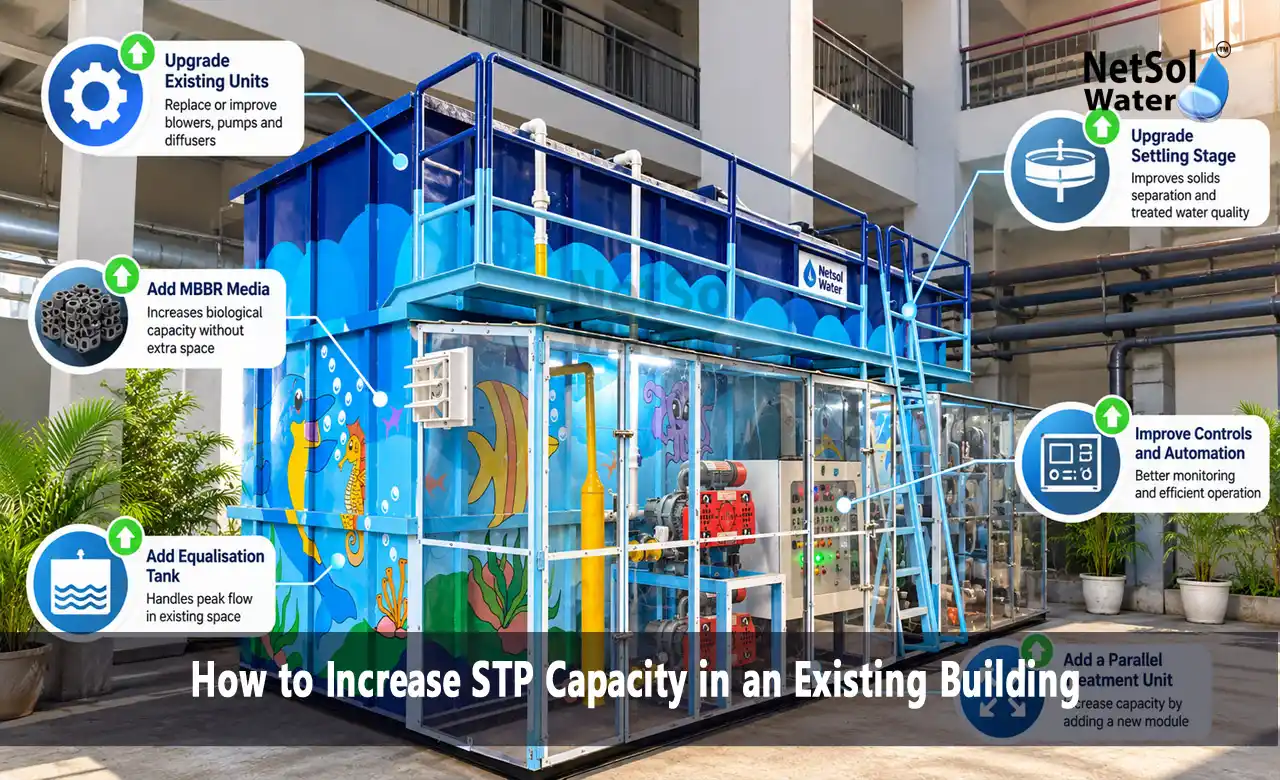
Not every plant needs the same fix. Depending on what the assessment shows, STP capacity expansion usually follows one of these routes, or a combination of them.
| Option | What It Involves | Works Best When |
|---|---|---|
| Repair and Tune the Existing Units | Replace worn blowers, pumps and diffusers, clear blockages, and restore proper operation | The plant is underperforming but its design is still adequate |
| Add MBBR Media | Place suitable media in the biological tank so more microorganisms grow on its surface | Tank volume is limited and the biological stage is the bottleneck |
| Add a Flow Equalisation Tank | Store and release sewage evenly so the plant does not face sudden peaks | Load is acceptable on average but spikes at morning and evening hours |
| Upgrade the Settling Stage | Improve or enlarge the clarifier, or add tube settlers or a polishing filter | Solids carry over into the treated water |
| Add a Parallel Treatment Unit | Install a second module that shares the flow with the old plant | Load has grown well beyond what upgrades to old tanks can handle |
| Improve Controls and Automation | Update the panel, timers, level controls and alarms | Operation depends too much on manual switching and guesswork |
Upgrading the units you already have
This is usually the cheapest place to start. A blower that is too small cannot supply enough air, so the bacteria cannot digest the extra load. Replacing it, or fixing broken diffusers, can restore a lot of lost performance. Adding MBBR media for STP tanks is another widely used retrofit, because the media gives microorganisms a larger surface to live on without enlarging the tank. For a real example of this technology on a Greater Noida project, see how Netsol Water installed a 40 KLD STP with MBBR technology at Sleepwell, Greater Noida.
Remember that one upgraded stage pushes pressure onto the next. If you add biological capacity but the clarifier or the pumps cannot keep up, the bottleneck simply moves. That is why the whole treatment train should be checked together and sized by calculation, not by guesswork.
Adding a new treatment unit
When upgrades alone cannot cover the extra load, a second unit is the practical answer. A part of the sewage is diverted to the new module while the old plant continues to treat the rest. Before this is done, the team should confirm:
. Free space for the new tank or module, and safe access for desludging and maintenance.
. Pipe routes, levels and the point where the flow will be split.
. Electrical load, power supply and panel space for the new motors.
. Noise, odour control and the effect on neighbours or occupants during installation.
If you are comparing suppliers for such work, look for an experienced STP manufacturer in Greater Noida that will survey the site first and explain the design logic in writing, rather than quote a number before seeing your plant.
Step 3: Plan the Upgrade to Avoid Disruption
A building cannot switch off its toilets for a week, so the work needs sequencing. Ask for a written plan that covers the following.
. Which tanks or equipment will be taken offline, for how long, and how sewage will be handled meanwhile.
. Whether the work can be done in stages, starting with the item that gives the largest gain.
. A trial run after commissioning, with outlet water tested and results shared with the building management.
. Clear operating and maintenance instructions for the staff who will run the plant daily.
Also confirm which discharge or reuse standards apply to your building. These depend on the local authority and the state pollution control board, so the final design should be checked against the requirements that apply to your site.
Common Mistakes to Avoid
. Buying a bigger blower or pump without checking the rest of the plant.
. Judging capacity by flow alone and ignoring the strength of the sewage.
. Skipping desludging, then blaming the plant design for poor results.
. Hiring on the basis of the lowest quote without a site survey.
. Leaving operators untrained after the upgrade.
Frequently Asked Questions (FAQs)
Q1. Can I increase the capacity of an existing STP without building a new one?
Often yes. If the assessment shows the plant is underperforming or only moderately overloaded, repairing equipment, adding media, improving flow balancing or upgrading the settling stage can raise the usable capacity. A new unit is needed only when the load has grown far beyond what the old tanks can handle.
Q2. How do I know if my STP is overloaded?
Common signs are a strong odour, foam, dark or cloudy treated water, frequent overflow or choking, and tanks needing desludging much more often than before. Lab tests of inlet and outlet samples confirm the diagnosis.
Q3. How much extra capacity can an upgrade give?
There is no single figure, because it depends on the plant type, the condition of the equipment, the available tank volume and the quality you need to achieve. An engineer can estimate it only after studying your plant.
Q4. Will the building have to stop using the STP during the upgrade?
Not always. With careful staging and a parallel unit, much of the work can be done while the plant keeps running, although short shutdowns may be needed for connections. Ask for the shutdown plan in advance.
Q5. Who should I talk to for STP capacity upgrade in Greater Noida?
Speak to a treatment plant supplier that will inspect your plant, test the sewage and recommend only what is needed. Netsol Water offers this kind of site-based guidance for buildings in Greater Noida and nearby areas.
Conclusion
To increase STP capacity in an existing building, start with the facts: measure the present load, check each treatment stage and find the true bottleneck. From there, the answer may be as simple as a new blower, or as involved as adding a parallel unit. Either way, a well-planned existing STP upgrade protects your investment, keeps the building comfortable and helps the plant meet its treatment goals without a full rebuild.
If your STP is struggling with a higher load, Netsol Water can help you assess it and plan the right upgrade. Call or email us to discuss your building and get a practical recommendation.
Contact Netsol Water
Phone: +91-9650608473, Email: enquiry@netsolwater.com