

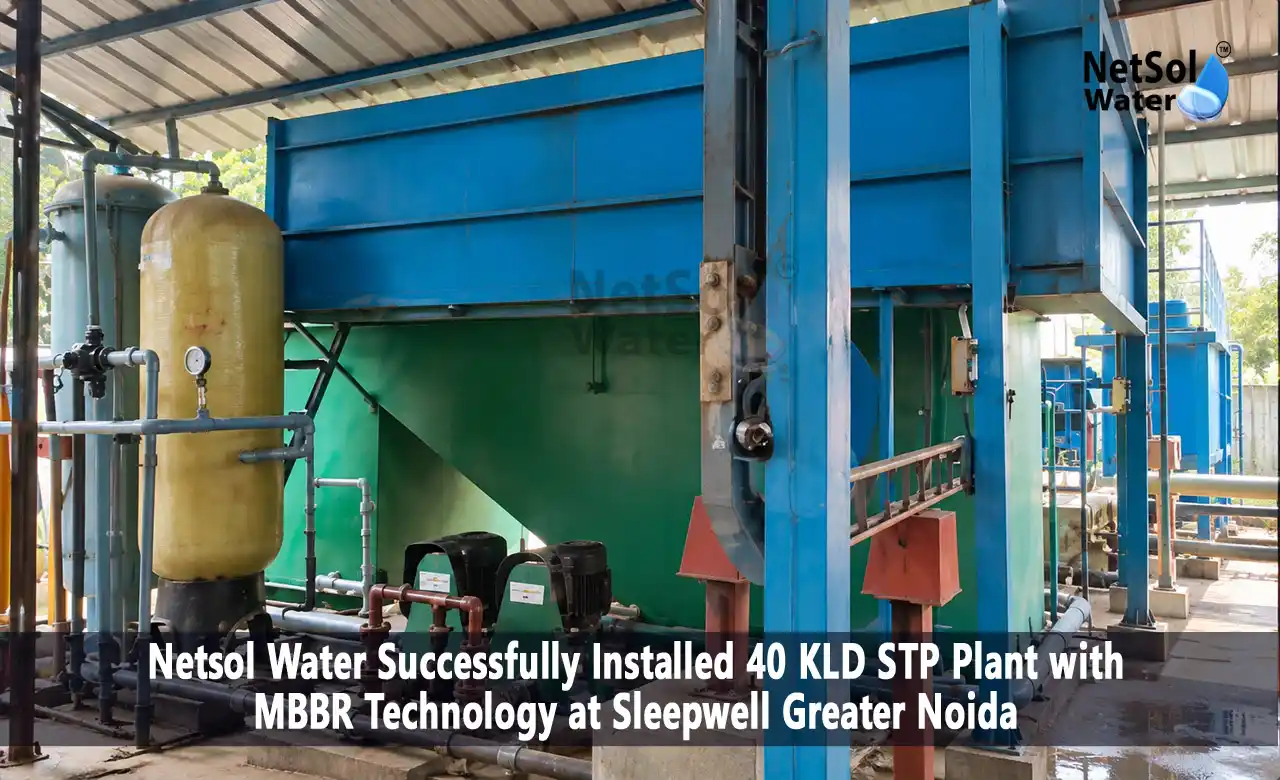
Case Study: Installed 40 KLD STP Plant with MBBR Technology at Sleepwell
In 2013, Netsol Water installed a 40 KLD STP plant with MBBR technology at Sleepwell in Greater Noida, Uttar Pradesh. It is a package sewage treatment plant built to treat domestic sewage, and the treated water is used for gardening and landscaping.
The most useful detail of this project is its age. The plant has been installed for more than 12 years and is reported to be working fine, with occasional servicing. For anyone comparing sewage treatment systems, a plant that has stayed in use for over a decade says more about practical suitability than a brochure can.
Project Background and Client Requirements
Every building that uses water produces wastewater, much of it domestic sewage from toilets, washrooms and kitchens. If left untreated or handled poorly, it can create odour, health risks and pollution of soil and groundwater.
A sewage treatment plant (STP) removes solids and reduces the organic load, so the water can be reused or discharged more responsibly. A sewage treatment plant in Greater Noida, a fast-growing urban area, is a practical way to manage water on site.
This project involved a 40 KLD package STP at Sleepwell in Greater Noida.
Project Specifications of the 40 KLD Package STP Plant
| Parameter | Details |
|---|---|
| Project name | 40 KLD STP Installation at Sleepwell |
| Location | Greater Noida, Uttar Pradesh, India |
| Year of installation | 2013 |
| Rated capacity | 40 KLD (40,000 litres per day) |
| Plant type | Package Sewage Treatment Plant |
| Treatment technology | MBBR (Moving Bed Biofilm Reactor) |
| Wastewater source | Domestic sewage |
| Treated water use | Gardening and landscaping |
| Reported current status | Working fine, with occasional servicing |
| Operating history | More than 12 years since installation |
Why MBBR Technology Was Used in the STP?
MBBR stands for Moving Bed Biofilm Reactor. It is a biological treatment method used in sewage treatment plants, and our guide to MBBR technology in STP covers it in more detail.
Inside an MBBR tank, small plastic carriers, called biofilm media, move freely in the wastewater. Air supplied by a blower keeps the media in motion. Microorganisms attach to the surface of the carriers and grow as a thin biofilm. These microorganisms feed on the organic matter present in sewage and break it down. Because the biomass is held on the media, the system can carry a large population of microorganisms in a compact tank.
Generally, MBBR is valued for these reasons:
. Compact footprint: Attached growth allows a smaller tank, which suits package plants.
. Operational stability: Biofilm on media can handle variations in load reasonably well.
. Simple operation: The media stays in the reactor, so large quantities of biomass need not be returned from the clarifier.
Treatment Process of a 40 KLD MBBR Sewage Treatment Plant
This section describes the general stages of an MBBR sewage treatment plant treating domestic sewage. The actual process flow at Sleepwell must be confirmed from project records or the installation footage. The stages below should not be read as confirmed equipment specifications for this site.
. Preliminary treatment
Raw sewage first passes through a screen to remove plastics, rags and other coarse material. An equalisation or collection tank then evens out the flow, because sewage generation varies through the day.
. Biological treatment
The wastewater enters the aeration tank holding the MBBR media. Blowers supply air, which keeps the media moving and gives the microorganisms the oxygen they need to break down organic matter.
. Solids separation
After biological treatment, the water moves to a settling or clarifier stage. Here, suspended solids and loose biomass settle, and the clearer water flows on. The settled sludge is collected and managed separately.
. Final polishing and disinfection
Depending on the design and the intended reuse, treated water may pass through filtration and disinfection, often chlorination, before use. For landscaping reuse, this stage helps make the water more suitable for contact with plants and grounds.
Installation of the Package STP at Sleepwell, Greater Noida
A package STP is usually fabricated as a ready unit and installed on a prepared foundation at the site. This reduces on-site construction compared with a fully civil plant, which is one reason package systems are chosen for compact locations.
Installing any package STP involves practical considerations such as:
. Preparing a level, load-bearing base with working space around the unit.
. Connecting the inlet sewage line and treated water outlet correctly.
. Arranging electrical supply and controls for pumps and blowers.
. Providing operator access for routine checks and servicing.
More Than 12 Years of Operation: The Sleepwell STP's Long-Term Performance
The Sleepwell plant was installed in 2013. It has now been in place for more than 12 years, and it is reported to be working fine, with occasional servicing. This is the central point of the case study.
. Why long-term operation matters?
A sewage treatment plant is expected to work every day for many years, through changing seasons, varying loads and different operating staff. Many STP problems do not appear in the first few months. They appear later, through wear on pumps and blowers, sludge build-up and missed inspections.
A plant that remains in service after more than a decade shows that the system is practical to operate in everyday conditions. That matters to facility managers more than a single result at commissioning.
. The role of operation, inspections and servicing
Long-running plants are not unattended plants. Appropriate operation, regular inspections and occasional servicing keep a biological treatment system healthy. The reported occasional servicing at Sleepwell is consistent with normal practice for equipment of this type.
. What facility managers can learn?
. Ask for track record: Check whether a supplier can point to plants still running after many years.
. Plan for servicing: Prefer accessible components and a supplier who supports servicing.
. Keep records: Maintenance logs and water quality checks make long-term performance easy to demonstrate.
. What this information does and does not show?
The operating status described here is reported project information from Netsol Water. It has not been independently audited, and this page does not include laboratory results or a continuous maintenance log. We do not claim zero breakdowns, uninterrupted operation, zero maintenance or any guaranteed lifespan. Plant life always depends on the quality of operation, the load, and how well the plant is maintained.
Watch the Sleepwell 40 KLD STP Installation Video
The video below shows the Sleepwell 40 KLD STP installation. It helps readers see the physical form of a package STP and how it is arranged on site, which suits consultants and facility teams who want to visualise a plant of this size.
The video relates to the installation. It should not be taken as proof of the plant's present condition unless it shows recent footage, and the reported working status is stated separately in this case study.
Key Project Outcomes and Practical Learnings
The confirmed outcomes of this project are straightforward:
. A 40 KLD STP plant with MBBR technology was installed at Sleepwell, Greater Noida, in 2013.
. The plant treats domestic sewage.
. Treated water is used for gardening and landscaping.
. The plant has been installed for more than 12 years.
. It is reported to be working fine, with occasional servicing.
Maintenance Considerations for Long-Term MBBR STP Operation
The points below are general good practice for MBBR plants. They are not a record of maintenance performed at Sleepwell, and the exact needs of any plant depend on its configuration.
. Pumps and blowers: Inspect them regularly for unusual noise, vibration, heating or reduced output. Blowers supply the air that sustains the biological process.
. Aeration: Check that air distribution is even and that the media is moving freely in the tank.
. Screens and equalisation: Clear screens of trapped waste so that the flow remains smooth.
. Sludge management: Remove settled sludge at suitable intervals, and dispose of it responsibly.
. Treated water quality: Monitor the outlet water, for example its appearance, odour and chlorine residual, and send samples for laboratory analysis at periodic intervals.
. Records: Keep a simple log of inspections and servicing to spot problems early.
A trained operator and an agreed servicing schedule make a considerable difference to how long a plant performs well.
Frequently Asked Questions (FAQs)
Q1. What is the capacity of the STP installed at Sleepwell, Greater Noida?
The plant has a rated capacity of 40 KLD, which is 40,000 litres per day. This is the design capacity, not a record of the actual daily flow.
Q2. Which technology is used in the Sleepwell STP?
It uses MBBR (Moving Bed Biofilm Reactor) technology in a package sewage treatment plant, treating domestic sewage.
Q3. When was the 40 KLD STP installed?
The plant was installed in 2013.
Q4. Is the Sleepwell STP still working?
Yes, according to the reported project information, the plant has been working fine for more than 12 years, with occasional servicing. This is the company's reported status and is not based on independently verified performance data.
Q5. What is the treated water used for?
The treated water is used for gardening and landscaping.
Q6. What maintenance does an MBBR STP require?
Typical maintenance includes inspecting pumps and blowers, checking aeration, clearing screens, managing sludge and monitoring treated water quality. The exact schedule depends on the plant's design and the load it handles.
Conclusion:
The Sleepwell project brings together a 40 KLD package STP, MBBR technology, domestic sewage treatment and the reuse of treated water for gardening and landscaping. Installed in 2013, the plant is reported to be working fine after more than 12 years, with occasional servicing.
That long operating history is the most meaningful part of the story. It shows why a suitable plant and steady servicing both matter.
Netsol Water designs and manufactures sewage treatment plants, effluent treatment plants and water treatment systems for homes, institutions and industries across India. If you are planning a 40 KLD sewage treatment plant or another MBBR STP installation, you can read about our sewage treatment plant solutions or contact our team to discuss your requirements. For a similar installation in Uttar Pradesh, see our case study on a 25 KLD MBBR STP plant at Bajaj Energy, Balarampur.