

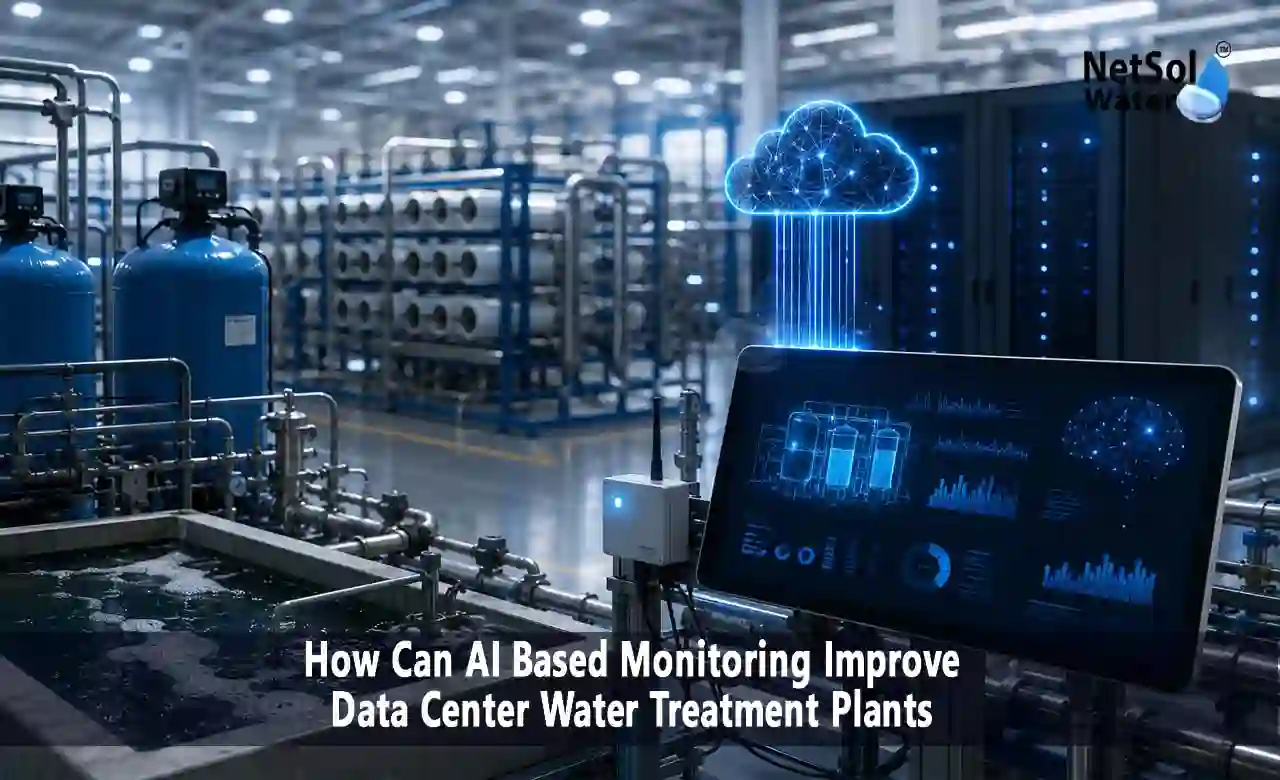
AI-Based Monitoring for Data Center Water Treatment Plants
Data centers get judged on uptime, full stop. That is the metric everyone outside the facilities team actually cares about. What almost nobody talks about is the water running quietly in the background: the cooling towers, the STPs, the RO plants all the machinery keeping servers from overheating and the facility from falling foul of environmental regulations.
For years these systems were run the way factories have run them for decades. Someone walks the plant, checks a reading a couple of times a day and reacts once something looks off. It mostly worked because the stakes were lower and the margin for error was wider.
That is changing. AI-based monitoring is now showing up in data center water treatment plants and it is not a buzzword bolted onto a sales brochure. It is changing how these plants are operated day to day, faster than most people in the industry expected.
Why Are Smart Water Treatment Systems Becoming Essential for Modern Data Centers?
. Cooling is the biggest water draw in the building. Cooling towers pull far more water than any other system in a data center. When a facility runs 24x7, 365 days a year, even a small inefficiency in the plant feeding those towers compounds. A slightly off dosing rate or an over-long blowdown cycle does not cost extra once, it costs extra every single day.
. Regulatory pressure is getting tighter. Pollution control boards now watch discharge and reuse compliance far more closely, especially in cities already under water stress. Inspections are more frequent, documentation requirements are heavier, and the consequences of being caught out of compliance are more serious than a warning.
. Manual monitoring cannot keep pace. Checking a gauge twice a day made sense when facilities were smaller. At data center scale, the gap between two manual readings is exactly where problems slip through. By the time the next round catches it, the issue has often already done its damage.
What Is AI-Based Monitoring?
At its core, AI-based monitoring is a software layer sitting on top of the plant’s existing sensors and equipment. It ingests incoming data continuously and learns what “normal” looks like for that specific plant, not a generic industry average, but the real operating pattern of that facility with its own quirks and seasonal swings.
Sensors on their own only produce numbers. They do not tell you whether a given number matters. The AI layer adds interpretation: it compares each fresh reading against the plant’s own history and local context, then decides whether it needs a human to look now or whether it is just normal variation.
In practice this usually combines three things: a learned baseline built from the plant’s historical data, anomaly detection that flags deviations from that baseline, and, in more advanced setups, predictive models that estimate where a trend is heading. It is worth being clear about the limits too. The quality of the output depends entirely on clean, well-calibrated sensor data and a newly deployed model tends to produce more false positives until its baseline matures. Those are setup realities to plan for, not reasons to avoid the technology.
The net effect: instead of one person glancing twice a day, the plant is observed continuously, and anything unusual gets flagged as it begins to drift rather than after it has already caused a downstream mess.
| Aspect | Manual monitoring | AI-based monitoring |
|---|---|---|
| Frequency | 2 to 3 spot checks a day | Continuous, every reading |
| Problem detection | After the issue surfaces | As the trend starts to drift |
| Baseline | Operator judgment | Learned from the plant’s own history |
| Response | Reactive | Early and predictive |
| Record keeping | Handwritten paper logs | Automated, timestamped logs |
| Staffing | On-site rounds | Remote visibility, alerts routed to the owner |
How Does AI Improve Operational Efficiency, Sustainability and Compliance?
. Efficiency: less energy is wasted on aeration and pumping running harder than the load requires. Aeration is usually the single largest electricity user in a treatment plant, put at roughly 45 to 75 percent of total plant energy in industry literature. Peer-reviewed studies of intelligent, demand-based aeration control report energy reductions broadly in the 20 to 40 percent range against fixed-rate operation, and the US EPA has cited 25 to 40 percent for a well-designed aeration control system. These are published industry benchmarks, not Netsol Water’s own measured results, and the actual saving on any given plant can come out higher or lower than these figures depending on its size, load pattern and current setup. Either way, they show why continuous, demand-matched control shows up directly on the monthly power bill.
. Sustainability: consistent, well-monitored treated water quality is what makes reuse for cooling towers viable in practice. Many facilities avoid reuse not because they do not want to, but because they are not confident the quality will stay stable. Tighter monitoring removes that hesitation.
. Compliance: catching a deviation while it is still small means it never becomes a violation. That is a very different position from finding out through a lab report three weeks later, when the only option left is damage control.
What Is AI-Based Monitoring in Data Center Water Treatment Plants?
If the previous section covered the idea, this one covers the architecture. A working system is built in three layers.
. The sensor layer. Sensors across the STP, ETP, or RO plant track parameters such as pH, turbidity, dissolved oxygen, and flow continuously, feeding a steady stream of data rather than occasional spot checks.
. The learning layer. The model is trained on the plant’s own historical performance, so it knows what normal looks like for that specific setup, its own seasonal patterns and load variations, rather than a benchmark borrowed from a different facility.
. The alert layer. Once a baseline exists, the system flags anything that drifts from it early, giving operators time to act before water quality or equipment performance actually degrades.
For a data center specifically, this matters because the cooling infrastructure that keeps servers running depends entirely on these water systems. Continuous, intelligent monitoring closes that risk in a way periodic manual checks cannot.
How Does AI Improve the Performance of STP, ETP and RO Plants?
. STP performance is mostly about optimizing aeration and tracking BOD and COD trends, so the biological stage does not quietly drift out of range before anyone notices.
. ETP performance is harder because influent quality can swing depending on upstream processes. AI stabilizes chemical dosing against that variability in real time and flags anything unusual in the effluent well before it becomes a discharge problem on a compliance report.
. RO plant performance centers on tracking membrane fouling and pressure differentials, since both directly affect clean water yield and membrane life, which is not a cheap replacement line item.
| Stage | What AI mainly tracks | Key parameters | Failure mode caught early |
|---|---|---|---|
| STP | Aeration and biological load | BOD, COD, dissolved oxygen | Biological stage drifting out of range |
| ETP | Dosing against variable influent | Influent and effluent quality, dosing rate | Effluent breach before discharge |
| RO plant | Membrane condition | Pressure differential, conductivity, flow | Membrane fouling and falling water yield |
These stages usually feed into each other as part of the data center’s overall water loop. Monitoring them as one connected system, rather than isolated silos, means a problem in one stage gets caught before it cascades into the next.
How Can AI Reduce Water and Energy Consumption in Data Centers?
This section is about the mechanisms of water and energy consumption reduction.
. Blowdown cycles. AI predicts the right blowdown cycles and cycles of concentration for cooling towers, so the plant is not flushing out more fresh makeup water than it needs, a common source of waste in conventionally run systems.
. Aeration control. Aeration does not need to run at a constant, conservative setting once the system can adjust it to real-time demand. Because fixed-schedule blowers almost always run harder than the load requires, this tends to be the single largest energy saving across the plant.
. Pump runtime. Pumps often run longer than necessary simply because they are on a fixed schedule. Demand-based control matches runtime to actual load, cutting electricity use without anyone manually reprogramming a controller.
None of these look dramatic on a single day. Stacked across a full year of continuous operation, they add up to a meaningfully lower utility bill and a lighter footprint on the local water supply.
How Does AI Help Detect Equipment Failures Before They Occur?
This section is about detection, spotting equipment failures early. Pumps, blowers, and membranes almost always show small warning signs before they fail: extra vibration, a slow pressure drift, a subtle temperature creep. These are exactly the signals a person glancing at a gauge for ten seconds will miss.
Manual checks happen on a fixed schedule, so a drift that starts between two scheduled readings goes unnoticed until it has already become a bigger, more expensive problem. A continuously running model compares each reading against the plant’s baseline and picks up that drift almost as soon as it begins. That lead time is the difference between a planned fix and a scrambled response to an unplanned outage.
The result is fewer emergency call-outs, fewer weekend breakdowns and equipment that gets serviced before it has been stressed to the point of accelerated wear.
Can AI Optimize Chemical Dosing in Water Treatment Plants?
The problem with manual dosing. Operators tend to dose conservatively to stay safely within compliance without constant rechecking. That is understandable, but it wastes chemicals and generates more sludge than necessary.
How AI fixes it. The system matches dosage to real influent characteristics in real time, instead of a fixed cautious default that effectively assumes worst-case conditions all day, every day. Studies of real-time, model-driven dosing report chemical savings roughly in the 10 to 26 percent range versus manual control. These are published benchmarks and the actual saving on your plant can land above or below that range depending on how much your influent varies and which chemicals are used.
The downstream effect on sludge. Less chemical dosing waste means less excess sludge from over-dosing, which lowers the cost and handling burden of sludge disposal further down the line.
Consistency beyond cost. Precision dosing also keeps treated water quality more stable, which matters a great deal when that water is reused for cooling towers rather than simply discharged.
How Does AI Improve Cooling Tower Water Quality Management?
. The problem. Cooling towers are sensitive to scaling, biofouling and corrosion and all three worsen the moment water quality is not tightly controlled. Left unchecked, they erode equipment efficiency long before anyone sees a visible problem.
. Real-time tracking. AI monitors conductivity, hardness, and biological activity continuously, rather than relying on periodic sampling that only captures a single moment.
. Dynamic adjustment. Instead of running blowdown and biocide dosing on a fixed timer, both adjust to actual conditions. That reduces scale buildup and keeps biological growth in check without tipping into over-dosing.
. Longer equipment life. Tighter cooling tower water quality control extends the life of fill media, heat exchangers, and pipework, reducing how often expensive parts need replacing.
How Can AI Help Predictive Maintenance in Data Center Water Treatment Plants?
Where the detection section covered how failures get spotted, predictive maintenance is about how the maintenance workflow itself changes.
. From reactive to condition-based. Instead of fixing things after they break, or servicing on a rigid calendar whether it is needed or not, the system tells you when a specific component needs attention based on what it is actually doing.
. Smarter scheduling. Rather than a technician working a fixed monthly checklist regardless of plant condition, maintenance gets prioritized by what the data shows. Attention goes where it is needed, which is a better use of everyone’s time.
. Less unplanned downtime. Fewer emergency repairs and fewer unplanned shutdowns of supporting infrastructure, which for a data center means fewer risks to the systems that depend on a steady water and cooling supply.
How Does AI Help Ensure CPCB and SPCB Compliance?
The problem with manual tracking. Compliance in most plants still runs on periodic sampling and paper logs. That is slow and reactive, and it usually surfaces a problem only after it has already happened.
Continuous monitoring. AI checks relevant parameters against CPCB and SPCB limits in real time, so a drifting value gets flagged and corrected before it becomes a violation on record.
The parameters below are the ones most commonly tracked for CPCB and SPCB compliance. The values shown are the general standards commonly referenced for discharge to inland surface water under the Environment (Protection) Rules. Treat them as indicative only. The exact limits that apply to your facility depend on the discharge destination (inland surface water, public sewer, or land for irrigation), your industry category, and the specific conditions in your SPCB consent to operate, which can be stricter. Confirm every figure against the current CPCB notification and your own consent before relying on it.
| Parameter | General standard, inland surface water discharge | Note |
|---|---|---|
| pH | 5.5 to 9.0 | Verify against your consent |
| BOD (3 days at 27°C) | 30 mg/L | Higher limits apply for public sewer or land discharge |
| COD | 250 mg/L | Verify against your consent |
| Total Suspended Solids (TSS) | 100 mg/L | Verify against your consent |
| Oil and Grease | 10 mg/L | Verify against your consent |
| Temperature | Not more than 5°C above receiving water temperature | Verify against your consent |
Continuous monitoring against whichever limits actually apply is what turns compliance from a periodic gamble into a controlled process.
Better documentation. Automated logging creates a clean, verifiable record for inspections, which is far more reassuring than digging through handwritten registers when an inspector wants six months of readings.
Lower penalty risk. Catching issues early protects water quality and protects the facility from fines, renewal delays, and the reputational hit of a documented CPCB and SPCB compliance violation.
How Can AI Enable Real-Time Remote Monitoring of Water Treatment Plants?
. Monitoring from anywhere. A cloud-connected dashboard lets a facilities manager check plant status from a phone or laptop, not just the control room, which matters when problems do not wait for business hours.
. Multiple sites, one view. For operators running several data centers across cities, real-time remote monitoring gives one unified view of every plant’s health instead of piecing together separate site reports.
. Faster alert routing. Alerts go straight to whoever owns that specific issue the moment a value goes out of range, rather than waiting for the next scheduled walk-through.
. Less dependence on constant on-site staffing. Remote visibility reduces how much on-site supervision a plant needs without giving up oversight. It is about using staff time more wisely, not removing people.
What Are the Benefits of Integrating AI with IoT in Data Center Water Treatment Systems?
. IoT as the data backbone. IoT sensors provide the continuous, granular data the models need. Without solid sensor coverage, even a good model has little to learn from.
. Automated responses, not just alerts. Combined systems can go beyond flagging a problem and automatically adjust dosing, aeration, or blowdown without waiting for manual intervention.
. The model improves over time. The more historical data a system accumulates, the more accurately it predicts issues and recommends adjustments. Performance improves the longer it runs.
. A self-monitoring plant. Put together, AI with IoT turns a water treatment plant from something that reports numbers into something that watches itself and responds, which is a meaningfully different way to run a facility.
How Can AI Reduce the Overall Operating Cost of Data Center Water Treatment Plants?
This section rolls up the savings covered above into their cost impact rather than re-explaining each mechanism.
Lower energy costs from the optimized aeration and pumping described earlier, one of the largest recurring costs in any plant. Lower chemical costs from precision dosing instead of conservative over-dosing, plus less sludge to handle. Fewer emergency repairs because predictive maintenance catches problems while they are small. Less manual oversight because continuous monitoring frees staff time from routine checks and paperwork for higher-value work.
Individually these are incremental. Together, across a year of continuous operation, they are what bring down the overall operating cost of the plant. The energy and chemical benchmark ranges cited earlier (roughly 20 to 40 percent on aeration energy and 10 to 26 percent on chemicals in published studies) give a sense of the direction, but the actual figure for any facility depends on its load, tariffs, and current practice, and is best established through a plant-level assessment.
Conclusion
AI-based monitoring does not just make a water treatment plant smarter on paper. It makes it dependable in a way manual operation cannot match at data center scale. Lower energy use, fewer surprise failures, tighter compliance, and lower running costs stack up over time. For an industry where downtime is measured in real money, that combination is hard to ignore, which is why more data centers are moving in this direction instead of waiting until they are forced to.
Netsol Water: Bringing AI-Based Water Treatment Monitoring to Data Centers
Everything above sounds good in theory. The harder part is getting it implemented on a live plant without disrupting operations. That is where Netsol Water comes in.
Netsol Water works with data centers and industrial facilities to bring AI-based monitoring onto existing STP, ETP and RO plants without a full teardown. The approach is straightforward: layer the right sensors onto the plant that already exists, connect that data into a system that learns the specific behavior of that facility and give the operations team a clear, real-time view of what is happening instead of a rearview mirror built from yesterday’s manual readings.
For a data center, that means fewer surprises. Cooling tower water quality stays in range instead of drifting for days. Chemical dosing gets tuned to what the water is actually doing rather than a fixed default. Equipment issues get flagged while they are still small and inexpensive to fix, well before they cause an outage that ripples through to the systems the plant exists to protect.
The bigger picture is simple. Water treatment does not have to be the part of a data center that only gets attention when something has already gone wrong. With the right monitoring in place, it can run quietly and reliably in the background, exactly the way the rest of the facility is expected to. If you are looking to bring this kind of monitoring into your own facility’s water systems, Netsol Water is worth a conversation.
Frequently Asked Questions (FAQs)
Q1. Can AI be integrated into existing STP, ETP and RO plants?
Yes, in most cases. AI monitoring is usually added through retrofitted sensors and a software layer, so an existing plant does not need to be rebuilt from scratch.
Q2. What sensors are required for AI-based water treatment monitoring?
Common ones include pH, turbidity, dissolved oxygen, conductivity, flow meters, and pressure sensors, depending on the plant type and treatment stage being monitored.
| Sensor | Measures | Typical stage |
|---|---|---|
| pH | Acidity and alkalinity | STP, ETP |
| Turbidity | Suspended particles | STP, ETP, RO feed |
| Dissolved oxygen | Aeration adequacy | STP |
| Conductivity | Dissolved solids and salinity | RO, cooling tower |
| Flow meter | Throughput | All stages |
| Pressure sensor | Differential across membranes | RO plant |
Q3. Is AI-based monitoring suitable for small and medium-sized data centers?
Yes, though the scale of deployment and sensor density is adjusted to the facility’s size and budget rather than mirroring a hyperscale setup.
Q4. How does AI improve the lifespan of water treatment equipment?
By catching early signs of wear such as pressure drift, vibration changes, and temperature creep, it allows maintenance before a component fails outright, reducing the cumulative stress that shortens equipment life.
Q5. What is the return on investment (ROI) of AI-based water treatment systems?
ROI varies by facility and depends on energy costs, chemical use, and repair history. Published studies point to meaningful energy and chemical savings (broadly 20 to 40 percent on aeration energy and 10 to 26 percent on chemicals), but because payback is so site-specific, a reliable estimate comes from a plant-level assessment rather than a generic figure.