

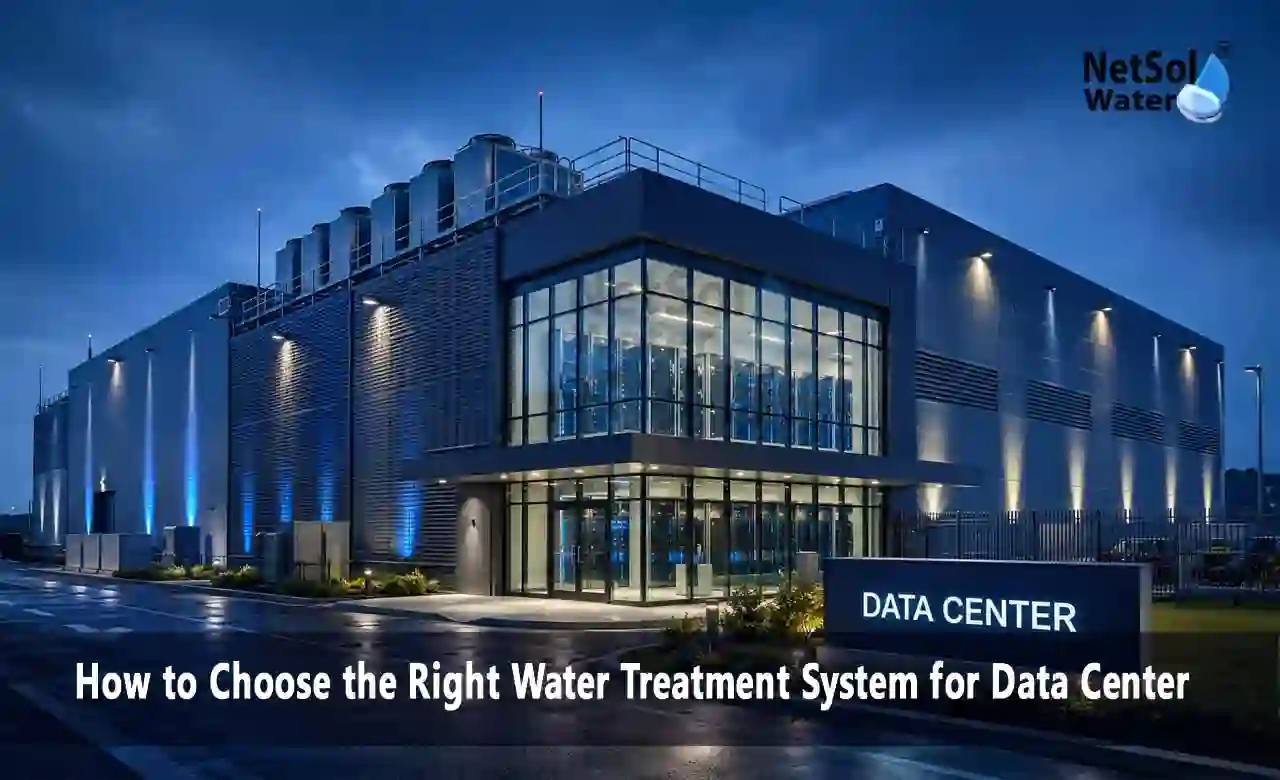
How to Choose the Right Water Treatment System for Data Center?
Talk to most people about data centers and the conversation goes straight to power. Megawatts, PUE, backup generators, uptime SLAs. Water barely gets a mention. But walk through any large facility with the mechanical team and you will hear a different story. Cooling is where most of the operational headaches actually live, and in a large share of Indian facilities, cooling still runs on water.
Water has to come from somewhere, be treated to the right specification for whatever it is being used for, and eventually leave the site again, whether as vapour, as discharge, or ideally as water that gets used a second or third time before it goes anywhere. Get any part of that chain wrong and the consequences show up quickly. Heat exchangers scale, piping corrodes, cooling towers biofouled and a pollution control board starts asking uncomfortable questions about your discharge numbers.
Most guidance on this topic starts in the wrong place. It opens with an equipment list, STP, ETP, RO, softener, DM as though a data center were a shopping cart to be filled. It is not. The equipment list is the output of a design process, not the input. Choose the boxes first and you will almost certainly end up with a plant that is oversized, undersized, or solving a problem you did not have.
This article works the other way around. It starts with why a data center needs a coordinated water treatment system at all, then walks through the five decisions that actually determine your treatment train, then covers each system, how the process fits together end to end, reuse, cost, CPCB and SPCB compliance and how to evaluate a supplier.
Why Does Data Center Need Complete Water Treatment System?
Because a data center is never really one water user. It is several, stitched together under one roof.
Staff need clean water for restrooms and pantries. Cooling towers, where they are used, need water conditioned against scale, corrosion and bacterial growth. Some sites need demineralised water for humidification or for specific mechanical processes on top of that. And every drop that comes in has to go somewhere when the facility is finished with it, usually under conditions set by a State Pollution Control Board.
A complete water treatment system means all of that is handled as one coordinated setup rather than a pile of separate boxes, each solving its own narrow problem. Miss a piece and it tends to surface later, at the worst possible time. A cooling tower that scales up faster than expected. An ETP that cannot keep pace with blowdown volume because it was sized for domestic sewage alone. A large volume of reusable water going straight to drain because nobody built the loop to catch it.
Data centers do not get much slack for downtime. Water infrastructure has to be designed with the same seriousness as the electrical and mechanical systems around it, not bolted on afterwards.
The Five Decisions That Determine Your Treatment Train
Before anyone quotes you a plant, these five questions need answers. Take them in this order, because each one constrains the next.
| # | Decision | What it determines |
|---|---|---|
| 1 | Cooling architecture | Whether you need heavy water treatment at all, and how much. |
| 2 | Raw water source and quality | Your pretreatment train and RO feasibility. |
| 3 | Cycles of concentration (COC) | Blowdown volume, and therefore ETP sizing. |
| 4 | Reuse target (WUE) | Whether RO polishing and ZLD are in scope. |
| 5 | SPCB consent conditions | Discharge limits, monitoring, and whether ZLD is optional. |
Decision 1: What is your cooling architecture?
This is the fork in the road, and it comes before everything else. A data center that rejects heat through evaporative cooling towers and one that runs air-cooled chillers are not the same water problem. They are barely the same category of problem.
| Cooling approach | Water demand | What treatment you actually need |
|---|---|---|
| Evaporative cooling towers | Highest. Evaporation and blowdown are continuous. | Full train: pretreatment, softening, cooling tower water treatment, ETP for blowdown, RO for reuse. |
| Air-cooled chillers and dry coolers | Low. Mostly domestic use only. | STP for domestic sewage. Little or no cooling water treatment. Higher power draw is the trade-off. |
| Adiabatic and hybrid systems | Moderate and seasonal. Water used mainly on hot days. | Cooling water treatment sized for peak season, not annual average. Easy to oversize by mistake. |
| Direct-to-chip liquid cooling | Small closed-loop volume, but a tight water quality specification. | Low volume, high purity. Usually DM plant or polished RO water. Loop chemistry matters more than throughput. |
The practical point: if your facility is air-cooled, much of the equipment discussed later in this article does not apply to you, and a vendor who quotes it anyway is quoting a template. If you are running evaporative towers, water treatment is a first-order design problem and deserves the same attention as the electrical single line diagram.
If you are still choosing between architectures, understand the trade. Evaporative cooling buys better power efficiency and pays for it in water. Air cooling buys water savings and pays for it in power. In a water-stressed region with an increasingly assertive pollution control board, that trade is no longer purely an engineering decision.
Decision 2: What is actually in your raw water?
Nobody should design a water treatment plant off a municipal supply brochure. You need a laboratory analysis of the actual source, and if you are drawing from a borewell, ideally across seasons, because borewell chemistry moves.
At minimum the raw water analysis should cover total hardness, TDS, alkalinity, chlorides, sulphates, iron, manganese, silica and microbiological load. Silica deserves a specific mention. It is the parameter most often left off the analysis and the one most likely to quietly wreck RO membrane performance and cap the cycles of concentration you can safely run in the tower. If your raw water report does not carry a silica number, it is not a complete report.
Two facilities with identical IT loads and identical cooling towers can need genuinely different treatment trains purely because one is on soft municipal supply and the other is on hard, high-silica borewell water. This is exactly why a template design underperforms the moment real load hits it.
Decision 3: What cycles of concentration will you run?
This is the number most water treatment articles skip, and it is the one that sizes half your plant.
Cooling towers work by evaporating water. The dissolved solids left behind do not evaporate, so they concentrate in the circulating loop. Cycles of concentration (COC) is simply how many times more concentrated the tower water is than the makeup water feeding it. To stop that concentration running away, you continuously bleed a portion of the loop to drain. That bleed is your cooling tower blowdown.
Here is why it drives so much downstream. The higher your COC, the less blowdown you generate. The less blowdown you generate, the smaller your ETP needs to be and the less water you waste. Push COC up and both your freshwater intake and your effluent volume come down at the same time.
The catch is that COC cannot be pushed arbitrarily high. It is capped by whichever parameter reaches its solubility or corrosion limit first, usually calcium hardness, alkalinity, silica or chlorides. That cap is a function of your makeup water chemistry and your chemical dosing programme. Which is precisely why pretreatment, cooling water chemistry and ETP sizing are one decision and not three. Soften the makeup water and you can run higher COC. Run higher COC and your ETP shrinks.
Design note: if a vendor sizes your ETP without first telling you what COC the cooling loop will run at and which parameter caps it, they have guessed. Ask for the number and the reasoning behind it.
Decision 4: What is your reuse target?
Data center operators already track PUE for power. The equivalent metric for water is WUE (water usage effectiveness), expressed as litres of water consumed per kilowatt hour of IT energy. If you are setting a water strategy, WUE is the number your treatment design should be pointed at, because it is the number your sustainability reporting will eventually be judged on.
The reuse target you set changes the plant fundamentally, not marginally.
| Reuse ambition | Treatment train implication |
|---|---|
| Compliance only. Treat and discharge. | STP and ETP sized to meet consent limits. No RO polishing loop. Cheapest capex, highest lifetime water cost. |
| Moderate reuse. Treated water to landscaping and flushing. | STP with tertiary treatment. ETP to consent standard. Modest capex increase. |
| High reuse. Treated water back into cooling makeup. | STP and ETP output polished through RO before it re-enters the loop. Significant capex, significant freshwater savings. |
| Zero Liquid Discharge (ZLD). | Everything above, plus reject management, evaporator, and often a crystallizer. Largest single cost line on the project. |
Decide this on day one. Retrofitting a water recycling loop into a plant that was designed to discharge is far more expensive and disruptive than designing headroom in from the start. The same applies to capacity: size for where the facility is heading, not for the IT load on commissioning day.
Decision 5: What will your consent conditions actually say?
Your SPCB consent is not paperwork that follows the design. It is an input to the design. It sets your discharge quality limits, your treatment capacity obligations, your monitoring requirements, and in some regions it decides whether Zero Liquid Discharge is a choice or a condition. The norms are covered in detail further down, but the decision belongs here in the sequence, because a treatment plant designed before the consent conditions are known is a treatment plant that may need rebuilding.
Which Water Treatment Systems Are Required for Data Center?
With those five decisions made, the equipment list stops being a menu and starts being an answer. Here is what each system does, and more usefully, when you actually need it.
1. Sewage Treatment Plant (STP)
A sewage treatment plant handles domestic wastewater from restrooms, pantries and general staff facilities. Treated output typically goes to landscaping and toilet flushing, or is polished further and returned as cooling tower makeup water. Every facility needs a STP, regardless of cooling architecture, because staff generate sewage whether the site is air-cooled or not.
2. Effluent Treatment Plant (ETP)
An effluent treatment plant handles the tougher stream, principally cooling tower blowdown, which carries concentrated dissolved solids and whatever treatment chemicals were dosed upstream. ETP design depends heavily on the cooling water treatment programme running above it, and on the cycles of concentration that programme allows. The two are not independent decisions, and an ETP sized without reference to COC is an ETP sized by guesswork.
3. Commercial or Industrial RO Plant
Reverse osmosis (RO) brings dissolved solids down to whatever level a given application needs. In a data center, an industrial RO plant commonly plays two roles: conditioning incoming raw water where source TDS is high, and polishing STP and ETP output so that recycled water is safe to send back into the cooling loop without accelerating scale.
4. Cooling Tower Water Treatment System
Cooling tower water treatment is not a one-off installation but an ongoing chemical dosing programme that keeps scale, corrosion and biological growth under control in the circulating loop. Legionella is the obvious biological concern and the one with the highest consequences. The programme runs continuously, with dosing adjusted against real-time water chemistry, and it is the programme that determines how high a COC you can safely hold.
5. Water Softener
A water softener strips out hardness, meaning calcium and magnesium, before water reaches boilers, humidifiers or cooling towers. Skip it on hard water and scale builds on heat exchange surfaces faster than most people expect. Softening is also the lever that lets you run higher cycles of concentration, which is why it often pays for itself twice over: once in protected equipment, once in a smaller ETP.
6. DM (Demineralisation) Plant
A DM plant is needed where equipment demands very low conductivity water, typically in certain humidification setups, in some liquid cooling loops, or where a manufacturer specification calls for it. Not every site needs one. Check what is actually installed before letting a DM plant onto the drawing, because it is a common piece of specified-but-unused capex.
7. Filtration Systems
Multimedia filters, activated carbon filters and cartridge filters sit ahead of RO and softening equipment and quietly do a lot of the work, protecting RO membranes and resin beds from the sediment, chlorine and organic fouling that would otherwise shorten their life dramatically. This is the least glamorous part of the train and the part where cutting cost has the fastest payback in damage.
Summary: what you need and when
| System | When you need it |
|---|---|
| STP | Every facility, regardless of cooling type. |
| ETP | Any facility with evaporative cooling towers. |
| Water softener | Hard makeup water, or wherever higher COC is the goal. |
| Filtration systems | Almost always. This is what protects the expensive equipment. |
| RO plant | High raw water TDS, or where reuse into the cooling loop is the target. |
| Cooling water dosing programme | Any facility with evaporative cooling towers. Continuous, not a one-off install. |
| DM plant | Only where equipment demands it. Verify against the manufacturer specification. |
| ZLD components | Where regulation mandates it, or a sustainability commitment justifies the cost. |
Choosing your STP technology
Once you know you need a STP, the next question is which one. This choice is usually made badly, on capex alone.
| Technology | Footprint | Output quality | Best suited to |
|---|---|---|---|
| Conventional activated sludge | Largest | Adequate for discharge or landscaping. | Sites with space to spare and no cooling reuse ambition. |
| SBR | Moderate | Good, with reliable nutrient removal. | Mid-size sites wanting a balance of cost and quality. |
| MBR | Smallest | Highest. Effectively pre-filtered for RO. | Space-constrained sites, and any site polishing STP output through RO for cooling reuse. |
| MBBR | Compact | Good and stable, but needs tertiary filtration before RO. | Sites with fluctuating load, or retrofits where an existing tank has to be upgraded without new civil work. |
The decision rule is simple. If treated sewage is going back into the cooling loop, MBR usually earns its higher capex, because it hands RO a clean and consistent feed and RO membranes are unforgiving about the alternative. If treated sewage is only going to landscaping, a conventional or SBR plant may be entirely sufficient and paying for MBR is paying for capability you will not use.
What Is the Complete Water Treatment Process in Modern Data Center?
On the inlet side
Raw water arrives, whether municipal, borewell or tanker-supplied, and is filtered first to strip out suspended solids and organics that would otherwise foul everything downstream. From there it is routed through softening or RO depending on where it is headed and what the source analysis showed. Water going to the cooling towers is dosed continuously to hold scale, corrosion and biological growth in check, and a portion of the loop is bled off as blowdown so dissolved solids do not simply keep concentrating.
On the outlet side
• Domestic sewage goes to the STP.
• Cooling tower blowdown and other process wastewater go to the ETP.
• Well-designed facilities blend and polish that treated output through RO and send it back as cooling makeup water rather than letting it disappear down the drain.
• Whatever genuinely cannot be reused is discharged under the site consent conditions, or at ZLD facilities, is evaporated and crystallized so that nothing leaves the site as liquid at all.
Read as a whole, the process is a loop rather than a line. Water enters once and, in a facility designed properly, does several jobs before it leaves.
How Do STP, ETP and RO Plants Work Together in Data Center?
On paper these are three separate systems. In practice they are one loop with three stages.
STP handles the biological load from domestic sewage and brings it to a reusable baseline. ETP deals with the more chemically loaded stream from cooling tower blowdown, which is a different problem requiring a different design. RO takes over once both have been treated to a reasonable baseline, pushing dissolved solids down far enough that the water can safely re-enter the cooling system without accelerating scale.
The sequencing is not optional. Feed an RO system water that has not been properly pretreated and membrane life drops off a cliff, sometimes within months instead of years. Send cooling tower blowdown straight to discharge without ETP treatment and you have a compliance problem, and it is one of the more common findings during inspections, because it is an easy thing to overlook when the ETP was sized for domestic sewage alone and blowdown was never in the brief.
Get the sequencing right and a facility can realistically recover a large share of its wastewater as usable cooling makeup, instead of treating wastewater and cooling water as two problems that happen to live in the same building.
Can Treated Water Be Reused in Cooling Towers and Other Data Center Applications?
Yes, and treated wastewater reuse is arguably the single biggest lever a facility has for cutting water use. Where evaporative cooling is in play, cooling towers consume more water than almost anything else on site, so even a modest increase in reuse percentage moves the number meaningfully.
Water that has been through STP and ETP treatment and then polished with RO can serve as cooling tower makeup water, provided its hardness, dissolved solids and biological load are held to the same standard fresh makeup water would have to meet. The cooling loop does not care where the water came from. It cares what is dissolved in it.
Where treated water can be used
• Cooling tower makeup water
• Landscaping and irrigation
• Toilet flushing
• Dust suppression during construction
• General non-potable washdown
Where it cannot
Anything potable, regardless of how advanced the treatment train is. That line matters from a regulatory standpoint and it matters for how honestly a facility can describe its water reuse numbers in a sustainability report.
It is also worth being realistic about the ceiling. Treated wastewater can offset a large portion of cooling makeup demand, but a facility running evaporative cooling will almost always still need some fresh water, because dissolved solids accumulate across repeated reuse cycles and something has to dilute them. Complete freshwater elimination is not a claim worth making.
How Can Treated Wastewater Reduce the Operating Cost of Data Center?
Freshwater is not cheap, and in many regions it is getting harder to source reliably, particularly for sites leaning on tanker deliveries or on municipal connections with usage caps. The savings from water recycling show up in three places.
• Lower freshwater purchases. Every litre recovered through treatment and returned to the cooling loop is a litre that did not need to be bought, trucked in, or pulled from an already stressed local aquifer.
• Lower discharge and disposal costs. Less effluent leaving the site means less to pay for in disposal, hauling and compliance monitoring.
• Compounding returns. A data center operating life is measured in decades, so these savings build year over year rather than landing once.
There is a fourth effect that rarely appears on a spreadsheet but matters just as much: reuse reduces exposure. A site that recovers most of its water is far less vulnerable to a tanker supply disruption, a municipal usage cap, or a tightening of local abstraction rules. In a water-stressed region, that resilience is worth something on its own.
Be careful how you model the savings. The payback depends on your local water tariff, your discharge cost, your cooling architecture and your achievable reuse percentage, and it varies widely between sites. Any vendor presenting a payback figure before seeing your water analysis and your tariff is presenting a template, not a business case. Ask for the calculation, not the conclusion.
How Can Data Centers Achieve Zero Liquid Discharge (ZLD)?
ZLD means exactly what it sounds like. No liquid leaves the site. Everything is reused, evaporated, or turned into solid waste.
On top of the standard STP, ETP and RO train, a Zero Liquid Discharge system typically adds a reject management stage to further concentrate the RO reject stream, an evaporator, often a multiple-effect design, to knock down volume, and in some cases a crystallizer to turn the remaining concentrate into a solid that can be hauled off site.
What ZLD does not do?
It is worth being clear-eyed here, because ZLD is frequently mis-sold. ZLD stops liquid from leaving the property. It does not reduce how much water the facility consumes. A site can run a fully compliant ZLD plant and still be a heavy net water consumer, because evaporation losses in the cooling towers, and in the ZLD process itself, still have to be made up with fresh water.
So ZLD is a discharge solution, not a consumption solution. If your objective is to reduce water consumption, the levers that actually move it are cooling architecture, cycles of concentration and reuse rate, in that order. Most operators adopt ZLD either because local regulation forces the issue, which is increasingly common in water-stressed regions, or because it is genuinely part of a broader sustainability commitment. Both are legitimate reasons. Cutting your water bill is not one of them.
What Are the CPCB and SPCB Water Treatment Requirements for Data Centers?
In India, a data center will generally need Consent to Establish (CTE) and Consent to Operate (CTO) from the relevant State Pollution Control Board (SPCB), working within the framework the Central Pollution Control Board (CPCB) sets under the Water (Prevention and Control of Pollution) Act, 1974 and the Environment (Protection) Act, 1986.
The national baseline for what you are allowed to discharge is set out in Schedule VI of the Environment (Protection) Rules, 1986, the General Standards for Discharge of Environmental Pollutants. These limits vary depending on where the effluent goes: an inland surface water body, a public sewer, land for irrigation, or a marine coastal area. The parameters most relevant to a data center are below.
CPCB Schedule VI discharge limits (the parameters that matter for a data center)
| Parameter | Inland Surface Water | Public Sewers | Land for Irrigation | Marine Coastal Areas |
|---|---|---|---|---|
| pH | 5.5 to 9.0 | 5.5 to 9.0 | 5.5 to 9.0 | 5.5 to 9.0 |
| Suspended Solids (mg/L, max) | 100 | 600 | 200 | 100 for process wastewater. For cooling water effluent, 10% above the influent TSS. |
| BOD (3 days at 27°C) (mg/L) | 30 | 350 | 100 | 100 |
| COD (mg/L, max) | 250 | Not specified | Not specified | 250 |
| Oil & Grease (mg/L, max) | 10 | 20 | 10 | 20 |
| Temperature | Not more than 5°C above the receiving water temperature | Not specified | Not specified | Not more than 5°C above the receiving water temperature |
| Total Residual Chlorine (mg/L, max) | 1.0 | Not specified | Not specified | 1.0 |
| Ammoniacal Nitrogen as N (mg/L, max) | 50 | 50 | Not specified | 50 |
| Free Ammonia as NH? (mg/L, max) | 5.0 | Not specified | Not specified | 5.0 |
| Nitrate Nitrogen (mg/L, max) | 10 | Not specified | Not specified | 20 |
| Dissolved Phosphates as P (mg/L, max) | 5.0 | Not specified | Not specified | Not specified |
| Iron as Fe (mg/L, max) | 3 | 3 | Not specified | 3 |
| Manganese as Mn (mg/L, max) | 2 | 2 | Not specified | 2 |
| Sulphide as S (mg/L, max) | 2.0 | Not specified | Not specified | 5.0 |
Source: Schedule VI, Part A, The Environment (Protection) Rules, 1986, as published by CPCB. Schedule VI also covers heavy metals, radioactive materials and a bio-assay test (90 percent fish survival after 96 hours in 100 percent effluent), which are less commonly the binding constraint for a data center.
Three things in that table that catch data centers out
• The cooling water clause. For marine coastal discharge, cooling water effluent is held to no more than 10 percent above the suspended matter of the influent. In other words, your cooling water must leave roughly as clean as it arrived. This is a different kind of limit from a fixed number and it is easy to miss.
• The public sewer trap. Schedule VI is explicit that the relaxed public sewer limits apply only if that sewer leads to a secondary treatment system including biological treatment. If it does not, your discharge is judged against the much stricter inland surface water limits instead. Many sites assume a sewer connection buys them the 350 mg/l BOD allowance. It only does if the sewer actually treats.
• The persistent COD clause. If treated effluent COD is persistently above 250 mg/l before disposal to any receiving body, the industrial unit is required to identify the chemicals causing it, and the State Board can direct installation of tertiary treatment within a stipulated time limit.
Where SPCB norms go beyond CPCB?
Schedule VI is the national floor, not the ceiling. State Pollution Control Boards routinely apply stricter limits, and where the state limit and the national limit differ, the stricter one applies. Several things vary meaningfully by state and by site:
| Requirement | What varies |
|---|---|
| Discharge limits for STPs | Many SPCBs and NGT directions apply significantly tighter STP norms than the Schedule VI general standards, particularly for BOD, TSS, COD, and faecal coliform. The applicable limits must be taken from your Consent to Operate/Consent to Establish, not from a general table. |
| Category classification | The category under which a data center is classified (and therefore the scale of consent obligations) is determined by the respective State Pollution Control Board and influences regulatory requirements. |
| Online Continuous Monitoring (OCEMS) | Whether real-time effluent monitoring linked to the SPCB is mandatory depends on the state, project category, and plant capacity. Always verify with the concerned authority. |
| Zero Liquid Discharge (ZLD) | Mandatory in some water-stressed regions and for certain industries or categories, while optional elsewhere. This often has the greatest impact on project cost and design. |
| Groundwater abstraction | Borewell water extraction is regulated separately and may require additional approvals depending on the groundwater block classification and local regulations. |
Do not design against assumptions here. Engage your SPCB early, in writing, and get the applicable conditions confirmed before the treatment plant is sized. Retrofitting a plant to meet consent conditions discovered late is one of the more expensive and disruptive fixes on a data center project. Regulations in this area have also been tightening, so a specification that cleared consent three years ago is not evidence of anything today.
Practically, this means the consent conversation should run in parallel with the mechanical design, not after it. The capacity you commit to on the consent application is the capacity you will be inspected against, so it needs to reflect peak load and future expansion, not commissioning day.
What Factors Should You Consider Before Selecting a Water Treatment System?
The five decisions at the top of this article are the strategic layer. These are the practical ones that sit underneath them.
1. Water source and quality
Borewell, municipal supply, tanker delivery, or some combination. Each carries its own baseline contaminant profile and its own reliability risk. Pair the source decision with a real raw water analysis covering hardness, TDS, iron, silica and biological content before anything is designed. Where the supply is a mix, design against the worst case, not the average, because the plant will have to handle the worst case on the day it arrives.
2. Demand and reuse targets
Size daily water demand for where the facility is heading, not just the current IT load. Retrofitting capacity later is a far bigger disruption than designing headroom in from day one. A site targeting high water reuse needs a genuinely different treatment train than one aiming only to meet minimum discharge compliance, and the difference is structural rather than incremental.
3. Space and footprint
STPs, ETPs and RO skids all need physical space, and in a data center that space competes directly with revenue-generating white space. This is often what pushes a site towards MBR despite the higher capex, and it is a legitimate reason to pay more.
4. Automation and monitoring
Given how tight uptime SLAs are in this industry, a treatment plant that depends on an operator noticing a problem is a weak link. Automated dosing control, online instrumentation, and BMS or SCADA integration should be treated as core requirements rather than upgrades.
5. Energy consumption
RO and any evaporation-heavy process draw significant power, and in a facility where power is the primary constraint and the primary cost, that draw is not a footnote. Ask for the specific energy consumption of the proposed train and include it in the comparison, because a cheaper plant that costs more to run is not cheaper.
6. Future expansion
A modular design lets you add capacity in phases as IT load grows, rather than rebuilding. Given how quickly IT load can scale in a live facility, modularity is usually worth the small premium it costs at the outset.
What Factors Affect the Cost of Data Center Water Treatment System?
Total cost of ownership across the plant life is a far more useful comparison across vendors than the initial quote, and it is often the number vendors are least keen to discuss. The main cost drivers:
• Source water quality. Poor raw water means more pretreatment stages, which adds capital cost and ongoing chemical and consumable spend.
• Capacity, and it is not a straight line. Larger systems get cheaper per litre treated. Very small systems carry a disproportionately high base cost.
• Technology choice. Conventional activated sludge versus MBR, or standard RO versus RO with heavy pretreatment, changes both the upfront number and the lifetime spend, often in opposite directions.
• ZLD components. Where required, these are usually the single largest cost addition on the list.
• Automation level. Higher upfront hardware cost, traded against lower labour and downtime cost across a plant life measured in decades.
• Material choice. Stainless steel outlasts FRP in many applications and costs more upfront.
• Civil work. Site preparation and piping runs, frequently underestimated at quotation stage.
• Recurring costs.Membrane replacement, chemical dosing and sludge disposal. These continue for the life of the facility and usually dwarf the capex difference between two competing quotes.
Treat planning budgets as ranges rather than fixed quotes. Final numbers move with site-specific water chemistry and scope, and any vendor giving you a firm figure before seeing a water analysis is quoting a template.
How Do You Choose the Right STP, ETP and RO Plant Manufacturer and Supplier?
This is not a commodity purchase, even though it can look like one on a spec sheet. A water treatment plant manufacturer with a real track record on mission-critical, always-on facilities counts as much as the equipment they are proposing. Questions worth asking before you sign anything:
• Do they have documented experience with uptime-sensitive facilities, and can they name them?
• Did they ask for a raw water analysis before quoting, or did they quote from a template?
• Can they explain what COC the cooling loop will run at, which parameter caps it, and how that determined the ETP size?
• Will they back the design with performance guarantees tied to actual commissioning data rather than brochure figures?
• Can their service and spares supply chain keep pace with your uptime requirements?
• Can they integrate with your existing BMS or SCADA setup?
• Do they offer ongoing operations and maintenance (O and M) support, or do they drop off equipment and leave?
One phone call with a reference site the vendor has supported for several years after commissioning, and not merely through handover, will tell you more than any brochure.
Where NetSol Water Fits?
NetSol Water designs, manufactures, commissions and maintains STP, ETP and RO systems for industrial and commercial facilities. That is the core of what we do and have done for years. Our engineering starts from an actual raw water analysis rather than a spec sheet template, we design blowdown treatment and cooling water dosing together rather than as separate scopes, and we support SPCB consent applications with capacity and monitoring designed to hold up during inspection rather than only on paper.
What we will not do is claim a hyperscale data center reference list that we do not have. If a vendor tells you they have deep data center experience, ask them to name the site and put you on a call with the operator. Apply that test to us as thoroughly as you apply it to everyone else you are evaluating. A vendor who is straight with you about the edges of their experience is telling you something useful about how they will behave when a commissioning problem comes up.
What we can offer is the part of this problem that genuinely transfers: correctly sized STP, ETP and RO plants built around the water chemistry actually present at your site, integrated as one loop rather than three boxes, and operations and maintenance support that continues well past handover. If your project mandates a supplier with a proven hyperscale portfolio, that is a fair requirement and you should hold out for it. If your project needs treatment engineering designed for your site rather than copied from a template, that is a conversation worth having.
Conclusion
There is no universal right water treatment system for a data center, and any article that hands you an equipment list without first asking about your cooling architecture and your water chemistry is selling you something.
What holds true across almost every facility is the sequence. Cooling architecture determines whether you have a serious water problem at all. Raw water chemistry determines your pretreatment. Cycles of concentration determine your blowdown volume and therefore your ETP. Your reuse target determines whether RO polishing and ZLD are in scope. And your SPCB consent determines what is negotiable and what is not.
What also holds true is that the pieces have to work as one integrated loop, meaning STP, ETP, RO, cooling water treatment, and softening or DM where needed, rather than as separate boxes each solving its own narrow problem in isolation. The facilities that get the most out of their water infrastructure are the ones that treated it as a design question from the very start: sized for growth, built around real site water chemistry, and aligned with regulatory conditions that were understood before ground was broken rather than discovered afterwards under compliance pressure.
If you are planning a new facility, or evaluating whether your current setup can support a growing IT load, NetSol Water can help you work through the decisions above and design a system built around your actual site conditions rather than a generic template. Get that right and the payoff is lower operating costs, far fewer compliance surprises, and a water story that holds up to scrutiny, which matters more each year as water availability becomes as central to site selection as power capacity already is.
Frequently Asked Questions (FAQs)
Q1. Which water treatment technology is best for hyperscale data centers?
There is no single winner, and the honest answer is that it depends on the cooling design before anything else. Sites running evaporative cooling typically combine an advanced STP such as MBR, high-recovery RO for reuse, and ZLD components where local rules or sustainability commitments require them. A site running air-cooled or direct-to-chip liquid cooling needs a fundamentally different and usually much lighter train.
Q2. How much water does a data center consume every day?
It varies enormously, and the deciding factor is cooling architecture rather than the size of the facility. An evaporatively cooled site consumes dramatically more water than an air-cooled site carrying the same IT load. Rather than working from a general industry figure, calculate it from your own cooling design, your evaporation rate and your intended cycles of concentration. Your mechanical consultant can produce that number, and it is the only one worth designing against.
Q3. Can treated wastewater completely replace freshwater in a data center?
Not fully, in most cases. Treated wastewater can offset a large share of cooling tower makeup demand, but some fresh water is normally still required to stop dissolved solids building up across repeated reuse cycles.
Q4. What are the CPCB discharge limits for a data center?
The national baseline is Schedule VI of the Environment (Protection) Rules, 1986. For discharge to inland surface water the key limits are pH 5.5 to 9.0, suspended solids 100 mg/l, BOD 30 mg/l, COD 250 mg/l and oil and grease 10 mg/l. Limits differ for public sewers, land for irrigation and marine coastal areas. Your SPCB can and often does impose stricter limits, and where the two differ, the stricter applies. Always work from the conditions written into your own Consent to Operate, not from a general table.
Q5. Does Zero Liquid Discharge reduce my water consumption?
No. ZLD stops liquid leaving your site. It does not reduce how much water your facility consumes, because evaporation losses still have to be made up with fresh water. If consumption is the target, look at cooling architecture, cycles of concentration and reuse rate instead.
Q6. What is the lifespan of a data center water treatment system?
Civil and structural work has a long service life with reasonable upkeep. Consumables are a different matter. RO membranes are replaced periodically depending on feed water quality and how hard the system is being run, which is one more reason pretreatment quality has a direct effect on lifetime cost. Ask your supplier for expected membrane life against your specific feed water rather than accepting a generic figure.
Q7. How often should a water treatment system be maintained?
Daily or weekly checks cover the basics, meaning dosing levels, pressure readings and filtration status. Larger jobs such as membrane cleaning, sludge removal and equipment servicing typically run on a monthly or quarterly schedule. In a facility with uptime SLAs, this should be a scheduled programme with named accountability, not a reactive one.