
How to Select Commercial RO Plant Capacity for 500 to 5000 LPH?
Selection of appropriate commercial RO plant is a significant choice of any business relying on uncontaminated and health water. A large number of commercial areas such as hotels, restaurants, schools, hospitals, offices, malls, factories and packaged drinking water units need a constant flow of purified water on a daily basis. That is why RO plants between the 500 LPH and 5000 LPH are one of the most requested in the market.
The process of choosing the proper RO plant does not just entail the capacity choice. The correct system depends on your pattern of water consumption, quality of feed water, its storage layout, running time and the future growth requirement. This guide will help you understand how to select the best Commercial RO Plant for 500 LPH to 5000 LPH based on practical factors, so you can avoid wrong investment and ensure long-term performance.
Learning of 500 LPH to 5000 LPH Commercial RO Plant Range
This kind of capacity is targeted at small to medium businesses and large commercial establishments with commercial RO plants of this capacity. A reduced capacity plant will well suit the circumstances in which the water demand is low whereas increased capacity plants are needed in situations where the water usage is high and constant.
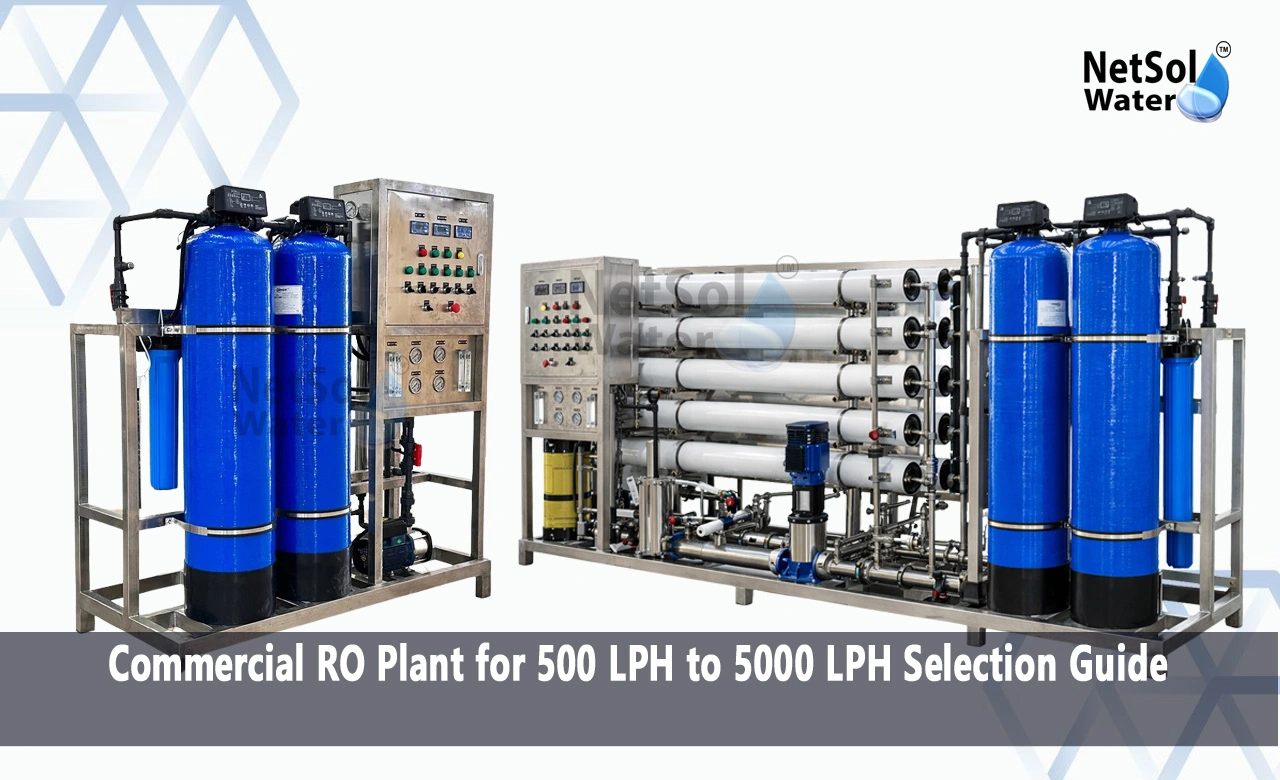
This product is popular as it includes the majority of the daily water requirements of commercial systems without getting into the heavy industrial RO. These are generally skid-mounted, small size, and easy to install, although the design and choice of components may vary widely among manufacturers.
Who Should Select a Commercial RO Plant within this range?
A Commercial RO Plant for 500 LPH to 5000 LPH is ideal for businesses that need purified water for drinking, cooking, washing, cleaning, production support, and customer services. Cafes and restaurants tend to use RO water in cooking and drinks. Hotels and resorts require clean water to serve the guest and kitchen activities. RO plants are applied in schools and colleges to supply drinking water. Patients require quality clean water to be treated and washed. Commercial RO systems are used in small factories to treat process water, cooling, and cleaning purposes.
Therefore, the range of capacities fits well in the instances where the water demand is routine, constant and exceeds domestic RO plants.
Commercial RO Plant for 500 LPH to 5000 LPH: Selection Guide
1: Know Your Daily Water Needs and Peak Demand
The first time would be to establish the amount of water that your business uses on a daily basis. A large number of businesses tend to estimate drinking water requirements only whereas the real consumption is quite large as it is used to clean, cook, wash and carry out business operations.
Even more important than the daily demand is the peak demand. An example of this is that hotels will need more water in the mornings and evenings compared to restaurants which will need as much water as possible in the times of the week that meals are taken. When the highest demand is high then you must have a higher capacity RO plant or a powerful storage system.
2: Base Capacity of RO Plants on Hours of Operation
All-day running of RO plants is not always the case. Other plants have a working shift of the RO plant whereas some do so when the business is in operation. Running time is also influenced by the availability of power and manpower.
In case your Reverse Osmosis plant will operate with lower number of hours every day, then you require greater capacity to satisfy the same demand daily. When you have more time to have your plant running, then it is better that you go with a moderate capacity having enough storage tanks.
3: Assess Feed Water Before RO Final Decision
One of the most significant RO selection criteria is the feed water quality. Pretreatment is required in water that is of high TDS, hardness, iron, silica or turbidity. When pretreatment is weak, then the membrane will clog very fast and the output will reduce and the cost of maintenance will increase.
Correct analysis report of water assists in deciding on the need to install sand filters, activated carbon filters, softeners, antiscalant dosing, iron removal or UF system prior to RO. Even a single capacity RO plant may have very different results under various conditions of raw water.
4: Select the Right Recovery and Reject Management Plan
Not every feed water in RO plants is converted to product water. Certain water is rejected as well as impurities. This implies that the supply of your raw water should not be limited to treated water demand alone but also reject water losses.
In addition, it is significant to reject water management. Other enterprises use reject water to wash down, plant, flush, or to cool down towers. An effective reject reuse strategy causes a cut in the total water bill and enhances sustainability.
5: Choose the Suitable Storage Tanks and RO Capacity
Storage planning plays a very important role in commercial RO plants. A large capacity RO plant might not be able to provide water immediately when it is most needed in case there is no storage. A treated water tank of correct size will guarantee continuous supply even in case the RO plant is shut down.
Equally, reject tanks and the raw water tanks should be planned well to ensure the stability of the running of the plants. Storage means that the RO plant is not stressed and enhances long-term performance.
6: Test Components and Construct Quality
A Commercial RO Plant for 500 LPH to 5000 LPH may look similar from outside, but component quality makes a huge difference. These are main items to be checked such as membranes, high pressure pump, dosing system, pressure gauges, flow meters, conductivity meter and control panel.
Build material also matters. FRP vessels, SS frames and corrosion-resistant piping enhance durability. Poor piping and fittings may lead to leaks, pressure wastage and failure.
7: Consider Automation and Safety Features
Automation saves on manpower and enhances the safety of the plant. Reliability is enhanced by such features as auto start/stop, dry run protection, low/high pressure protection, auto flushing, and online TDS monitoring.
Automation is very handy especially in commercial installations where the availability of an operator is not very feasible at all times. It minimizes down-time and guarantees the consistency of water quality.
8: Plan for Future Expansion
Businesses often grow. Hotels are being expanded, restaurants seating is being added, and production in factories is being increased. When you decide to use RO capacity according to the current requirements, you can end up with an inadequate supply in the future, and need to obtain another RO plant.
Another alternative would be to have a plant of slightly larger capacity, or to use a modular design which can be increased later by adding membranes or upgrading pumps.
Typical Errors in Choosing Commercial RO Plant Capacity
Most of the businesses opt to buy RO capacity depending on the price alone hence underperforming and spending a lot on maintenance. The other error is not paying attention to the analysis of feed water as it will result in incorrect choice of pretreatment. Some buyers choose a plant without planning storage tanks, causing shortage during peak hours. Many also ignore reject reuse possibilities, which increases water cost. Lastly, choosing a plant without automation increases labour cost and operational risk.
Avoiding these mistakes helps ensure smooth performance and long-term savings.
Conclusion
Selecting the right Commercial RO Plant for 500 LPH to 5000 LPH requires more than choosing a capacity number. It needs proper understanding of daily water usage, peak demand, operating hours, feed water quality, recovery, storage planning, component quality, automation, and future expansion needs. A well-selected RO plant ensures consistent purified water supply, lower operating cost, and reliable performance for years. If you invest with proper planning, your RO plant becomes a long-term support system for your business operations rather than a recurring maintenance problem.
Do you need an advice or assistance on selecting the best water and waste water treatment unit? We have solutions for all your problems!
Let us know your problem, our experts will make sure that it goes away.
For an assistance or related query,
Call on +91-9650608473 Or write us at enquiry@netsolwater.com