

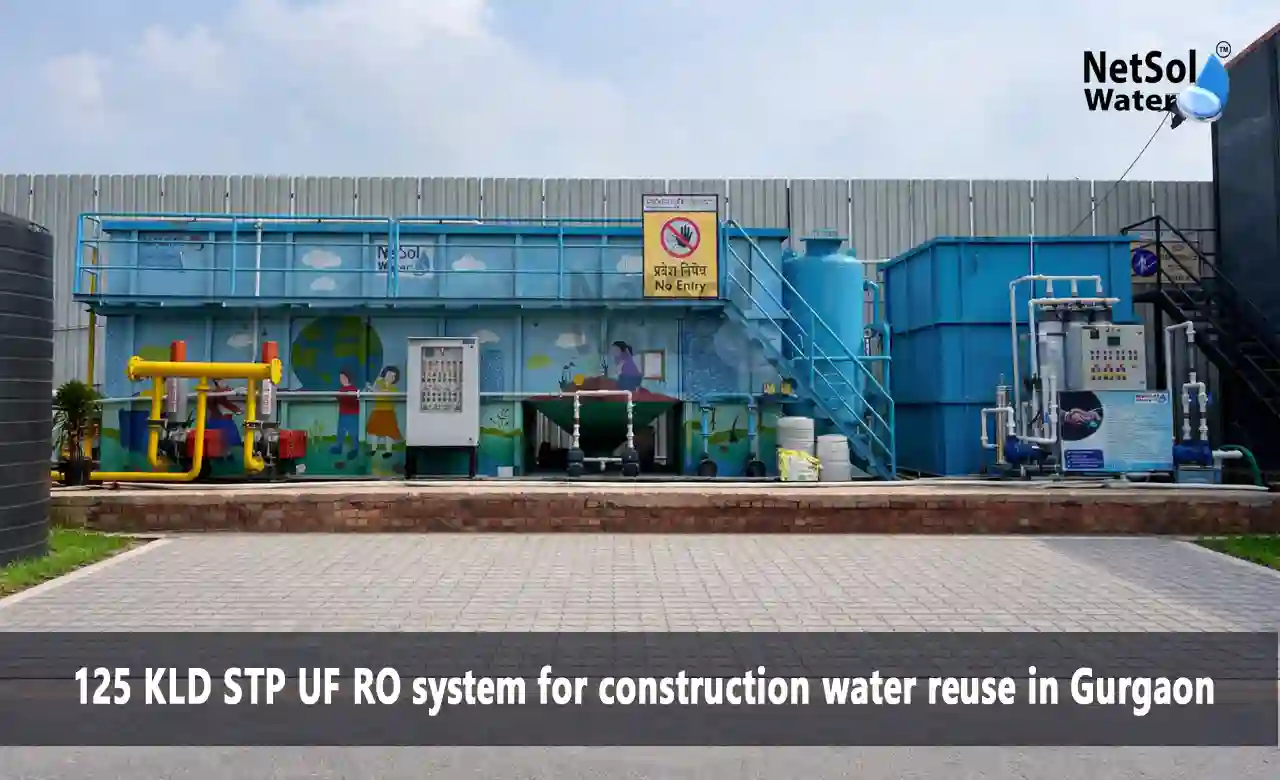
Case Study – Reuse of Labor Camp Wastewater into Construction Work Using 125 KLD STP + UF + RO System in Gurgaon
Introduction – Sustainable Alternative to Groundwater & Tanker Water in Delhi NCR
Water scarcity is no longer a future concern in India — it is a present reality. In rapidly developing regions like Gurgaon (Delhi NCR), construction companies face strict restrictions on groundwater extraction. At the same time, construction projects require large volumes of water daily for curing, concrete mixing, plastering, and equipment cleaning.
This case study presents how Netsol Water Solutions Pvt. Ltd. successfully designed and installed a 125 KLD Sewage Treatment Plant (STP) integrated with Ultrafiltration (UF) and Reverse Osmosis (RO) to reuse labor camp wastewater and provide high-quality construction-grade water at just INR0.035–INR0.040 per liter, with full compliance to BIS standards.
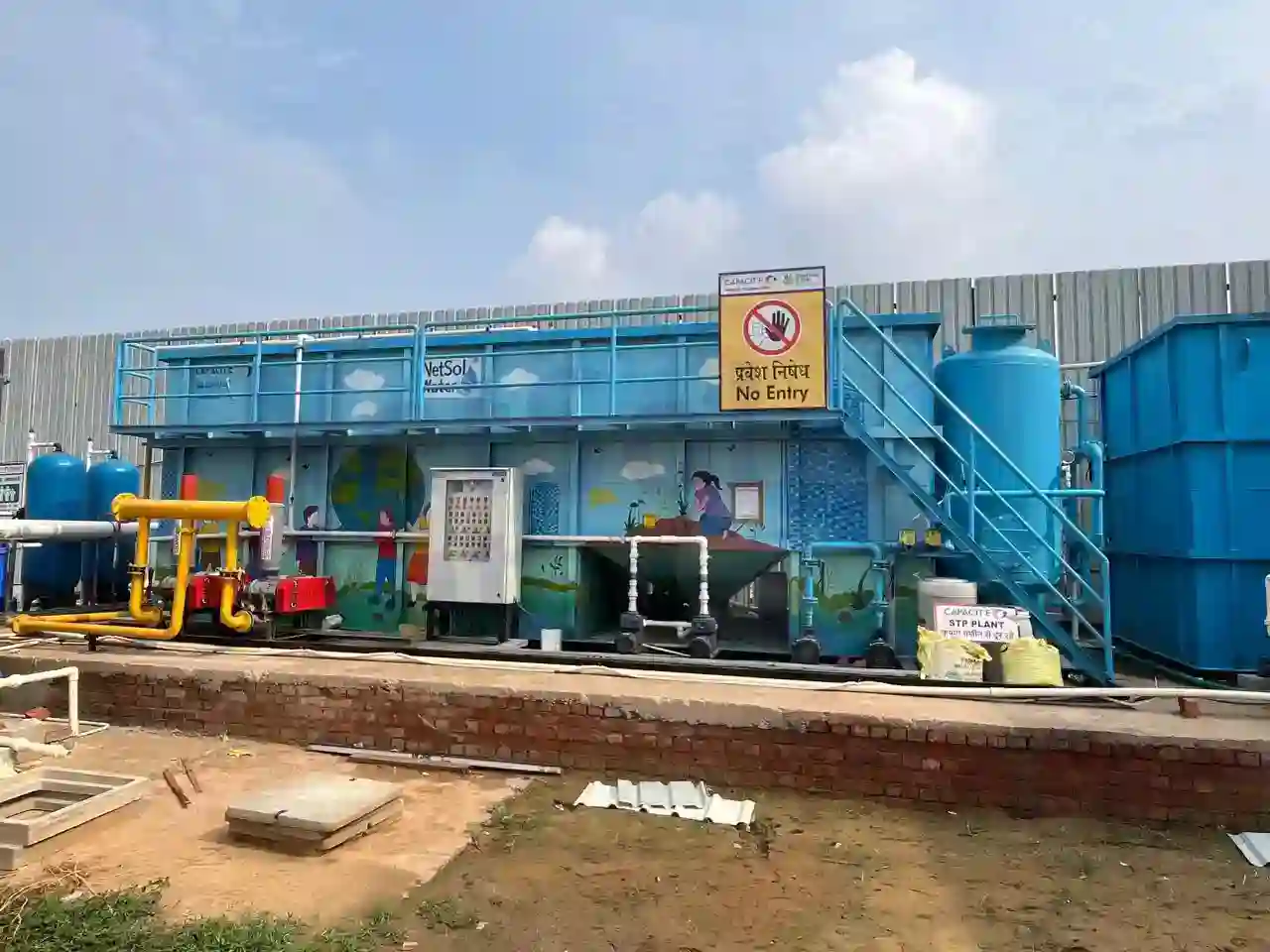
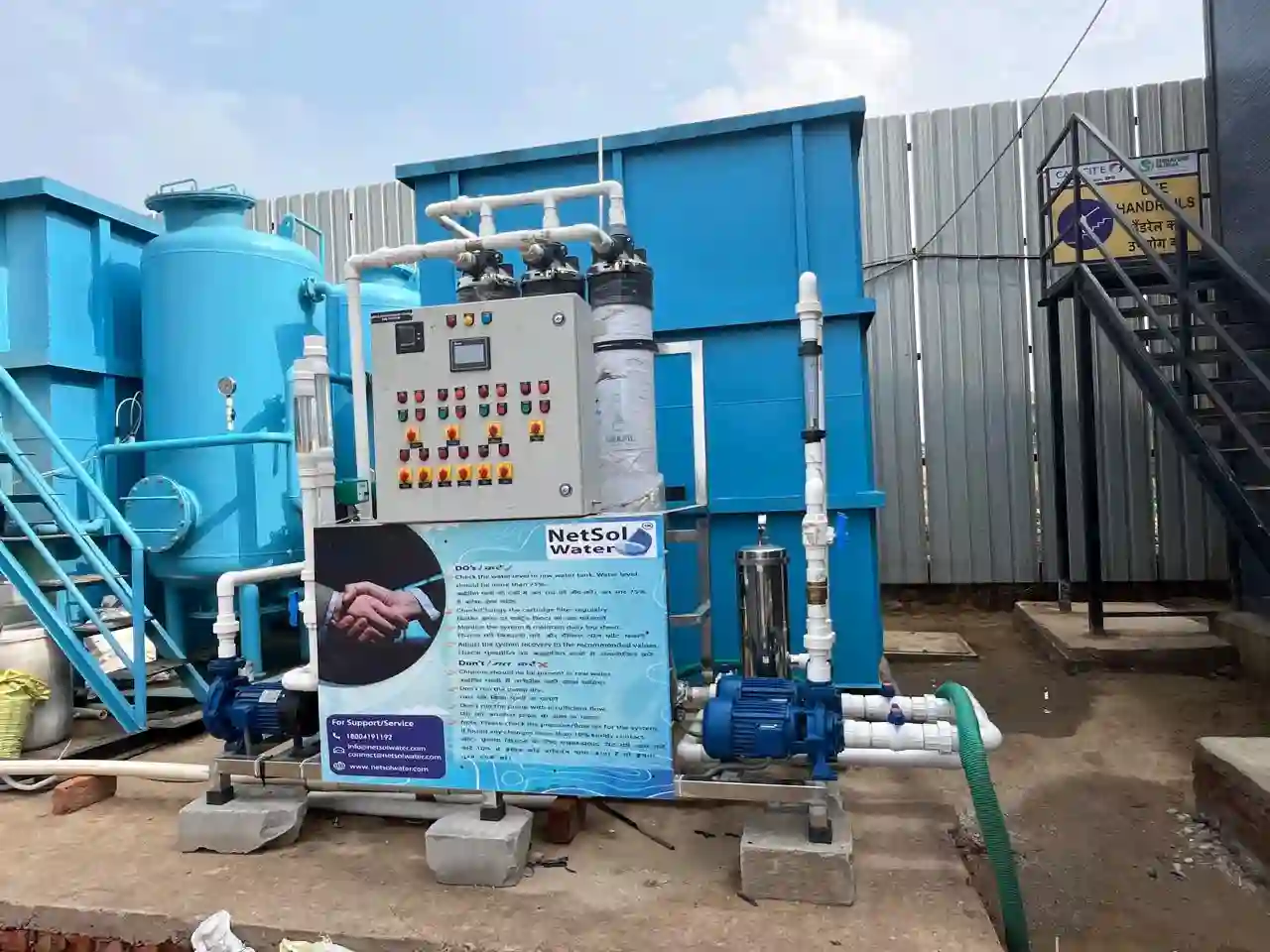
The above image shows the installed wastewater treatment plant designed and commissioned by Netsol Water for construction wastewater reuse.
Why Wastewater Reuse is Becoming Essential?
Modern infrastructure projects are shifting toward wastewater reuse solutions to reduce costs and meet sustainability mandates.
Project Overview
Client and Project Details
. Client (Civil Contractor): Capacite Infraprojects Ltd
. Developer: Signature Global India Ltd
. Technology Partner: Netsol Water Solutions Pvt. Ltd.
. Location: Gurgaon (Delhi NCR)
. Capacity: 125 KLD
. Application: Construction water reuse
This system converts secondary treated municipal sewage water into high-quality, low-TDS water suitable for concrete and finishing works.
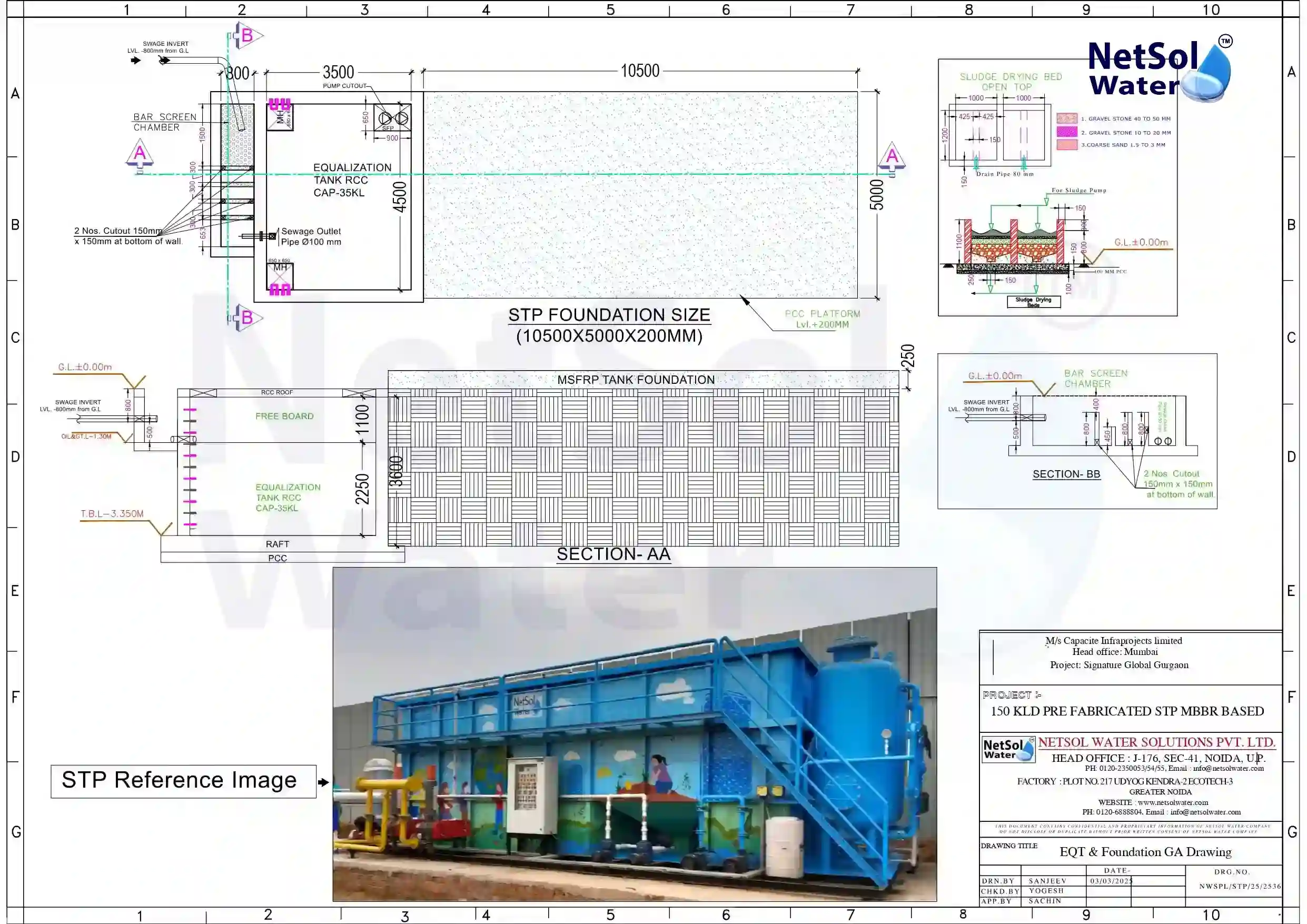
System Objective
Conversion of treated sewage water into construction-grade water suitable for RCC and finishing works.
Why Construction Sites Cannot Depend on Groundwater in Gurgaon/ Delhi NCR?
Delhi NCR / Gurgaon and other metropolitan cities like – Bengaluru, Mumbai, Chennai falls under highly water-stressed zones. Authorities have restricted groundwater extraction due to:
. Rapid urbanization
. Depleting aquifers
. Environmental compliance mandates
. Sustainable development norms
Construction companies relying on borewells face:
. Legal risk
. Inconsistent water quality
. High hardness and scaling
. Long-term structural risks
Tanker water, on the other hand:
. Costs INR60–INR120 per KL
. Has variable quality
. Increases diesel emissions
. Is operationally unreliable
A sustainable, compliant alternative was needed.
Engineering Solution – STP + UF + RO System
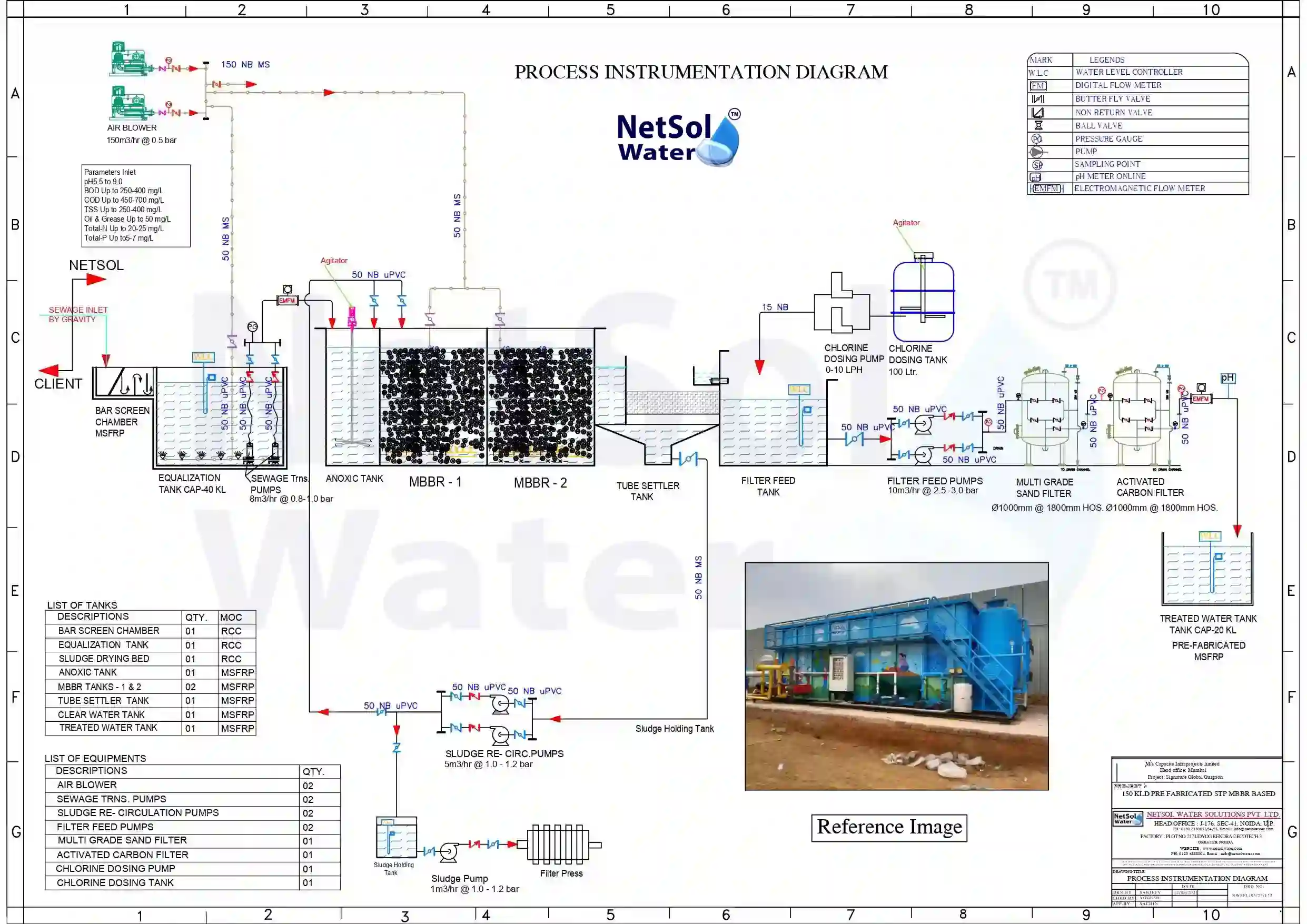
Treatment Flow
Municipal Treated Water → STP → Clarifier → UF → RO → Storage → Construction Use
Multi-Barrier Treatment Benefits
. Organic contaminants
. Suspended solids
. Dissolved salts
. Hardness
. Chlorides
. Scaling components
Incoming Labor Camp Wastewater Characteristics
Even though the raw water was secondary treated municipal sewage, it still contained residual contaminants:
Raw Water Parameters
| Parameter | Typical Range |
|---|---|
| TDS | 800–2000 mg/L |
| Hardness | 250–600 mg/L |
| TSS | 10–30 mg/L |
| Turbidity | 5–20 NTU |
| Chlorides | 150–500 mg/L |
| SDI | 5-7 |
Such water is not suitable for direct construction use or RO feeding without polishing.
Final Water Quality Achieved
After treatment through STP + UF + RO:
Output Parameters
| Parameter | Achieved Value |
|---|---|
| pH | 6.5–7.5 |
| BOD | <3 mg/l |
| COD | <5 mg/l |
| TSS | <1 mg/L |
| TDS | 50–150 mg/L |
| Hardness | <50 mg/L |
| Turbidity | < 0.5 NTU |
| Chlorides | < 50 mg/L |
Result:
. Water quality better than borewell water
. No scaling in pipelines
. No corrosion risk
. Clear water for curing
. Suitable for RCC and PCC
Compliance with BIS IS 456:2000 for Concrete Water
As per Bureau of Indian Standards under IS 456:2000:
Water used in concrete must be free from harmful salts, acids, alkalis, and organic matter.
Our system delivers water that:
. Exceeds permissible TDS limits
. Maintains pH above 6
. Controls chlorides below RCC threshold
. Keeps sulphates well within safe limits
This ensures:
. Proper strength gain
. Reinforcement protection
. No efflorescence
. Improved structural durability
Financial Analysis
Is STP Water Cheaper Than Tankers?
Yes it is cheaper than Tankers
1: Project Investment CAPEX
Total Cost: INR 49 Lakhs
(Including STP, UF, RO, installation & integration)
2: Monthly Operating Cost OPEX
|
Component |
Monthly Cost |
|---|---|
|
2 Operators |
INR48,000 |
|
Consumables |
INR3,000 |
|
Electricity |
INR88,920 |
|
Total |
INR1,39,920 |
3: Treatment Cost
INR 0.037 per liter
4: Water Production
125,000 Liters/day
37.5 Lakh Liters/month
5: Per Liter Treatment Cost
INR1,39,920 ÷ 37,50,000 liters
= INR0.037 per liter
= INR35–INR40 per KL
Just 3.5–4 paise per liter.
6: Savings Compared to Tanker Water
If tanker cost = INR80 per KL:
Monthly tanker expense: INR3,00,000
Actual treatment cost: INR,40,000
Monthly Savings:
INR1,60,000
7: ROI & Payback Period
Annual Savings: INR19.2 Lakhs
Project Cost: INR49 Lakhs
Payback Period:
~2.5 to 3 Years
After that, the system continues generating cost benefits.
8: 5-Year Impact
. 22.5 Crore liters treated
. INR96 Lakhs saved vs tankers
. INR47 Lakhs+ net benefit after cost recovery
This proves that wastewater reuse is not only sustainable — it is profitable.
Environmental & ESG Impact
Sustainability Outcomes
. Zero groundwater extraction
. Reduced tanker movement
. Lower diesel consumption
. Reduced carbon emissions
. Contribution to circular water economy
For developers, this strengthens ESG positioning and regulatory credibility.
STP Water vs Groundwater Comparison
| Groundwater | STP Treated Water |
|---|---|
| High hardness | Low hardness |
| High TDS | Controlled TDS |
| Scaling issues | Scaling-free |
| Iron presence | Iron-free |
| Inconsistent | Consistent quality |
| Environmentally damaging | Sustainable |
Why Choose Netsol Water?
As a leading Sewage Treatment Plant Manufacturer in Gurgaon, Delhi-NCR, Netsol Water offers:
. Modular STP design
. Custom capacity systems (50–1000+ KLD)
. Advanced tertiary treatment integration
. Energy-efficient design
. Long-term AMC support
. Proven installation record in Delhi NCR
We do not just install systems — we design financially viable, compliant water solutions.
Frequently Asked Questions
1: Can treated sewage water be used for construction work?
Yes, When wastewater is treated using a Sewage Treatment Plant followed by Ultrafiltration and Reverse Osmosis systems, it becomes suitable for construction activities such as concrete mixing, curing, and site cleaning as per BIS IS 456:2000 standards.
2: What is the cost of treated STP water compared to tanker water?
Treated STP water typically costs around INR0.035 to INR0.040 per liter, while tanker water may cost INR60 to INR120 per kiloliter, making wastewater reuse significantly more economical for construction projects.
3: Can STP treated water completely replace tanker water at construction sites?
Yes, Properly designed STP plus UF and RO systems can eliminate tanker dependency by providing a continuous and reliable supply of construction-grade water.
4: Is treated wastewater safe for RCC and concrete work?
Yes, Treated wastewater meeting BIS IS 456:2000 parameters maintains controlled TDS, low chlorides, and suitable pH levels required for reinforced concrete and long-term structural durability.
5: What is the ROI of installing an STP for construction water reuse?
Most construction wastewater reuse systems achieve a payback period of approximately 2.5 to 3 years due to significant savings from reduced tanker water consumption.
6: Why is groundwater not recommended for construction projects in Delhi NCR?
Groundwater extraction is restricted due to declining aquifers, environmental regulations, and sustainability mandates. Additionally, groundwater often contains high hardness and scaling components that may affect construction quality.
7: What technologies are used in construction water reuse systems?
Modern construction water reuse systems combine Sewage Treatment Plants, Ultrafiltration, and Reverse Osmosis technologies to remove organic matter, suspended solids, dissolved salts, and hardness.
8: How much water can be recycled using a 125 KLD STP system?
A 125 KLD system can recycle approximately 125,000 liters of wastewater per day, providing a consistent water supply for construction activities.
9: What are the environmental benefits of wastewater reuse in construction?
Wastewater reuse reduces groundwater extraction, lowers tanker transportation emissions, conserves freshwater resources, and supports circular water economy and ESG sustainability goals.
10: Is wastewater reuse legally compliant in Gurgaon and Delhi NCR?
Yes, Wastewater reuse aligns with environmental regulations and sustainability guidelines by reducing groundwater usage and promoting responsible water management practices.
Expert Insight
Engineering Expertise Behind the Project
This solution was engineered by Netsol Water Solutions Pvt. Ltd., a specialist in wastewater reuse systems across India, focusing on cost-efficient and regulation-compliant treatment technologies for infrastructure projects.
Conclusion – Future of Sustainable Construction Water
This 125 KLD STP + UF + RO project in Gurgaon proves that:
. Construction water can be sourced sustainably
. Treated sewage water can outperform groundwater
. Per liter treatment cost can be as low as 3.5–4 paise
. Capital investment can be recovered in under 3 years
Water scarcity is not just an environmental issue — it is a financial risk.
Smart developers are now investing in sustainable water infrastructure.
Looking to Install an STP for Construction Water Reuse?
If you are a:
. Real estate developer
. Infrastructure contractor
. EPC company
. Industrial project owner
We can design a customized STP + UF + RO solution for your site.
Contact Netsol Water Solutions Pvt. Ltd. today for a technical consultation and cost-benefit analysis.