

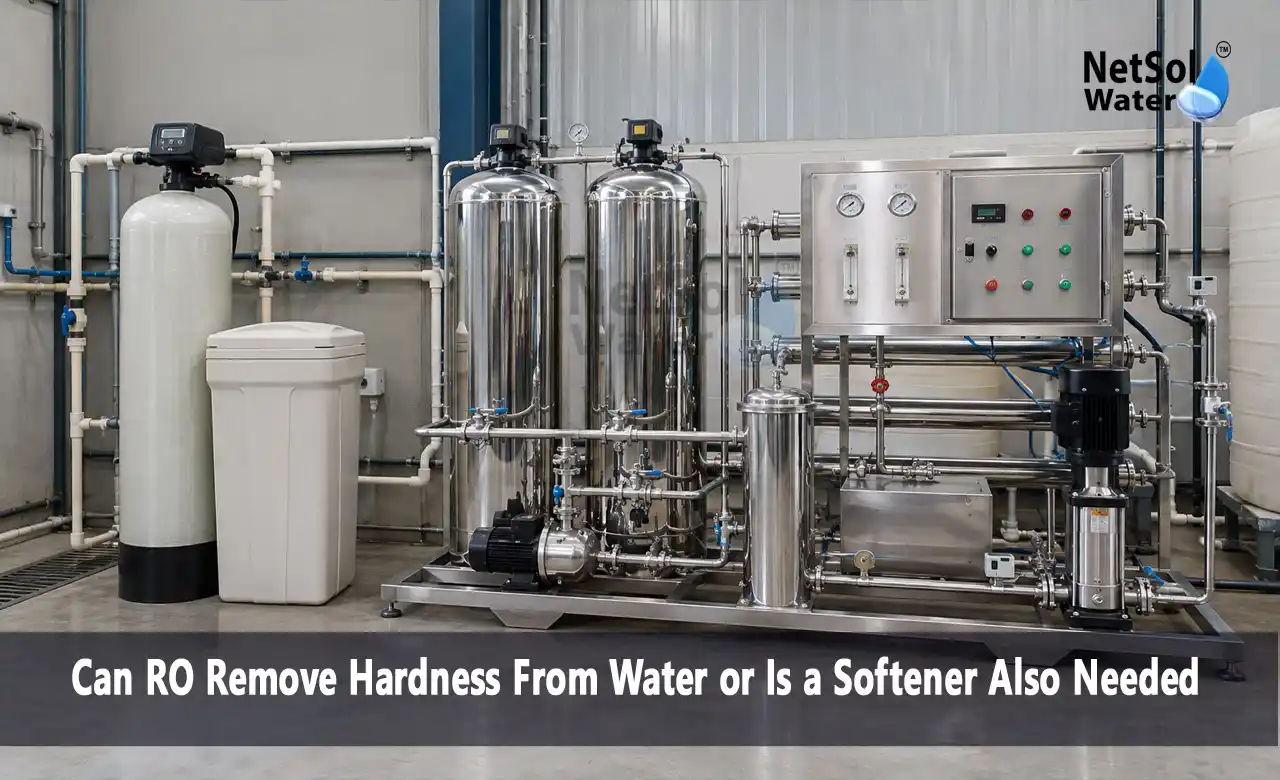
Does RO Remove Hardness? RO vs Water Softener Guide
RO removes most dissolved calcium and magnesium, so it does reduce hardness. But a softener may still be needed ahead of the RO when feed water is very hard, because hardness can scale and damage the RO membrane.
Hard water is a common problem in homes, commercial buildings and factories. Calcium and magnesium are the minerals behind it. Over time they form scale in pipes, boilers, heat exchangers and RO membranes, which raises energy use and repair cost.
RO and softeners are often confused because both deal with hardness. They do different jobs, and the right choice depends on your water test, your RO design and what you plan to use the water for.
Does RO Remove Hardness From Water?
Yes. In reverse osmosis, pressurised water passes through a semi-permeable membrane. Water molecules go through, while most dissolved salts, including calcium and magnesium, are held back and sent to the reject stream.
How well this works depends on membrane condition, feed water quality, operating pressure and recovery. A well-run system gives low TDS and low hardness water, which suits many process, drinking and utility needs.
There is one catch. As RO recovers more water, hardness in the reject side gets more concentrated. If it crosses the scaling limit, salts settle on the membrane. A properly engineered industrial RO plant is designed around this limit using your feed water data.
What Does a Water Softener Do?
A softener removes hardness ions only. It uses ion exchange resin that grabs calcium and magnesium and releases sodium in return. The resin is then regenerated with salt.
It does not act like RO. Dissolved salts stay in the water, so TDS does not fall. Softeners are valued for protecting equipment such as boilers, cooling systems and heat exchangers, and for pretreatment before RO.
Why Is a Softener Used Before RO?
Scale on an RO membrane cuts permeate flow, pushes up operating pressure and shortens membrane life. In severe cases the membrane is damaged for good.
Softening the feed water lowers this risk before water ever reaches the membrane. For plants with hard water, a water softener plant placed ahead of the RO is a common and reliable pretreatment step. It can also reduce how often the membrane needs cleaning for scale.
Not every RO needs one, though. The decision should come from feed water analysis and the RO projection, not from habit.
When Is RO Alone Enough?
RO alone can work when feed hardness is modest and the system is designed to control scaling. Some plants only want to cut TDS, and their water chemistry does not carry high scaling potential.
Hardness is never judged alone. Alkalinity, silica, sulfate, temperature and recovery rate all affect scaling, so check them together.
When Is a Softener Needed?
. Feed water has high hardness.
. The RO runs at high recovery, which concentrates salts in the reject.
. The system feeds boilers, heat exchangers or high-pressure RO.
. You want fewer scale-cleaning cycles on the membrane.
A softener only helps if it is run well. Regenerate the resin on time and keep salt and water supply steady for regeneration. Protect the resin from chlorine and from iron fouling too.
Can You Use a Softener Without RO?
Yes. If hardness is the only issue and you do not need low TDS, a softener alone is enough. Boiler feed is a typical case where softened water is the goal. If the end use needs low TDS water, a softener cannot replace RO.
RO vs Water Softener: Quick Comparison
| Point | RO System | Water Softener |
|---|---|---|
| Main job | Reduces dissolved salts, TDS and hardness | Removes calcium and magnesium only |
| Method | Semi-permeable membrane under pressure | Ion exchange resin swaps hardness ions for sodium |
| TDS reduction | High | None. TDS may rise slightly |
| Scaling risk | Membrane can scale if hardness is high | Protects boilers, heat exchangers and RO systems |
| Best use | Low-TDS water for process, drinking or feed applications | Hardness control before RO, boilers and cooling systems |
RO and Softener Together
In many industrial plants the two work as partners, not rivals. A common sequence is:
Raw water > Pretreatment > Water Softener > Cartridge Filter > RO > Treated Water
Some systems skip the softener and use antiscalant dosing or other pretreatment instead. No single layout fits every site. The water test decides.
How to Choose the Right Treatment?
Start with a full water analysis: hardness, calcium, magnesium, TDS, alkalinity, silica, sulfate, iron, chlorine and pH. Then match the design to the end use. Drinking water, boiler feed, process water and reuse water each need different treatment stages.
Frequently Asked Questions (FAQs)
Q1. Does RO remove hardness completely?
RO removes most dissolved calcium and magnesium, but not every ion. Rejection depends on membrane condition, pressure, recovery and feed quality. Hardness left in the reject stream also keeps rising, which is why scaling control matters.
Q2. Do I need a softener if I already have an RO plant?
Not always. If feed hardness is low and the RO is designed with proper scale control, RO alone can work. If hardness is high, a softener or antiscalant program is usually needed to protect the membrane.
Q3. Can antiscalant replace a softener?
In some designs, yes. Antiscalant dosing can control scale at moderate hardness and recovery. At very high hardness or high recovery, softening is often the safer choice. Your water report and RO projection decide this.
Q4. Does a softener reduce TDS?
No. A softener swaps hardness ions for sodium, so total dissolved solids stay about the same. Use RO when you need real TDS reduction.
Q5. Which test should I do before choosing?
Get a full water analysis covering hardness, calcium, magnesium, TDS, alkalinity, silica, sulfate, iron, chlorine and pH. A good design starts from this report.
Conclusion
RO can remove hardness, but it is not always enough on its own. If feed water is hard, a softener or other scale control protects the membrane and the plant behind it. A softener only handles hardness, while RO also cuts TDS and other dissolved solids.
The right setup comes from feed water chemistry, recovery, scaling potential and the quality you need at the end. Test first, then design.
Need help choosing the right water or wastewater treatment unit?
Share your water problem with the Netsol Water team and get a design matched to your water test.
Call on +91-9650608473 Or write to us at enquiry@netsolwater.com