

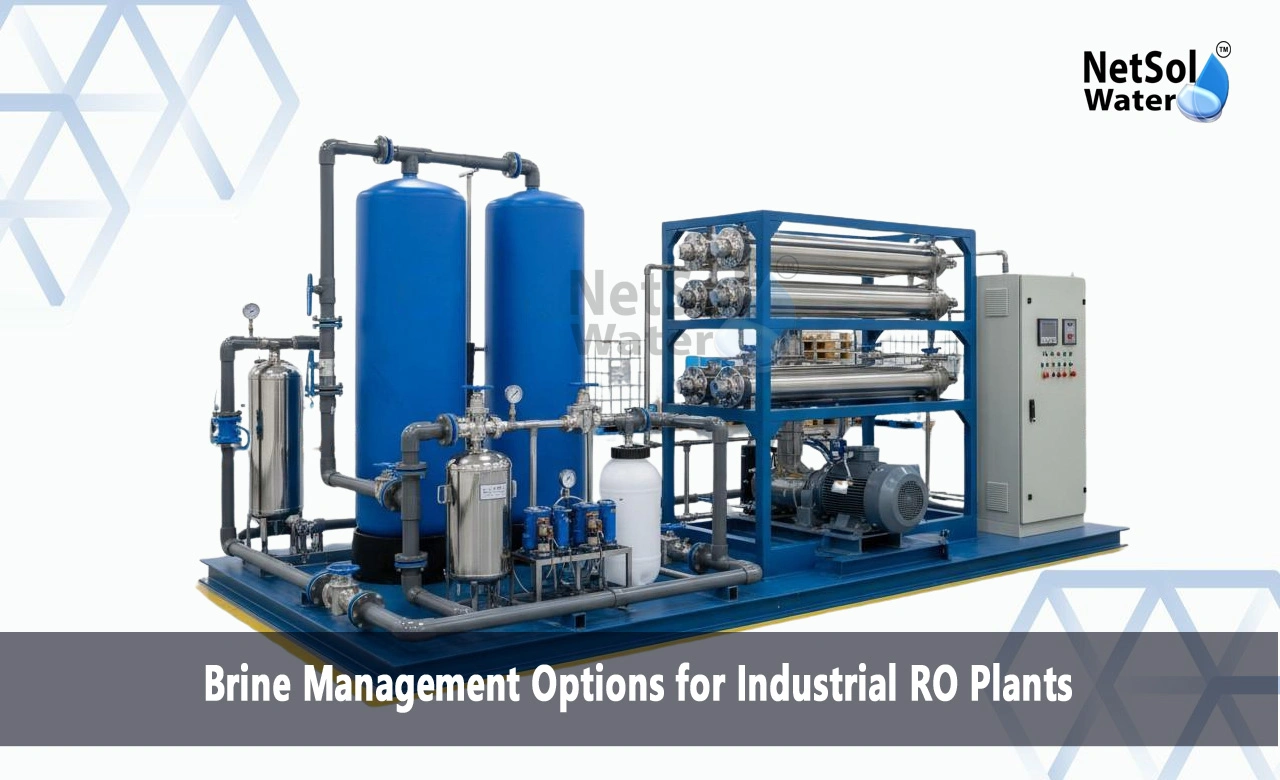
Brine Management Options for Industrial RO Plants
Industrial reverse osmosis works are significant in minimizing the use of freshwater, yet they produce a strong reject discharge called brine. High contents of dissolved salts, chemicals, and impurities are removed in the RO process and remain in this brine. The safe and cost effective management of this reject water has become the greatest challenge to industries particularly with the stricter discharge norms.
Choosing suitable Brine Management Options for Industrial RO Plants is no longer limited to disposal alone. It has a direct influence on the design of plants, the cost of operation, compliance with the regulations, and the environment responsibility. The efficient RO plant can be converted into a liability over the long term through poor brine management.
1: Direct Discharge Options
At certain industrial areas, RO brine released to sewer pipes or general effluent treatment systems is allowed under certain limit conditions. This alternative is easy and gradually limited owing to the high salt concentration and its effect to downstream treatment systems. The approvals of direct discharge are turning difficult to get.
2: Blending and Dilution Methods
Dilution of the brine can be done by mixing with treated effluent, then disposed. This decreases concentration however it does not decrease the load of pollutants. Several pollution control agencies do not encourage this approach unless it is backed up by environmental impact studies and suitable monitoring.
3: Evaporation-Based Management
Evaporation ponds make use of natural heat to evaporate water leaving salts behind. This approach can only be legitimized where the supply of land and climate allow. Mechanical evaporators are more controlled and fast in evaporation but have a high production of energy and demand of maintenance.
4: Zero Liquid Discharge Crystallization
Crystallizers transform concentrated brine to solid salts and no liquid waste is produced. This technique is extensively applied in Zero Liquid Discharge systems. It is effective however it involves a high level of capital investment and operation skills because of scaling and corrosion.
5: Reuse-Oriented Approaches
Other industries reuse the brine in uses that can withstand high salinity like cooling tower makeup or washing. Secondary membrane systems are applied in other situations to obtain more water under brine and minimize the final reject volume.
Economic Considerations that influence Brine Management Decisions
1: Capital Investment Requirements
More sophisticated systems of brine management such as evaporators and crystallizers cost much more to install. Initial costs are also high in land cost, equipment choice and auxiliary systems.
2: Operating and Energy Costs
Concentration processes on brine are energy-consuming. Long term operational costs are raised by power consumption, chemical dosing, regular cleaning and maintenance. These are some aspects that usually decide whether a solution is realistic or not.
3: Costs of regulatory Compliance
The compliance with discharge standards encompasses the monitoring systems, laboratory tests, and the documentation. The indirect economic pressure may be fines and loss of production or closure of the plant as a result of non-compliance.
4: Long-Term Risk and Liability
The mismanagement of the brine may cause the contamination of the soil, groundwater, and lawsuits. Remediation cost and environmental damage control can be relatively more expensive than the cost of installing appropriate brine management approach in the first place.
Conclusion
Effective Brine Management Options for Industrial RO Plants are essential for ensuring regulatory compliance, environmental protection, and economic sustainability. No single solution fits all industries. All options have to be considered according to water chemistry, recovery goals, availability of land, the cost of energy, and the regulations.
Industries that manage the brine during the preliminary RO design phase have a higher level of reliability of the systems and less expenses in the long-term perspective. When brine is treated as a by -product to be considered later, it can create challenges in the operations and regulatory processes. Properly designed brine management strategy will enable RO plants to be truly sustainable water treatment methods.
Do you need an advice or assistance on selecting the best water and waste water treatment unit? We have solutions for all your problems!
Let us know your problem, our experts will make sure that it goes away.
For an assistance or related query,
Call on +91-9650608473 Or write us at enquiry@netsolwater.com