

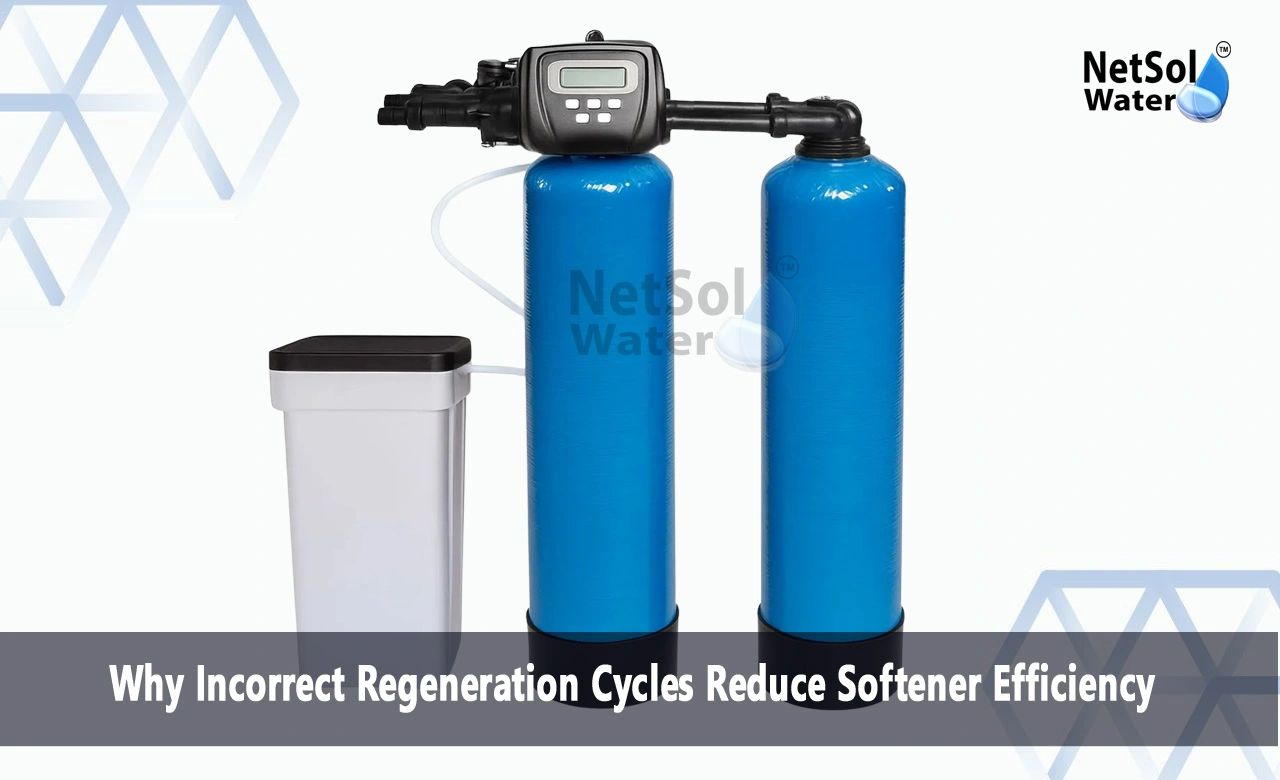
Why Incorrect Regeneration Cycles Reduce Softener Efficiency?
Water softeners have been considered as easy systems that can operateprovided that salt is of regular use. Regeneration cycles are actually important in determining the performance of them. Good regeneration practices cannot be replaced with high quality resin and sized vessels. Most installations employ wrong regeneration cycles, which decrease the efficiency of softeners progressively, causing leakage of hardness, increased salt usage and the premature failure of resin without any immediate notice.
The way Regeneration Cycles Reform Softener Performance
1: Saturation of Ion Exchange and Regeneration requirement
At the normal operation, sodium ions are exchanged on the resin surface by calcium and magnesium ions. With time, exchange sites are saturated with hardness ions, and thus, the resin is unable to soften water. To remove the hardness ions on the resin, regeneration removes these ions using a concentrated solution of sodium chloride, which replenishes exchange capacity. In case this process is not fully completed or at the wrong time, the performance of resin is lowered yet the system does not stop.
2: The Significance of appropriate Brine Contact
Brine and resin need sufficient contact time in order to regenerate effectively. When the flow of the brine is too high or when the contact time is reduced, sodium ions are not able to replace completely calcium and magnesium. Figures of partial regeneration cause a hardness that remains on the resin that fills up with each successive cycle and gradually becomes less efficient.
Reasons Why Regeneration Cycles are Incorrectly Regenerated and Ineffectively
1: Under-Regeneration Results in Capacity Loss Gradually
Among the most frequent errorsincorrect regeneration cycles reduce softener efficiency is the establishment of the regeneration frequency which is excessively low. Delay of regeneration beyond the ability of the resin to withstand it leads to longer retention of hardness ions which are more difficult to remove. This results in irreversible capacity loss and therefore the wrong regeneration cycles will decrease the efficiency of the softeners despite the normal salt consumption.
2: Excessive Regeneration Wastes Salt and destroys resin
Oversupply of regeneration is also bad. Regeneration is usually repeated that raises osmotic pressure on resin beads and hastens physical decay. Resin is brittle and fractures with time, as well as loses its exchange ability. The consumption of salt is also high, which does not enhance operations in any way.
3: Wrong Brine Strength Minimizes the Exchange Effectiveness
The level of concentration of brines is extremely important in the process of regeneration. Weak brine is ineffective to remove hardness ions whereas too strong brine does not enhance regeneration in an equivalent proportion and wastes salt. Wrong brine strength is an insidious factor in decreased softener performance.
Mechanical and Hydraulic Conditions which influence Regeneration
1: Asymmetric Distribution of the Flow during Regeneration
Through poor distributor design or internal fouling uneven brine flow through the resin bed may occur. There are zones of resin that regenerate exhaustively and others that do not regenerate. This nonuniform regeneration causes channeling in service cycles, which are less effective contacts of water and resin.
2: Poor Backwash Expansion
Backwashing causes the resin bed to become loose and clear the blocked debris. In case of the lack of backwash flow, fouling will remain in the bed and limit the contact of the brine. The insufficient backwash is a latent cause of the decreased efficiency of the softener regeneration cycle as time goes on.
Logic and Programming Errors in Control
1: Incorrect Cycle Timing
The modern softeners are based on programmable controllers. Mistiming of the cycles e.g. by having a short slow rinse or fast rinse, leave some brine or hardness ions in the bed. Such programming errors are usually hard to spot but add up in terms of performance.
2: Water Demand-Regeneration Mode Mismatch
The time-based regeneration of systems that have variably-demanded water results in inconsistent resin loading. There are those cycles that regenerate prematurely and those that regenerate too late. Demand-based regeneration is more efficient in terms of resin depletion and also regulates efficiency.
Long-Term Effects of inadequate Regeneration
1: Leakage Downstream Up
When the resin efficiency is reduced, hardness starts penetrating through the softener. This affects downstream equipment, including boilers, RO systems, and heat exchangers which raise the risk of scaling and the cost of maintenance.
2: Shortened Resin Lifespan
The stresses of improper regeneration with repeated exposures increases the resin aging. The replacement of the resin is done much sooner than expected, which adds to lifecycle costs.
Enhancing Regeneration Practice to Stabilize Performance
1: Matching Regeneration Frequency and Actual Capacity
Sizing and frequent monitoring of water consumption is to make sure that regeneration is done prior to its depletion rather than too soon. This balance maintains the resin capacity and minimizes salt.
2: Occasional Performance Testing and Adjustment
The test of hardness pre and post-regeneration will show the effectiveness of cycles. Raising and lowering the strength of the brine, the time of contact and rinse duration according to performance data prevents a progressive loss of efficiency.
Conclusion
Water softeners do not actually fail at once. In the majority of instances, incorrect regeneration cycles reduce softener efficiencyway back before any noticeable symptoms are observed. Poor performance and escalated operating costs are the result of under-regeneration, over-regeneration, inadequate brine control and programming errors. Best regeneration is not a single event but a duty that is constantly operational. The systems with proper regeneration practices provide steady supply of soft water, reduced salt consumption, and increased resin life.
Do you need an advice or assistance on selecting the best water and waste water treatment unit? We have solutions for all your problems!
Let us know your problem, our experts will make sure that it goes away.
For an assistance or related query,
Call on +91-9650608473 Or write us at enquiry@netsolwater.com