

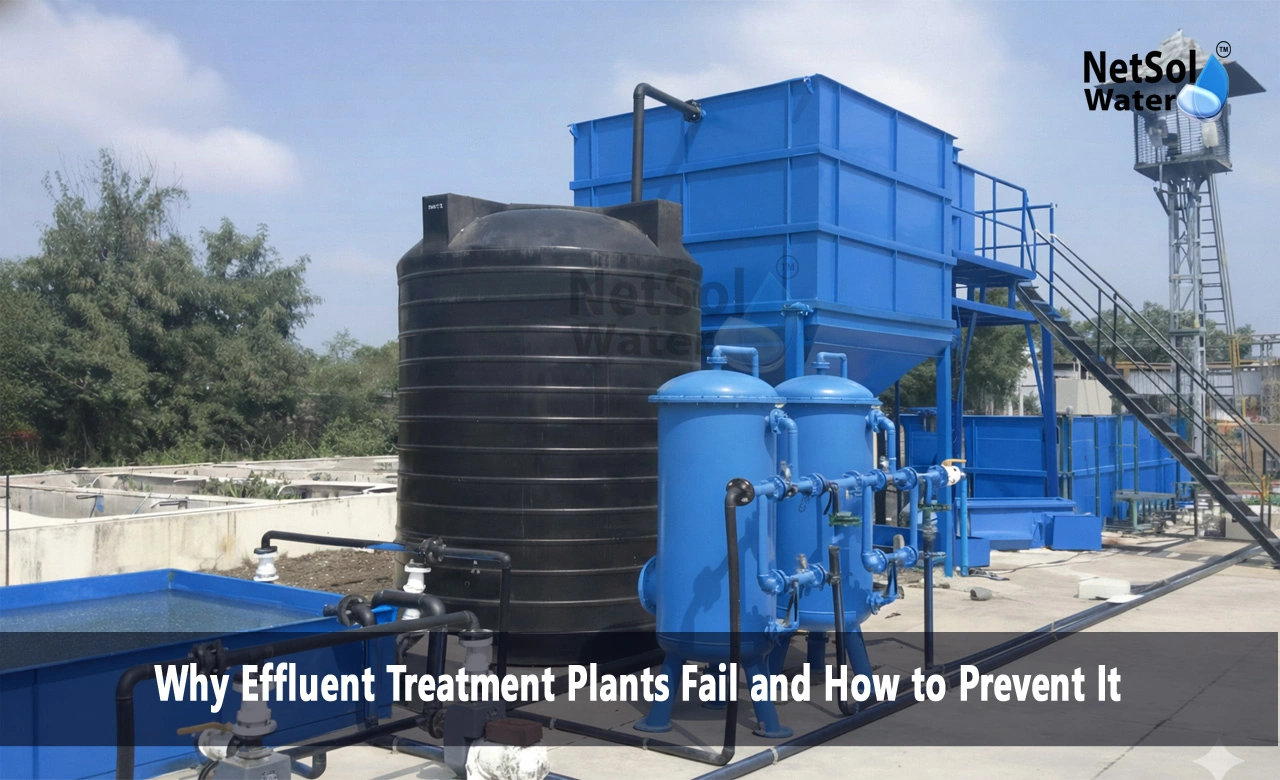
Why Effluent Treatment Plants Fail and How to Prevent It?
Effluent Treatment Plants are employed so that the regulations are met, the environment is protected and the industrial process is sustainable. However, in spite of the good sound engineering purpose, most ETPs do not perform consistently over time. Such failures do not occur in one day. Their creation is a gradual process because of design assumptions, working practice, and evolving effluent characteristics. The knowledge of why the effluent treatment plants fail is necessary to avoid the expensive failure, non-conformity and halt of the production.
Causes of Effluent Treatment Plant failure
1: Improper Effluent Characterization during Design
Poor characterization of effluent used in the planning stages is one of the most frequent causes of ETP failure. Most plants are built according to a limited or short-term sample, which is not a realistic operating situation. The effluent quality has been changed a lot due to seasonal variation, batch discharges, raw material variation and cleaning cycles. In cases where COD, TDS and oil content in the water or even the toxicity exceed the design assumptions, the units become overloaded, and as a result, the efficiency of the removal is low and the upsets are frequent.
2: Poor Hydraulic and Load Equalization
A hidden cause of ETP failure is poor or undersized equalization tanks. In the absence of flow and load balancing, downstream units are exposed to instant hydraulic and organic shocks. All these changes disrupt the operation of biological systems, decrease the efficiency of chemical treatment and make the process very unstable. Repeated shock loading leads to deterioration of the health of the microbes and decreases the overall resilience of the plant over time.
3: Poor match between Treatment Technology and Effluent Nature
The failure of ETPs is mostly due to the inappropriateness of the treatment technology chosen to handle the biodegradability or the chemical complexity of the effluent. When effluents that are toxic, biodegradable or of varying pH are treated using conventional biological treatment, chronic underperformance will be witnessed. On the same note, excessive dependence on chemical treatment without considering the upstream variability leads to overconsumption of chemical and sludge.
4: Lack of Process Control and Monitoring
Absence of real-time monitoring, and slow corrective response being taken are also major contributors to ETP failures. It is common not to monitor parameters like pH, ORP, dissolved oxygen, MLSS and nutrient balance at all times. Undetected deviations worsen the process and cause regulatory breakdown and emergency closures.
5: Improper Sludge Management
Sludge management is often considered as a secondary issue, yet the overall performance of ETP is directly influenced by its performance in sludge management. Over accretion of sludge decreases useful reactor volume, aeration efficiency, and enhances oxygen consumption. Poor sludge dewatering and disposal also causes operation bottlenecks and compliance risks.
6: Skill Gaps and Operator Dependency
The logic of process in many ETPs is largely operatorexperience-based. At times when the trained operators are off or the procedures are not written, there is a normal deviation in the plant performance. Misdosage of chemicals, slow action to process changes and absence of preventive maintenance push the ETP slowly to failure.
The Prevention of Effluent Treatment Plant failure
1: Precise and thorough Assessment of effluents
The first step of ETP prevention of failure is efficient analysis of effluent under various operating conditions. Sampling should be done using peak loads, cleaning loads, seasonal fluctuations and worst-case conditions. A design that considers the maximum expected loads and not the average conditions is one that can be guaranteed to be steady over time and meet the conditions.
2: Strong Equalization and Buffering Design
With a properly developed system of equalization, the flow and the concentration of pollutants are kept steady. Biological and chemical processes are shielded against shock loading by sufficient retention time, appropriate mixing and controlled discharge to down stream units. This design feature, in itself, enhances the reliability of ETP to a large extent.
3: Selection of Processes on the basis of treatability, rather than on cost
There is need to select treatment technologies not only on the capital cost but also on the basis of effluent characteristics. In the case of complicated industrial effluents, hybrid treatment methods that involve physio-chemical and biological methods may be more appealing in the long term. To deal with challenging pollutants, advanced oxidation, staged biological treatment or anaerobic-aerobic integration might be necessary.
4: Performance-Based Monitoring and Automation
Simple automation and round-the-clock monitoring measures would be useful in identifying deviations in the process. Critical parameter online sensors enable the operator to implement corrective action before things go wrong. Operation is data-driven, which ensures that it is not reliant on manual judgment, increases uniformity.
5: Intended Sludge Transporting and Disposal Policy
The production of sludge must be considered as one of the design parameters. Sufficiency of sludge withdrawal, conditioning, dewatering, and disposal capacity helps to avoid the choking of the process and ensure the reactor efficiency. Peak solids load design prevents the downstream operational stress.
6: Standard Operating Procedures and Operator Training
Frequent training of operators, recorded SOPs and performance audits are very vital in ensuring ETP does not fail. Operators react more to the abnormal conditions when they have a knowledge of the fundamentals of a process, as opposed to the usual course of action. This type of operation is knowledge based and it greatly prolongs the life of plants.
Conclusion
The failure of Effluent Treatment Plants is not caused by a single error but rather a set of unthoughtful decisions and unmonitored practices. Mistakes in design, equalization, technology selection, poor monitoring and lack of discipline in operations slowly undermine treatment performance. The prevention of ETP failure should be done in a holistic approach and this involves taking into consideration accurate effluent evaluation, sound design, selection of technology, proactive monitoring and proper operation. When such components are in harmony, the effluent treatment plants would have high levels of consistency, reduced operation costs and sustainability in the long term.
Do you need an advice or assistance on selecting the best water and waste water treatment unit? We have solutions for all your problems!
Let us know your problem, our experts will make sure that it goes away.
For an assistance or related query,
Call on +91-9650608473 Or write us at enquiry@netsolwater.com