

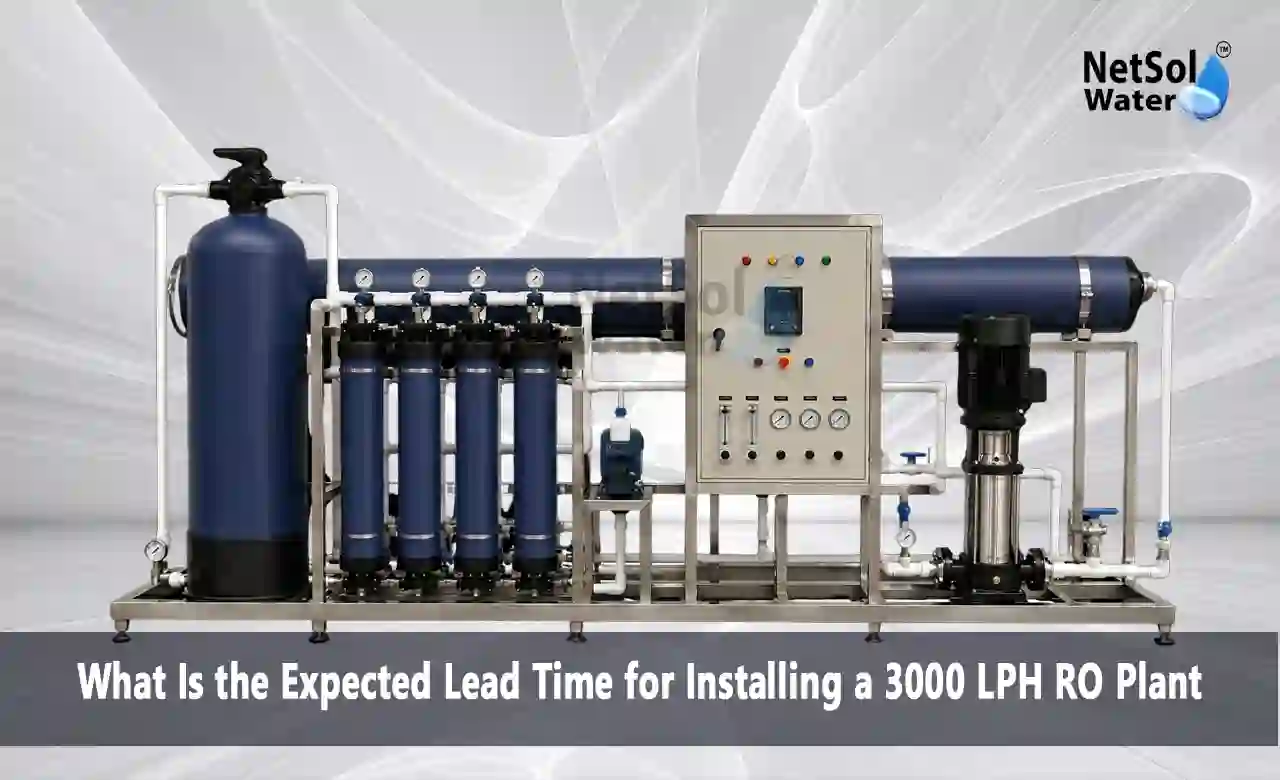
What Is the Expected Lead Time for Installing a 3000 LPH RO Plant?
If you have ever asked a vendor "how soon can you get my RO plant running," you already know the answer most people give: "soon." That word does not help you plan production, budget your cash flow, or tell your own customers when clean water will start flowing. So let us be honest and specific about it.
At Netsol Water, we build and commission commercial and industrial RO plants every week. A 3000 LPH (3000 litres per hour) system is one of the most common sizes we deliver, because it fits the sweet spot for mid sized factories, hotels, hospitals, packaged drinking water units, schools and housing societies. Over the years we have installed enough of them to give you a realistic timeline instead of a vague promise.
Here is what actually goes into the lead time, stage by stage, and what you can do to make it faster.
The short answer
For a standard 3000 LPH RO plant, the typical lead time from a confirmed order to a fully commissioned system is 3 to 5 weeks.
That range moves depending on three things: how good your raw water is, how much customisation you need, and how ready your site is when the plant arrives. A simple, skid mounted unit feeding on reasonably clean borewell water can be commissioned in around 3 to 4 weeks. A heavily customised plant treating hard, high TDS, or contaminated water with extra pre treatment can take 3 to 5 weeks. Everything else sits somewhere in between.
Now let us break down where that time goes, because understanding the stages is what helps you avoid surprises.
Stage 1: Water testing and requirement study (1 to 3 days)
This is the step people most want to skip, and the step that causes the most regret when skipped.
Before we design anything, we need a raw water analysis. TDS, hardness, iron, fluoride, chloride, pH, turbidity, and microbial load all change the membrane configuration, the pre treatment train, and the recovery rate. A plant designed for 800 TDS water will not perform on 2500 TDS water, and a plant that ignores high iron will foul its membranes within months.
If you already have a recent lab report, you save days here. If not, we collect a sample and test it. Either way, this stage sets the foundation, so it is worth doing properly.
Stage 2: Design, engineering, and approval (3 to 4 days)
Once we understand your water and your daily demand, our engineering team prepares the technical design. For a 3000 LPH plant this includes membrane selection and quantity, pump and pressure vessel sizing, the pre treatment scheme (sand filter, carbon filter, antiscalant dosing, softener if needed), the control panel logic, and the general arrangement drawing.
You review it, ask questions, and approve. The faster you confirm the design and release the advance, the faster procurement begins. In our experience this approval loop is where customer side delays most often creep in, so keeping your decision makers in the loop early genuinely helps.
Stage 3: Procurement of components (5 to 7 days)
This is usually the longest single stage, and it is the one most affected by what you choose.
Standard components such as FRP pressure vessels, multi grade and activated carbon filters, dosing systems, and common Indian made high pressure pumps are generally available quickly. Where lead time stretches is with imported membranes from premium brands, specific grades of stainless steel for hygienic or pharma applications, PLC and HMI based automation, and any non standard fittings.
A good commercial RO plant manufacturer in India keeps fast moving items in stock and maintains strong supplier relationships, which is exactly why an established manufacturer can quote you four weeks while a smaller fabricator might quote eight. Stock and supply chain are not glamorous, but they decide your delivery date.
Stage 4: Fabrication, assembly, and factory testing (5 to 7 days)
With parts in hand, the plant is built. The skid is fabricated, the filters and vessels are mounted and plumbed, the control panel is wired, and the membranes are loaded. Before anything leaves our facility, we run a factory acceptance test. We pressurise the system, check for leaks, verify the dosing, and confirm the control logic responds correctly.
We would rather catch a wiring fault or a leaking joint on our shop floor than on your site. A factory tested plant arrives ready to run, which is one of the quiet reasons commissioning goes smoothly later.
Stage 5: Dispatch and transport (2 to 3 days)
Once tested, the plant is packed and dispatched. Transit time depends on the distance between our facility and your site. Within the NCR region delivery is quick. For locations across India it adds a few days. For remote or hilly sites, plan for a little more.
A 3000 LPH plant is compact enough to ship as a single skid in most cases, which keeps transport simple and reduces the risk of damage in transit.
Stage 6: Installation and commissioning (2 to 4 days)
This is the stage everyone pictures when they think about lead time, but as you can see, it is only a small part of the total.
Our service team positions the plant, connects it to your raw water inlet, treated water outlet, drain, and power supply, and then commissions it. Commissioning means we flush the membranes, calibrate the dosing, set the operating pressures, tune the recovery, and run the plant until the output water meets the agreed quality. We also train your operator on daily checks, cleaning cycles, and basic troubleshooting.
The single biggest cause of delay at this stage is site readiness. If the foundation, plumbing points, drainage, and three phase power are not ready when the plant arrives, the team waits, and waiting costs you time. More on that below.
Why lead times differ between manufacturers?
Two manufacturers can quote the same plant and promise wildly different timelines. The difference usually comes down to a few real factors.
An experienced commercial RO plant manufacturer in India carries inventory, has in house engineering and fabrication rather than outsourcing it, and has a service team that commissions plants regularly rather than occasionally. These are not marketing lines. They are the difference between a plant that runs in five weeks and one that drags into its third month with excuses.
This is also where trust matters. Ask any vendor for references, for plants of similar size they have commissioned, and for a written timeline with stage wise milestones. A manufacturer confident in its delivery will give you all three without hesitation.
How you can shorten the lead time?
You have more control over the timeline than you might think. Here is what genuinely speeds things up.
Share a recent water test report at the very first conversation, so design does not wait on lab results. Approve the technical design and release the advance promptly, because procurement cannot start without it. Prepare your site in parallel while the plant is being built, including the level foundation, inlet and outlet plumbing, a proper drain, and stable three phase power. Keep a single point of contact on your side who can make decisions, so approvals do not bounce between people for days.
Do these four things and you will routinely land at the faster end of the range.
A realistic timeline at a glance
To put it all together, here is how a typical 3000 LPH project flows when things are handled well.
| Stage | Typical Duration |
|---|---|
| Water testing and requirement study | 1 to 3 days |
| Design, engineering, and approval | 3 to 4 days |
| Procurement of components | 5 to 7 days |
| Fabrication, assembly, and testing | 5 to 7 days |
| Dispatch and transport | 2 to 3 days |
| Installation and commissioning | 2 to 4 days |
Add it up and you land at that 3 to 5 week window, with the exact figure decided by your water, your customisation, and your site readiness.
Final thoughts
A 3000 LPH RO plant is a serious investment in your operation, and you deserve a straight answer about when it will run. The honest version is that most projects take between four and seven weeks, that the installation itself is the quick part, and that the planning and procurement before it are where the real timeline lives.
The right partner makes all of this predictable. As a commercial RO plant manufacturer in India with in house design, fabrication, testing, and a service team that commissions these systems regularly, Netsol Water can give you a firm, stage wise timeline at the quotation stage rather than a vague promise. If you tell us your water quality, your daily demand, and your location, we can tell you, with confidence, exactly when your plant will be producing clean water.
If you are planning a 3000 LPH RO plant or any commercial or industrial water treatment system, reach out to Netsol Water for a water analysis, a clear design, and a delivery schedule you can actually build your plans around.