

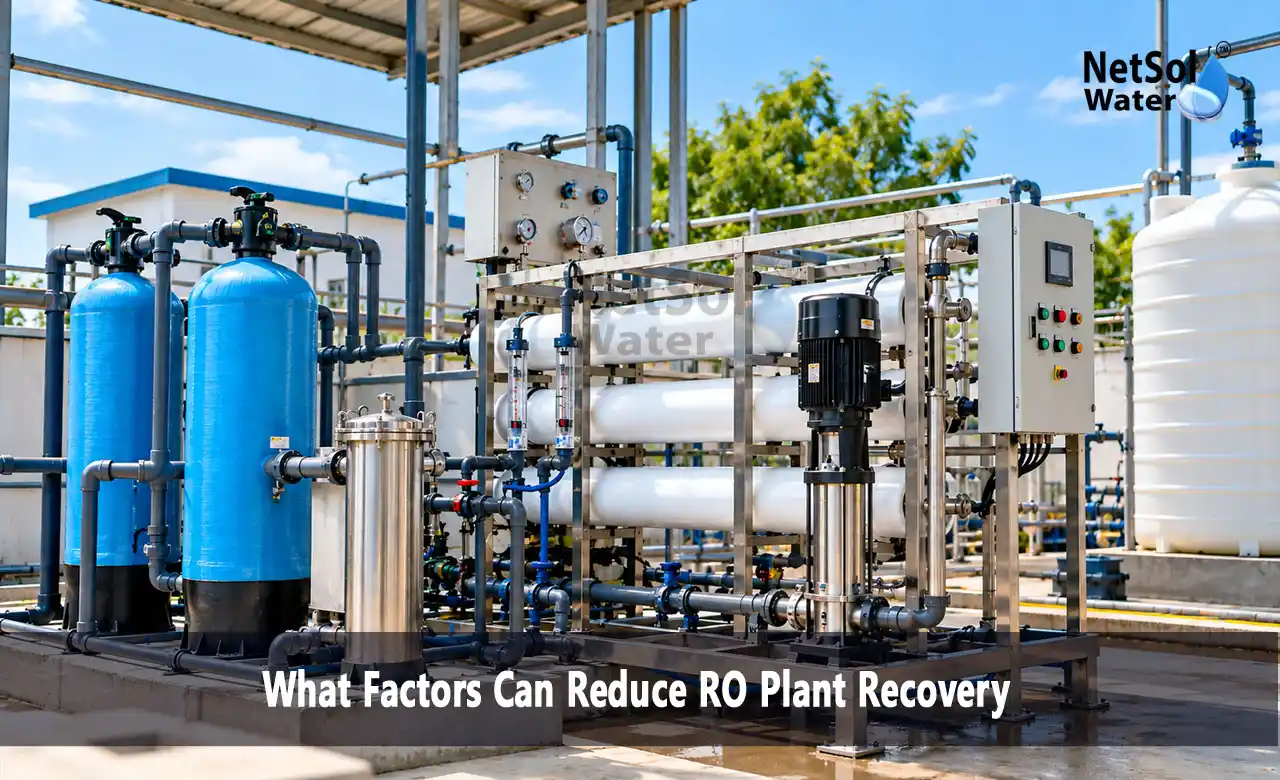
What Factors Can Reduce RO Plant Recovery?
RO plant recovery is the percentage of feed water that leaves the system as permeate (product water). The rest leaves as reject, also called concentrate or brine. The formula is simple: Recovery (%) = Permeate flow ÷ Feed flow × 100. If a plant takes in 100 m³/h of feed and produces 75 m³/h of permeate, its recovery is 75%.
When recovery drops, more water goes to drain, product output falls and the cost of every cubic metre of treated water goes up. In most plants the drop is not random. It is a signal that something has changed in the feed water, the membranes, the pressure or the settings. This guide explains the eight most common causes, how to spot them, and what operators can do about each one.
What Reduces RO Plant Recovery?
The most common factors that reduce RO plant recovery are:
. High scaling potential in the feed water
. Membrane fouling
. Insufficient feed pressure
. High feed TDS
. Low feed water temperature
. Poor pretreatment
. Incorrect recovery or flow settings
. Membrane age and condition
1. High Scaling Potential
Calcium, sulfate, silica, barium and strontium are present in most raw water sources. As water passes through the membranes, these salts become more concentrated in the reject stream. Once their concentration crosses the solubility limit, crystals form on the membrane surface. This is scaling, and it blocks water flow and forces operators to cut recovery to protect the membranes.
How to control it: lower the recovery set point, correct the feed pH, improve softening and use a suitable antiscalant at the right dose. You can read more about why antiscalants are used in RO plants and the scaling control strategies used in industrial RO plants. Note that overdosing antiscalant can itself cause fouling, so dosing should always be based on feed water analysis.
2. Membrane Fouling
Suspended solids, colloids, organic matter and biological growth coat the membrane and restrict water passage. As fouling builds up, the plant produces less permeate at the same pressure, and the differential pressure across the stages starts to rise.
How to control it: strong pretreatment and cleaning on time. Many operators plan a clean-in-place (CIP) when normalized permeate flow falls by about 10%, salt passage rises by 10 to 15%, or differential pressure rises by about 15%. Waiting longer makes cleaning harder and can permanently damage the membrane. See these measures to control RO membrane fouling for practical steps.
3. Insufficient Feed Pressure
The feed pressure must overcome the osmotic pressure of the water and still leave enough net driving pressure to push water through the membrane. If pressure is too low, permeate flow drops and recovery falls with it.
Common causes: a worn high-pressure pump, a clogged cartridge filter, a partly closed valve, a faulty VFD setting or excessive pressure loss in the pretreatment section. Fix these first. Raising the recovery setting without solving a pressure problem only pushes the membranes harder.
4. High Feed TDS
Osmotic pressure increases with the TDS of the feed water. A plant designed for 1,500 mg/L TDS needs much more pressure if the feed rises to 3,000 mg/L. At the same time, a higher TDS means the concentrate reaches its scaling limit sooner, so the safe recovery becomes lower.
How to control it: test the feed water regularly, especially if you use borewell water or mixed sources, and review the recovery setting whenever the water chemistry changes. Use updated projection software or consult the RO supplier before changing set points.
5. Low Feed Water Temperature
Membrane permeability depends on temperature. As a rough guide, permeate flux changes by about 2 to 3% for every degree Celsius. Cold water passes through the membrane more slowly, so in winter a healthy plant may produce less water at the same pressure.
How to control it: always compare performance using normalized data (for example, per ASTM D4516 methods) instead of raw production numbers. Otherwise a seasonal drop can be mistaken for fouling and lead to unnecessary cleaning.
6. Poor Pretreatment
Turbidity, hardness, iron, manganese, free chlorine, suspended solids and bacteria all move on to the RO membranes if pretreatment is weak. The result is faster fouling, faster scaling and a recovery that keeps falling over time.
How to control it: match the pretreatment to the feed water. Multimedia filters, activated carbon, softeners, ultrafiltration, dechlorination and chemical dosing each solve a different problem. Here is a useful overview of the pretreatment methods used in commercial RO plants.
7. Incorrect Recovery Setting
Recovery is controlled by the balance between the feed flow, the concentrate valve and the permeate flow. If the concentrate valve is closed too far, recovery rises beyond what the feed water chemistry can support. Scaling follows, and the plant eventually loses recovery anyway. If the valve is open too wide, recovery is lower than design and water is wasted.
How to control it: calibrate flow meters and pressure gauges, log the actual recovery daily and compare it with the design value. Any change in recovery should be made in small steps and checked against scaling limits.
8. Membrane Age and Condition
Over time, membranes lose performance through compaction, chemical exposure, repeated cleaning, oxidation damage and irreversible fouling. Older membranes may need higher pressure for the same output, and the permeate quality can also drift.
How to control it: good pretreatment and gentle, correctly timed cleaning can extend membrane life. When cleaning no longer restores normalized flow and salt rejection, replacement is the practical option.
Summary Table: Cause, Warning Sign and Action
| Factor | Typical warning sign | Corrective action |
|---|---|---|
| Scaling | Rising differential pressure in last stage, falling permeate flow | Adjust pH, optimize antiscalant, soften, reduce recovery, acid or chemical CIP |
| Fouling | Higher DP in the first stage, lower normalized flow | Improve filtration, control biogrowth, perform CIP on time |
| Low feed pressure | Low pump discharge pressure, clogged cartridge filter | Service pump, replace cartridges, check valves and VFD |
| High feed TDS | Higher operating pressure, higher permeate TDS | Re-test feed, update projection, revise set points |
| Low temperature | Seasonal drop in permeate flow, normalized data stable | Use normalized data, adjust pressure within limits |
| Poor pretreatment | Frequent SDI or turbidity spikes, short filter cycles | Upgrade filtration, softening, dechlorination, dosing |
| Wrong settings | Recovery differs from design, unstable concentrate flow | Calibrate instruments, reset concentrate valve gradually |
| Aged membranes | Poor recovery after proper cleaning, rising salt passage | Replace membranes, review design and pretreatment |
How to Diagnose a Recovery Drop Step by Step?
. Check the numbers first. Verify that feed, permeate and concentrate flow meters read correctly before looking for process problems.
. Normalize the data. Correct for temperature, pressure and feed salinity so you see real membrane performance.
. Look at the pressure profile. Check feed pressure, interstage pressure and differential pressure across each stage.
. Test the feed water. Review TDS, hardness, silica, iron, SDI and free chlorine.
. Inspect pretreatment. Check filters, softeners, antiscalant dosing and cartridge filters.
. Decide on cleaning or replacement. Clean when the limits are reached, and replace if cleaning does not restore performance.
Frequently Asked Questions (FAQs)
Q1. What is a good recovery rate for an RO plant?
It depends on the feed water. Brackish water systems often run between 60% and 85%, while seawater systems usually run lower. The right figure is the one your feed chemistry and membrane design can support without scaling.
Q2. Can I increase recovery by closing the concentrate valve?
You can, but it raises the concentration of salts on the membrane and increases scaling and fouling risk. Increase recovery only after checking the scaling limits for your feed water.
Q3. Does low temperature reduce RO recovery?
Cold water reduces permeate flow, so output drops unless pressure is adjusted. It is a normal effect and should not be mistaken for fouling.
Q4. When should RO membranes be replaced?
When normalized permeate flow and salt rejection cannot be restored by proper cleaning, replacement is usually required.
Conclusion
RO plant recovery falls when scaling, fouling, low pressure, high TDS, cold water, poor pretreatment, wrong settings or old membranes reduce the plant's ability to produce permeate. Recovery should never be pushed higher only to cut reject water. It must stay within what the membranes, feed water chemistry and plant design can safely support. Regular monitoring of feed pressure, permeate flow, concentrate flow, TDS, differential pressure and normalized performance keeps an RO plant stable and efficient.
If your plant is losing recovery, an experienced industrial RO plant manufacturer can review your feed water analysis, pretreatment and operating data and recommend the right fix. You can also explore the complete range from a trusted RO plant manufacturer in India or visit Netsol Water for water and wastewater treatment solutions.
Do you need advice or assistance on selecting the best water and wastewater treatment unit? We have solutions for all your problems!
Let us know your problem, our experts will make sure that it goes away.
For assistance or related queries,
Call on +91-9650608473 Or write us at enquiry@netsolwater.com