

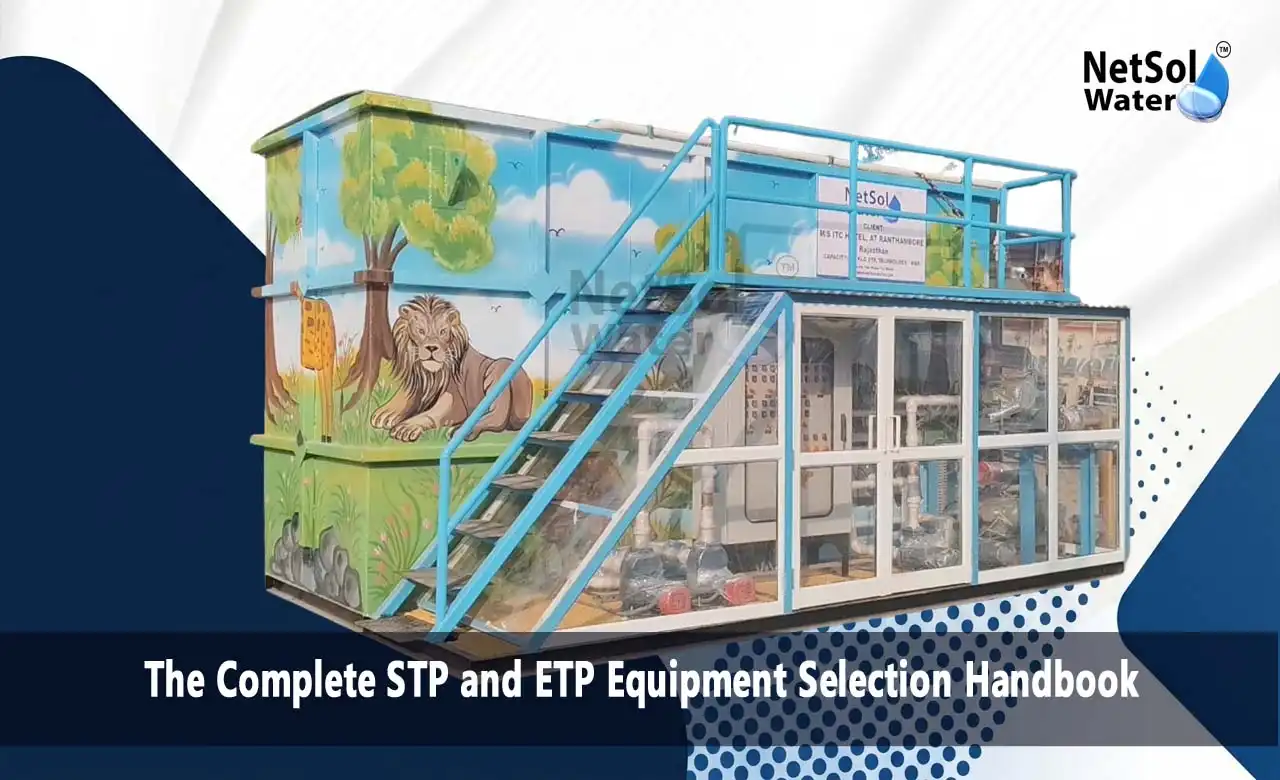
STP & ETP Equipment Selection Guide
Anyone who has commissioned a STP or ETP will tell you the same thing eventually: the plant is only as good as the equipment sitting inside it. You can nail the process design, get the tank volumes exactly right, and still end up with a plant that underperforms because someone picked the wrong pump, undersized the blower, or bought diffusers that clog within a year. Equipment selection is where good design either survives contact with reality or quietly falls apart.
This handbook walks through the major equipment categories that go into a typical sewage or effluent treatment plant, pumps, blowers, diffusers, bio-media, dosing systems, filtration units, membranes, valves, and the instrumentation that keeps everything honest. For each one, we'll cover what actually matters when selecting it, work through a sizing example, flag the mistakes that trip people up most often, talk through maintenance, and look at how to compare brands sensibly rather than just on price.
To keep the sizing examples grounded rather than abstract, we'll use a reference plant throughout: a 200 KLD facility, average flow of 8.33 m³/hr, peak flow of around 21 m³/hr. The same logic scales up or down for other capacities; only the input numbers change.
Pumps: The Workhorses Nobody Notices Until They Fail
Every treatment plant runs on pumps, raw sewage lift, recirculation, permeate transfer, sludge transfer, chemical dosing. Get the wrong pump in any of these spots and you'll either starve a downstream process or burn through electricity and maintenance budget keeping an oversized unit limping along at partial load.
1. What Actually Decides the Right Pump?
. Flow rate required, both average and peak, since a pump sized only for average flow will choke during morning and evening spikes
. Total dynamic head, which includes static lift, friction losses through pipework, and any pressure the downstream process demands
. The nature of the fluid, raw sewage with rags and grit needs a submersible or non-clog pump, not a standard centrifugal unit built for clean water
. Duty cycle, whether the pump runs continuously or intermittently, since this affects motor sizing and wear
. Available power supply and whether a soft starter or VFD is worth the extra cost for energy savings
2. A Sizing Example
For our reference plant's raw sewage lift station, we need to handle Qpeak of 21 m³/hr against a total head of, say, 12 metres (accounting for a 6 m static lift plus friction and fitting losses). Using the standard hydraulic power formula:
Hydraulic Power (kW) = (Q × H × ρ × g) / (3.6 × 10?)
Where Q is in m³/hr, H in metres, ρ is fluid density (roughly 1,000 kg/m³ for sewage), and g is 9.81 m/s².
Hydraulic Power = (21 × 12 × 1000 × 9.81) / 3,600,000 ≈ 0.69 kW
Accounting for pump efficiency of around 65% for a submersible non-clog unit, actual motor power required = 0.69 / 0.65 ≈ 1.06 kW, so a 1.5 kW (2 HP) motor with margin is the practical choice, paired with a duty-standby arrangement so the lift station never goes fully offline.
3. Where People Go Wrong
. The most common mistake is sizing pumps purely off average flow and getting caught out during peak hours.
. A close second is ignoring the actual solids content of raw sewage and installing a clean-water pump that clogs within weeks.
. Oversizing is its own problem too, a pump running well below its best efficiency point wastes power and wears out prematurely from constant throttling.
4. Keeping Them Running
Regular impeller inspection, checking for wear from grit and abrasive solids, monitoring bearing temperature and vibration, and never letting a pump run dry, even briefly, since that's one of the fastest ways to burn out a seal. Duty-standby rotation, running each pump on alternating weeks rather than always defaulting to one, evens out wear across both units.
5. Comparing Brands
| Factor | Why It Matters |
|---|---|
| Efficiency curve at your operating point | Look past headline price and check the actual efficiency curve at your operating point, not just the pump's peak efficiency, since plants rarely run exactly at a pump's sweet spot all the time. |
| Local spare parts availability | A cheaper pump with a six-week wait for a replacement seal costs far more in downtime than a slightly pricier one with parts available within a day. |
| Warranty terms & field service network | Check the manufacturer's actual field service network, not just their catalogue promises, worth verifying directly with existing customers if you can. |
Air Blowers: Getting Oxygen Where It Needs to Go
Blowers supply the air that keeps aerobic biology alive, and undersizing this single piece of equipment quietly sabotages an otherwise well-designed plant, since starved microorganisms simply can't do their job properly.
1. What Actually Decides Blower Selection
. Air volume required, calculated from oxygen demand, not guessed at
. Discharge pressure, driven by diffuser submergence depth plus piping losses
. Blower type, positive displacement (roots-type) blowers handle variable pressure well and suit smaller plants; centrifugal or turbo blowers are more efficient at larger, steadier flows
. Turndown capability, how far the blower can throttle down during low-load periods without losing efficiency
. Noise levels, particularly relevant for plants near residential areas
2. Sizing Example
Continuing our reference plant: from earlier oxygen demand calculations for a 200 KLD MBR-type system, the Standard Oxygen Requirement comes to roughly 102 kg O?/day. At a Standard Oxygen Transfer Efficiency of 27% for fine bubble diffusers and an oxygen content of air of 0.28 kg/m³:
Air required = 102 / (0.27 × 0.28) ≈ 1,349 m³/day, or about 56 m³/hr
Adding a 20-25% safety margin for diffuser fouling and future load brings design capacity to roughly 70 m³/hr. Two blowers rated for the full duty each, running duty-standby, is the standard arrangement, so servicing one never interrupts aeration.
3. Frequent Errors
. Sizing blowers off tank volume rather than actual oxygen demand, which routinely leads to undersized air supply
. Ignoring altitude and ambient temperature corrections for blower capacity, which matter more in some regions than people expect
. Skipping a turndown-capable blower for a plant with genuinely variable load, leading to energy waste during low-flow periods
4. Maintenance That Actually Matters
Air filter replacement on a fixed schedule, since a clogged intake filter silently reduces output long before anyone notices a problem. Belt tension checks for belt-driven units, vibration monitoring, and oil level checks for lubricated bearing types. Blower rooms also need decent ventilation themselves, since blowers generate real heat and an overheated blower room shortens equipment life across the board.
5. Brand Comparison Worth Doing
| Factor | Why It Matters |
|---|---|
| Specific power consumption (kW per Nm³/min) | Directly affects your electricity bill over the plant's life. |
| Noise rating (dB at 1m) | Critical near residential zones. |
| Turndown range | Determines energy savings during low-load hours. |
| After-sales support network | Determines how fast a breakdown gets fixed. |
Diffusers: Small Parts With an Outsized Effect
Diffusers convert blower air into fine bubbles that actually transfer oxygen into the water, and the difference between a good diffuser layout and a poor one shows up directly in your air bill and your effluent BOD numbers.
1. What to Weigh When Choosing Them
. Bubble size matters most, fine bubble diffusers (membrane discs or tubes) transfer oxygen far more efficiently than coarse bubble systems, though coarse bubble units are cheaper and better suited to mixing-only zones like equalization tanks
. Membrane material, EPDM versus silicone, affects both cost and how well the diffuser resists fouling and cracking over time
. Diffuser density and layout across the tank floor needs to match the oxygen demand profile, uneven placement creates dead zones where biology simply doesn't get enough air
2. Working Through the Numbers
For our 64 m³ aeration tank, if we're using fine bubble disc diffusers rated at roughly 4-6 Nm³/hr per diffuser at typical operating pressure, and our air requirement is around 70 m³/hr:
Number of diffusers = 70 ÷ 5 (average rating) = 14 diffusers
Spread across the tank floor in a grid pattern, spaced to avoid overlapping bubble plumes, this gives even oxygen distribution without wasting air on redundant coverage in any one spot.
3. What Goes Wrong Most Often
. Buying diffusers on price alone and ending up with membranes that crack or clog within a year, forcing an expensive tank drain-down for replacement
. Poor layout planning, clustering diffusers in one area instead of spreading them evenly, which creates uneven mixing and localised low-oxygen pockets
. Ignoring backpressure buildup as membranes age, which quietly increases blower energy consumption long before anyone notices a drop in treatment performance
4. Keeping Diffusers Effective
. Periodic acid cleaning to dissolve mineral scale buildup on membrane surfaces
. Visual inspection during any tank drain-down for cracking or biofouling
. Tracking backpressure over time as an early warning sign that cleaning or replacement is due
5. Brand-Level Comparisons
| Factor | Why It Matters |
|---|---|
| Membrane material & fouling resistance | Its resistance to fouling in your specific water chemistry matters more than the spec sheet alone. |
| Oxygen transfer efficiency ratings | Compare ratings under actual operating conditions rather than lab conditions. |
| Expected membrane lifespan | Typically 3–5 years for good quality EPDM under normal conditions, though this varies a lot with water hardness and biofilm buildup. |
Bio-Media: The Surface Biology Grows On
For MBBR and similar attached-growth systems, bio-media is what gives bacteria somewhere to colonise, and the surface area this media offers directly determines how much biomass a given tank volume can support.
1. Choosing Media Comes Down To
. Specific surface area (m² per m³ of media), higher surface area supports more biomass per unit volume
. Media fill ratio, typically 40-60% of tank volume for MBBR applications, going higher reduces mixing efficiency
. Material durability, since media needs to survive years of abrasion and biological activity without breaking down
. Retention screens, which keep media inside the tank while allowing water through, a detail that's easy to underdesign
2. A Worked Example
Say our aeration tank needs to support the equivalent biomass of a much larger conventional tank, using MBBR media rated at 500 m²/m³ specific surface area, filled to 50% of the 64 m³ tank volume.
Media volume = 64 × 0.5 = 32 m³
Total media surface area = 32 × 500 = 16,000 m²
That's the surface available for biofilm growth, a substantial jump in effective treatment capacity compared to relying purely on suspended growth in the same tank volume.
3. Common Missteps
. Overfilling the tank with media past 60%, which restricts water movement and actually reduces treatment efficiency rather than improving it
. Choosing media based purely on surface area numbers without checking how well it actually fluidises with the available air or mixing energy, some high-surface-area media needs more aggressive mixing than a standard blower can provide
. Undersized retention screens that let media escape into downstream units, clogging pumps and pipework
4. Maintaining It Over Time
. Periodic inspection of retention screens for damage or blockage
. Monitoring media movement to confirm proper fluidisation
. Watching for excessive biofilm thickness, which can make media sink or clump if left unchecked for too long
5. What Separates One Brand From Another
| Factor | Why It Matters |
|---|---|
| Actual verified surface area vs. marketing claims | This varies more between suppliers than most buyers expect. |
| Chemical & UV resistance | Relevant for media used in outdoor tanks exposed to sunlight. |
| Genuine field performance data | Look for data from similar installations, rather than lab-only figures. |
Dosing Pumps: Precision Over Power
Dosing pumps handle chemicals, coagulants, disinfectants, pH correction, antiscalants, in quantities measured in millilitres rather than cubic metres, which means precision matters far more here than raw pumping capacity.
1. Getting Selection Right Involves
. Dosing accuracy and turndown ratio, since a plant's chemical demand often varies significantly through the day and a pump that can only deliver its rated maximum accurately is a poor fit for variable dosing needs
. Chemical compatibility of wetted parts, sodium hypochlorite, for instance, is aggressive toward certain elastomers and metals, and a pump built for a different chemical family will fail early
. Pulsation and mixing characteristics, since some dosing points need smooth, continuous injection while others tolerate pulsed dosing without issue
2. Running a Sizing Example
For continuous chlorine dosing on our 200 KLD plant at a 5 mg/L dose rate: chlorine demand works out to 1 kg/day (as covered in our earlier calculation), needing roughly 10 litres a day of 10% strength hypochlorite solution.
That's 10,000 mL ÷ 24 hours = 417 mL/hr average dosing rate
A metering pump rated for 0.5-1 LPH with fine stroke-length adjustment gives comfortable control at this rate, with enough turndown to handle lower dosing during low-flow periods without losing accuracy.
3. Mistakes That Show Up Repeatedly
. Selecting a pump rated far above actual dosing needs, running it at the low end of its stroke range, where accuracy typically suffers the most
. Ignoring chemical compatibility and watching diaphragms or seals degrade within months
. Skipping a calibration column or flow verification device, which makes it nearly impossible to confirm actual dosing rate against the pump's theoretical output
4. Keeping Dosing Accurate Over Time
. Regular calibration checks against actual delivered volume, not just the pump's dial setting
. Inspection of diaphragms and check valves for wear
. Flushing suction lines periodically to prevent crystallisation or scaling from chemicals like antiscalants
5. Comparing Options
| Factor | Why It Matters |
|---|---|
| Turndown ratio & accuracy at low stroke settings | This is where cheaper pumps typically fall short. |
| Availability of chemical-specific wetted parts | Ensures long service life for the chemical in use. |
| Genuine calibration & accuracy guarantee | Look for a real guarantee rather than just a flow rate spec on paper. |
Pressure Sand Filters: The Workhorse of Physical Filtration
Pressure sand filters remove suspended solids through a graded media bed, and they're common both as a tertiary polishing step after biological treatment and as pre-treatment ahead of RO or UF systems.
1. What Decides the Right Filter
. Filtration rate, typically 10-15 m³/hr per m² of filter bed area for standard applications
. Media grading and bed depth, which determines how fine a particle size the filter can capture
. Backwash flow requirements, since undersized backwash piping leads to poor bed cleaning and gradual clogging
. Vessel material, mild steel with lining versus FRP versus stainless steel, based on water chemistry and budget
2. Sizing It Out
For our plant treating Qavg of 8.33 m³/hr through a filtration rate of 12 m³/hr/m²:
Filter area required = 8.33 ÷ 12 ≈ 0.69 m²
That corresponds to a vessel diameter of roughly 0.94 m (since Area = π × r²), rounding up to a standard 1,000 mm diameter vessel for practical availability, giving a comfortable margin above the calculated minimum.
3. Where People Slip Up
. Sizing purely on average flow and finding the filter overwhelmed during peak periods, leading to solids breakthrough
. Skipping proper backwash sequencing and timing, which lets the bed compact and channel over time, reducing effective filtration area
. Choosing media grading that's too fine for the actual solids load, causing excessive pressure drop and short filter runs between backwashes
4. Upkeep That Keeps Performance Steady
Monitoring differential pressure across the filter bed as the primary indicator for when backwashing is due, rather than running on a fixed calendar schedule alone. Periodic media inspection to check for channeling, mudball formation, or media loss over time, and replacing media entirely every few years as it degrades and loses its effective filtration capacity.
5. Brand-Level Factors
| Factor | Why It Matters |
|---|---|
| Vessel build quality & internal distribution design | A poorly designed underdrain system causes uneven flow and channeling regardless of how good the media is. |
| Availability of replacement media & internals | Check local availability before committing to a brand. |
| Genuine backwash sequence guidance | Look for real guidance from the manufacturer rather than a generic manual. |
Activated Carbon Filters: Handling What Sand Can't
Where sand filters remove particulates, activated carbon filters handle dissolved organics, chlorine, odour, and colour, making them a common polishing step for treated water headed toward reuse applications.
1. Selecting the Right Unit Means Considering
. Carbon type and iodine number, a measure of the carbon's adsorption capacity, since higher-grade carbon costs more but lasts considerably longer before breakthrough
. Contact time, since adsorption needs sufficient dwell time within the carbon bed to actually work, rushing water through an undersized vessel defeats the purpose
. Bed depth and flow rate, typically 5-10 m³/hr per m² for domestic and light commercial water treatment applications
2. A Quick Sizing Pass
Using the same 8.33 m³/hr average flow at a design rate of 8 m³/hr/m²:
Filter area required = 8.33 ÷ 8 ≈ 1.04 m²
This works out to roughly the same 1,000 mm diameter vessel range as the sand filter, often installed as a matching pair in series, sand filter first, carbon filter second, a fairly standard arrangement.
3. Common Oversights
. Treating activated carbon as a permanent, install-and-forget media, when it actually has a finite adsorption capacity and needs periodic replacement once it's exhausted
. Skipping upstream sand filtration, letting suspended solids clog the carbon bed prematurely and shorten its effective life dramatically
. Ignoring chlorine's dual role, carbon does remove residual chlorine effectively, but continuous high chlorine exposure also degrades the carbon bed faster than expected
4. Keeping It Working
. Tracking run time and treated volume against the carbon's rated capacity rather than guessing when replacement is due
. Periodic backwashing to prevent channeling and remove trapped fines
. Testing outlet water quality periodically to catch breakthrough before it becomes a visible problem
5. Comparing Suppliers
| Factor | Why It Matters |
|---|---|
| Actual iodine number & adsorption capacity | Two filters that look identical on paper can perform very differently depending on carbon quality. |
| Ease of media replacement | Check whether the vessel design allows straightforward carbon changeout without major disassembly. |
UF Systems: A Membrane Step Below RO
Ultrafiltration sits between conventional filtration and reverse osmosis, removing bacteria, suspended solids, and larger organic molecules while letting dissolved salts pass through, useful both as RO pre-treatment and as a standalone polishing step for reuse applications.
1. Selection Hinges On
. Membrane pore size, typically 0.01-0.1 microns, chosen based on what needs removing and what can safely pass through
. Flux rate and the resulting membrane area needed for your design flow, generally lower than MBR flux rates since UF handles a cleaner feed stream
. Module configuration, hollow fibre is the most common for water treatment applications, offering a good balance of packing density and cleanability
2. Working Through an Example
At a typical UF design flux of 40-50 LMH for pre-treated water (considerably higher than MBR's mixed-liquor flux, since UF feed is much cleaner), using Qavg of 8,333 L/hr and a design flux of 45 LMH:
Membrane area required = 8,333 ÷ 45 ≈ 185 m²
Depending on module size from the chosen manufacturer, this might translate to anywhere from 3 to 6 individual UF modules, sized with some standby capacity for cleaning cycles.
3. Frequent Mistakes
. Running UF on poorly pre-treated feed water, high suspended solids or oil content fouls membranes fast regardless of how good the UF unit itself is
. Ignoring backwash and chemical cleaning frequency during design, which affects both membrane life and the plant's actual net output once cleaning downtime is accounted for
. Undersizing feed pumps relative to the transmembrane pressure the system actually needs to maintain flux over time
4. Maintenance Realities
. Regular backwashing on a fixed cycle
. Chemical enhanced backwash at longer intervals to manage fouling that regular backwash can't clear
. Monitoring transmembrane pressure trends to catch fouling early rather than after flux has already dropped noticeably
5. What to Compare Across Brands
| Factor | Why It Matters |
|---|---|
| Membrane material (PVDF is common and durable) | Material choice affects durability under real fouling conditions. |
| Documented membrane lifespan | Look for realistic fouling-condition data, not just lab figures. |
| Individual fibre repair vs. full module replacement | A module design that allows fibre-level repair saves cost when a few fibres fail. |
MBR Membranes: Already Covered in Depth, Worth a Quick Recap Here
Since MBR membrane selection deserves its own detailed treatment, and has been covered extensively elsewhere, here is the short version for this handbook:
. Choose based on flux rating appropriate to your peak flow, not just average flow
. Verify module area against actual manufacturer datasheets rather than generic assumptions
. Always build in standby module capacity so cleaning cycles don't threaten your plant's compliance during peak demand periods
Trans-membrane pressure trending is the single best early warning indicator for fouling across virtually every MBR installation, worth monitoring closely regardless of brand.
Valves: Unglamorous but Absolutely Critical
Valves rarely get much thought until one fails at the worst possible moment, stuck open, stuck shut, or leaking exactly where it shouldn't.
1. What Matters When Specifying Them
. Valve type matched to function, butterfly valves for general isolation, ball valves for tight shutoff on smaller lines, diaphragm valves for chemical dosing lines, non-return valves wherever backflow is a risk
. Material compatibility with the fluid, particularly important for chemical dosing lines carrying hypochlorite or acids
. Actuation, manual for infrequently operated valves, motorised or pneumatic for anything needing remote or automated control
. Pressure and temperature rating appropriate to the actual line conditions, not just a generic assumption
2. Common Mistakes Worth Avoiding
. Using cheap, generic valves on chemical dosing lines where the wrong material degrades within months
. Skipping non-return valves on pump discharge lines, leading to backflow and potential pump damage during shutdown
. Underspecifying actuator torque on motorised valves, causing premature actuator failure under real operating pressure
3. Keeping Valves Functional
. Periodic exercising of valves that sit in one position for long stretches, since valves left static for months can seize
. Checking seals and gaskets during scheduled shutdowns, and lubricating actuator mechanisms per the manufacturer's schedule rather than ignoring them until something jams
4. Brand Considerations
| Factor | Why It Matters |
|---|---|
| Body & seat material suited to your fluid chemistry | Ensures long-term compatibility with the specific fluid handled. |
| Availability of spare seals & actuator parts locally | Reduces downtime when a component needs replacing. |
| Genuine pressure rating verification | Verify actual ratings rather than relying purely on catalogue claims. |
Flow Meters, pH Meters, and DO Analyzers: The Instruments That Tell You the Truth
Grouping these together makes sense, since they share a common purpose: without reliable instrumentation, you're essentially running a plant blind, guessing at performance rather than actually knowing it.
1. Flow Meters
Flow meters need selecting based on the fluid's characteristics, magnetic flow meters work well for conductive fluids like sewage and don't obstruct flow, while ultrasonic meters suit clean water applications without needing direct fluid contact at all. Accuracy class and turndown ratio matter more than raw cost, since a meter that loses accuracy at low flows gives misleading data exactly when you need it most, during low-flow periods when process adjustments matter.
2. pH Meters
pH meters hinge on electrode type and calibration frequency. Standard glass electrodes work fine for most applications but need regular calibration and eventual replacement as they age and drift. Response time matters too, a slow-responding pH probe on a dosing control loop causes overshoot and undershoot in chemical dosing, wasting chemicals and destabilising the process it's meant to control.
3. DO Analyzers
DO analyzers, monitoring dissolved oxygen in aeration tanks, come down to choosing between optical and traditional membrane-based probes. Optical DO sensors have become the more popular choice in recent years, since they need far less maintenance and don't suffer from membrane fouling the way older electrochemical probes do, though they cost more upfront.
4. Sizing and Placement, Briefly
Flow meters need enough straight pipe run upstream and downstream, typically 5-10 pipe diameters, to read accurately; cramming one right after a bend or valve guarantees unreliable readings. pH and DO probes need placement in representative, well-mixed locations, not in a dead zone or right next to a dosing point where readings will be skewed.
5. Mistakes That Undermine Good Instrumentation
. Installing sensors without adequate straight-run clearance or in poorly mixed locations, getting technically functioning but practically meaningless readings
. Skipping regular calibration schedules, letting sensor drift go unnoticed until process control decisions are being made on bad data
. Choosing the cheapest sensor available without checking its actual accuracy and drift characteristics over months of continuous service, not just its day-one specification sheet
6. Keeping Instruments Trustworthy
. Calibration against certified reference standards on a fixed schedule, not just when something seems off
. Physical cleaning of probes exposed to fouling, especially DO and pH probes sitting directly in biological tanks
. Cross-checking instrument readings against manual grab samples periodically, since even well-maintained sensors can drift silently between calibrations
7. What Separates Instrument Brands
| Factor | Why It Matters |
|---|---|
| Long-term drift characteristics | How often recalibration is genuinely needed matters more than claimed accuracy on a spec sheet. |
| Ease of maintenance & probe replacement | Simpler probe replacement means less plant downtime. |
| Local calibration service & reference standards | Instruments that need to be shipped out for calibration create real operational gaps. |
Bringing It All Together
Equipment selection for a STP or ETP isn't really about finding the single best pump or the single best membrane in isolation, it's about matching every piece to the actual duty it needs to perform, checked against real numbers rather than rules of thumb borrowed from a different plant entirely. The sizing examples throughout this handbook follow that same principle: start from actual flow and load data, run the calculation properly, and only then pick equipment that comfortably meets that number with reasonable margin, not equipment that happens to be available or cheapest that week.
Get this right at the selection stage, and a plant runs quietly and predictably for years. Get it wrong, and even a well-designed process ends up fighting equipment limitations every single day it operates.
NetSol Water works through exactly this kind of equipment selection process for every STP and ETP project the team takes on, matching pumps, blowers, membranes, and instrumentation to actual site data rather than generic assumptions. If you're specifying equipment for a new plant, or trying to figure out why an existing one isn't performing the way it should, NetSol's engineers can review your process numbers and recommend equipment sized properly for your actual duty, not just your budget.