

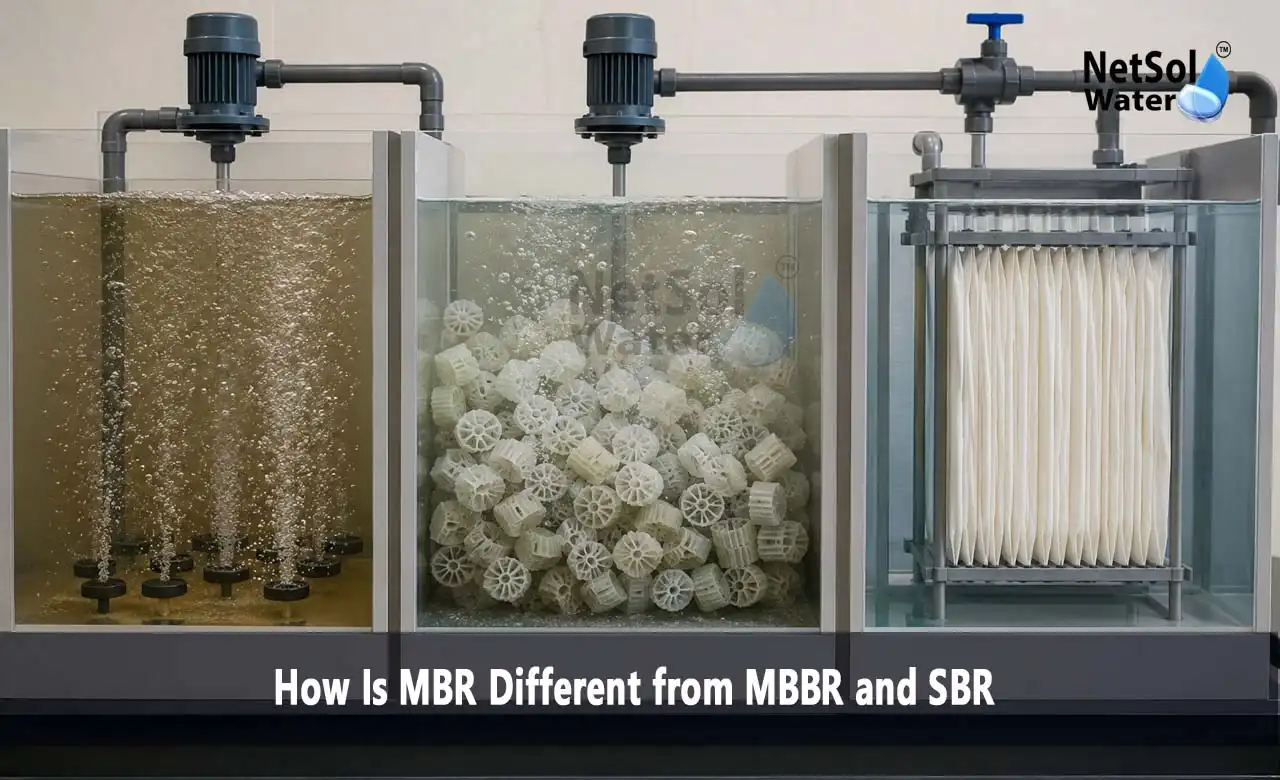
How Is MBR Different from MBBR and SBR?
Choosing the appropriateness of the sewage treatment technology is one of the most critical choices when considering any residential, commercial, or industrial project. The most popular sewage treatment systems are the Membrane Bioreactor (MBR), Moving Bed Biofilm Reactor (MBBR), and Sequencing Batch Reactor (SBR). All three technologies are used to treat wastewater but differ with respect to treatment process, water quality, space, operating cost and maintenance.
These differences have to be understood to select the most appropriate sewage treatment plant for a project. We will provide an explanation on the differences between MBR, MBBR and SBR and when each would be the ideal technology.
Understanding the Three Technologies
To compare the systems, it is necessary to understand how they work.
A Membrane Bioreactor (MBR) is a combination of biological treatment and membrane filtration. It is a membrane separation device which separates sludge and treated water by using a conventional clarifier. This yields very clean treated water, ideal for reuse.
MBBR (Moving Bed Biofilm Reactor) is a biofilter that employs certain types of plastic media that are freely moving in the aeration tank. These are used as a substrate for the growth of beneficial microorganisms which decompose organic contaminants. The treated water is then filtered for solids in a secondary clarifier.
SBR (Sequencing Batch Reactor) is a wastewater treatment process that processes wastewater in batches. The treatment process is carried out in one tank in a set operating sequence, from filling through discharge.
All three technologies are capable of removing pollutants, but each has its own application and performance.
. Difference in Treatment Process
The main difference between these technologies is the treatment of wastewater.
As a combination of biological treatment and membrane filtration, MBR is capable of removing even very fine suspended particles and microorganisms. The treated water is much cleaner since membranes replace the secondary clarifier.
MBBR uses floating media to grow biofilm to break down organic matter. Once the treatment is completed, a clarifier is needed to remove solids from the water.
In SBR, treatment takes place in a single reactor in cycles of time. The wastewater is fed into the tank where it is treated biologically, naturally settles, and is discharged before the next cycle.
Of these three technologies, MBR is the most advanced filtration technology.
. Quality of Treated Water
Many organizations choose to use MBR because of the high quality of treated water it is able to produce.
The membrane filtration process captures suspended solids, bacteria and most harmful microorganisms leading to the production of crystal clear water fit for various non potable reuse applications like gardening, flushing, cooling towers and industrial process.
Although MBBR also yields good quality treated water, the treated water contains higher amount of suspended solids due to using conventional clarification.
SBR can deliver more water quality than some conventional treatment systems, but the treatment results are dependent on the correct operating of cycles and regular maintenance. It can produce very good results, but the treated water is not as consistently good as that produced by an MBR system.
. Space Requirement
Another key consideration is available space for installation of the sewage treatment technology.
Since membrane filtration does not need large secondary settling tanks, MBR systems use the least space. Due to their small size they are suitable for buildings in small areas and urban environments.
In addition to the space needed for the MBBR itself, more space is needed for other treatment units such as clarifiers. MBBR plants are still relatively small in size compared to conventional activated sludge plants.
SBR systems typically need larger treatment tanks because all of the treatment stages are placed in the same treatment reactor and are operated according to a fixed cycle.
In projects where space for installation is limited, MBR is normally the preferred choice.
. Water Reuse Capability
With the diminishing availability of freshwater resources, water reuse is gaining greater significance.
MBR technology is particularly developed to generate high quality treated water which can be reused for many purposes without the need for extensive additional treatment.
Depending on the purposes of reuse, further filtration or disinfection might be needed after MBBR treatment.
Likewise, if high quality reclaimed water is desired, SBR-treated water may require further polishing treatment.
MBR provides the biggest benefit for projects that are wastewater recycling.
. Operation and Maintenance
The maintenance needs vary from one technology to another.
Membrane cleaning is necessary for MBRs so they are able to function properly. While the operation of membranes is technically demanding, the automated membrane cleaning systems in use today have simplified the process.
Its MBBR systems require less maintenance and have fewer moving parts. But it is the operator's responsibility to routinely check the biofilm carriers and keep the secondary clarifier in good working order to ensure efficient operation.
The treatment cycles, aeration timing and settling periods in SBR systems need to be well controlled. A disruption in the treatment sequence may impact treatment efficiency.
In general, MBBR is easier to run and require less specialized maintenance, while MBR has a higher treatment performance at a slightly more specialized maintenance.
. Installation and Operating Cost
When choosing any sewage treatment plant, cost is one of the key factors to take into account.
Due to its advanced membrane technology, the initial installation of MBR is usually very expensive. This can offer substantial long-term savings for its ability to recycle water, water use reduction and space savings during installation.
The installation cost of MBBR is moderate, and its maintenance cost is small, which is suitable for projects with limited budgets.
In addition, SBR is also deemed as an economical treatment technology, especially for medium-sized sewage treatment plants. But the correct operation of the system is essential for operating efficiency.
It's not just the price of purchase, it is the total cost of the technology's entire lifecycle that should be considered.
What's the best Technology?
No single treatment technology can be used in all projects. This depends on wastewater features, land availability, water reuse needs, operating budget and environmental regulations.
For projects which demand treated water with an excellent quality, compact installation, and maximum water reuse, MBR is the best alternative. It is widely used in hospitals, hotels, commercial buildings, residential societies, pharmaceutical industries and smart cities developments.
MBBR technology is suitable for municipal sewage treatment, residential complexes, and industrial sewage treatment plants that require stable treatment within a moderate expense.
For medium-sized project and municipal wastewater treatment projects, SBR is sometimes used because it can be effectively batch treated.
Conclusion
MBR, MBBR, and SBR are all proven wastewater treatment technologies, but each offers distinct advantages. MBR stands out for its advanced membrane filtration, superior treated water quality, compact footprint, and excellent water reuse capability. MBBR offers reliable performance with relatively simple operation, while SBR provides efficient treatment through batch processing at a competitive cost.
Before selecting a sewage treatment technology, it is important to assess your wastewater volume, reuse objectives, available space, budget, and long-term operating requirements. Consulting an experienced sewage treatment plant manufacturer can help you choose the most suitable solution for your specific application and ensure efficient wastewater management for years to come.
Do you need an advice or assistance on selecting the best water and waste water treatment unit? We have solutions for all your problems!
Let us know your problem, our experts will make sure that it goes away.
For an assistance or related query,
Call on +91-9650608473 Or write us at enquiry@netsolwater.com