

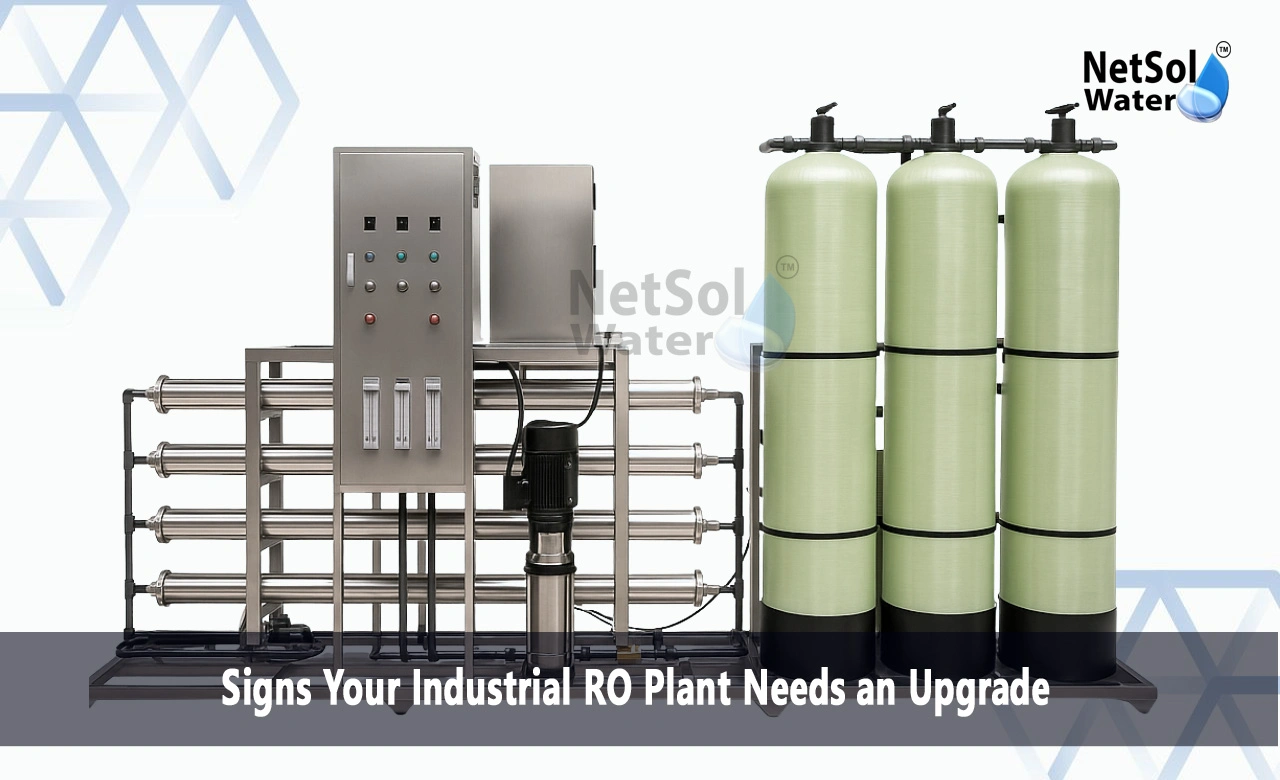
When to Upgrade Your Industrial RO Plant?
The design of an industrial RO plant is usually structured according to the quality of the water, demand of the production and the existing conditions of the regulatory authorities at the time of installation. The conditions vary over the years. The chemistry of the feed water becomes more complicated, the volumes of production get larger and the needs of treated water become more high. In spite of this, a lot of industries are still using the same RO plant, and they are using frequent repairs and quick solutions to keep the industry running.
At some moment, though, the issue of operations cease to be a local problem and turns into a systemic constraint. Recognizing when an industrial RO plant needs an upgrade is essential to avoiding escalating costs, unstable operation, and production risks.
Signs Your Industrial RO Plant Needs an Upgrade
1: Stable Decrease of Recovery and Production
A gradual decrease in the output of permeate despite the cleaning of membranes is one of the best messages. When recovery decreases consistently and never recovers completely, it is an indication that the system will no longer be hydraulically or chemically compatible with the existing feed water conditions.
With TDS, silica or organic loading, older RO designs tend to be problematic as they become overloaded with time. Such systems require redesign to operate in higher recovery to cause chronic fouling and lose performance.
2: Frequency of Chemical Cleaning Increasing
An increase in CIP frequency between occasional and regular shows that there are more profound fouling processes, which cannot be addressed by cleaning alone. Regular washing reduces the life of membrane and increasing the cost of chemicals.
At this point, rarely is it simply membrane condition. It tends to blame outdated pretreatment design, improper staging, or lack of adequate crossflow velocity- issues that need system level improvements.
3: Increase in Energy consumption with no growth
A RO plant which is taking increasingly more power each year and yet producing the same or less water is obviously a good candidate to upgrade. When the operating pressure is increased, it is usually to counter foulage, bad hydraulics, or deteriorated membranes.
The current RO upgrades are aimed at energy efficient membranes, optimumrecovery and better choice of pumps which contribute a lot to the reduction in specific energy consumption.
4: Poor Quality of Permeates
Varying permeate conductivity or inability to achieve process water requirements is a sign of decreasing separation efficiency. This can be caused by aging of membranes, bypass within the system or improper design of the system to deal with variable feed water.
In the case where the quality instability happens even after performing the correct operation and cleaning, it is related to the design limitation, but not an operational error.
5: Pretreatment is no longer protecting the RO Plant
The pretreatment systems that were developed many years ago might not be able to deal with the present levels of turbidity, iron, oil, biological load and organics. When the reoccurrence of fouling occurs when too soon after cleaning usually the root cause is the inadequacy of pretreatment.
The upgrading of membranes without upgrading the pretreatment results into a series of failures.
6: Regular Trips, Alarms, and Operational Stress
The high number of high-pressure trips, the imbalance between the flows, pump failures, or unexpected shutdowns demonstrate that the system is not functioning within the designed envelope. This instability augments the risk of downtime and maintenance workload.
The monitoring of older RO plants can be primitive and it is hard to identify issues in time.
When an Upgrade is More Reasonable than Repairs?
· Lifecycle Cost Exceeds upgrade cost: In the case when annual maintenance, chemical cleaning, and replacement of membranes keep increasing, the total cost of ownership may be higher than the cost of upgrading the system. Repairs at this stage just postpone ineffective redesign.The upgrades usually lower the operating costs and enhance reliability.
· Process change or Production Expansion: When the demand of production grows or the conditions of water reuse get more stringent, it is more likely that overloading an old RO plant would cause faster degradation. Upgrade will guarantee that the system is capable of sustaining the future as opposed to a bottleneck.
· Regulatory and Compliance Pressure: Some tighter discharge standards and water reuse standards may demand greater recovery and quality of water. Without a lot of retrofitting of older RO plants, the requirements may not be met.Upgrade offers sustainability in terms of compliance rather than a series of corrective measures.
· ZLD or Reuse Systems Integration: Crystallizers, reuse systems, or evaporators When an Reverse Osmosis plant is to be combined with evaporators, crystallizers, or reuse systems, obsolescent designs become ineffective and risky. The upgrades introduced in the modern world enable easy integration and greater recovery without high levels of foulage.
Conclusion
An industrial RO plant needs an upgrade when declining recovery, rising energy costs, frequent cleaning, unstable water quality, and operational stress become persistent issues rather than occasional problems. These are indications that the system design is no longer consistent with present feed water conditions, production requirements or regulatory anticipations.
Timely upgrading of the RO plant enhances efficiency, stabilization of the performance, low costs in the long term and the reliability of the water supply. Preventive improvements are always cheaper and safer in operation than the reactive ones.
Do you need an advice or assistance on selecting the best water and waste water treatment unit? We have solutions for all your problems!
Let us know your problem, our experts will make sure that it goes away.
For an assistance or related query,
Call on +91-9650608473 Or write us at enquiry@netsolwater.com