

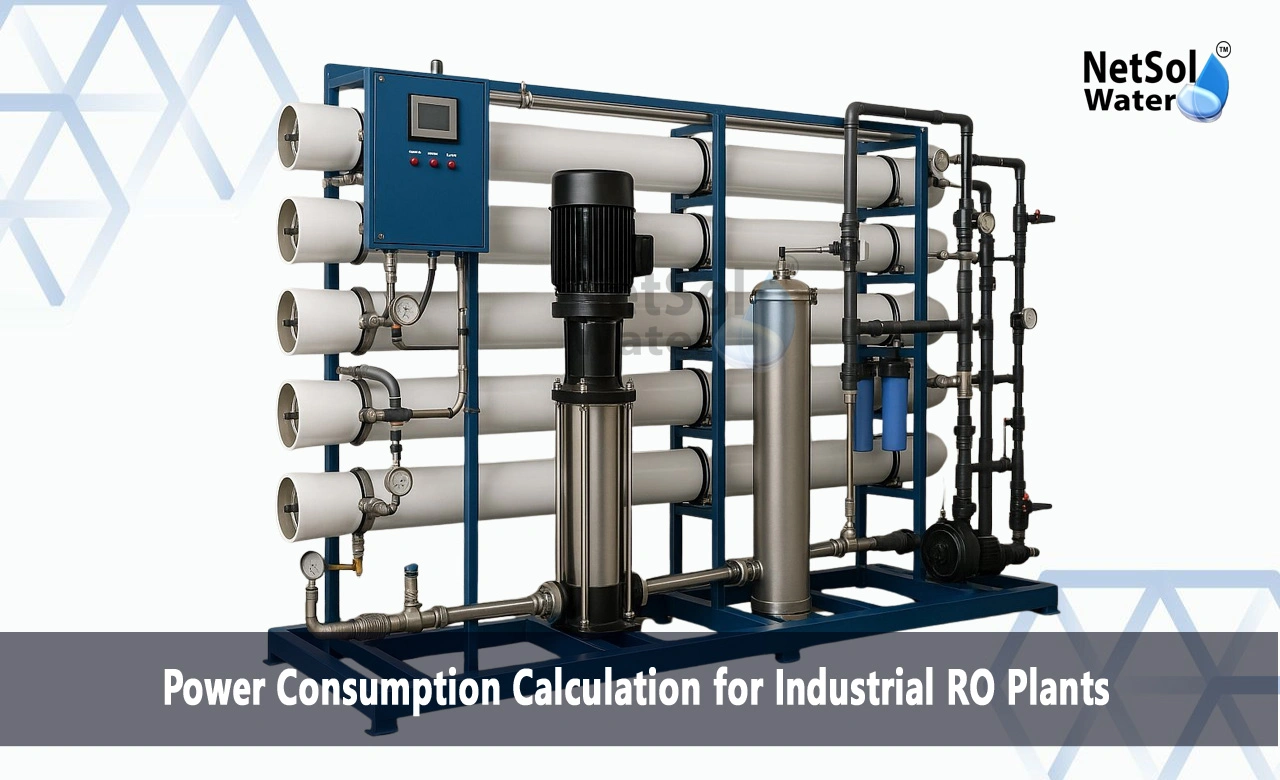
How to Calculate the Power Consumption for Industrial RO Plants?
Industrial RO plants have one of the highest operating costs in power consumption, which often representsa significant portion of the overall lifecycle costs. When the issues that need to be handled in many plants are the cost of capital and the recovery percentage, the use of energy quietly defines the economic feasibility in the long term. Such misguided assumptions in the design or inappropriate operational habits may lead to a significant increase in power consumption.
Understanding power consumption calculation for industrial RO plants helps plant owners estimate operating cost accurately, optimize design, and identify opportunities for energy reduction without compromising performance.
What Defines Power Consumption of an Industrial RO Plant?
1: Quality Feed Water and Pressure of operation
Operating pressure directly depends on the concentration of total dissolved solids of the feed water. Increased TDS raises Osmotic pressure and more energy is required to pump water across membranes. With a rise in feed TDS the power demand of pumps rises exponentially as opposed to linearly.
This renders proper analysis of feed water very important in power estimation.
2: Flow rate and System Recovery
Recovery defines the amount of permeate formed out of a specific feed flow. Increase in recovery decreases intake water and raises operating pressure and polarization of concentration. When recovery is exceeded in design limits, consumption of energy increases in disproportion.
On the same note, when feed flow increases, pumping energy is also increased, all other things being equal.
3: Pumping efficiency and Motor losses
Hydraulic demand is not the only important factor in determining the actual electrical power consumed, and includes the pump efficiency, motor efficiency, and mechanical losses. Outdated or improperly chosen pumps will continue to run at widely varying points of efficiency, consuming lots of energy.
A pump efficiency that declined by a mere small percentage can result in huge losses of energy every year.
Power Consumption Calculation for Industrial RO Plants
1: Simple Power Calculation Equation
The calculation of power consumption is done based on the relationship between flow, pressure and efficiency. Feed flow rate multiplied by operating pressure creates hydraulic power and pump and motor efficiency results in electrical power.
The amount of electrical power will rise with the rise in pressure, flow, and lowering of efficiency in the system.
2: Specific Energy Consumption (SEC)
Specific energy usage is the power usage per unit volume of permeate. Itgenerally is in kilowatt-hours per cubic meter. SEC offers an equal comparison of the various RO systems irrespective ofmagnitude.
The SEC is lower, which means that it is designed and operated more efficiently.
3: Reporting Auxiliary Equipment
The power used in industrial RO plants is in addition to the high-pressure pump. Pretreatment systems, booster pumps, dosing systems, control panels and CIP systems add to the amount of energy used.
Any neglect of auxiliary loads causes underestimation of real power consumption to be made.
Factors Which raise Actual Power Consumption with Time
1: Scaling and Membrane fouling
With membrane foulage or scaling, the operating pressure needs to be raised to sustain permeate flow. Even moderate fouling may cause great consumption of power with no apparent loss of output.
Late cleaning leads to irrevocable energy fines.
2: Operating Below Design Flow
Operating a RO plant at a lower flow than the design can be perceived to save energy, yet in most cases, it lowered pump efficiency. Pumps that do not work at their design pay more natural energy to push a unit of water.
This augmented SEC despite the reduction of the total power.
3: Unfavorable Pretreatment Results
Poor pretreatment leads to quick fouling and this forces operators to work harder to produce more or compromise in production. The two outcomes augment particular power usage.
Quality of pretreatment directly affects the energy efficiency.
Power minimization in industrial RO Plants
· Precise Calculations in Designs: Worst-case feed water conditions should be used in power estimation as opposed to the average values. Peak-TDS design preventsspikes in energy.
· Superior Energy Pumps and Motors: The high efficiency rating of the pumps and motors that are picked lowers electrical losses. The correct pump sizing will put the pump at a nearoptimum.
· Optimized Recovery and Staging: Staged load balancing minimizes regional fouling and threshold losses. Excessive focus on the last step will become a waste of energy.
· Energy Recovery Where Applicable: Net power can be greatly minimized in high-pressure systems with energy recovery devices. They are more frequently applied to seawater RO, but are becoming applied in high-TDS industrial applications.
Typical Errors in Power Consumption Estimation
Most power calculations do not consider future feed water degradation, foul margin and auxiliary power consumption. The other widespread wrongdoing is that the nameplate motor power is equal to the real consumption and hence, the projected cost is usually not accurate.
The degradation factors and the variability of operations have to be factored in realistic estimation.
Conclusion
Power consumption calculation for industrial RO plants is not just a design exercise but a critical component of long-term cost control. Quality of feed water, recovery, pump efficiency, membrane operation, and working practices are all of an energy-using nature.
Proper power design coupled with correct calculation of power and effective precautionary maintenance should guarantee predictable operation, reduced operating cost and predictable performance during the life cycle of the plant. Economic and operational benefits are accrued to industries that have an insight and control over the consumption of power.
Do you need an advice or assistance on selecting the best water and waste water treatment unit? We have solutions for all your problems!
Let us know your problem, our experts will make sure that it goes away.
For an assistance or related query,
Call on +91-9650608473 Or write us at enquiry@netsolwater.com