

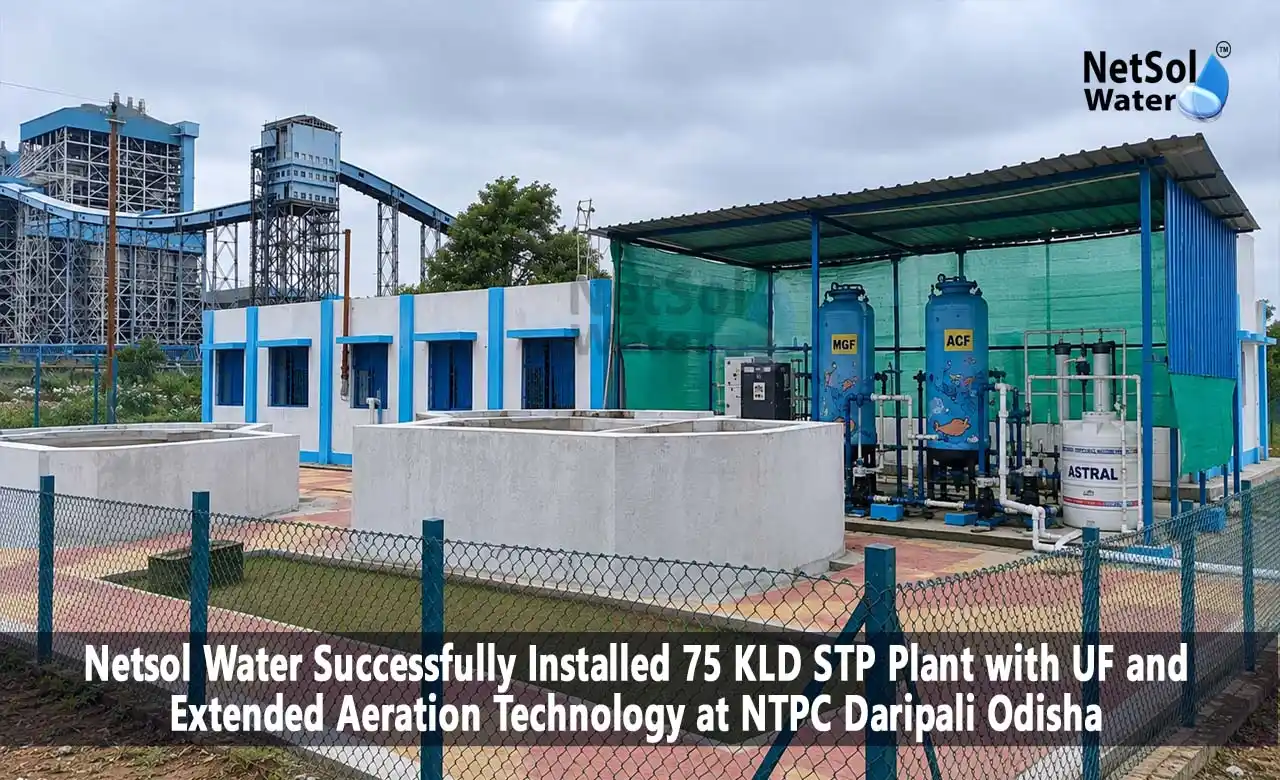
Case Study: Installed 75 KLD STP Plant With UF at NTPC Daripali, Odisha
Netsol Water Solutions Pvt. Ltd. has successfully designed, engineered, supplied, and installed a 75 KLD Civil Sewage Treatment Plant (STP) at NTPC Daripali, Odisha. The plant is built on Extended Aeration technology integrated with an Ultrafiltration (UF) polishing stage, combining reliable biological treatment with an additional membrane-based step for improved treated-water clarity.
As an NTPC pre-approved/empanelled vendor for civil sewage treatment plant supply, erection, and commissioning, Netsol Water delivered this project to meet the sewage treatment requirements of a large power-sector facility, where consistent performance, structural durability, and long-term reliability are essential.
Project Details at a Glance
| Parameter | Details |
|---|---|
| Project | 75 KLD Civil Sewage Treatment Plant |
| Client | NTPC Daripali, Odisha |
| Location | Daripali, Odisha |
| Plant Capacity | 75 KLD |
| Plant Type | Civil STP (RCC construction) |
| Technology | Extended Aeration (EA) + Ultrafiltration (UF) |
| Vendor | Netsol Water Solutions Pvt. Ltd. |
| Application | Sewage treatment and treated-water reuse |
| Contact | 9650608473 |
About NTPC Daripali, Odisha
NTPC Daripali is a facility of NTPC Limited, India's largest power generation utility, located in Odisha. Power-sector installations of this scale generate continuous domestic and institutional sewage from residential colonies, offices, and support facilities, which requires a dependable, code-compliant treatment system capable of handling steady daily inflow with minimal operational disruption.
Why a 75 KLD Civil STP Was Required?
A facility the size of NTPC Daripali needs a sewage treatment system that can be relied upon for uninterrupted daily operation. A 75 KLD Civil STP was specified to treat the sewage generated at the site and enable suitable reuse of treated water, in line with environmental compliance expectations for PSU and industrial infrastructure.
A civil (RCC) construction approach was selected over a purely package/skid-based system to provide the structural robustness, hydraulic stability, and long service life expected in a permanent power-sector installation.
Why Civil STPs Are Suitable for PSU & Government Projects
Civil STPs are often specified or preferred for many government, PSU, and large institutional projects because RCC-based construction offers certain structural and operational advantages over purely modular systems. These include:
. Robust RCC/civil construction designed for long-term structural integrity
. Long structural service life when properly designed, constructed, and maintained
. Strong hydraulic and load-bearing stability suited to continuous sewage inflow
. Suitability for round-the-clock institutional and industrial sewage loads
. Long-term maintenance advantages compared to certain modular alternatives
. Scope for future expansion or retrofitting as facility requirements evolve
. Compatibility with government and PSU infrastructure planning norms
. Better utilization of underground or semi-underground construction where site layout permits
. Reduced above-ground land footprint at space-constrained sites
. Long-term asset value as a permanent civil structure
These factors make civil STPs a practical choice for facilities such as NTPC Daripali, where infrastructure is expected to serve reliably over an extended operational life.
Extended Aeration Technology: How It Works
Extended Aeration (EA) is a widely used variant of the activated sludge process for biological sewage treatment. In an Extended Aeration STP, sewage is mixed with a biologically active mass of microorganisms inside an aeration tank, where continuous air supply keeps the mixture aerobic and in suspension.
The defining feature of Extended Aeration is a longer aeration and detention time compared to conventional activated sludge systems. This extended contact period allows the microorganisms more time to break down organic pollutants present in sewage, resulting in a more stable and thoroughly treated effluent before it moves to the next treatment stage.
Key characteristics of the process include:
. Microorganisms consume and break down biodegradable organic matter in the sewage
. Longer aeration time supports more complete biological treatment and process stability
. The extended detention period helps the system absorb moderate variations in incoming sewage load
. Sludge produced under Extended Aeration is generally more stabilized, which can simplify downstream sludge handling
Because of this stability and tolerance for variable loading, Extended Aeration is widely used for institutional, township, industrial, and PSU sewage treatment applications, including facilities such as NTPC Daripali.
Role of Ultrafiltration in the STP
Ultrafiltration (UF) is a membrane-based treatment process used as a polishing step after biological treatment. UF membranes work on a physical size-exclusion principle, allowing treated water to pass through while retaining suspended solids and certain microorganisms above the membrane's pore size.
In the NTPC Daripali STP, UF is positioned after the biological (Extended Aeration and clarification) stage to further improve treated-water quality. The role of UF in this system includes:
. Reduction of residual suspended solids carried over from the biological treatment stage
. Reduction of turbidity, contributing to visibly clearer treated water
. Reduction of microbial/bacterial load through membrane filtration
. Improved consistency in treated-water clarity compared to biological treatment alone
UF does not remove every contaminant present in sewage, and its performance depends on factors such as incoming water quality, membrane condition, and operating parameters. However, as a polishing stage after Extended Aeration, UF meaningfully improves treated-water quality and supports its consideration for suitable non-potable reuse applications such as gardening, toilet flushing, and applicable cooling-related uses, subject to site-specific quality requirements. The treated water from this system is not intended or claimed to be potable.
Treatment Process of the 75 KLD STP
The 75 KLD STP at NTPC Daripali follows a defined treatment sequence, moving sewage through preliminary, biological, and membrane-based stages before it is made available for reuse.
| Stage | Function |
|---|---|
| Inlet Sewage | Raw sewage from the facility enters the treatment system. |
| Preliminary Treatment / Screening | Removal of coarse solids and debris before further treatment. |
| Equalization | Balances flow and load variations to ensure stable downstream treatment. |
| Extended Aeration | Biological breakdown of organic pollutants by aerobic microorganisms. |
| Secondary Clarification | Settling and separation of treated water from biological sludge. |
| Ultrafiltration (UF) | Membrane-based polishing to reduce suspended solids, turbidity, and microbial load. |
| Treated Water | Output water meeting the quality level achieved through the above treatment stages. |
| Reuse | Suitable non-potable applications such as gardening and toilet flushing, subject to site requirements. |
Engineering, Installation & Commissioning
Delivering a Civil STP at a PSU and power-sector facility such as NTPC Daripali involves coordinated engineering across civil, mechanical, and process disciplines. Key considerations in this project included:
. Site-specific engineering to suit the layout and sewage generation pattern of the facility
. Civil/RCC construction of the treatment tanks and associated structures
. Hydraulic design to ensure proper flow through each treatment stage
. Configuring biological treatment and aeration requirements for the Extended Aeration process
. Integration of the Ultrafiltration system as a polishing stage after biological treatment
. Installation of process equipment, piping, and interconnections between treatment stages
. Coordination of electrical and instrumentation requirements for plant operation
. Testing and commissioning of the plant prior to handover
. Guidance on operation and maintenance practices for sustained performance
This structured approach reflects the standards expected for civil sewage treatment infrastructure at PSU and government installations.
Key Benefits of the NTPC Daripali STP
| Benefit | Description |
|---|---|
| Reliable civil construction | RCC-based structure built for long-term, continuous operation. |
| Stable biological treatment | Extended Aeration provides consistent biological breakdown of organic pollutants. |
| Improved treated-water quality | UF polishing helps reduce suspended solids, turbidity, and microbial load. |
| Reuse potential | Treated water can be used for suitable non-potable applications subject to site requirements. |
| Long-term asset value | Civil infrastructure provides a robust long-term wastewater treatment asset. |
| PSU-aligned execution | Delivered by an NTPC pre-approved vendor for civil STP projects. |
Sustainable Wastewater Management & Water Reuse
Responsible sewage management is an important part of sustainable operations at large industrial and power-sector facilities. By treating sewage on-site through the Extended Aeration and UF process, NTPC Daripali is able to manage its wastewater responsibly rather than discharging it untreated.
The treated water generated by this system also supports water conservation efforts, as it can be considered for suitable non-potable reuse applications, reducing dependence on fresh water for tasks such as gardening and toilet flushing where treated-water quality and site standards permit. This approach reflects the broader move toward sustainable, reliable wastewater infrastructure at institutional and PSU facilities across India.
About Netsol Water: NTPC Pre-Approved Civil STP Supplier
Netsol Water Solutions Pvt. Ltd. is a water and wastewater treatment company offering a range of solutions including Sewage Treatment Plants (STPs), Effluent Treatment Plants (ETPs), Water Treatment Plants (WTPs), RO plants, and Ultrafiltration systems.
Netsol Water's capabilities span design and engineering, manufacturing and supply, and installation and commissioning of customized wastewater treatment solutions. The company has experience delivering projects for government, PSU, industrial, commercial, and institutional clients, with project execution capability across India.
Based on the NTPC Daripali project, Netsol Water is recognized as an NTPC pre-approved/empanelled vendor for civil sewage treatment plant supply, erection, and commissioning, reflecting its capability to meet the engineering and compliance standards expected on PSU projects.
Watch the Project Video
To see the 75 KLD STP Plant at NTPC Daripali, Odisha in operation, watch the project video below.
Project Outcome
The 75 KLD Civil STP at NTPC Daripali, Odisha now provides the facility with a dependable, RCC-based sewage treatment system built on Extended Aeration and Ultrafiltration technology. The plant supports the facility's sewage treatment needs while enabling suitable reuse of treated water, contributing to more sustainable site operations.
Frequently Asked Questions (FAQs)
Q1. What is the capacity of the STP installed at NTPC Daripali, Odisha?
The plant installed at NTPC Daripali is a 75 KLD (Kilolitres per Day) capacity Civil Sewage Treatment Plant.
Q2. Which technology is used in the NTPC Daripali STP?
The plant uses Extended Aeration technology for biological treatment, combined with Ultrafiltration (UF) as a polishing stage.
Q3. What is Extended Aeration Technology in an STP?
Extended Aeration is an activated sludge-based biological treatment process that uses a longer aeration and detention time, allowing microorganisms more time to break down organic pollutants and producing a more stable treated effluent.
Q4. What is the role of Ultrafiltration (UF) in this STP?
UF acts as a membrane-based polishing stage after biological treatment, reducing suspended solids, turbidity, and microbial load to improve treated-water clarity for suitable reuse.
Q5. Why was a Civil STP selected for the NTPC Daripali project?
A Civil (RCC) STP was selected for its structural robustness, hydraulic stability, long service life, and suitability for continuous sewage treatment at a large PSU facility.
Q6. Who supplied and installed the 75 KLD STP at NTPC Daripali?
The plant was designed, supplied, and installed by Netsol Water Solutions Pvt. Ltd., an NTPC pre-approved vendor for civil STP projects.
Final Conclusion & Call to Action
The 75 KLD STP Plant at NTPC Daripali, Odisha reflects Netsol Water's engineering capability in delivering Civil Sewage Treatment Plants for PSU and power-sector facilities, combining Extended Aeration and Ultrafiltration technology for reliable, reusable treated water.
For 75 KLD and customized Civil STP requirements for NTPC, PSU, industrial, institutional, commercial, and township projects, contact Netsol Water at 9650608473.