
Case Study: Installed 5000 LPH SS RO Plant at Syngenta, Hyderabad
Project Overview
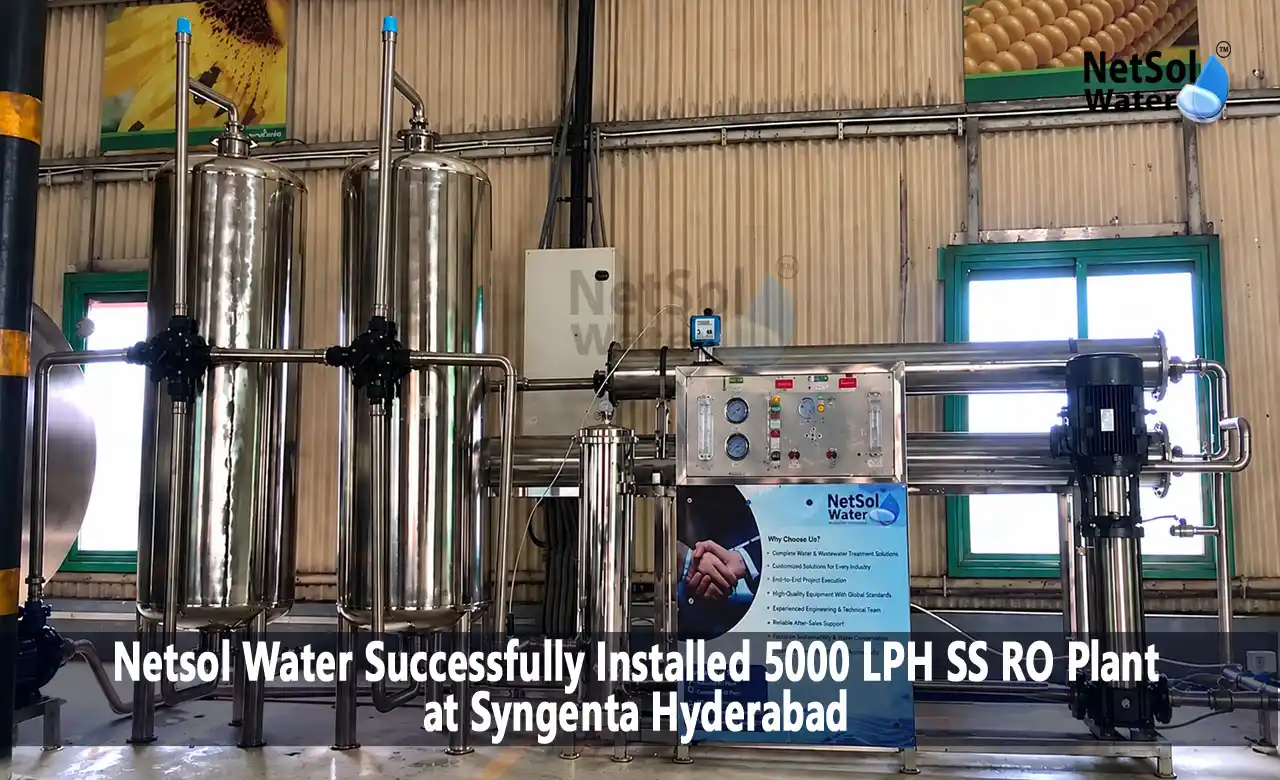
In 2024, Netsol Water installed a 5000 LPH SS RO plant for Syngenta at Hyderabad, India. The unit is a Stainless Steel RO plant built to treat borewell water with a raw water TDS of approximately 6000 mg/L. It runs at 60% RO recovery and gave treated water at approximately 80 mg/L TDS during the trial run.
As one of our water treatment plant projects, this case study covers the water condition at the site, the treatment line, the installation and commissioning stages, and the result observed. Where a detail was not documented for this project, we have left it out instead of estimating it.
About the 5000 LPH SS RO Plant Installation
The purpose of this installation was to turn high-TDS borewell water into treated water with far lower dissolved solids, at a working capacity of 5000 LPH. Dissolved salts pass straight through sediment and cartridge filters, so filtration alone could not solve the problem at this site. At approximately 6000 mg/L, the borewell water needed a process that separates dissolved ions from water. Reverse osmosis does that.
In an RO system, feed water is pressurised and passed across semi-permeable membranes. Water passes through the membrane as treated water, while most dissolved salts stay on the feed side and leave with the reject stream. For a feed at this TDS level, the membranes and the high-pressure stage carry most of the treatment work, which is why the plant was built around them.
The Syngenta unit is an industrial RO plant with a straightforward process line: pretreatment, cartridge filtration, high-pressure pumping, RO membranes and a treated water tank. No UV, ozone or softener stage forms part of this configuration.
Project Requirement: Treating High-TDS Borewell Water
The raw water at the site came from a borewell and carried approximately 6000 mg/L of TDS. That single figure set the treatment requirement for the project. The plant had to bring the water down to a low-TDS output at a steady 5000 LPH.
High-TDS borewell water places a heavier load on an RO system than lightly mineralised supply. The membranes have to reject a large amount of dissolved salt, and recovery has to be set with care, because a higher recovery concentrates more salt on the reject side. This plant operates at 60% recovery. The table below lists the project details as recorded.
| Parameter | Project Detail |
|---|---|
| Client | Syngenta |
| Location | Hyderabad, India |
| Installation Year | 2024 |
| Plant Capacity | 5000 LPH |
| Raw Water Source | Borewell |
| Raw Water TDS | Approx. 6000 mg/L |
| RO Recovery | 60% |
| Membrane | LG |
| Membrane Housing | Stainless Steel |
| Control System | HMI |
| Treated Water TDS | Approx. 80 mg/L |
A borewell water RO plant working at this TDS range also depends on stable pretreatment and a correctly matched high-pressure stage. Both are part of the process line described later in this case study.
Technical Specifications of the 5000 LPH SS RO Plant
The table lists the specifications confirmed for this project. Details that were not supplied for this plant, such as pump ratings and operating pressure, are not listed.
| Specification | Detail |
|---|---|
| Plant Type | Stainless Steel (SS) RO Plant |
| Plant Capacity | 5000 LPH |
| Installation Year | 2024 |
| Raw Water Source | Borewell |
| Raw Water TDS | Approx. 6000 mg/L |
| RO Recovery | 60% |
| RO Membrane Brand | LG |
| Membrane Housing | Stainless Steel (SS) |
| Control System | HMI |
| Process Line | Pretreatment → Cartridge Filter → High-Pressure Pump → RO → Treated Water Tank |
| Commissioning / Trial Run | Done |
| Treated Water TDS | Approx. 80 mg/L |
Each item in the table has a clear role in the plant:
. 5000 LPH capacity: sets the treated water output the plant is built to deliver, and decides the scale of the membrane section and the pumping stage.
. Stainless Steel construction: the plant is built in stainless steel, which suits continuous industrial duty.
. Stainless Steel membrane housing: holds the RO membranes and contains the feed pressure needed for high-TDS water.
. LG RO membranes: the membranes do the salt rejection. LG is the membrane brand used in this plant.
. HMI control system: gives operators a screen-based interface to run and monitor the plant.
. 60% recovery: the share of feed water recovered as treated water.
. Cartridge filtration: the last filtration barrier ahead of the high-pressure pump and membranes, catching fine particles.
. High-pressure pump: raises feed pressure to the level the membranes need to separate water from dissolved salts.
. RO membrane treatment: the stage where the reduction in TDS takes place.
RO Treatment Process
The treatment sequence at Syngenta Hyderabad is:
Borewell Water → Pretreatment → Cartridge Filter → High-Pressure Pump → RO Membrane → Treated Water Tank
. Borewell water: the raw feed, carrying approximately 6000 mg/L of TDS.
. Pretreatment: prepares the feed before it reaches the sensitive parts of the plant. It removes matter that would otherwise foul the cartridge filter and the membranes.
. Cartridge filter: a fine filter placed just before the high-pressure pump. It stops fine particles from reaching the pump and the membranes.
. High-pressure pump: pressurises the feed water and drives it across the RO membranes.
. RO membrane: the LG membranes, held in Stainless Steel housing, separate water from dissolved salts. Treated water passes through, and the concentrated salts leave as reject. At 60% recovery, six parts of every ten parts of feed water are recovered as treated water.
. Treated water tank: collects the RO output, which was observed at approximately 80 mg/L TDS.
Every stage in this line has a single job. Pretreatment and the cartridge filter protect the membranes, the high-pressure pump provides the driving force, and the RO membranes deliver the TDS reduction.
Installation of the RO Plant at Syngenta Hyderabad
The RO plant installation followed a straightforward sequence. There was no significant space constraint at the site, and the plant was not integrated with an existing treatment system, so the work was a fresh installation of a standalone RO line.
. Site preparation: the plant location was prepared for the Stainless Steel RO plant.
. Positioning: the SS RO plant was placed at the prepared location.
. Connection of treatment stages: pretreatment, cartridge filter, high-pressure pump, RO section and treated water tank were connected in process order.
. Pipeline connections: pipelines were connected between the stages, from the borewell feed through to the treated water tank.
. Electrical and control connections: power and control connections were completed and the HMI was brought into service.
. RO system setup: the membranes and Stainless Steel housing were set up for operation.
. Commissioning and trial operation: the plant was started up, commissioned and run as a trial.
A new installation without tie-ins to older equipment keeps the scope simple: assemble the process line in the correct order and confirm that it works as a complete system.
Key Project Challenge: Controlling High TDS
The main challenge in this project was controlling high TDS. The borewell water carried approximately 6000 mg/L of dissolved solids, and the plant had to bring that down to a much lower level.
The RO section handles that reduction. The high-pressure pump drives the pretreated and filtered feed across the LG membranes, the membranes reject most of the dissolved salts, and the treated water is collected in the tank. Recovery was set at 60%, which balances the volume of treated water against the amount of concentrated reject leaving the system.
Raw Water TDS: ~6000 mg/L
Treated Water TDS: ~80 mg/L
Approximate TDS reduction: 98.7%
The reduction is calculated from the two project values, (6000 - 80) / 6000, and rounded. It is an approximate figure based on the TDS values supplied for this project. It is not a certified laboratory result, because no formal before and after water test report is available.
Commissioning and Trial Run
After installation, the plant was commissioned and a trial run was conducted. During the trial, treated water TDS was observed at approximately 80 mg/L, against approximately 6000 mg/L in the borewell feed.
This figure should be read as the value observed during the trial run, and not as a certified laboratory result. The general steps are explained in our guide to commissioning of reverse osmosis plants.
Project Outcome
The outcome of the project is easy to state. High-TDS borewell water was treated by a 5000 LPH SS RO plant and delivered at approximately 80 mg/L TDS. It is a practical reference for industrial water treatment that relies on borewell supply.
. Treatment of borewell water at approximately 6000 mg/L TDS
. 5000 LPH RO production capacity
. Treated water TDS of approximately 80 mg/L
. 60% RO recovery
. Better water consistency for the client
. A practical example of RO treatment applied to high-TDS water
Why Stainless Steel Was Used for the RO Plant?
Stainless Steel is a common choice for industrial RO plant construction. It offers good strength and corrosion resistance, and it holds up in wet, continuous-duty environments of the kind an industrial RO plant works in. It is also easy to keep clean.
The membrane housing on this plant is Stainless Steel as well, and it is a separate part of the design. The housing holds the RO membranes and contains the feed pressure generated by the high-pressure pump. Stainless Steel housings are commonly used where a plant runs at higher feed pressures, as is typical when treating high-TDS water.
This section describes Stainless Steel in RO plant design in general. It does not claim a specific reason given by Syngenta for choosing it.
YouTube Video: 5000 LPH SS RO Plant at Syngenta
A photograph shows the plant, but a video shows it in place. The video below shows the installed RO plant and its installation and working at the Syngenta Hyderabad project. It is useful for readers who want to see the actual plant before they compare it with their own requirement.
Placement recommendation: embed the video on the page with the YouTube embed player so it plays inside the page, instead of linking out with a plain URL. Title, description and schema details are given in the Video SEO section.
Key Project Takeaways
. Netsol Water Solutions installed a 5000 LPH Stainless Steel RO plant at Syngenta, Hyderabad, in 2024.
. The raw water source was a borewell, with approximately 6000 mg/L TDS.
. The plant runs at 60% RO recovery with LG RO membranes.
. The membrane housing is Stainless Steel.
. The plant is operated through an HMI control system.
. The plant was commissioned and a trial run was conducted.
. Treated water TDS was approximately 80 mg/L, an approximate 98.7% reduction based on the supplied project values.
Frequently Asked Questions (FAQs)
Q1. What was the capacity of the RO plant installed at Syngenta Hyderabad?
The RO plant installed at Syngenta Hyderabad has a capacity of 5000 LPH.
Q2. Where was the 5000 LPH RO plant installed?
The plant was installed at Syngenta in Hyderabad, India, in 2024.
Q3. What was the source of raw water?
The raw water source was a borewell.
Q4. What was the raw water TDS?
The borewell water had a TDS of approximately 6000 mg/L.
Q5. What was the treated water TDS?
The treated water TDS was approximately 80 mg/L, as observed during the trial run.
Q6. What was the RO recovery?
The RO recovery of the plant is 60%.
Q7. Which RO membrane was used?
LG RO membranes were used in the plant.
Q8. What type of membrane housing was used?
The membrane housing is made of Stainless Steel (SS).
Q9. What control system was provided?
The plant is provided with an HMI control system.
Q10. Was the RO plant commissioned after installation?
Yes. The plant was commissioned after installation and a trial run was conducted.
Conclusion
The Syngenta Hyderabad project is a clear example of RO treatment applied to high-TDS water: 6000 mg/L high-TDS borewell water → 5000 LPH SS RO treatment → approximately 80 mg/L treated water TDS.
The plant combines cartridge filtration, high-pressure pumping, LG RO membranes in Stainless Steel housing, and an HMI control system, running at 60% recovery. For industries in Hyderabad or elsewhere in India that depend on borewell water with high TDS, this project shows what a properly configured industrial RO plant can deliver. Netsol Water Solutions is an RO plant manufacturer that designs, supplies and installs plants of this kind, and our team can discuss your water condition and capacity requirement. For smaller capacity needs, see our commercial RO plant range.