
Case Study: Installed 5000 LPH RO Plant at R&C RMC Plant in Noida
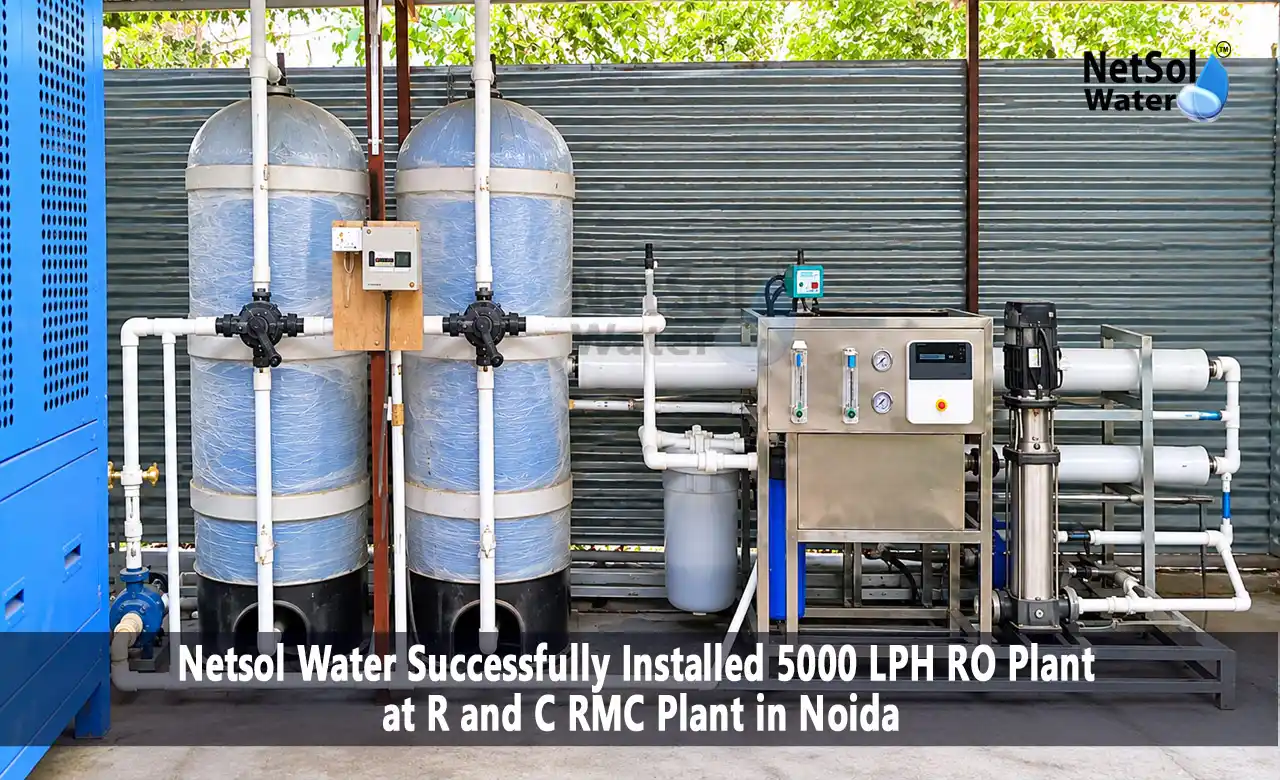
In July 2026, Netsol Water installed a 5000 LPH industrial Reverse Osmosis (RO) plant at the R&C RMC Plant in Noida, Uttar Pradesh. The system was installed to treat borewell water for ready mix concrete (RMC) production and construction applications.
The raw borewell water at the project site had a Total Dissolved Solids (TDS) level of 2800 mg/L. After RO treatment, the treated water TDS was reduced to 70 mg/L, representing an overall reduction of approximately 97.5%.
The industrial RO plant features MSFRP construction, LG RO membranes and a Kirloskar high-pressure pump. It operates through a manual control arrangement and has an RO recovery rate of 65%.
Netsol Water completed the installation within four days. One of the main challenges during the project was unloading and shifting the plant to its designated installation location.
This project demonstrates how an industrial RO plant can help reduce dissolved salts in borewell water and provide a more controlled water supply for concrete production.
Project Overview
The R&C RMC Plant required a water treatment solution to reduce the dissolved solids present in its borewell water. Netsol Water installed a 5000 LPH industrial RO plant to meet this requirement. The following table provides an overview of the project specifications.
| Project Parameter | Details |
|---|---|
| Client | R&C RMC Plant |
| Location | Noida, Uttar Pradesh, India |
| Installation Month | July 2026 |
| Plant Capacity | 5000 LPH |
| Plant Type | Industrial RO Plant |
| Raw Water Source | Borewell |
| Raw Water TDS | 2800 mg/L |
| Treated Water TDS | 70 mg/L |
| RO Recovery | 65% |
| Plant Construction | MSFRP |
| RO Membrane Brand | LG |
| High Pressure Pump Brand | Kirloskar |
| Operation | Manual |
| Treated Water Application | RMC Concrete Production and Construction |
| Installation Duration | 4 Days |
| Main Installation Challenge | Plant Unloading and Shifting |
Project Video
Understanding the Water Treatment Requirement at an RMC Plant
A Ready Mix Concrete (RMC) plant produces concrete by combining cement, aggregates, water and chemical admixtures in controlled proportions. The prepared concrete is then transported to construction sites using transit mixers.
Water is an important ingredient in concrete production because it participates in the cement hydration process. Its quality can influence concrete workability, setting behaviour, strength development and long-term durability.
Water containing excessive concentrations of certain dissolved substances may create problems during concrete production. For example, excessive chlorides can increase the risk of reinforcement corrosion, while sulphates and other harmful substances may affect concrete durability.
In India, IS 456:2000, Clause 5.4, provides requirements for water used in concrete mixing and curing. Potable water is generally considered suitable, while water from other sources should be evaluated against the applicable quality requirements.
Some important permissible limits commonly cited for the standard include the following. Check the printed standard and applicable project requirements before publication.
| Water Quality Parameter | Maximum Permissible Limit |
|---|---|
| Organic Solids | 200 mg/L |
| Inorganic Solids | 3000 mg/L |
| Sulphates (as SO?) | 400 mg/L |
| Chlorides for Reinforced Concrete | 500 mg/L |
| Chlorides for Concrete Without Embedded Steel | 2000 mg/L |
| Suspended Matter | 2000 mg/L |
The minimum pH value specified under IS 456:2000 is 6. These parameters are important when selecting and treating water for concrete production. TDS provides a useful indication of dissolved mineral content, but it does not identify individual dissolved substances. Therefore, water quality assessment should also consider parameters such as chlorides, sulphates, pH and suspended solids.
For RMC facilities using borewell water, an appropriate water treatment system can help maintain more consistent water quality for industrial operations.
Why Borewell Water Required RO Treatment?
The R&C RMC Plant uses borewell water as its primary water source. Groundwater naturally contains dissolved minerals and salts because it passes through different soil and rock formations. The concentration of these dissolved substances depends on the geological composition of the surrounding area, groundwater depth and other environmental conditions.
At the R&C RMC Plant, the raw borewell water had a reported TDS level of 2800 mg/L. This indicates a significant concentration of dissolved substances in the source water.
Conventional filtration systems such as Pressure Sand Filters (PSF) and Activated Carbon Filters (ACF) are useful for removing suspended particles, turbidity, chlorine and certain organic impurities. However, these filtration systems cannot effectively remove most dissolved salts.
Reverse Osmosis technology addresses this requirement through a semi-permeable membrane. Water is passed through the membrane under pressure, allowing a large proportion of dissolved salts to be separated from the treated water stream.
RO salt rejection depends on membrane type, feed water composition, temperature and system design. For the R&C RMC Plant, the installed industrial RO system reduced the reported water TDS from 2800 mg/L to 70 mg/L. This reduction provides a lower-TDS water supply for the plant's concrete production and construction applications.
Project Challenges: Plant Unloading and Shifting
One of the main challenges during the installation of the 5000 LPH RO plant at R&C RMC Plant was equipment unloading and shifting.
Industrial RO plants contain several interconnected components, including filtration vessels, pumps, membrane housings, pipelines and electrical equipment. Handling these components requires proper coordination to avoid damage during transportation and positioning.
. Safe Equipment Handling: Industrial water treatment equipment must be handled carefully to protect pumps, filtration vessels, membrane housings and connected components.
. Installation Access: The movement route from the unloading point to the designated installation area should have sufficient clearance for safe equipment movement.
. Equipment Positioning: The plant should be positioned on a suitable and level foundation to support the equipment and provide convenient access for maintenance.
. Pipeline and Component Protection: Pipes, valves, fittings and other connected components should be protected against unnecessary physical stress during shifting.
. Installation Coordination: Proper coordination between the handling and installation teams helps avoid unnecessary delays and supports the overall installation schedule.
Despite the unloading and shifting challenge, Netsol Water completed the installation within four days.
5000 LPH RO Plant: Technical Specifications
The R&C RMC Plant project involved the installation of a 5000 LPH industrial RO system with MSFRP construction. The plant uses LG RO membranes and a Kirloskar high-pressure pump. It also includes multiple pretreatment and protection components to support the membrane treatment process.
The system operates manually, allowing the operator to manage routine start-up, shutdown and operating checks.
Main equipment used in the RO plant:
· Raw Water Pump
· Pressure Sand Filter (PSF)
· Activated Carbon Filter (ACF)
· Micron Filter
· Chemical Dosing System
· Low Pressure Switch
· Kirloskar High Pressure Pump
· High Pressure Switch
· LG RO Membranes
Understanding RO Recovery
The plant has an RO recovery rate of 65%. RO recovery represents the percentage of feed water converted into treated water. The remaining water leaves the RO membrane section as reject water, also known as concentrate.
For example, if 100 litres of water enter the RO membrane section, approximately 65 litres become treated water and 35 litres become reject water at 65% recovery.
RO recovery and TDS reduction are two different performance measurements. Recovery measures the quantity of treated water produced from the feed water, whereas TDS reduction indicates the reduction in dissolved solids concentration. Both parameters are important when evaluating industrial RO plant performance.
RO Plant Treatment Process Explained
An industrial RO plant uses multiple treatment stages to prepare raw water before it enters the RO membrane section. Each stage performs a specific function and helps protect downstream equipment. The following explains the general function of the equipment included in this project.
1. Borewell Water Collection and Raw Water Pumping. The treatment process starts with collecting groundwater from the borewell. The raw water pump transfers water towards the pretreatment section. A consistent water supply is important for maintaining the required operating conditions of an industrial RO system.
2. Pressure Sand Filtration. The Pressure Sand Filter removes suspended particles such as sand, silt, dirt and other physical impurities from the incoming water. This stage helps reduce turbidity and prevents excessive accumulation of suspended solids in downstream filters and membrane components. Regular backwashing is necessary to remove accumulated impurities and maintain filtration efficiency.
3. Activated Carbon Filtration. The Activated Carbon Filter helps remove residual chlorine, certain organic compounds, colour and odour-causing substances. Chlorine removal is particularly important for systems using thin-film composite polyamide RO membranes because free chlorine can damage the membrane material.
4. Micron Filtration. Micron filtration provides finer particle removal after the main pretreatment filters. Cartridge filters capture smaller suspended particles that may pass through the pressure sand and activated carbon filters. This stage acts as an additional physical filtration barrier before water enters the high-pressure RO section.
5. Chemical Dosing and Pressure Protection. Chemical dosing is commonly used in industrial RO plants to control scaling and protect membrane surfaces. Antiscalants are widely used to reduce mineral scale formation caused by dissolved substances such as calcium and sulphates. Their selection and dosage depend on feed water chemistry, membrane specifications and system design. The low-pressure switch provides protection against insufficient inlet pressure.
6. High-Pressure Pumping. The high-pressure pump increases water pressure to the level required for reverse osmosis membrane separation. The R&C RMC Plant uses a Kirloskar high-pressure pump. A high-pressure switch provides additional protection by monitoring system pressure and helping prevent operation beyond the specified pressure limit.
7. RO Membrane Separation. The RO membrane section performs the main dissolved salt separation process. Water passes through semi-permeable LG membranes under pressure. The membranes allow water molecules to pass through while rejecting a large proportion of dissolved salts and other dissolved impurities. The treated water stream is called permeate, while the concentrated stream is called reject water or concentrate.
8. Treated Water Collection. The treated water produced by the RO membranes is collected for further use in RMC concrete production and construction applications. Suitable treated water storage and distribution arrangements help maintain an adequate supply for industrial operations. Storage tanks should be designed and maintained to prevent contamination.
Role of Different RO Plant Components
| Component | Function |
|---|---|
| Raw Water Pump | Transfers borewell water to the pretreatment section |
| Pressure Sand Filter | Removes suspended solids and turbidity |
| Activated Carbon Filter | Removes chlorine and certain organic impurities |
| Micron Filter | Captures fine suspended particles before the RO section |
| Dosing System | Adds treatment chemicals in controlled quantities |
| Low Pressure Switch | Protects the high-pressure pump against insufficient inlet pressure |
| Kirloskar High Pressure Pump | Builds the pressure required for RO membrane separation |
| High Pressure Switch | Provides protection against excessive operating pressure |
| LG RO Membranes | Separate treated water from the concentrated reject stream |
Proper maintenance of these components is important for maintaining the performance and operational reliability of an industrial RO plant.
Installation Process at R&C RMC Plant
Netsol Water completed the installation of the 5000 LPH RO plant at the R&C RMC Plant within four days. Industrial RO plant installation generally involves several stages, starting with equipment handling and ending with operational checks and treated water quality testing.
1. Equipment Unloading and Shifting: Moving the plant and associated equipment safely to the designated installation area.
2. Plant Positioning: Placing the equipment on a suitable foundation with sufficient space for operation and maintenance.
3. Pretreatment Equipment Arrangement: Positioning the pressure sand filter, activated carbon filter and micron filter.
4. Pump and Pipeline Connections: Connecting the raw water pump, high-pressure pump and associated water pipelines.
5. RO Membrane Installation: Installing membrane elements inside their respective pressure vessels according to the manufacturer’s instructions.
6. Electrical and Control Connections: Connecting pump controls, pressure switches and other electrical components.
7. Initial Operational Checks: Checking pipeline connections, leakage, pump rotation and operating conditions.
8. Treated Water Quality Testing: Measuring treated water TDS to evaluate the performance of the RO treatment system.
Following installation, the project achieved a treated water TDS reading of 70 mg/L against the reported raw water TDS of 2800 mg/L.
Raw Water vs Treated Water Quality
| Water Quality Parameter | TDS Value |
|---|---|
| Raw Borewell Water | 2800 mg/L |
| RO Treated Water | 70 mg/L |
| TDS Reduction | 97.5% |
| RO Recovery | 65% |
How Much TDS Reduction Was Achieved?
The TDS reduction percentage can be calculated using the following formula:
TDS Reduction (%) = [(Raw Water TDS - Treated Water TDS) / Raw Water TDS] × 100
For this project: [(2800 - 70) / 2800] × 100 = 97.5%.
This means the reported TDS concentration was reduced by approximately 97.5% after RO treatment.
It is important to understand that TDS reduction and RO recovery measure different aspects of system performance. TDS reduction indicates the change in dissolved solids concentration, while recovery represents the percentage of feed water converted into treated water.
Application of RO-Treated Water in RMC Production
Water quality is an important consideration in ready mix concrete production because water participates directly in the cement hydration process. The quality of mixing water can influence workability, setting behaviour and the durability of concrete. Therefore, RMC facilities need to evaluate their water sources before using them in concrete production.
At the R&C RMC Plant, the RO-treated water is used for concrete production and construction applications. Reducing dissolved salts can help improve control over the quality of water supplied to the batching process.
However, a low TDS value alone does not establish complete suitability for concrete mixing. The treated water should also be evaluated for pH, chlorides, sulphates, organic matter and other relevant parameters according to applicable requirements, including IS 456:2000.
Consistent water quality monitoring is particularly useful for RMC plants that depend on groundwater sources, as the mineral composition of borewell water can change with groundwater conditions and seasonal variations. An industrial RO plant provides a practical treatment solution for reducing dissolved salts and producing a more controlled water supply for industrial applications.
Project Outcome and Installation Summary
Netsol Water successfully installed a 5000 LPH industrial RO plant at the R&C RMC Plant in Noida, Uttar Pradesh, in July 2026.
The plant treats borewell water using an RO-based treatment system incorporating pressure sand filtration, activated carbon filtration, micron filtration and membrane separation.
The system features MSFRP construction, LG RO membranes and a Kirloskar high-pressure pump. It operates manually with an RO recovery rate of 65%.
The reported raw water TDS of 2800 mg/L was reduced to 70 mg/L after treatment, representing an overall reduction of approximately 97.5%.
The treated water is used for RMC concrete production and construction applications. The installation was completed within four days, with plant unloading and shifting being the main installation challenge.
This project demonstrates Netsol Water's experience in providing industrial water treatment solutions for facilities that require controlled water quality for their operational applications.
Frequently Asked Questions (FAQs)
Q1. What is a 5000 LPH RO plant?
A 5000 LPH RO plant is an industrial reverse osmosis water treatment system with a rated capacity of 5000 litres per hour. It uses high-pressure pumps and semi-permeable membranes to reduce dissolved salts and other impurities from water.
Q2. Why was an RO plant installed at R&C RMC Plant in Noida?
The R&C RMC Plant uses borewell water with a reported TDS level of 2800 mg/L. An industrial RO plant was installed to reduce dissolved solids and provide treated water for concrete production and construction applications.
Q3. What was the raw water TDS at the R&C RMC Plant?
The reported raw borewell water TDS was 2800 mg/L.
Q4. How much TDS reduction was achieved by the RO plant?
The reported TDS was reduced from 2800 mg/L to 70 mg/L, representing an overall reduction of approximately 97.5%.
Q5. What is the recovery rate of the 5000 LPH RO plant?
The RO plant operates at a recovery rate of 65%. This means approximately 65% of the water entering the RO membrane section is converted into treated water, while the remaining 35% leaves as reject water.
Q6. Which RO membrane brand was used in this project?
LG RO membranes were used in the 5000 LPH industrial RO plant installed at R&C RMC Plant.
Q7. Which high-pressure pump brand was used?
The plant uses a Kirloskar high-pressure pump to provide the pressure required for reverse osmosis membrane separation.
Q8. How long did the RO plant installation take?
Netsol Water completed the installation within four days in July 2026.
Q9. Can RO-treated water be used for concrete production?
Yes, RO-treated water can be considered for concrete production after checking its quality against applicable requirements, including IS 456:2000. Parameters such as pH, chlorides, sulphates and other relevant solids should be evaluated before use.
Q10. What is the role of pretreatment in an industrial RO plant?
Pretreatment removes suspended particles, turbidity, chlorine and certain impurities before water enters the RO membrane section. It helps protect membranes, reduce fouling risks and support consistent system performance.
Q11. Why is TDS reduction important in industrial water treatment?
TDS indicates the concentration of dissolved substances in water. Reducing excessive dissolved solids can help meet the water quality requirements of different industrial applications. However, suitability must also be assessed using application-specific water quality parameters.