

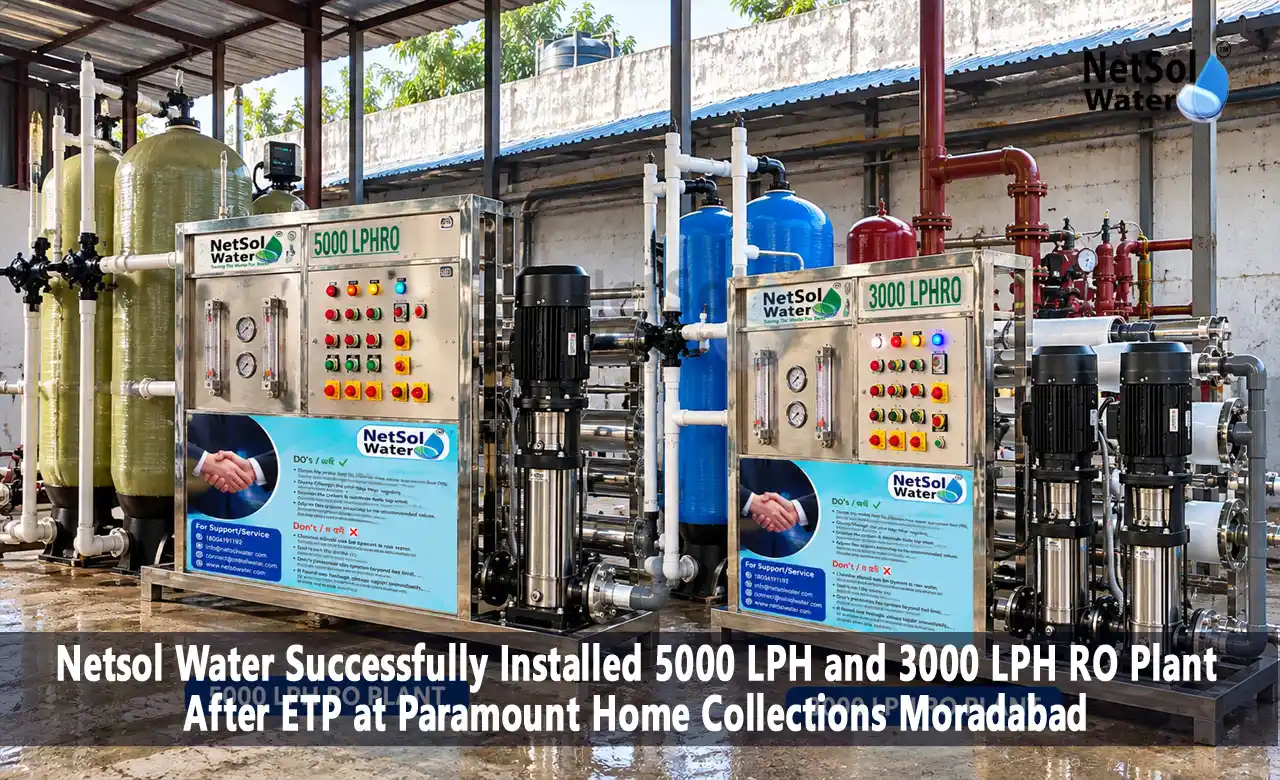
Case Study: Installed 5000 LPH and 3000 LPH RO Plant After ETP at Paramount
In 2025, Netsol Water installed two RO plants, one of 5000 LPH and one of 3000 LPH, after the existing Effluent Treatment Plant (ETP) at Paramount Home Collections in Moradabad, Uttar Pradesh. The plants run one after the other. Water from the ETP goes to the 5000 LPH plant first, and the water it treats then goes to the 3000 LPH plant.
The client wants to recover and reuse as much water as it can, as part of its Zero Liquid Discharge (ZLD) objective. This case study covers how the plants are arranged, why two stages were used, how a tight site affected the work, and what this installation can and cannot claim.
Project Overview
Paramount Home Collections already had an ETP running at its Moradabad facility. What it needed next was a way to treat the ETP outlet further, so the water could be considered for reuse. Netsol Water, an RO plant manufacturer in Moradabad, installed the RO plants for this.
The first plant is rated at 5000 LPH and the second at 3000 LPH. Both use LG membranes. The whole installation took five days. Space was the main problem, because the site had very little of it.
A few details are not available for this write-up: raw water TDS, treated water TDS, recovery percentage, membrane quantity and configuration, and pump specifications. We have left them out rather than guess.
One note on how to read this page. The table below lists the confirmed project details. The explanations of how RO, ETP and ZLD work are general engineering background, and they are written as such.
| Project Detail | Information |
|---|---|
| Client | Paramount Home Collections |
| Location | Moradabad, Uttar Pradesh, India |
| Installation Year | 2025 |
| First RO Plant | 5000 LPH |
| Second RO Plant | 3000 LPH |
| Arrangement | Two RO plants connected in series after the ETP |
| Application | Further treatment of ETP-treated industrial wastewater |
| RO Membrane Brand | LG |
| Installation Duration | 5 days |
| Main Challenge | Limited available space at the site |
| Objective | Water recovery and reuse to support the client's ZLD objective |
| RO Reject Management | Sent for further treatment or evaporation |
Project Video
Why Were RO Plants Installed After the ETP?
An Effluent Treatment Plant (ETP) is built mainly to bring down the pollutant load in industrial wastewater, using physical, chemical and biological steps. Dissolved salts usually pass through most of these steps. Whether the treated water can be reused depends on its quality and on what the reuse point needs.
At Paramount Home Collections, the client wanted to reuse water from the ETP outlet rather than send all of it for disposal. RO fits that need because the membranes hold back most dissolved salts. The water that passes through is called permeate. The salty stream that is held back is called reject.
Not every ETP outlet needs RO. That depends on the wastewater, the reuse or discharge requirement, and what the plant is trying to achieve. Here the aim was water recovery and reuse in support of ZLD, so a membrane stage after the ETP made sense. We do not have feed water test data, so we cannot say what the water entering the RO plants looked like.
Two-Stage RO Treatment Process
The sequence after the ETP is fixed. Water moves through it in this order:
ETP-Treated Industrial Wastewater
↓
5000 LPH RO Plant (first stage)
↓
First-Stage RO Treated Water
↓
3000 LPH RO Plant (second plant)
↓
Further-Treated Water for Suitable Reuse
RO reject: sent for further treatment or evaporation
Water leaves the ETP and enters the 5000 LPH plant. After the first round of membrane treatment, it is passed to the 3000 LPH plant, which treats it further. What comes out is meant for reuse, once it has been tested against what the reuse point requires.
The plants are in series, not in parallel. So you cannot add 5000 and 3000 and call it an 8000 LPH system. The actual output depends on feed flow, recovery, operating conditions and how the system is configured.
Running RO stages in series is one way to get further treatment from the same water. It also has a cost. Each extra stage means more equipment, more pumping energy and more maintenance, so the choice is made against the reuse requirement and not for its own sake.
Every RO stage makes permeate and reject. In this project the reject goes for further treatment or evaporation, as per the project information we have. We have no details of the equipment used for that, so we do not describe it.
Stage 1: 5000 LPH RO Plant for ETP-Treated Water
The 5000 LPH plant is the first membrane stage after the ETP. It takes the ETP-treated wastewater and puts it through the first round of reverse osmosis. Pressure pushes water through the membrane, and most of the dissolved salts stay behind on the reject side.
It uses LG membranes. The 5000 LPH figure is the nominal capacity. Real output moves with feed quality, temperature, pressure and the recovery setting, so it will not be the same every day.
The treated water from this stage goes on to the second plant. This is the larger of the two plants, and the second one works on water that has already been through a membrane once.
We do not have the membrane quantity, recovery percentage, pump specifications or pretreatment details, so none of them are mentioned here.
Stage 2: 3000 LPH RO Plant for Further Water Treatment
The 3000 LPH plant takes the water treated by the first stage and treats it further, in support of the client’s reuse goal. Its feed has already been through one RO membrane, so it is not dealing with raw ETP water.
Like the first plant, it uses LG membranes, and 3000 LPH is a nominal figure.
Final water quality has to be checked against what the reuse point needs. A cooling system, a process line and a utility service can all have different limits. We have no test results, so we do not quote a final TDS or promise any specific quality. The client can confirm suitability by testing the treated water for the parameters that matter at each reuse point.
How the RO System Supports the Zero Liquid Discharge (ZLD) Objective
Zero Liquid Discharge means cutting the liquid effluent that leaves a site by recovering and reusing as much water as practical. Each litre that is reused is a litre that does not have to be discharged.
The RO plants here help by recovering water from the ETP outlet, which supports the client’s ZLD objective. The basic cycle is simple: treat, recover, reuse, and then deal with what is left.
What is left is the RO reject, which holds the concentrated salts. How it is handled matters a great deal. In this project it goes for further treatment or evaporation. Without a proper route for the reject, a recycling system only moves the disposal problem somewhere else.
Installing RO plants does not by itself mean a site has achieved complete ZLD. ZLD is the client’s objective, and this installation supports it. We are not presenting complete or independently verified ZLD as a result of this project.
Installation Challenge: Limited Space at the Site
Space was the main constraint on this job. Two RO plants after an ETP need room for equipment, pipes and people, and the site had little of it.
On a tight site, a few things get most of the attention:
. Layout: Skids, tanks and pumps need to sit so that water moves from the ETP to the first plant and then the second without long or awkward runs
. Piping: Feed, permeate and reject lines need clear paths. Pipes that are boxed in are hard to inspect and harder to repair.
. Maintenance room: Membrane housings need space to open for service and replacement, and pumps and valves need working room.
. Operator access: Someone should be able to reach and read the gauges, flow indicators and control panel without climbing over equipment.
These are general points about this kind of job. We do not have verified details of the layout decisions made at this site, so we are not claiming any.
Installation and Commissioning in Five Days
The installation was completed in five days. For two plants that had to fit into limited space and connect to an existing ETP, that is quick.
A job like this comes down to a few basics: putting the equipment in the right place, connecting the piping between the ETP, the first plant and the second plant, and checking everything before start-up. Those checks catch leaks, wrong flow directions and loose fittings before they turn into problems.
We are not reporting any commissioning tests, performance readings or trial results, because we do not have verified data for them.
Project Outcomes and Practical Benefits
What we can confirm from this project:
. A 5000 LPH and a 3000 LPH RO plant are installed in series after the existing ETP.
. ETP-treated wastewater now goes through two RO stages for further treatment.
. The work was finished in five days on a site with limited space.
. The setup supports the client’s water recovery and reuse goal under its ZLD objective.
We are not quoting water savings, cost reductions, recovery rates, discharge reductions or financial benefits. Verified figures are not available.
Frequently Asked Questions (FAQs)
Q1. What was the capacity of the RO plants installed at Paramount Home Collections, Moradabad?
Two plants were installed. One is rated at 5000 LPH and the other at 3000 LPH. They run in series, so the two capacities should not be added together to get a final output.
Q2. Why were two RO plants installed after the ETP?
The client wanted to treat the ETP outlet further so the water could be recovered and reused. Putting two RO plants one after the other means the water goes through two membrane stages before it reaches the reuse point.
Q3. How does the 5000 LPH and 3000 LPH RO treatment process work?
ETP-treated wastewater goes into the 5000 LPH plant for first-stage treatment. The treated water then goes to the 3000 LPH plant for further treatment. Each stage produces permeate and reject, and the reject is sent for further treatment or evaporation.
Q4. Which membrane brand was used in the RO plants?
LG membranes. We do not have the membrane quantity or configuration for this case study.
Q5. How long did the RO plant installation take?
Five days.
Q6. How does the two-stage RO system support the ZLD objective?
It recovers water from the ETP outlet for reuse, so less water needs to be discharged. The reject also has to be handled through further treatment or evaporation. The RO plants support the client’s ZLD objective, but they do not prove complete ZLD on their own.
Conclusion
At Paramount Home Collections in Moradabad, Netsol Water installed a 5000 LPH and a 3000 LPH RO plant in series after the existing ETP. The first plant treats the ETP outlet and passes its water to the second, which treats it further. The work took five days on a site with little room, and it supports the client’s aim of recovering and reusing water as part of its ZLD plan. RO reject goes for further treatment or evaporation.
Netsol Water designs, makes and installs industrial RO plants, ETP systems and wastewater recycling systems. If your facility wants to reuse water after effluent treatment, talk to our team and we can look at what your site needs.