

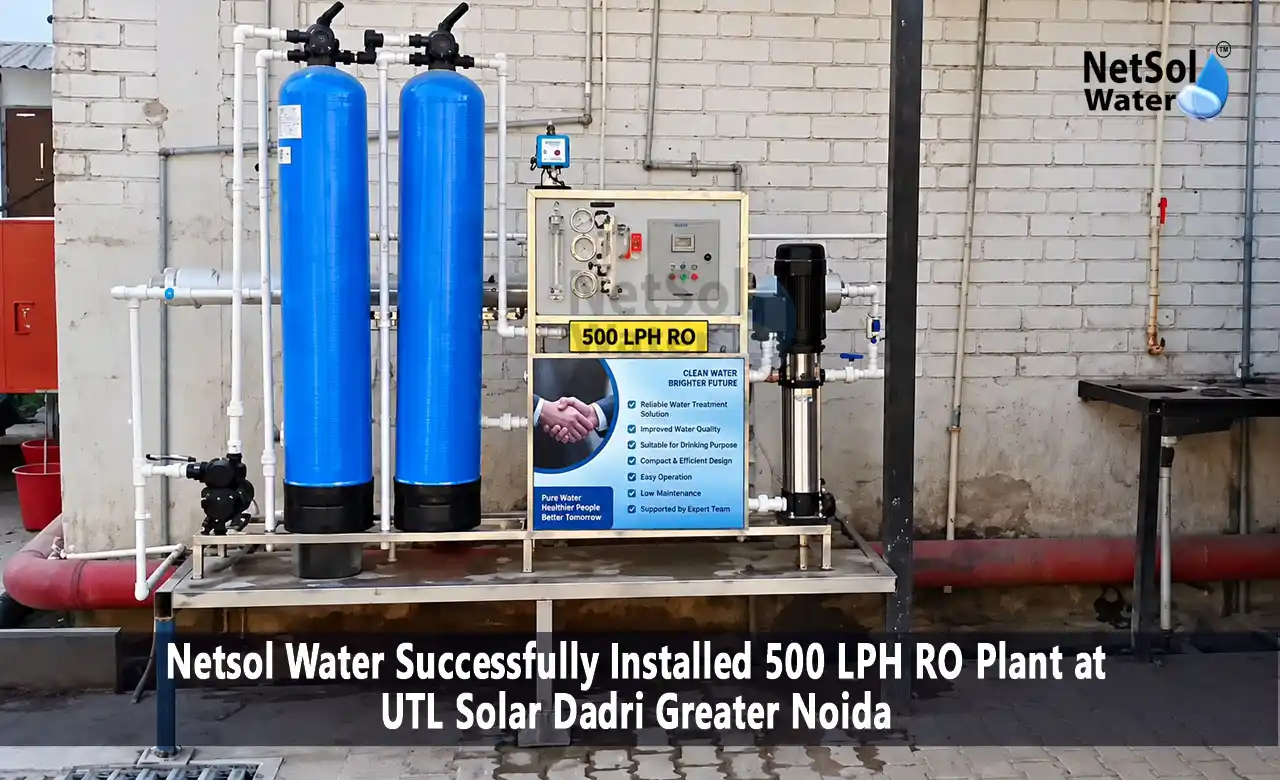
Case Study: Installed 500 LPH RO Plant at UTL Solar, Dadri
In January 2026, Netsol Water installed a 500 LPH RO plant at UTL Solar in Dadri, Greater Noida, Uttar Pradesh. The plant treats groundwater for drinking use. Our team handled both the installation and the commissioning. The work took 3 days, and the main constraint on site was limited space.
This case study records what was installed, how the treatment sequence is arranged, and the TDS values measured before and after treatment.
Project Overview
UTL Solar needed a treated drinking-water supply at its Dadri site, and groundwater was the available raw water source. The groundwater had a TDS of 2,000 mg/L. At that level, reverse osmosis is a common choice for reducing dissolved solids, so an RO-based system was installed.
Netsol Water supplied a 500 LPH plant built on an MSFRP package. The plant uses a Pressure Sand Filter, an Activated Carbon Filter and a Micron Filter ahead of a single LG RO membrane. A 1 HP raw water pump feeds the pretreatment stages, and a 2 HP high-pressure pump feeds the membrane.
The system was installed in January 2026 and commissioned by the Netsol Water team. Treated-water TDS after commissioning was 80 mg/L. The sections below cover the requirement, the equipment, the installation and the measured outcome.
Project Snapshot
| Project Detail | Information |
|---|---|
| Client | UTL Solar |
| Location | Dadri, Greater Noida, Uttar Pradesh |
| Installation | January 2026 |
| Plant Capacity | 500 LPH |
| Plant Type | RO Plant |
| Raw Water Source | Groundwater |
| Raw Water TDS | 2,000 mg/L |
| RO Recovery | 60% |
| RO Membrane | LG |
| Number of Membranes | 1 |
| Raw Water Pump | 1 HP |
| High Pressure Pump | 2 HP |
| Pretreatment | PSF, ACF, Micron Filter |
| Treated Water TDS | 80 mg/L |
| Application | Drinking Water |
| Construction | MSFRP |
| Installation Duration | 3 Days |
| Main Challenge | Limited Space |
| Commissioning | Netsol Water Team |
Water Treatment Requirement at UTL Solar
The requirement at UTL Solar was straightforward: produce treated water for drinking from the groundwater available at the site. The one water-quality figure confirmed for this project is the raw water TDS of approximately 2,000 mg/L.
TDS measures the total dissolved solids in water, and it is the parameter this plant was designed and checked around. Reverse osmosis was selected because RO membranes are designed to reduce dissolved solids. We do not present this as removal of every possible contaminant. Other raw-water parameters were not part of the information recorded for this case study, so none are discussed here.
This project is one example of the water treatment plants Netsol Water designs and supplies, alongside its industrial RO plant range.
Why a 500 LPH RO Plant Was Selected?
A 500 LPH RO plant is a compact, commercial-scale RO system, and it belongs to the wider commercial RO plant range. For this project, the capacity suited a drinking-water application supplied from groundwater, and it could be arranged within the site's limited space.
Several points supported the choice:
. Capacity: 500 LPH fits a single-membrane configuration, which keeps the plant small.
. Application: The treated water is for drinking, so a TDS-reduction step was the central requirement.
. Source: Groundwater with 2,000 mg/L TDS called for RO rather than filtration alone.
. Layout: The MSFRP package keeps the equipment together as one unit, which helped with installation in a tight area.
No daily consumption figure was supplied for this project, so we do not tie the 500 LPH capacity to a specific volume of daily demand.
Raw Water Quality and Treatment Requirement
Three figures define the treatment result at UTL Solar.
| Item | Value |
|---|---|
| Raw water TDS | 2,000 mg/L |
| Treated water TDS | 80 mg/L |
| RO Recovery | 60% |
The measured TDS fell from 2,000 mg/L to 80 mg/L, a TDS reduction of approximately 96%. This describes the change in total dissolved solids only. It is not a statement that every contaminant was removed.
The 60% recovery figure means that about 60% of the water entering the RO stage is recovered as treated water, while the remainder leaves as reject water. Recovery is a design setting that affects how much feed water the plant uses and how much reject it produces.
Read these figures together. The treated-water TDS of 80 mg/L is the value recorded after commissioning, and it belongs to this site's raw water and this plant's configuration. A different water source or a different plant layout would give different numbers, which is why the raw water TDS is always stated next to the treated value.
500 LPH RO Plant Treatment Process
The treatment sequence at UTL Solar is:
Groundwater → 1 HP Raw Water Pump → Pressure Sand Filter → Activated Carbon Filter → Micron Filter → 2 HP High Pressure Pump → LG RO Membrane → Treated Water
. Raw Water Pump (1 HP). This pump draws groundwater into the plant and moves it through the pretreatment stages.
. Pressure Sand Filter (PSF). The PSF is the first treatment stage. Sand filtration is generally used to reduce suspended particles before water reaches finer filters and the membrane.
. Activated Carbon Filter (ACF). The ACF follows the PSF. Activated carbon is generally used to reduce organic matter, taste and odor, and chlorine. We did not record those parameters for this site, so this describes the stage's usual role only.
. Micron Filter. The micron filter is the last stage before the high pressure pump. It captures fine particles that earlier stages may let through, which helps protect the pump and membrane.
. High Pressure Pump (2 HP). Reverse osmosis needs water delivered to the membrane at elevated pressure. The 2 HP pump supplies that pressure. We have not recorded operating pressure values for this case study.
. LG RO Membrane. The plant uses one LG RO membrane. This is the stage where dissolved solids are reduced, and it is responsible for the drop from 2,000 mg/L to 80 mg/L in measured TDS.
The plant does not include a softener, dosing system, UV unit or second-pass RO.
The order of the stages matters. The pretreatment stages sit ahead of the high pressure pump, so the membrane receives water that has already passed through the sand, carbon and micron stages.
Installation of the RO Plant at Dadri, Greater Noida
Installation took place in January 2026 at the UTL Solar site in Dadri, Greater Noida. The Netsol Water team handled the work from placement through commissioning.
The plant is built on an MSFRP package, so the filters, pumps and RO section were installed as one arranged unit rather than assembled piece by piece. The site offered limited room, so equipment placement was decided with that constraint in mind.
The RO plant installation was completed in 3 days. Once the equipment was in position and connected, the plant moved straight to commissioning, which the same Netsol Water team carried out.
For anyone comparing similar projects, the useful details here are the 3-day duration and the single-membrane, MSFRP-packaged layout. Both relate directly to the limited-space condition at the site.
Installation Challenge: Limited Space
The main challenge at this site was limited space.
. Challenge: The area available for the plant was small, which left little room to spread out the pumps, filtration stages and RO section.
. Installation Approach: Equipment placement was planned before work began so that the treatment sequence could be laid out in order within the available area. The compact MSFRP configuration, together with a single-membrane design, kept the footprint manageable.
. Outcome: The plant was installed in 3 days and commissioned by the Netsol Water team.
We have not published plant or site dimensions, because they were not part of the data supplied for this case study.
RO Plant Commissioning and Testing
After installation, the Netsol Water team commissioned the plant. Commissioning covered the following:
. Basic installation checks on the completed plant
. Operation of the 1 HP raw water pump and the 2 HP high pressure pump
. Operation of the Pressure Sand Filter, Activated Carbon Filter and Micron Filter stages
. Operation of the LG RO membrane stage
. Testing of the treated water
Because the same team that installed the plant also commissioned it, the system was checked as a whole, from the raw water pump through to the treated-water output.
The treated-water TDS recorded after commissioning was 80 mg/L. This is the confirmed figure for the plant's output. We have not included pressure readings, flow readings, electrical specifications or laboratory reports in this case study, since none were supplied.
Project Results and Water Quality Improvement
| Parameter | Result |
|---|---|
| Plant Capacity | 500 LPH |
| Raw Water TDS | 2,000 mg/L |
| Treated Water TDS | 80 mg/L |
| RO Recovery | 60% |
| Application | Drinking Water |
The measurable outcome is the reduction in TDS from 2,000 mg/L in the groundwater to 80 mg/L in the treated water, about 96%, at 60% recovery. The plant produces drinking water from a groundwater source at a 500 LPH capacity.
The figures in the table are the confirmed project values. No additional performance figures are claimed.
MSFRP Construction and Site Suitability
This plant was supplied with MSFRP construction. In practical terms, the construction determined how the plant was delivered and installed: the equipment came as an arranged package, which suited a site where space was tight and the installation window was short.
We are not making claims about service life, structural strength or chemical resistance here, because no test data was provided for this project. The relevant point for this case study is that the MSFRP package supported a compact layout and an installation completed in 3 days.
Watch the 500 LPH RO Plant Installation at UTL Solar
For a visual look at the project, watch the video of the installed plant below. It gives a view of the plant and the installation at UTL Solar in Dadri.
Video:
Project Outcome for UTL Solar
. Capacity: 500 LPH RO plant
. Raw water source: Groundwater
. Application: Drinking water
. TDS: Reduced from 2,000 mg/L to 80 mg/L
. Recovery: 60%
. Installation: Completed in 3 days
. Challenge: Limited space
. Commissioning: Completed by the Netsol Water team
Frequently Asked Questions (FAQs)
Q1. What was the capacity of the RO plant installed at UTL Solar?
The plant has a capacity of 500 LPH.
Q2. Where was the 500 LPH RO plant installed?
At UTL Solar in Dadri, Greater Noida, Uttar Pradesh.
Q3. When was the RO plant installed?
In January 2026.
Q4. What was the source of raw water?
Groundwater.
Q5. What was the raw water TDS?
Approximately 2,000 mg/L.
Q6. What was the treated water TDS?
80 mg/L, a TDS reduction of about 96%.
Q7. Which RO membrane was used?
One LG RO membrane.
Q8. What was the RO recovery?
60%.
Q9. What pretreatment does the plant use?
A Pressure Sand Filter, an Activated Carbon Filter and a Micron Filter.
Q10. What was the main installation challenge, and how long did installation take?
The main challenge was limited space. Installation took 3 days, and the Netsol Water team completed the commissioning.
Conclusion
At UTL Solar in Dadri, Greater Noida, Netsol Water, an RO plant manufacturer based in Greater Noida, installed a 500 LPH RO plant to treat groundwater for drinking use. The raw water TDS of 2,000 mg/L passes through a Pressure Sand Filter, Activated Carbon Filter and Micron Filter, then a single LG RO membrane fed by a 2 HP high pressure pump. Treated-water TDS was 80 mg/L, with RO recovery at 60%.
The plant was installed in 3 days in January 2026 despite limited space, and the Netsol Water team completed the commissioning.