

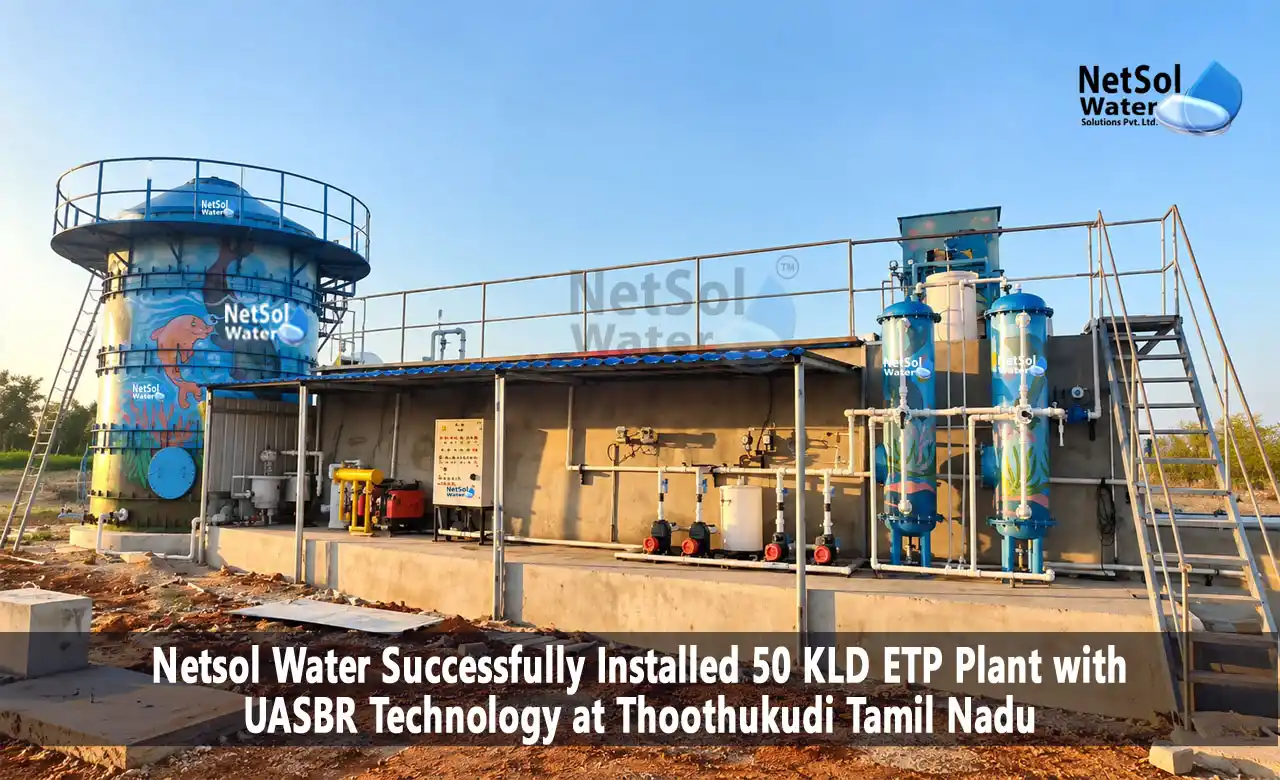
Case Study: Installed 50 KLD ETP Plant with UASBR Technology in Tamil Nadu
Netsol Water designed, supplied, and commissioned a 50 KLD ETP Plant with UASBR Technology for a Cooperative Milk Producers’ Union in Thoothukudi, Tamil Nadu. The project reflects a growing need across India’s dairy sector: treating process wastewater in a controlled, biologically sound manner before it is discharged or reused. Dairy plants generate wastewater that is organically rich, and an untreated discharge can create serious environmental and regulatory concerns for the facility.
This installation is a Dairy Effluent Treatment Plant built to handle up to 50,000 litres of wastewater per day, using an Upflow Anaerobic Sludge Blanket Reactor (UASBR) as the core biological treatment unit. For a cooperative milk union that processes and handles milk on a daily basis, having a dedicated, in-house effluent treatment system is an important step toward responsible operations and long-term regulatory compliance. The purpose of this article is to walk through the project background, the treatment approach, and the reasoning behind choosing UASBR technology for this dairy wastewater application.
Project Snapshot
| Particulars | Details |
|---|---|
| Client | Cooperative Milk Producers’ Union |
| Location | Thoothukudi, Tamil Nadu |
| Industry | Dairy Processing |
| Plant Type | Dairy Effluent Treatment Plant |
| Capacity | 50 KLD (up to 50,000 litres per day) |
| Core Technology | UASBR Technology |
| Application | Treatment of dairy process wastewater |
| Solution Provider | Netsol Water Solutions Pvt. Ltd. |
About the Cooperative Milk Producers’ Union and Dairy Wastewater
Cooperative milk producers’ unions play a central role in India’s dairy economy. They collect milk from member farmers, process it, and distribute dairy products across regional and sometimes national markets. Facilities of this kind typically run receiving, chilling, processing, and cleaning operations on a daily schedule, which means wastewater generation is a continuous part of plant operations rather than an occasional event.
Wastewater treatment matters in dairy processing because the effluent generated during milk handling and cleaning is rich in organic content. Left untreated, this wastewater can affect local water bodies, soil, and groundwater, and can also draw the attention of pollution control authorities. For a cooperative union serving a wide farmer base, maintaining an environmentally responsible operation is also a matter of institutional reputation. While the specific internal processes of this particular union are not detailed here, the decision to install a dedicated Dairy Wastewater Treatment Plant reflects a broader industry recognition that effluent management cannot be an afterthought in dairy operations.
Project Requirement and Wastewater Treatment Challenge
Dairy processing facilities, as a category, generate wastewater with certain well-documented characteristics. This is general industry knowledge and is presented here to explain why an ETP is typically required in this sector, not as a confirmed measurement from this specific project:
. Biodegradable organic matter, largely from milk residues, whey, and processing losses
. Suspended solids, arising from washing, cleaning, and product handling
. Fats, oils, and grease (FOG), common in dairy effluent due to milk fat content
. Cleaning-in-place (CIP) wastewater, containing detergents and sanitising agents used for equipment hygiene
. Variable flow patterns, since dairy operations often follow batch-based receiving, processing, and cleaning cycles rather than a constant flow
These characteristics make dairy wastewater a good candidate for biological treatment, since the organic load can be broken down effectively by microbial action when the right treatment system is in place. The requirement for this project was to install a system capable of receiving and treating the union’s wastewater in a structured, ongoing manner, rather than relying on ad hoc disposal practices.
Proposed Solution: 50 KLD ETP Plant
To address this requirement, Netsol Water proposed and installed a 50 KLD ETP Plant. In technical terms, 50 KLD represents a treatment capacity of up to 50,000 litres per day, meaning the plant is sized to receive and process wastewater volumes within this daily range. The “KLD” abbreviation, kilolitres per day, is a standard way of denoting effluent treatment plant capacity in India.
The treatment approach centres on biological degradation of organic pollutants using UASBR technology as the primary treatment stage, supported by the necessary upstream and downstream arrangements needed to make the biological process effective. Since detailed equipment specifications for every stage of this particular installation have not been supplied, this case study focuses on describing the treatment approach and the technology at a conceptual level, rather than listing exact equipment models or dimensions that have not been confirmed for the project.
UASBR Technology Explained
UASBR Technology, or Upflow Anaerobic Sludge Blanket Reactor, is one of the most widely used anaerobic biological treatment methods for industrial and agro-based wastewater, including dairy effluent. Understanding how it works helps explain why it is a relevant choice for this project.
. Full form and basic concept
UASBR stands for Upflow Anaerobic Sludge Blanket Reactor. As the name suggests, wastewater is introduced from the bottom of the reactor and flows upward through a suspended layer of anaerobic microorganisms, known as the sludge blanket.
. Working principle
Inside the reactor, a dense community of anaerobic bacteria forms granules or flocs that remain suspended in the lower and middle sections of the tank. As wastewater moves upward through this sludge blanket, the microorganisms come into close contact with the organic matter present in the effluent. This contact allows the bacteria to break down complex organic compounds in the absence of oxygen, a process known as anaerobic digestion.
. Upward flow and sludge blanket dynamics
The upward flow pattern is central to how a UASBR functions. As wastewater rises through the reactor, it passes through the active sludge blanket, where biological breakdown takes place. Gas produced during this process, along with treated water and residual solids, moves toward the top of the reactor, where a three-phase separator divides gas, liquid, and settled sludge. This design allows the reactor to retain a high concentration of active biomass while continuously treating incoming wastewater.
. Microbial activity and organic breakdown
The anaerobic microorganisms in a UASBR work through a multi-stage biological process, generally involving hydrolysis, acidogenesis, acetogenesis, and methanogenesis. Each stage breaks down organic material into progressively simpler compounds, ultimately converting a significant share of the organic load into biogas and reducing the overall pollutant concentration in the wastewater.
. Relevance to dairy wastewater
Dairy effluent, being high in biodegradable organic content, is well suited to anaerobic treatment. UASBR systems are commonly used in agro-based and food processing industries precisely because they are effective at handling wastewater with a substantial organic fraction, without needing continuous aeration. This makes UASBR a technically sound and operationally efficient choice for a Dairy ETP Plant of this nature. It is important to note that actual removal efficiencies depend on plant-specific operating conditions, and no specific performance percentage is being claimed for this project unless supported by verified project data.
Treatment Process and Major Treatment Stages
A typical ETP Plant with UASBR Technology for dairy wastewater generally follows a sequence of stages designed to prepare the wastewater for biological treatment, treat it anaerobically, and then polish the treated water before discharge or further use. The table below outlines these stages at a conceptual level, reflecting general treatment practice for this type of application. It should be read as an explanation of how such systems typically function rather than a confirmed, project-specific equipment list.
| Treatment Stage | Purpose | Project Relevance |
|---|---|---|
| Screening and preliminary treatment | Removes coarse solids and debris before further treatment | General practice for dairy effluent handling |
| Equalisation | Balances variable flow and organic load from batch operations | Relevant given the variable nature of dairy processing wastewater |
| UASBR (anaerobic treatment) | Core biological stage for organic matter breakdown | Confirmed as the technology used in this project |
| Post-treatment / polishing | Further improves treated water quality before discharge or reuse | Applied where additional treatment is required after biological treatment |
Where specific equipment details beyond the UASBR stage have not been confirmed for this installation, this case study avoids listing exact machinery, tank counts, or process instrumentation that has not been verified for the project.
Installation and Commissioning
The installation of the 50 KLD ETP Plant at the cooperative union’s Thoothukudi facility involved the standard sequence followed in effluent treatment plant projects of this type: site assessment to understand available space and wastewater characteristics, positioning and installation of the treatment units including the UASBR reactor, and the necessary piping and interconnections to route wastewater through the system.
As with any ETP installation, electrical and instrumentation work is carried out to support plant operation, followed by testing of individual components and the system as a whole. Commissioning activities confirm that the plant is operationally ready to receive and treat wastewater on a continuous basis. Since exact commissioning dates and detailed technical specifications for this project have not been provided, this section describes the general installation and commissioning approach followed for such projects rather than project-specific milestones.
Operational Performance and Treatment Outcomes
The intended outcome of installing this Dairy Wastewater Treatment Plant is a structured reduction in the organic load and pollutant concentration of the union’s wastewater through biological treatment, before the water is discharged or considered for reuse. Anaerobic treatment through UASBR technology is designed to bring down key pollution indicators, and plants of this kind are generally expected to help the facility move toward compliance with applicable effluent discharge norms.
At this stage, specific inlet and outlet laboratory results, such as pH, BOD, COD, TSS, and Oil & Grease values, have not been supplied for this project. In line with responsible reporting practice, this case study does not present fabricated figures or percentage reductions. Should verified laboratory data become available, it can be added to this case study in tabular form to demonstrate actual treatment performance.
| Parameter | Indicative Inlet | Indicative Treated Outlet | Indicative Reduction |
|---|---|---|---|
| pH | 6.0–8.5 | 6.5–8.5 | Maintained within suitable range |
| BOD | 500–600 mg/L | <30 mg/L | >95% |
| COD | 2,000–2,200 mg/L | <250 mg/L | >88% |
| TSS | 250–350 mg/L | <100 mg/L | >60% |
| Oil & Grease | 150–170 mg/L | <10 mg/L | >94% |
Key Benefits of the Installed ETP
The installation of this 50 KLD ETP Plant with UASBR Technology offers the cooperative milk union several practical benefits:
. Systematic treatment of dairy process wastewater instead of untreated discharge
. Controlled biological treatment using proven anaerobic technology suited to organically rich effluent
. Improved overall wastewater management as part of daily plant operations
. Support for responsible environmental practices in line with the union’s role as a cooperative institution
. A structured foundation for working toward applicable effluent discharge requirements
These benefits are described at a general, proportionate level, consistent with the information available about this project.
Watch the 50 KLD ETP Plant Installation Video
For a closer look at the installation, visitors to the Netsol Water website can watch the project video documenting this 50 KLD ETP Plant at the Cooperative Milk Producers’ Union in Thoothukudi. The video offers a practical, on-site view of the plant and installation work, which can be useful for readers who want to see the treatment setup in addition to reading about it.
Why Netsol Water for Dairy ETP Projects?
Netsol Water works on the design, manufacturing, installation, and commissioning of effluent treatment plants across various industries, including dairy processing. As an Effluent Treatment Plant Manufacturer, the company’s role in this project covered proposing a suitable treatment approach for the union’s wastewater, supplying the UASBR Technology based system, and carrying out installation and commissioning at the Thoothukudi site.
For dairy clients specifically, working with a provider experienced in biological wastewater treatment technologies matters, since dairy effluent has particular characteristics that call for the right combination of anaerobic and supporting treatment stages. Ongoing service support after commissioning is also part of running an ETP successfully over its operational life, helping facilities keep their treatment systems functioning as intended.
Conclusion
The 50 KLD ETP Plant with UASBR Technology installed at the Cooperative Milk Producers’ Union in Thoothukudi, Tamil Nadu, represents a practical application of anaerobic biological treatment for dairy wastewater. With a capacity to treat up to 50,000 litres per day, the plant is built around UASBR technology to address the organically rich effluent typical of dairy processing operations. For a cooperative institution serving a broad farmer community, systematic effluent treatment is both an operational necessity and a demonstration of environmental responsibility. This project reflects the broader importance of purpose-built Dairy Effluent Treatment Plant systems in supporting sustainable dairy processing across Tamil Nadu and India more widely.
FAQs
Q1. What is the capacity of the ETP installed at this project?
The plant is a 50 KLD ETP, meaning it is designed to treat up to 50,000 litres of wastewater per day.
Q2. Where was the plant installed?
The plant was installed at a Cooperative Milk Producers’ Union in Thoothukudi, Tamil Nadu.
Q3. Which technology is used in this ETP plant?
The plant uses UASBR Technology, an Upflow Anaerobic Sludge Blanket Reactor, as its core biological treatment process.
Q4. What is UASBR technology?
UASBR stands for Upflow Anaerobic Sludge Blanket Reactor. It is an anaerobic treatment method in which wastewater flows upward through a suspended blanket of microorganisms that break down organic matter without the need for aeration.
Q5. Why is UASBR relevant to dairy wastewater treatment?
Dairy wastewater is high in biodegradable organic content, which makes it well suited to anaerobic digestion. UASBR systems are widely used in the dairy and food processing sectors for this reason.
Q6. What does 50 KLD mean?
KLD stands for kilolitres per day. A 50 KLD ETP is designed to handle a treatment capacity of up to 50,000 litres of wastewater daily.
Q7. Who installed the ETP plant for this project?
The 50 KLD ETP Plant with UASBR Technology was installed by Netsol Water.