

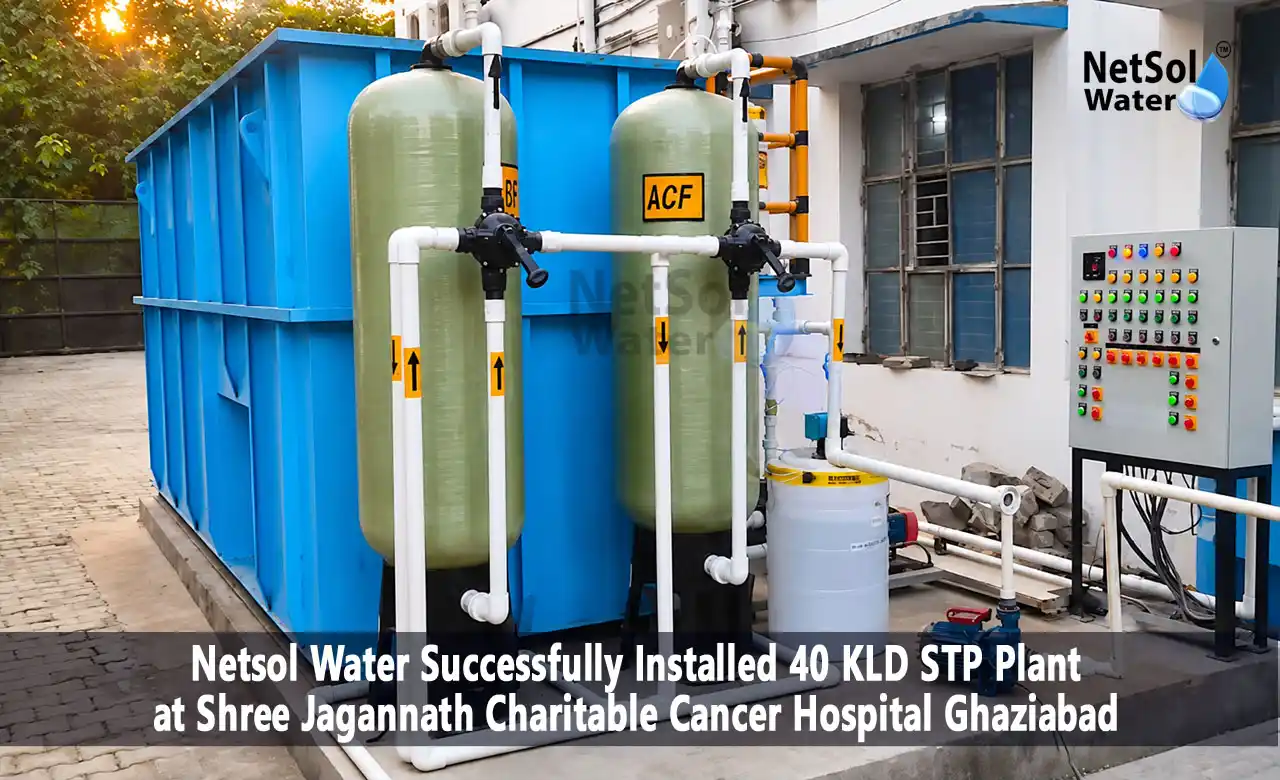
Case Study: Installed 40 KLD STP Plant at Hospital, Ghaziabad
Healthcare facilities generate wastewater every day through patient care activities, housekeeping, washrooms and general facility operations. Left untreated, this wastewater can pose serious risks to public health and the environment. To address this need, Netsol Water Solutions Pvt. Ltd. designed, supplied and commissioned a 40 KLD STP Plant based on MBBR (Moving Bed Biofilm Reactor) technology at Shree Jagannath Charitable Cancer Hospital, located in Ghaziabad, Uttar Pradesh.
This case study walks through the project, from the reasoning behind the plant's capacity and technology choice to the treatment process, installation approach and the benefits the hospital now has access to. Proper sewage treatment is not optional for a healthcare setup; it is a basic operational requirement, and this project reflects how a hospital sewage treatment plant should be planned and executed.
About Shree Jagannath Charitable Cancer Hospital
Shree Jagannath Charitable Cancer Hospital is located in Ghaziabad, Uttar Pradesh, and functions as a healthcare facility serving patients in the region. As with any hospital, its daily operations generate domestic sewage that needs to be collected, treated and either reused or discharged safely.
Wastewater management holds particular importance for healthcare facilities. Hospitals operate continuously, house medical and support staff, attendants and visitors, and run housekeeping and sanitation activities around the clock. This means sewage generation is fairly consistent throughout the day, and there is little margin for treatment systems to be inadequate or poorly maintained. A dependable, well-designed STP allows a hospital to manage its wastewater responsibly while meeting environmental compliance requirements applicable to healthcare establishments.
Project Overview
| Parameter | Details |
|---|---|
| Client | Shree Jagannath Charitable Cancer Hospital |
| Project Location | Ghaziabad, Uttar Pradesh |
| STP Capacity | 40 KLD |
| Treatment Technology | MBBR (Moving Bed Biofilm Reactor) |
| Plant Type | Sewage Treatment Plant (STP) |
| Application | Hospital Sewage Treatment |
| Project Executed By | Netsol Water Solutions Pvt. Ltd. |
Why Was a 40 KLD STP Required?
Every hospital generates domestic sewage from toilets, washrooms, kitchens, laundry areas and general housekeeping operations. This wastewater carries organic matter, detergents, suspended solids and other contaminants that cannot be released into the environment without treatment. For a facility the size of Shree Jagannath Charitable Cancer Hospital, a 40 KLD Sewage Treatment Plant was identified as the appropriate capacity to handle the daily wastewater generated on the premises.
In practical terms, "40 KLD" means the plant is designed to treat 40,000 litres of sewage per day. This capacity is sized to match the hospital's typical daily water usage and corresponding wastewater output, ensuring the system neither falls short during regular operations nor remains oversized and inefficient.
Treating sewage before reuse or discharge serves two purposes. First, it prevents untreated wastewater, which can carry pathogens and organic pollutants, from contaminating soil, groundwater or nearby water bodies. Second, it allows the treated water to be considered for non-potable applications such as gardening or flushing, where local guidelines and site conditions permit, reducing the overall dependency on fresh water.
Why MBBR Technology Was Selected?
MBBR (Moving Bed Biofilm Reactor) is a biological wastewater treatment process that uses specially designed carrier media, small plastic elements with a high surface area, that float and circulate freely within the reactor tank. These carriers act as a surface on which microorganisms attach and grow, forming a biofilm. To understand how this technology performs across applications, see this overview of MBBR technology in sewage treatment plants.
The microorganisms in this biofilm consume organic pollutants present in the sewage as part of their natural metabolic activity. As wastewater flows through the reactor, it comes into continuous contact with this biofilm, allowing biological breakdown of contaminants to take place. Aeration plays a central role in this process: diffused air is introduced into the reactor, which keeps the carrier media in constant motion, maintains dissolved oxygen levels needed by the microorganisms, and supports uniform contact between the biomass and the wastewater.
Because the biomass in an MBBR system is attached to carrier media rather than suspended freely, the process tends to be compact and relatively stable against fluctuations in flow and organic load, which is a common characteristic of institutional settings like hospitals where usage patterns can vary through the day. This makes MBBR a technology suited for applications where consistent performance and a smaller equipment footprint are both important considerations. It is worth noting that actual treatment performance depends on factors such as influent characteristics, loading, operation and maintenance, and no specific removal percentages are claimed here for this project.
Treatment Process of the 40 KLD MBBR STP Plant
The treatment process for this plant follows the general sequence used in MBBR-based sewage treatment systems:
. Inlet and Screening: Raw sewage from the hospital's drainage network enters the plant through an inlet chamber. Screening removes larger solids and debris, protecting downstream equipment from damage or blockage.
. Collection and Equalization: Screened sewage is collected in an equalization tank, which balances variations in flow rate and pollutant concentration that occur through the day. This helps maintain steady conditions for the biological treatment stage that follows.
. Biological Treatment in the MBBR Reactor: Equalized sewage is directed into the MBBR reactor, where carrier media populated with microorganisms carry out biological breakdown of organic matter. Continuous aeration supplies oxygen and keeps the media in motion, supporting consistent biological activity.
. Settling and Clarification: After biological treatment, the water passes into a settling or clarification stage, where biological solids and treated water are separated. Clarified water moves forward in the process, while settled solids are directed to sludge handling.
. Disinfection: Before final discharge or reuse, the treated water typically passes through a disinfection stage to address residual pathogens, using methods such as chlorination, commonly applied in STP systems of this scale.
. Treated Water Output: The treated water, having passed through biological treatment, clarification and disinfection, is ready for discharge in line with applicable norms or for reuse in permitted non-potable applications.
. Sludge Management: Solids separated during clarification are managed through a sludge handling process, which may include thickening and periodic removal, an essential part of keeping the biological system functioning properly over time.
It should be noted that specific equipment configurations beyond what has been confirmed for this project are described here in general terms, reflecting standard MBBR STP practice rather than project-specific detail.
Major Components of the STP
| Component | Function |
|---|---|
| Screen Chamber | Removes large solids and debris from raw sewage |
| Equalization Tank | Balances flow and load variations before biological treatment |
| MBBR Reactor with Carrier Media | Houses biofilm-supported microorganisms for biological treatment |
| Aeration System (Blower and Diffusers) | Supplies oxygen and keeps carrier media in motion |
| Clarifier/Settling Tank | Separates treated water from biological solids |
| Disinfection Unit | Reduces pathogens in treated water before discharge or reuse |
| Sludge Handling Unit | Manages and removes settled biological solids |
| Piping and Pumping System | Transfers wastewater and treated water between stages |
Installation of the 40 KLD STP at the Hospital
Executing STP project at an operational hospital requires careful planning so that treatment infrastructure fits in with the site's existing layout and daily functioning. The broad process followed for this project included the following stages.
. Site Assessment: The available space at the hospital premises was assessed, along with existing drainage points and access routes, to determine the most suitable layout for the plant.
. Planning and Design: Based on the site assessment and the hospital's expected wastewater generation, the plant was designed around a 40 KLD capacity using MBBR technology, with component sizing matched to this requirement.
. Equipment Installation: Tanks, the MBBR reactor and associated equipment were installed as per the finalized layout.
. MBBR Media Installation: Carrier media was loaded into the reactor tank in the required quantity to support the biological treatment process.
. Piping: Inlet, interconnecting and outlet piping was laid to connect the hospital's sewage lines to the plant and to route treated water to its intended discharge or reuse point.
. Electrical Connections: Electrical connections were established for blowers, pumps and other equipment requiring power.
. Aeration System Setup: Blowers and diffuser networks were installed within the MBBR reactor to enable consistent aeration.
. Testing and Trial Operation: Once installation was complete, the plant underwent testing and trial operation to check that individual components and the overall system were functioning as intended.
. Commissioning: Following successful trial operation, the plant was commissioned for regular use at the hospital, in line with standard STP commissioning practice followed for wastewater treatment projects.
Project Challenges and Site Considerations
Installing a sewage treatment plant at a functioning healthcare facility involves working around considerations that differ from a greenfield site. Space constraints are common, since hospital premises often have limited open area available for utility infrastructure, requiring compact plant layouts. Integrating new piping with an existing drainage network needs careful coordination to avoid disrupting hospital operations during installation.
Equipment placement also needs to account for noise and access considerations, given the sensitive nature of a hospital environment. Coordination with hospital facility staff is generally necessary to schedule installation work at times and in a manner that minimizes disturbance to patients and daily hospital functioning. Safe installation practices, including careful handling of electrical work and equipment near an operational facility, are a standard part of executing such projects responsibly.
These points represent general considerations relevant to STP installation at healthcare facilities. No specific installation challenges or delays beyond the standard execution process have been documented for this project.
Project Outcome and Benefits
With the 40 KLD MBBR STP now operational, Shree Jagannath Charitable Cancer Hospital has an organized system in place for managing its daily sewage generation. Wastewater that was previously a source of concern is now routed through a structured treatment process rather than being discharged without treatment.
The MBBR-based biological treatment process gives the hospital a compact and manageable system suited to its available space and daily requirements. This reduces the volume of untreated sewage that would otherwise leave the premises, supporting better environmental management around the facility.
Additionally, treated water from the plant offers potential for reuse in non-potable applications, such as gardening or landscaping, wherever this is permitted and technically suitable for the hospital's site conditions. This can help reduce dependency on fresh water for such secondary uses. As with any STP, ongoing operation and maintenance play an important role in sustaining these benefits over the plant's working life.
YouTube Project Video
To see the installed 40 KLD MBBR STP at Shree Jagannath Charitable Cancer Hospital and get a clearer, visual understanding of the project, visitors can watch the project video below.
Watch here:
Why Choose Netsol Water for STP Projects?
Netsol Water works across the full lifecycle of sewage and wastewater treatment projects, including design, manufacturing, installation and commissioning of STPs for institutional, commercial and industrial clients. For a sewage treatment plant manufacturer, this end-to-end involvement means each project, including this 40 KLD STP Plant in Ghaziabad, is handled from initial planning through to operational handover.
Beyond installation, Netsol Water also provides after-sales support and Annual Maintenance Contract (AMC) services, helping clients keep their STP systems running reliably over time. For healthcare facilities in particular, where consistent plant performance matters, this ongoing support forms an important part of the overall service offering, alongside experience in delivering STP solutions across different capacities and technologies, including MBBR-based systems.
Conclusion
The 40 KLD STP Plant with MBBR technology at Shree Jagannath Charitable Cancer Hospital, Ghaziabad, reflects a practical approach to hospital wastewater management. By combining an appropriately sized 40 KLD capacity with MBBR's biofilm-based biological treatment process, the project gives the hospital a dependable system for treating its daily sewage output. For any healthcare facility, proper sewage treatment is a fundamental operational responsibility, and this project stands as an example of how that responsibility can be addressed through sound engineering and execution by Netsol Water.
Frequently Asked Questions (FAQs)
Q1. What is the capacity of the STP installed at Shree Jagannath Charitable Cancer Hospital?
The plant installed at the hospital has a capacity of 40 KLD (40,000 litres per day).
Q2. Where was the 40 KLD STP installed?
It was installed at Shree Jagannath Charitable Cancer Hospital in Ghaziabad, Uttar Pradesh.
Q3. Which technology is used in this STP?
The plant uses MBBR (Moving Bed Biofilm Reactor) technology for biological sewage treatment.
Q4. What is MBBR technology?
MBBR is a biological treatment process where microorganisms grow as a biofilm on floating carrier media inside the reactor, breaking down organic matter present in wastewater.
Q5. What does 40 KLD mean?
40 KLD means the plant is designed to treat 40,000 litres of sewage per day.
Q6. Why is sewage treatment important for hospitals?
Hospitals generate continuous domestic sewage from washrooms, housekeeping and other activities. Treating this wastewater prevents environmental contamination and supports responsible, compliant facility operations.
Q7. What is the purpose of MBBR media?
The carrier media in an MBBR reactor provides surface area for microorganisms to attach and form a biofilm, which carries out biological treatment of the wastewater.
Q8. Can treated STP water be reused?
Treated water from STP can potentially be reused for non-potable purposes, such as gardening or landscaping, where local guidelines and site conditions allow it.